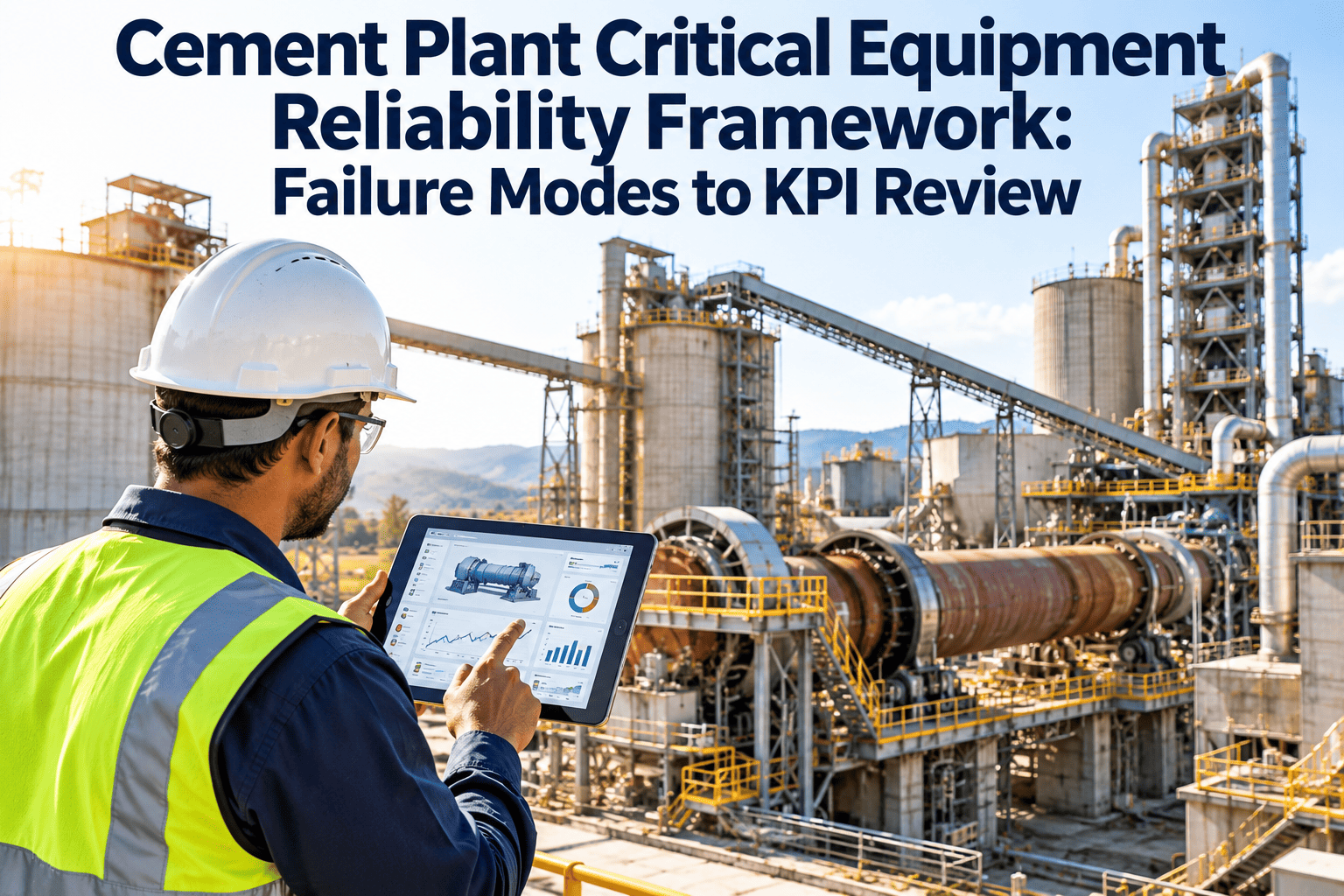
A vertical roller mill gearbox carries the full grinding load of a raw, coal or cement mill, and when it fails the whole line stops for weeks, not days. Replacement lead times are long, repairs are specialist work, and the cost of lost output usually dwarfs the cost of the gearbox itself. Most failures send warning signs well in advance through vibration, oil condition, temperature and lubrication system behavior. The challenge is turning those signs into planned action before damage spreads. Reliability teams use cement plant maintenance software to connect condition data, inspections and work orders so early warnings are acted on rather than noticed too late.
Grinding and Milling / VRM Gearbox Reliability / Failure Prediction
Best VRM Gearbox Failure Prediction Software for Cement Plants
Find the software approach that links vibration, oil, temperature and inspection findings to planned work, so a developing gearbox fault becomes a scheduled repair instead of an unplanned mill stop.
Main motor and couplingAlignment, temperature, current
Bevel and planetary gear stagesVibration, tooth wear, oil debris
Thrust bearing and oil filmPad temperature, oil pressure, flow
Grinding table and rollersBed stability, load, foreign metal
Lubrication and cooling systemFilters, pumps, cooler performance
Why VRM Gearbox Failures Are So Costly
- The gearbox sits directly in the load path between the motor and the grinding table.
- Large units are repaired or replaced through lengthy, specialist and often off-site work.
- A stopped raw mill or cement mill can limit kiln feed or finished product output.
- Secondary damage to the table, rollers or motor can follow a gearbox event.
- Spare gearboxes are expensive, so many plants do not hold a complete unit.
Common VRM Gearbox Failure Modes and Their Early Signals
| Failure Mode | Typical Contributing Causes | Early Signals | Useful Response |
|---|---|---|---|
| Thrust bearing damage | Oil film loss, contamination, overload, poor oil flow | Rising pad temperature, falling oil pressure or flow | Check lube system, reduce load, plan inspection |
| Gear tooth pitting or wear | Lubricant degradation, shock load, misalignment | Gear mesh frequencies in vibration, wear metals in oil | Increase monitoring, plan borescope or inspection |
| Rolling bearing defects | Contamination, fatigue, lubrication problems | Bearing defect frequencies, particle counts | Trend, confirm and schedule replacement |
| Lubrication system failure | Pump wear, blocked filters, cooler fouling | Differential pressure, oil temperature, low flow alarms | Corrective work order and immediate check |
| Water or dust in oil | Breather and seal problems, cooler leaks | Moisture and particle readings, oil appearance | Fix source, filter or change oil |
| Shock overloading | Unstable grinding bed, tramp metal, rapid feed changes | Vibration spikes, drive load swings | Review process conditions with operations |
| Foundation and coupling problems | Loose bolts, misalignment, wear | Elevated low-frequency vibration, bolt looseness | Alignment check and torque inspection |
From Warning Sign to Planned Repair: The Prediction Pathway
1
Collect
Vibration, temperature, pressure, oil samples and inspection observations.
2
Compare
Readings are checked against baselines, limits and past trends for the same asset.
3
Diagnose
An analyst links symptoms to likely failure modes and estimates urgency.
4
Act
A work order is raised with tasks, parts and a target window, often a planned stop.
5
Learn
Findings after repair are recorded, so future alerts are judged with better evidence.
See Gearbox Condition and Maintenance Action in One Place
Connect inspections, condition findings and work orders on every VRM gearbox so warnings lead to scheduled work.
What a Gearbox Failure Prediction Program Needs to Include
Sensing and sampling
- Vibration monitoring on input, intermediate and output stages.
- Temperature on bearings, pads and oil sumps.
- Oil pressure, flow, filter differential pressure and cooler performance.
- Regular oil analysis with consistent sampling points.
Process and context
- Motor current and mill load.
- Grinding bed stability and differential pressure.
- Feed changes, tramp metal events and trips.
- Maintenance history and previous repairs.
Comparing Approaches to VRM Gearbox Monitoring
| Approach | Strength | Limitation | Best Use |
|---|---|---|---|
| Time-based overhaul | Simple to plan | Misses faults between overhauls, may disturb healthy parts | Baseline protection for all gearboxes |
| Manual rounds only | Low cost, catches visible issues | Subjective, infrequent, no trend history | Daily checks that support other methods |
| Portable vibration routes | Trained analysts, flexible | Snapshot data, depends on route frequency | Less critical or supporting equipment |
| Online condition monitoring | Continuous data, fast alerting | Needs analysis skills and response processes | Critical VRM gearboxes |
| Maintenance software with workflows | Turns findings into assigned work and history | Needs good condition data to act on | Connecting every method to action |
Evaluation Scorecard: What to Look for in Prediction Software
Asset-level history
Every reading, inspection and repair stays on the gearbox record for trend comparison.
Threshold-driven work
Out-of-range findings create work orders with priority, owner and due date.
Mobile inspections
Technicians capture readings, photos and notes at the mill, even for hard-to-reach points.
Parts and inventory
Required seals, bearings, filters and oil are visible before the repair window.
Shutdown planning
Repairs can be scheduled into planned stops, with tasks and resources listed.
Reporting
Dashboards show overdue inspections, alert response time and repeat issues.
Data openness
Condition data from your existing monitoring tools can be used rather than replaced.
Before and After a Connected Gearbox Workflow
Before
- Vibration reports sit in email or a separate system.
- Oil results are reviewed late or not at all.
- Operators notice alarms but no work order follows.
- Parts are ordered after the fault is confirmed.
After
- Findings are recorded on the gearbox asset.
- Oil and vibration trends are reviewed in the same place.
- Alerts become work orders with a clear owner.
- Parts and labor are planned ahead of the stop.
Lubrication System Reliability: The Hidden Driver of Gearbox Life
- Track filter differential pressure and change filters on condition as well as on schedule.
- Inspect pumps, motors, valves and hoses for leaks, noise and heat.
- Monitor oil cooler performance and water side fouling, since high oil temperature thins the oil film.
- Check breathers and seals to keep dust and moisture out of the sump.
- Confirm oil grade matches the manufacturer specification and record every top-up.
Maintenance Workflow for a Developing Gearbox Alert
A
Alert raised
A reading crosses a defined limit or a technician logs an abnormal finding.
B
Verify
A quick inspection checks sensors, oil level, leaks and operating conditions.
C
Classify
The team sets urgency: continue with monitoring, restrict load or plan an inspection.
D
Plan
Work order, parts, contractors and stop window are lined up.
E
Close out
Findings and photos are recorded and monitoring limits are reviewed.
How Oxmaint Supports VRM Gearbox Reliability
Asset management
Gearbox, motor, lubrication system and mill records linked in one hierarchy.
Inspections
Mobile checklists for temperatures, pressures, oil levels and visual findings.
Preventive maintenance
Scheduled oil sampling, filter changes, alignment and bolt checks.
Condition-based workflows
Findings outside limits trigger corrective work with the right priority.
Work orders
Tasks, labor, parts and notes recorded for each repair or inspection.
Inventory and reports
Spare tracking plus dashboards for response time and recurring issues.
KPIs for VRM Gearbox Reliability
Alert response time
Time from abnormal finding to assigned action.
Planned versus unplanned stops
Share of gearbox work done in planned windows.
Inspection compliance
Completed checks against the schedule.
Oil condition
Samples within limits and actions closed.
Mean time between failures
Interval between significant gearbox events.
Software Selection Checklist for Cement Reliability Teams
- Supports your VRM gearbox hierarchy and related lubrication system.
- Allows readings and observations to be captured on mobile devices.
- Creates work orders from defined thresholds and findings.
- Stores oil analysis reports and links them to the asset.
- Handles shutdown planning with tasks, parts and resources.
- Provides reporting your reliability and plant leadership can use.
- Can be rolled out in stages beginning with the most critical mills.
VRM Gearbox Software FAQs
Is vibration monitoring enough to predict gearbox failure?
It is vital but works best combined with oil analysis, temperature, lubrication data and inspections.
What should trigger a gearbox work order?
Readings beyond agreed limits, adverse trends and abnormal inspection findings should all raise work.
Can the software track both raw and cement mills?
Yes. Get started with Oxmaint to manage each mill and gearbox in one asset hierarchy.
How do I plan repairs around production?
Schedule work orders into planned stops. Book a demo to see planning in practice.
Where should a plant start?
Start with the most critical mill gearbox, its lubrication system and one clear alert-to-action workflow.
Turn Gearbox Warnings Into Planned Maintenance
Give your reliability team one connected system for condition findings, inspections and repairs on every VRM gearbox.