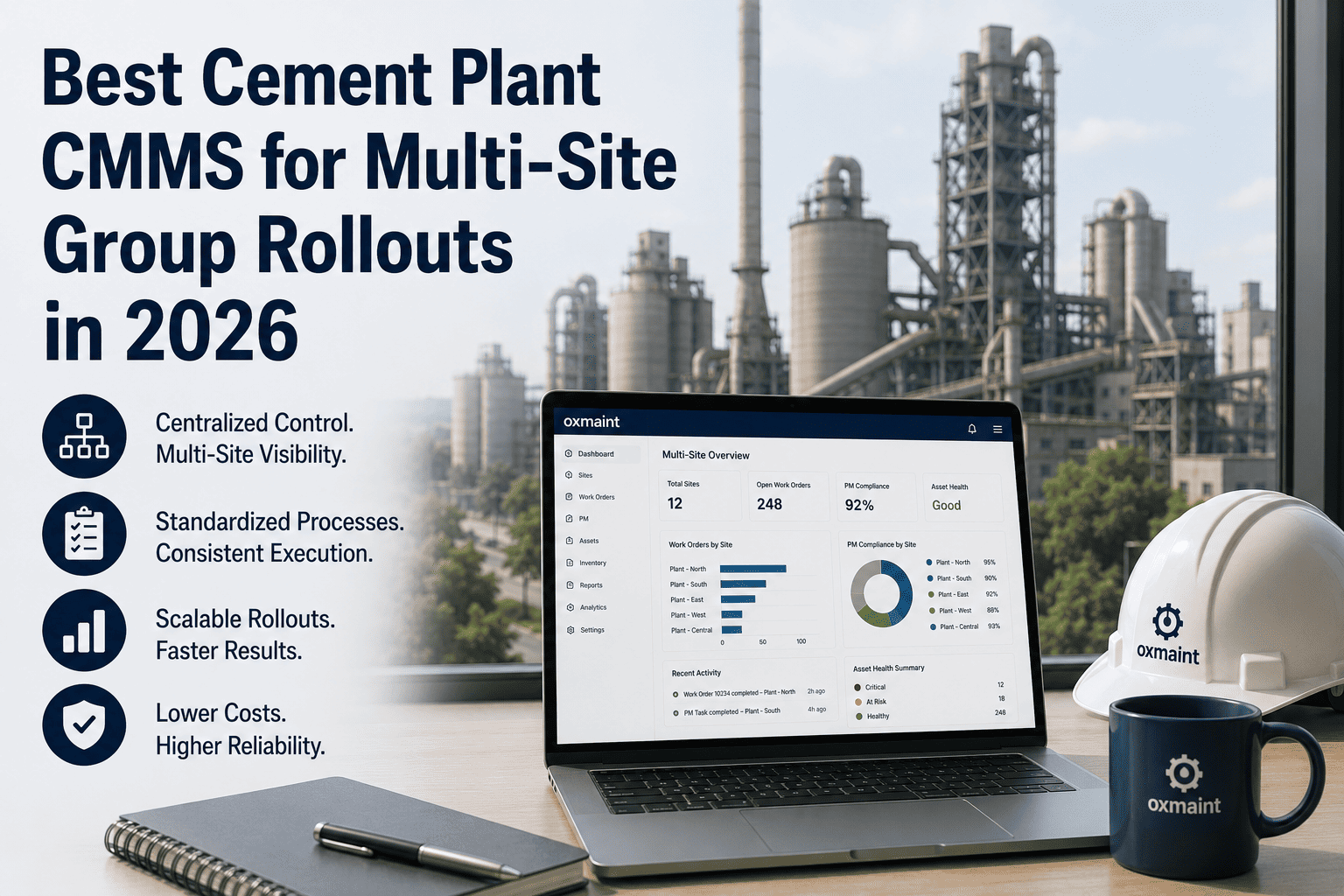
Choosing the Best CMMS for Cement Plants: Buyer's Guide 2026
By Alice Walker on March 13, 2026
Cement plants lose an average of $300,000 per day of unplanned downtime—yet over 60% still manage maintenance with paper logbooks and fragmented spreadsheets. The global CMMS software market is projected to reach $3.56 billion by 2035, growing at 10.51% CAGR, driven by manufacturing facilities transitioning from reactive firefighting to predictive reliability. For cement operations running 24/7 with critical assets like kilns, mills, and crushers operating under extreme thermal and abrasive conditions, selecting the right Computerized Maintenance Management System is not a technology decision—it is an operational survival strategy. This buyer's guide breaks down the exact evaluation criteria, feature requirements, and vendor comparison frameworks that cement plant maintenance managers need in 2026. Sign up for Oxmaint to begin evaluating CMMS capabilities with a free trial built specifically for cement operations.
Why Cement Plants Need Specialized CMMS Solutions
Generic maintenance software designed for commercial buildings or light manufacturing fundamentally fails in cement environments. The combination of continuous process operations, extreme operating temperatures exceeding 1,450°C in kilns, highly abrasive raw materials, and complex regulatory requirements creates maintenance challenges that demand purpose-built solutions. Plants using CMMS-driven predictive maintenance programs typically reduce unplanned downtime by 30–50% within the first year while cutting maintenance costs by 25–40%. Understanding what separates adequate systems from exceptional ones requires examining the operational realities unique to cement production.
The Cost of Getting CMMS Selection Wrong
$20,000+
Hourly Kiln Downtime Cost
When rotary kiln failures occur, the entire production line halts. Recovery requires 24–72 hours including cooldown, repair, and temperature ramp-up.
78%
Corrective Work Orders
Plants without proper CMMS implementation spend the majority of maintenance effort reacting to failures rather than preventing them.
25–35%
Maintenance Cost Share
Without optimized work order management, maintenance consumes up to one-third of total cement production operating expenses.
9
Average Kiln Breakdowns/Year
Industry data shows typical plants experience nine kiln-related failures annually from ring buildup, thermal stress, and refractory deterioration.
Ready to Transform Your Cement Plant Maintenance?
Join cement facilities that have reduced unplanned downtime by 45% and cut maintenance costs by 25% using modern CMMS technology.
Not every CMMS feature matters equally for cement plants. The evaluation framework below prioritizes capabilities based on their direct impact on reducing unplanned downtime, extending asset life, and ensuring regulatory compliance in harsh cement production environments. Decision-makers should weight these criteria according to their specific operational challenges—whether kiln reliability, grinding efficiency, or compliance documentation is the primary concern. Book a demo to see how these features work in real cement plant configurations.
CMMS Feature Evaluation Matrix for Cement Plants
Feature Category
Cement-Specific Requirement
Business Impact
Priority
Kiln Condition Monitoring
Shell temperature tracking, refractory thickness logging, thermal imaging integration
Prevents catastrophic failures that cost $280,000+ per incident
Critical
Mobile Work Orders
Offline-capable app for dust-heavy environments, QR code asset scanning
Reduces work order completion time by 40%, improves compliance
Critical
Predictive Maintenance Triggers
Vibration alerts, motor current analysis, conveyor belt wear thresholds
30–50% reduction in unplanned downtime within first year
Critical
Asset Hierarchy Management
Parent-child relationships for kiln systems, mill assemblies, conveyor networks
Complete equipment genealogy for root cause analysis
High
Spare Parts Inventory
Min/max alerts for critical spares, supplier lead time tracking, cost per failure analysis
Eliminates 18–25% premium for emergency parts procurement
High
Regulatory Compliance
OSHA safety inspections, environmental permits, ISO 45001 audit trails
Maintains production license, avoids regulatory penalties
High
Multi-Site Visibility
Centralized dashboard for multiple production lines or plant locations
SAP, Oracle, or legacy system connectors for financial and procurement sync
Unified cost tracking, eliminates duplicate data entry
Medium
Cement Plant CMMS Buyer's Checklist
Before engaging vendors, cement plant maintenance teams should complete this requirements checklist to ensure the evaluation process focuses on operationally relevant capabilities rather than generic software features. The checklist covers technical requirements, integration needs, and organizational readiness factors that determine implementation success.
Technical Requirements
Supports equipment hierarchies 4+ levels deep (Plant → Line → System → Component)
Mobile app works offline in areas without WiFi coverage
QR/barcode scanning for rapid asset identification in dusty conditions
API access for IoT sensor integration (vibration, temperature, current)
Configurable PM schedules: calendar, meter-based, and condition-triggered
Photo and video attachment for work order documentation
Integration Requirements
Native or API connection to existing ERP system
Compatibility with plant control systems (DCS/PLC data feeds)
Data export capabilities for corporate reporting requirements
Single sign-on (SSO) support for enterprise security policies
Historical data migration tools for existing maintenance records
Supplier portal for contractor work order visibility
Organizational Readiness
Executive sponsor identified for implementation oversight
Equipment master list documented with criticality rankings
PM schedule templates defined for top 20 critical assets
Maintenance KPIs established (MTTR, MTBF, PM compliance)
Training time allocated for technician onboarding
Change management plan for transitioning from paper systems
Cement plants that establish 80%+ technician adoption within the first 30 days consistently report the fastest payback periods—typically 6–9 months from implementation. The organizational readiness factors above determine whether adoption targets are achievable. Book a demo with Oxmaint to review your specific readiness assessment and develop a customized implementation timeline.
CMMS Pricing Models Explained
Understanding CMMS pricing structures prevents budget surprises and ensures accurate total cost of ownership calculations. The cement industry typically encounters four primary licensing models, each with distinct advantages depending on plant size, user count, and feature requirements. Request a demo to get customized pricing for your plant's specific requirements.
Per-User Licensing
$20–$85/user/month
Most common model for mid-size cement operations. Cost scales directly with maintenance team size.
Predictable monthly costs
Easy to add users as teams grow
Often includes mobile access
Expensive for large workforces
May limit read-only access
Best Value for Cement
Asset-Based Licensing
$1–$5/asset/month
Ideal for cement plants with large equipment inventories but smaller maintenance crews. Unlimited users typical.
Unlimited technicians
Cost tied to plant complexity
Scalable for multi-line plants
Asset count requires accurate inventory
Definition of "asset" varies by vendor
Site-Based Licensing
$5,000–$50,000/year
Fixed annual fee per plant location. Simplifies budgeting for single-site cement operations.
Predictable annual cost
Unlimited users and assets
Simple contract structure
Less flexible for multi-site
Higher entry point
Enterprise Agreement
Custom Pricing
Negotiated contracts for cement groups with multiple plants. Volume discounts and custom SLAs included.
Volume discounts
Custom implementation support
Dedicated account management
Longer negotiation cycles
May require multi-year commitment
Implementation Timeline Expectations
CMMS implementation timelines vary dramatically based on platform architecture and organizational complexity. Cloud-native solutions designed for rapid deployment can be operational within hours, while enterprise systems requiring deep integrations may take 3–6 months for full implementation. The phased approach below represents realistic milestones for typical cement plant deployments.
1
Week 1–2: Foundation
Equipment master data importUser account configurationWork order workflow definitionPM schedule templates
Outcome: Digital work orders operational, baseline metrics established
Outcome: Field technicians submitting digital work orders, paper eliminated
3
Month 2–3: Optimization
Spare parts inventory linkingIoT sensor integrationPredictive trigger configurationKPI dashboard deployment
Outcome: Condition-based work orders generating automatically
4
Month 4–6: Maturity
ERP integration completionReliability analytics activationTPM program alignmentMulti-site rollout (if applicable)
Outcome: Measurable MTTR and MTBF improvements, emergency work order volume declining
Most cement plants begin seeing measurable ROI within 60–90 days of full digital work order adoption. The earliest gains appear in administrative time savings of 2–3 hours per supervisor daily, reduced parts-hunting, and elimination of lost work orders. Deeper ROI from reduced unplanned downtime typically materializes at 6–12 months as historical data accumulates for predictive insights.
Key Questions to Ask CMMS Vendors
During vendor demonstrations, cement plant evaluation teams should move beyond generic feature walkthroughs to probe capabilities specific to cement manufacturing environments. These questions expose whether a vendor understands heavy industrial maintenance or simply markets generic software to any industry.
01
How does your system handle rotating equipment hierarchies with multiple failure modes—specifically for kilns, mills, and crusher assemblies?
Why it matters: Generic systems struggle with the parent-child-sub-component relationships that cement assets require.
02
Can you demonstrate work order creation and completion using only a mobile device in offline mode?
Why it matters: Many areas of cement plants have no WiFi coverage. True offline capability is essential.
03
What does your customer success team's engagement look like after go-live, and what is your average time to first value?
Why it matters: Vendors who disappear after implementation leave plants struggling with adoption challenges.
04
How do you handle predictive maintenance triggers from vibration sensors, thermal cameras, or motor current signature analysis?
Why it matters: Condition monitoring integration separates basic CMMS from reliability-focused platforms.
05
Can we see your MTTR, MTBF, and OEE reporting dashboards with cement plant reference data?
Why it matters: Industry-relevant analytics prove the vendor understands cement KPI requirements.
06
What is your data migration approach for plants transitioning from paper logs or legacy maintenance systems?
Why it matters: Historical equipment data is too valuable to abandon during system transitions.
Schedule a demo with Oxmaint to see how these questions are answered with live cement plant configurations and real maintenance workflow demonstrations.
ROI Calculation Framework
Cement plant leadership teams require quantified business cases before approving CMMS investments. The framework below provides calculation templates for the three primary ROI drivers: downtime reduction, labor efficiency, and parts optimization. Conservative assumptions based on industry benchmarks ensure credible projections that withstand financial scrutiny.
(Annual Parts Spend) × (20% Emergency Premium Avoided)
Example: $2,500,000 × 20% = $500,000/year
Typical Mid-Size Cement Plant Annual Savings:
$2,000,000 – $3,000,000
Payback period: 6–12 months based on implementation investment of $50,000–$150,000
For comprehensive ROI documentation strategies, maintenance leaders should document baseline metrics before implementation, track improvements monthly, and present quantified savings to executive stakeholders using the formula templates provided above.
Get Your Personalized ROI Analysis
Our cement industry specialists will calculate projected savings based on your specific plant data, equipment inventory, and current maintenance metrics.
Cement plants frequently make avoidable errors during CMMS evaluation that result in failed implementations, poor adoption, or expensive mid-project vendor switches. Learning from these common pitfalls accelerates decision-making and improves selection outcomes.
Evaluating Based on Demo Quality, Not Shop Floor Reality
Vendors who excel at demonstrations may deliver software that fails in dusty, high-temperature cement environments. Always test mobile functionality in actual plant conditions before committing.
Ignoring Change Management Requirements
Technology selection consumes 20% of implementation effort—organizational change management requires the remaining 80%. Plans that neglect technician training and supervisor adoption strategies fail regardless of software quality.
Underestimating Data Migration Complexity
Decades of equipment history in paper logs, spreadsheets, and legacy systems represent institutional knowledge worth preserving. Budget adequate time for data cleansing and migration.
Selecting Enterprise Platforms for Single-Site Operations
Enterprise-grade systems like IBM Maximo require 3–6 months implementation and substantial internal IT resources. Single cement plants often achieve faster results with cloud-native platforms designed for rapid deployment.
Treating CMMS as IT Project Instead of Operations Initiative
When IT departments lead CMMS selection without maintenance leadership involvement, the result is technically compliant software that maintenance teams refuse to use. Operations must own requirements and adoption accountability.
2026 CMMS Market Trends for Cement Industry
The CMMS landscape is evolving rapidly with AI integration, IoT convergence, and mobile-first architectures reshaping expectations. Cement plants evaluating systems in 2026 should ensure selected platforms align with these emerging capabilities to avoid obsolescence within the typical 5–7 year software lifecycle.
45%
AI Integration Rate
Nearly half of leading CMMS platforms now incorporate AI-driven failure prediction, moving from scheduled maintenance to true condition-based intervention.
55%
Mobile Maintenance Adoption
Over half of industrial facilities now execute maintenance workflows primarily through mobile devices, eliminating paper-based processes entirely.
52%
Cloud Deployment Growth
Cloud-based CMMS adoption continues accelerating, with faster deployment cycles and real-time data sync driving preference over on-premise installations.
40%
IoT-Linked Assets
Connected sensors feeding real-time data to CMMS platforms enable automatic work order generation based on equipment condition rather than calendar schedules.
Frequently Asked Questions
What is the typical ROI timeline for CMMS implementation in cement plants?
Most cement plants begin seeing measurable ROI within 60–90 days of full digital work order adoption. Initial gains come from administrative time savings and elimination of lost work orders. Deeper ROI from reduced unplanned downtime typically materializes at 6–12 months as the system accumulates historical data for predictive analytics.
How much does CMMS software cost for a cement plant?
Pricing varies by model: per-user licensing ranges from $20–$85 per user per month, asset-based licensing runs $1–$5 per asset monthly, and site-based licenses typically cost $5,000–$50,000 annually. Mid-size cement facilities should budget $50,000–$150,000 annually including licensing, implementation, and training.
Can cloud-based CMMS work in cement plant environments with limited connectivity?
Yes, leading cloud-based CMMS platforms include offline-capable mobile applications that function without WiFi or cellular coverage. Work orders, checklists, and asset data sync automatically when connectivity resumes, making them suitable for cement plant environments where many areas lack network access.
How long does CMMS implementation take for a cement plant?
Implementation timelines range from days to months depending on platform architecture and integration requirements. Cloud-native solutions can be operational within 1–2 weeks, while enterprise systems requiring deep ERP integration may take 3–6 months for full deployment including data migration, customization, and comprehensive training.
What cement plant equipment benefits most from CMMS-driven predictive maintenance?
Rotary kilns, raw mills, and finish mill drive systems benefit most because they have the highest downtime costs and longest repair times. A single unplanned kiln stop can require 24–72 hours for recovery, making predictive maintenance on these assets deliver the highest ROI.
How does CMMS integrate with existing cement plant control systems?
Modern CMMS platforms support API-based integrations with DCS and PLC systems, allowing real-time equipment data to trigger automated work orders. Vibration alerts, temperature thresholds, and motor current anomalies can generate maintenance tickets without manual intervention, enabling true condition-based maintenance.
Should cement plants choose industry-specific or general-purpose CMMS software?
While general-purpose CMMS can work, cement plants benefit from platforms with configurable templates for rotating equipment, high-temperature asset monitoring, and compliance workflows relevant to heavy industry. The key is selecting software that handles deep equipment hierarchies and integrates with condition monitoring sensors common in cement operations.