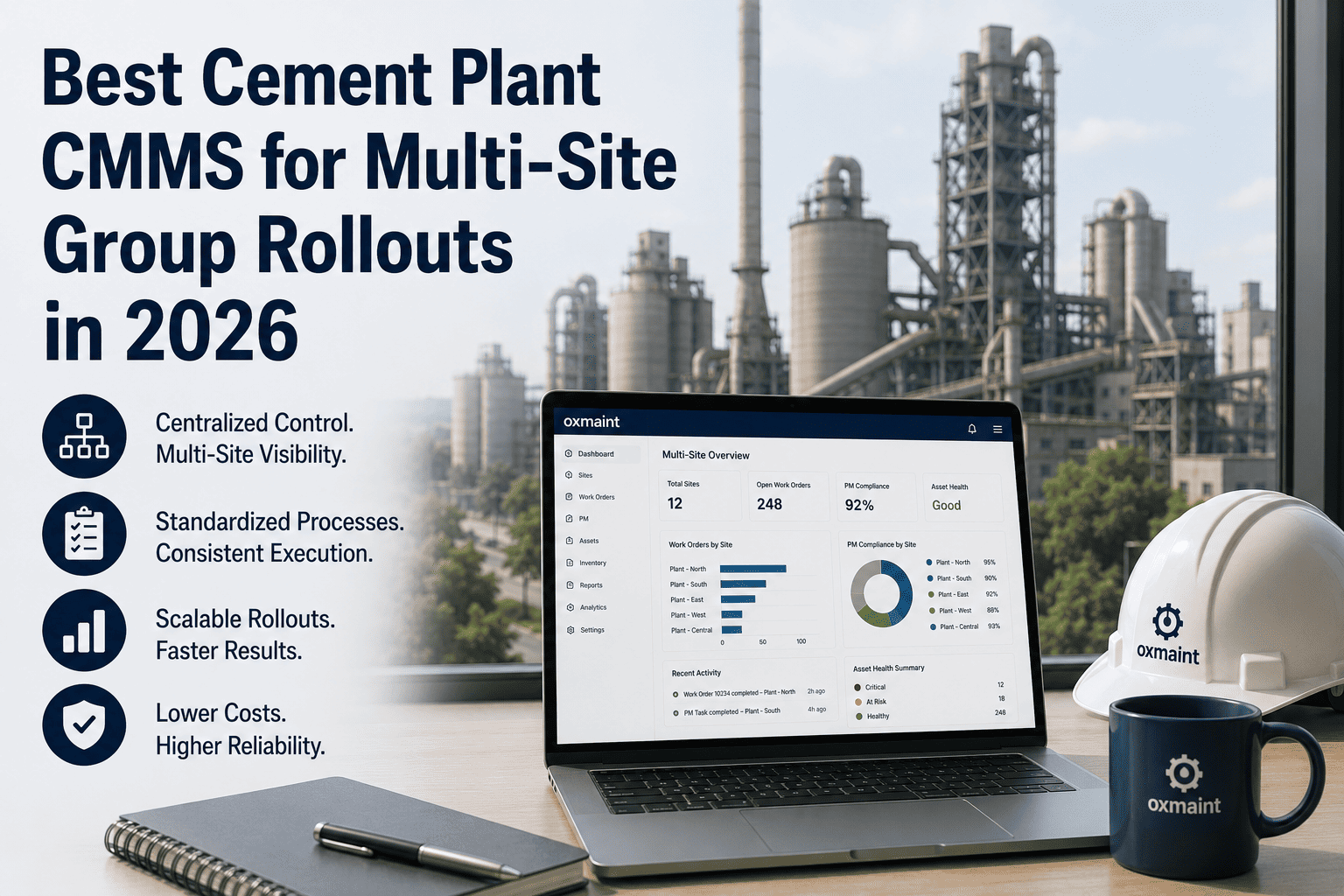
Best Cement Plant CMMS for Multi-Site Group Rollouts in 2026

By Johnson on June 2, 2026

best-cement-plant-cmms-multi-site-group-rollouts-2026

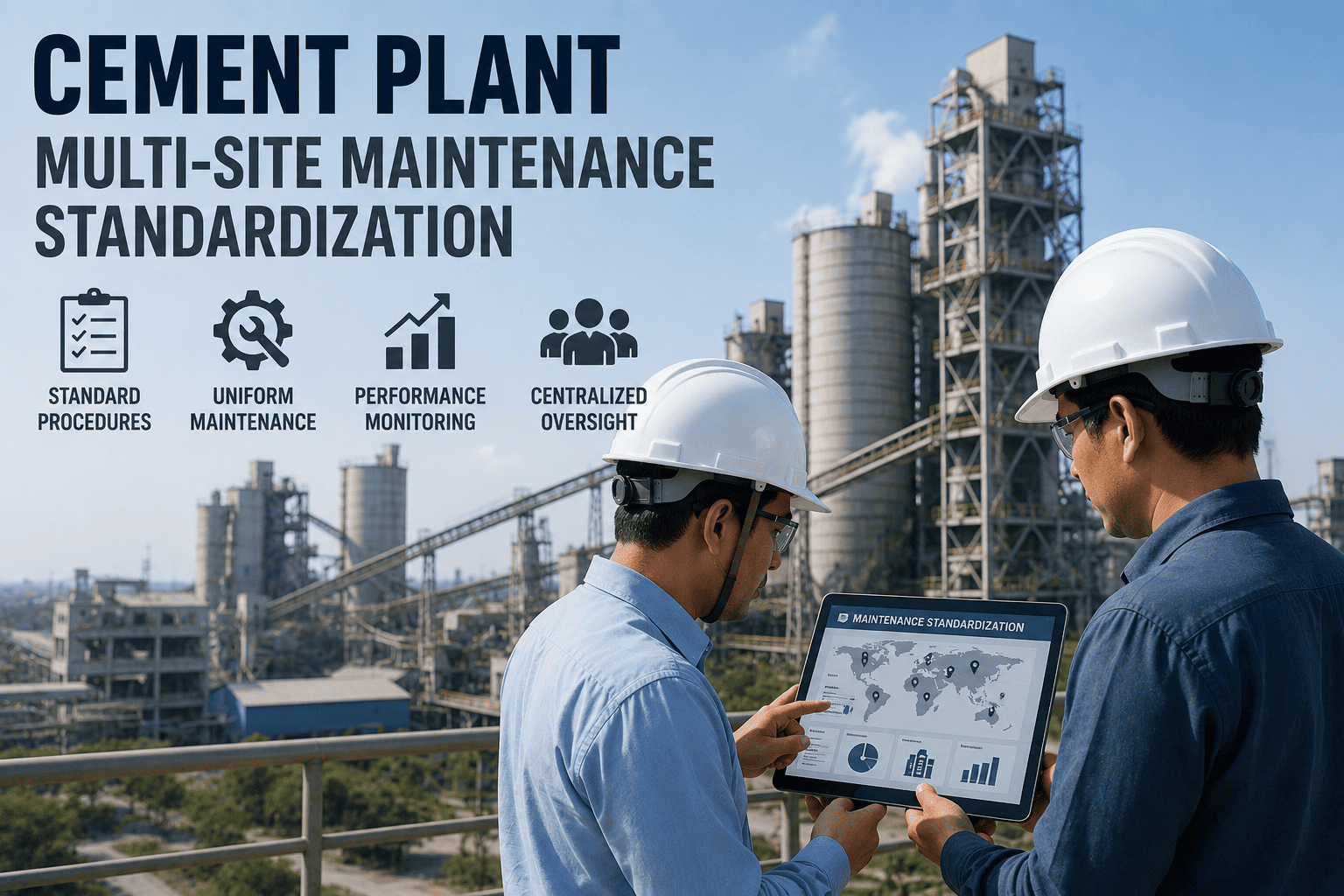
Running a cement group with five plants is not five times harder than running one plant — it is exponentially more complex, because every plant's maintenance culture, equipment configuration, and work order practice is different, and none of them are talking to each other. The VP of Operations who discovers that Plant A is running at 91% OEE while Plant D limps at 69% — despite similar equipment vintages — is looking at a data problem masquerading as a performance problem. Standardization is the answer, but forcing every plant onto a rigid, one-size-fits-all maintenance template destroys the local knowledge and operational flexibility that keeps individual plants running. The best cement plant CMMS for multi-site group rollouts in 2026 solves this tension: corporate defines the governance layer, sets KPI definitions, and enforces mandatory inspection points, while individual plants retain the autonomy to manage their own work order queues, spare parts, and maintenance scheduling within that framework. For cement groups operating three or more plants and still comparing performance through monthly PDF reports assembled by hand, Oxmaint's enterprise architecture gives you portfolio-level visibility and plant-level control from a single platform.

ENTERPRISE CMMS GUIDE · MULTI-SITE 2026

Best Cement Plant CMMS for Multi-Site Group Rollouts in 2026

Cement groups running 3 to 50 plants face a maintenance fragmentation problem that single-site CMMS platforms cannot solve. This guide shows what the best multi-site architecture looks like — and which features determine whether a group rollout succeeds or collapses at implementation.

THE FRAGMENTATION PROBLEM

What multi-plant maintenance fragmentation actually costs

What you see in the monthly report
Plant A: 91% OEE
Plant B: 78% OEE
Plant C: 74% OEE
Plant D: 69% OEE
Plant E: 71% OEE
What you cannot answer without a unified CMMS
Why is Plant A at 91% when D is at 69% with the same kiln type?
Which plant's PM program can we replicate across the group?
Are we carrying duplicate spare parts across plants 2 hours apart?
Which plant has the highest emergency repair spend this quarter?
What is our group-wide CapEx exposure in the next 3 years?
ENTERPRISE ARCHITECTURE

The two-tier model that makes group rollouts work

Corporate Layer
Governance, Standards and Benchmarking
Mandatory inspection point definitions for all kiln and mill asset classes
KPI calculation standards — OEE, MTBF, MTTR, PM compliance rate — defined once, applied everywhere
PM template library with best practices from highest-performing plants pushed to all sites
Cross-plant benchmarking dashboard — every plant's performance visible side by side
Portfolio-level CapEx forecast aggregated from individual plant RUL data
Single Sign-On for all users — corporate managers see everything, plant managers see their site
Plant Layer
Local Execution and Operational Autonomy
Plant-specific asset hierarchy reflecting local equipment configuration and spare parts stock
Work order queue managed by local maintenance team with full mobile access offline
Local PM scheduling within corporate-defined mandatory inspection framework
Plant-level emergency repair tracking and corrective action management
Local spare parts inventory with visibility into sister plant stock for critical components
Plant manager dashboard showing local KPIs versus corporate benchmark in real time
ROLLOUT PLAYBOOK

How to deploy CMMS across 5 cement plants in 12 weeks

Weeks 1-2
Corporate Configuration
Define group-wide KPI standards, mandatory inspection point library, and asset classification taxonomy. Configure corporate dashboard and reporting templates. Set role-based access permissions for corporate and plant-level users.
Weeks 3-6
Plant 1 Live + Template Validation
Deploy highest-performing plant first to build the reference template. Asset hierarchy, PM schedules, and work order workflows tested in production. Lessons from Plant 1 incorporated into the group rollout template before subsequent deployments.
Weeks 5-10
Parallel Plant Deployments
Plants 2-5 deployed in parallel using the validated template from Plant 1. Each plant's asset registry and historical maintenance data migrated. Local maintenance teams trained on mobile work order app. No plant shutdown required at any stage.
Weeks 8-12
Portfolio Dashboard Active
Corporate benchmarking dashboard live with all plants reporting to the same data model. Cross-plant OEE comparison, PM compliance ranking, and emergency repair benchmarking operational. Group CapEx forecast generated from plant-level RUL data within 90 days of first site go-live.

See what your cement group's portfolio dashboard looks like

Oxmaint's enterprise architecture deploys across multiple cement plants in parallel — with portfolio-level visibility live within 8 to 12 weeks of the first site going live. Book a demo to see the cross-plant benchmarking dashboard in action.

FEATURE EVALUATION

What to look for when evaluating multi-site cement CMMS in 2026

Feature Why It Matters for Multi-Site Groups Red Flag If Missing
Two-tier governance model Corporate standards enforced without removing plant autonomy — the only architecture that achieves group standardization at scale Groups forced to choose between rigid corporate control or no standards at all
Cross-plant KPI benchmarking Identifies performance gaps between plants with similar equipment — the fastest way to find what Plant A is doing that Plant D is not Monthly PDF reports assembled by hand from each plant's local data
Single Sign-On (SSO) Corporate managers access all plants without separate logins — security, compliance, and operational visibility in one authenticated session Corporate team manages separate credentials for each plant system
Offline mobile work orders Field technicians in remote plants work without connectivity — data syncs automatically when back in range, never lost Mobile app abandoned within 60 days when connectivity fails in field areas
Cross-plant spare parts visibility Critical spares at sister plants visible to local teams — reduces emergency stockouts and cross-site parts sharing for unplanned repairs Each plant carries full safety stock independent of sister plant inventory
Portfolio CapEx aggregation Group-level capital forecast from plant-level RUL data — CFO sees total group capital exposure, not five separate plant budget requests Annual CapEx process involves manual data collection from each plant team
PM template push from corporate Best practice PM procedures from top-performing plants deployed to all sites without requiring local IT work at each plant Best practice procedures documented but never operationalized at underperforming plants
DOCUMENTED RESULTS

What cement groups achieve in the first 12 months of unified CMMS

22%
OEE gap closure
The performance gap between highest and lowest OEE plants in a group closes by an average of 22 percentage points within 12 months of unified CMMS deployment, as best practices are replicated from leading to lagging sites.
8-12 wks
Portfolio dashboard active
Cross-plant benchmarking dashboard is live within 8 to 12 weeks of the first site going live, with all subsequent plants reporting to the same data model as their deployments complete.
31%
Spare parts inventory reduction
Cross-plant spare parts visibility allows groups to consolidate safety stock and reduce duplicate inventory held at neighboring plants — average 31% reduction in group-wide inventory carrying cost.
90 days
Full KPI dashboard maturity
Full KPI dashboard functionality including group CapEx forecast, cross-plant MTBF benchmarking, and predictive maintenance alerts is operational across all plants within 90 days of go-live on the first site.
FREQUENTLY ASKED QUESTIONS

What group operations leaders ask about multi-site CMMS rollouts

Yes — the two-tier architecture is designed for exactly this. Corporate defines mandatory inspection points and KPI calculation standards; individual plants manage their own work order queue, PM scheduling, and spare parts within that framework. Local teams retain full operational autonomy while contributing to group benchmarking. See how Oxmaint handles this in a free trial.
Edge connectors at each plant buffer data locally during connectivity loss and sync automatically when the link returns. Mobile app users work fully offline and sync when back in range. Plants in low-bandwidth regions operate identically to well-connected sites — no data is lost during connectivity outages. Book a demo to discuss your specific connectivity scenarios.
Initial deployment across all sites typically completes within four to six weeks, with full KPI dashboard functionality live within 90 days. The first plant goes live at week 3-4; subsequent plants deploy in parallel using the validated template. Full predictive maintenance capability matures 3-6 months after data baselines are established at each site.
Each plant's spare parts inventory is visible to maintenance planners at sister plants within the group — searchable by part number, asset compatibility, and location. When an unplanned repair requires a critical spare not in local stock, the planner can immediately see if a neighboring plant has the part available, reducing emergency expedite costs and extending planned outage duration. Start a trial to see the cross-plant inventory feature in action.
Existing maintenance data from SAP PM, spreadsheets, or legacy CMMS platforms is migrated into the group taxonomy during implementation. Historical work order data, PM schedules, and asset records are imported and normalized to the group data model. Plants do not lose their historical data or need to rebuild asset records from scratch — migration is handled during the deployment phase with no plant shutdown required.

Stop managing a collection of disconnected plants. Start governing a high-performance network.

Oxmaint's enterprise cement CMMS gives corporate maintenance leaders the infrastructure to standardize PM procedures, benchmark every plant from a single dashboard, and generate group-level CapEx forecasts without monthly data collection exercises. Portfolio-level visibility. Plant-level control.


Share This Story, Choose Your Platform!