Selecting a CMMS for a cement plant is a fundamentally different decision from selecting one for a warehouse, food plant, or utilities facility. Cement operations run continuous kiln campaigns measured in months, refractory maintenance programmes worth millions of dollars per cycle, NESHAP and MSHA compliance obligations that require structured audit trails, and ERP integrations that link maintenance costs to clinker cost-per-tonne reporting. The platforms that perform best in cement environments in 2026 are those that combine kiln-specific asset management, compliance workflow depth, mobile floor crew capability, and ERP integration maturity — not those with the longest general feature list. Book a Demo to see OxMaint configured for cement plant asset structures.
The Cement Plant CMMS Built for Kiln Operations
OxMaint delivers kiln campaign tracking, refractory lifecycle management, NESHAP compliance workflows, and ERP integration — without the 9-month implementation of enterprise platforms.
What to Evaluate When Choosing a Cement Plant CMMS
Most CMMS evaluation frameworks used by procurement teams — feature checklists, user count pricing, and integration API documentation — miss the factors that determine whether a platform will actually be used on the plant floor 12 months after go-live. For cement operations specifically, the five evaluation dimensions that matter most are: kiln and refractory asset management depth, compliance workflow structure for NESHAP and MSHA, mobile floor crew usability in high-dust and offline environments, shutdown and CapEx planning capability, and total time-to-value including implementation complexity and training burden. The vendor comparison below scores each platform against these cement-specific criteria.
Top CMMS Platforms for Cement Plants — 2026 Comparison
Recommended for Cement
OxMaint
Mid-Market | Cloud-Native | Fast Deployment
Pre-built cement plant asset templates, NESHAP compliance record structures, offline mobile, and kiln campaign tracking. Live in 2–4 weeks. Best fit for mid-size cement operations and multi-plant groups without enterprise IT budgets.
IBM Maximo
Enterprise | On-Premise or Cloud | Long Implementation
Deep ERP integration with SAP and Oracle. Highly configurable but requires 6–12 months implementation and dedicated IT resources. Best fit for global cement groups with existing Maximo investments and large IT departments.
UpKeep
SMB-Focused | Cloud | Fast Deployment
Good mobile usability and rapid deployment. Lacks cement-specific asset templates, NESHAP workflow structures, and campaign tracking. Best fit for small quarry operations or plant ancillary services where compliance depth is not required.
SAP PM (Plant Maintenance)
Enterprise | SAP Ecosystem | ERP-First
Unmatched ERP integration for SAP S/4HANA environments. Maintenance module is secondary to financial and procurement workflow. Mobile experience is poor without additional Fiori customisation. Typically 9–18 months to full deployment.
Detailed Feature Comparison Table
| Feature |
OxMaint |
IBM Maximo |
UpKeep |
SAP PM |
| Kiln Campaign Tracking | Native | Custom build | No | Custom build |
| Refractory Zone Mapping | Native | Custom | No | No |
| NESHAP Compliance Records | Structured | Custom | No | Custom |
| MSHA Safety Workflows | Yes | Custom | No | Custom |
| AFR Throughput-Based PM | Yes | Custom | No | Custom |
| Offline Mobile Mode | Full | Limited | Partial | No |
| QR Asset Scanning | Native | Native | Native | Fiori add-on |
| Condition Monitoring Integration | API + IoT | API | Limited | API |
| Shutdown Planning Module | Yes | Yes | No | Yes |
| ISO 50001 Export | Yes | Custom | No | Custom |
| Implementation Time | 2–4 weeks | 6–12 months | 1–3 weeks | 9–18 months |
| Starting Price (per user/month) | Contact | High | From $45 | SAP licensing |
Expert Review
VN
Vijay Narayan
Group Maintenance Director — South Asian Cement Conglomerate, 6 plants
"We evaluated Maximo, SAP PM, and two cloud CMMS options before selecting OxMaint. Maximo and SAP both required 9+ months of implementation and custom development to handle kiln campaign tracking and NESHAP records. OxMaint had cement plant templates pre-built. We were live across three plants in eight weeks — something neither enterprise vendor could offer."
HB
Helena Bauer
Plant Operations Manager — German Integrated Cement and Clinker Facility
"The platform comparison question in cement is often framed as 'how many features does it have' — but the better question is 'how many of those features address kiln operations specifically'. We found that the mid-market platforms with cement configuration depth outperformed enterprise tools on actual maintenance KPIs because maintenance teams used them — rather than working around them."
Compare OxMaint Against Your Current Platform
Book a 30-minute demo with a cement industry specialist — see kiln workflow templates, compliance records, and mobile floor crew capability side by side with what you use today.
Frequently Asked Questions
How long does it take to implement a CMMS in a cement plant?
Implementation time varies significantly by platform type. Enterprise platforms like IBM Maximo and SAP PM typically require 6–18 months for full deployment in a cement plant, including custom asset hierarchy configuration, compliance workflow build, ERP integration, and training. Cloud-native mid-market platforms like OxMaint can achieve a working cement plant configuration — with kiln campaign tracking, refractory records, and floor crew mobile capability — in 2–4 weeks, with full plant go-live at 6–8 weeks. The right choice depends on your IT infrastructure and how quickly you need operational value.
Book a demo to discuss your implementation timeline.
Can a CMMS integrate with SAP or Oracle ERP systems in a cement plant?
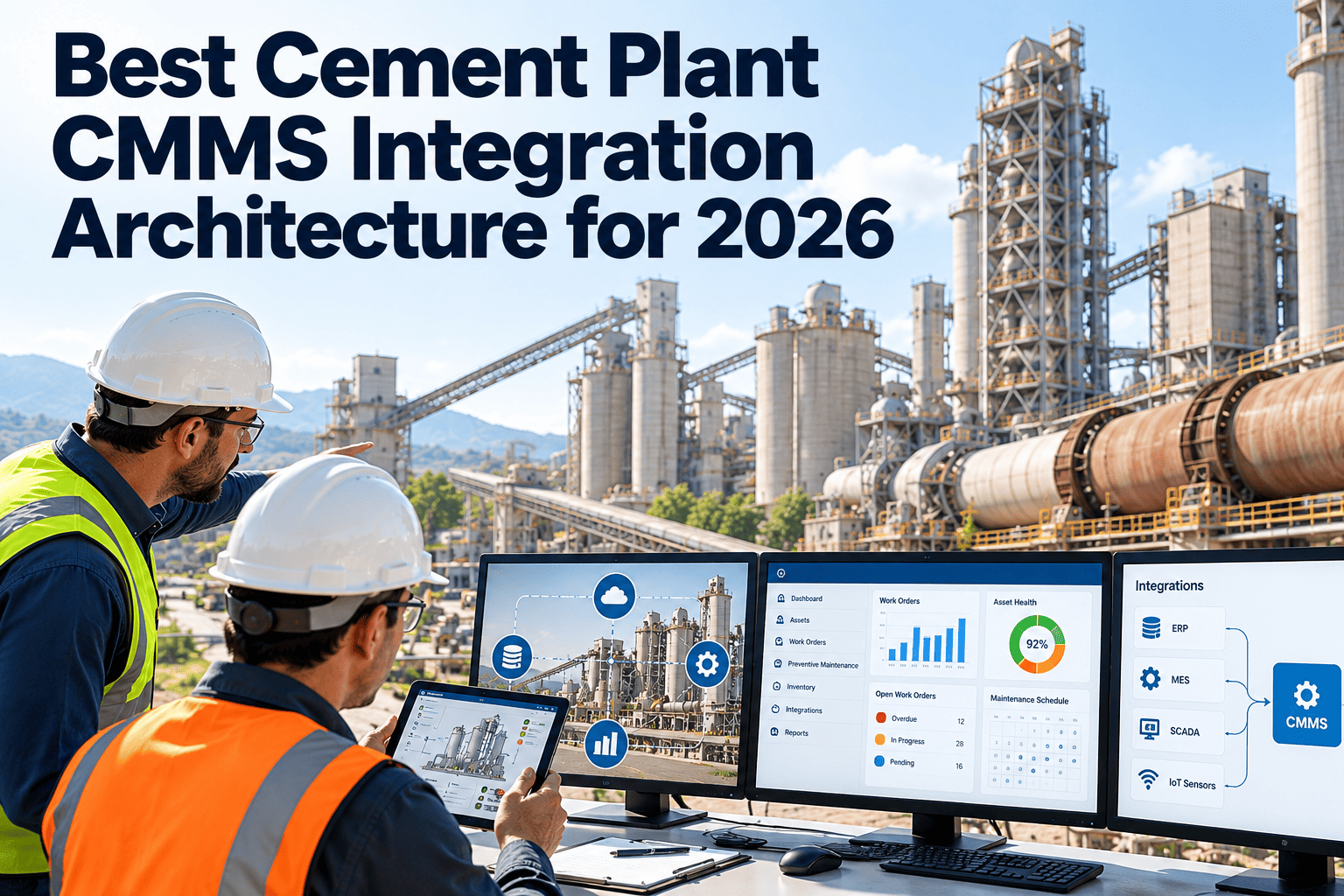
Yes. Most modern CMMS platforms offer ERP integration via REST API, with pre-built connectors for SAP S/4HANA, SAP ECC, and Oracle ERP Cloud. The integration typically covers purchase order generation from work orders, materials consumption posting to plant cost centres, and asset master data synchronisation. OxMaint's ERP integration layer connects maintenance work order costs to SAP cost objects in real time — enabling clinker cost-per-tonne calculations that include maintenance expenditure without manual data reconciliation.
Sign up to review OxMaint's ERP integration documentation.
What is the difference between a CMMS and SAP Plant Maintenance for a cement company?
SAP Plant Maintenance (PM) is a module within the SAP ERP ecosystem — its primary strength is financial and procurement integration, with maintenance workflow as a secondary function designed to feed cost centre accounting. A dedicated CMMS like OxMaint is built maintenance-first, with the asset management, PM scheduling, work order execution, compliance tracking, and mobile field crew workflows as primary functions — and ERP integration as a data exchange layer. For cement plants where maintenance execution quality and compliance traceability are the primary objectives, a dedicated CMMS typically delivers better maintenance KPI outcomes and higher floor crew adoption than SAP PM configured for the same environment.
Does OxMaint support multi-plant cement group deployments?
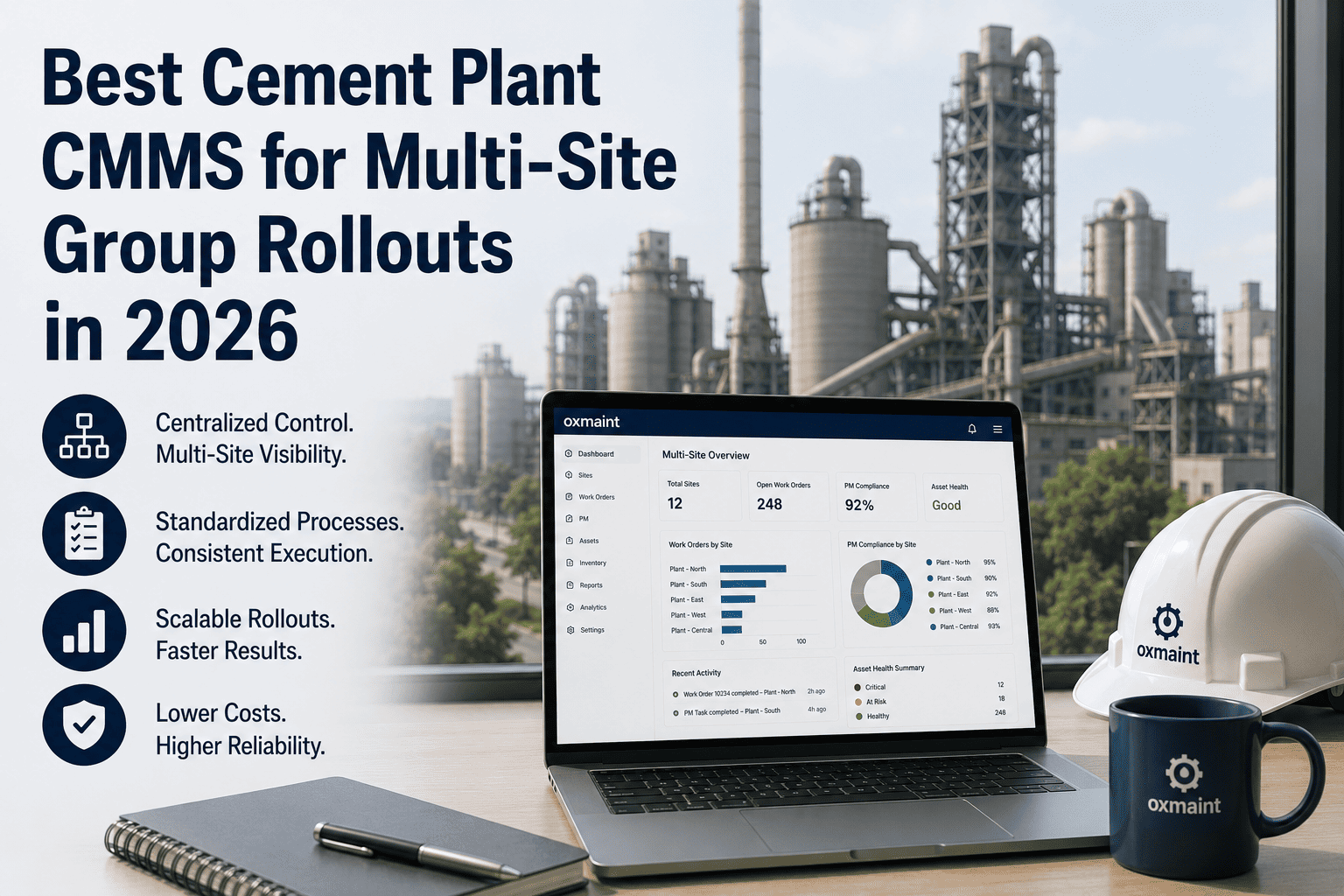
Yes. OxMaint is deployed across multi-plant cement groups with centralised KPI dashboards that aggregate kiln availability, PM compliance, MTBF, and MTTR across all plants — while allowing plant-level maintenance teams to operate with their own work order queues, asset hierarchies, and spare parts inventories. Group maintenance directors can benchmark performance across plants, identify best practices in one location for deployment at others, and manage CapEx shutdown planning across the portfolio from a single login.
Book a demo to see the multi-plant group view in OxMaint.