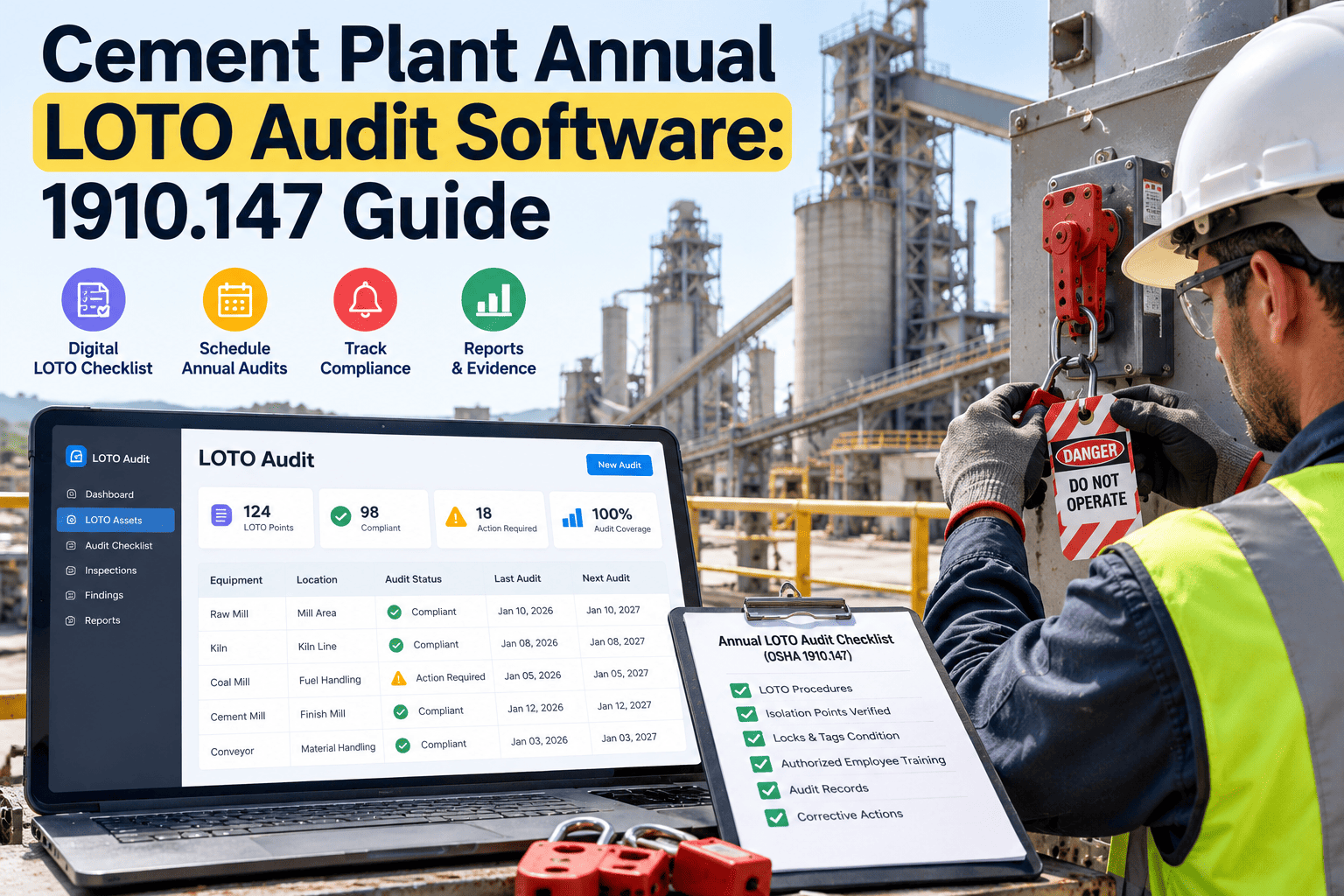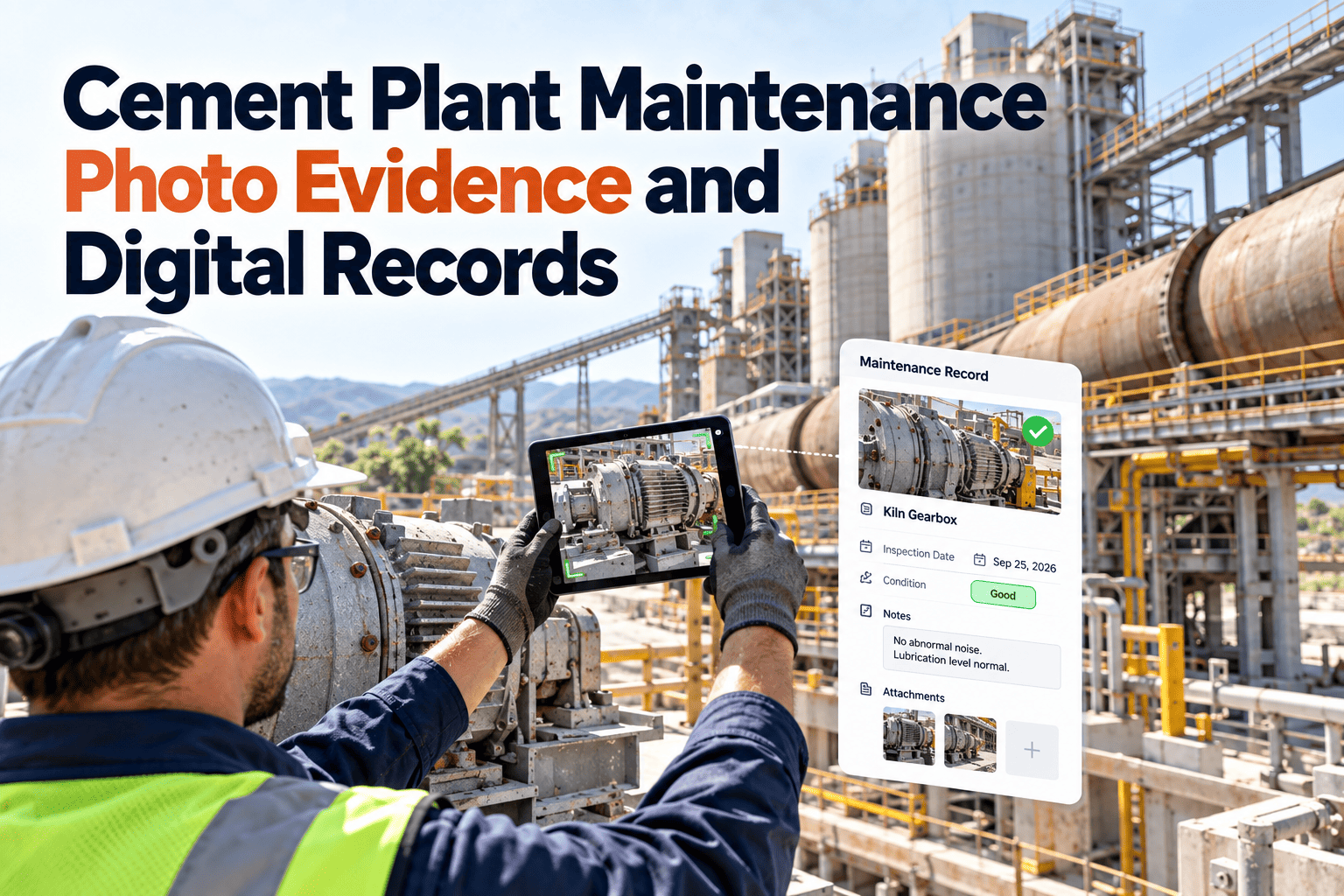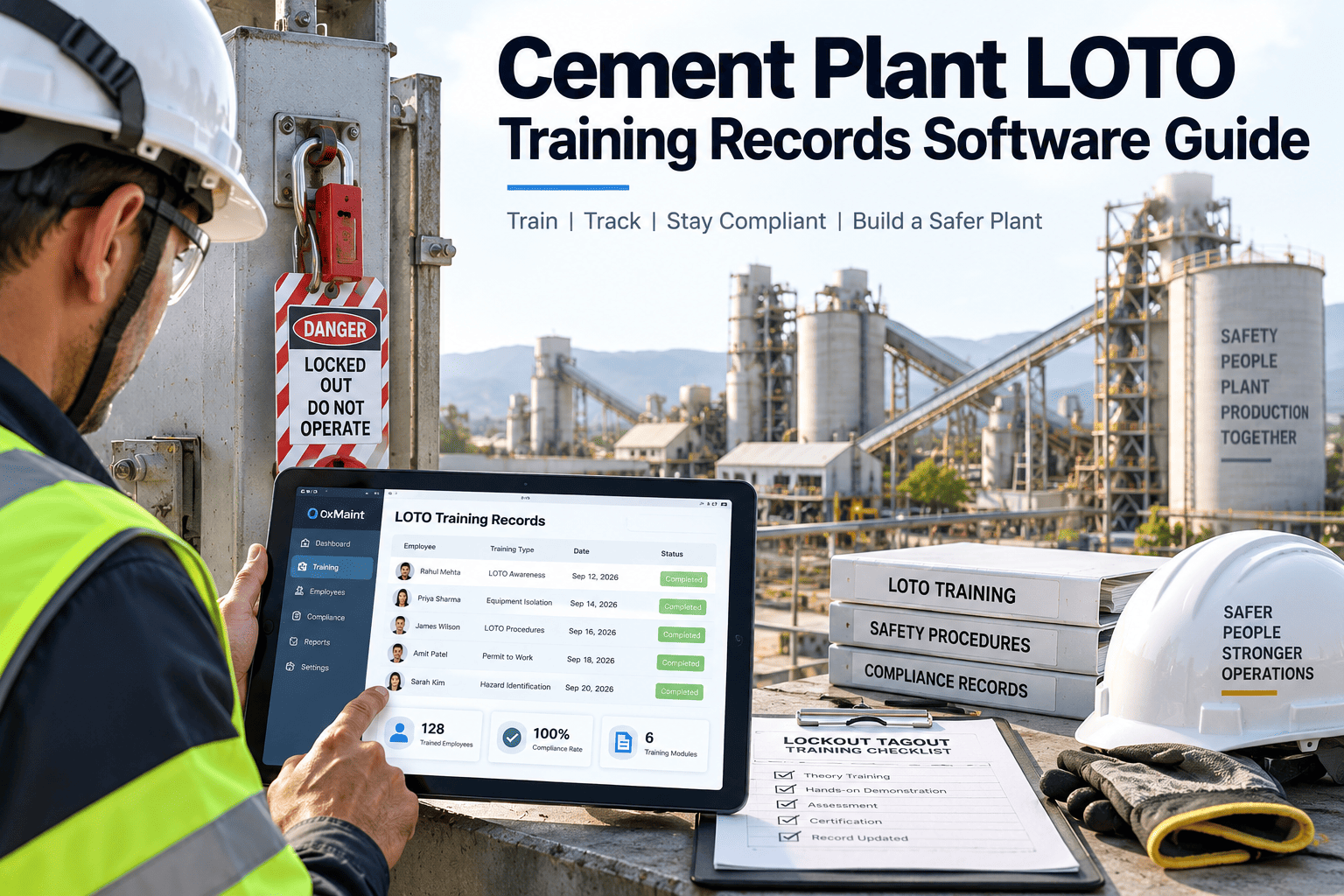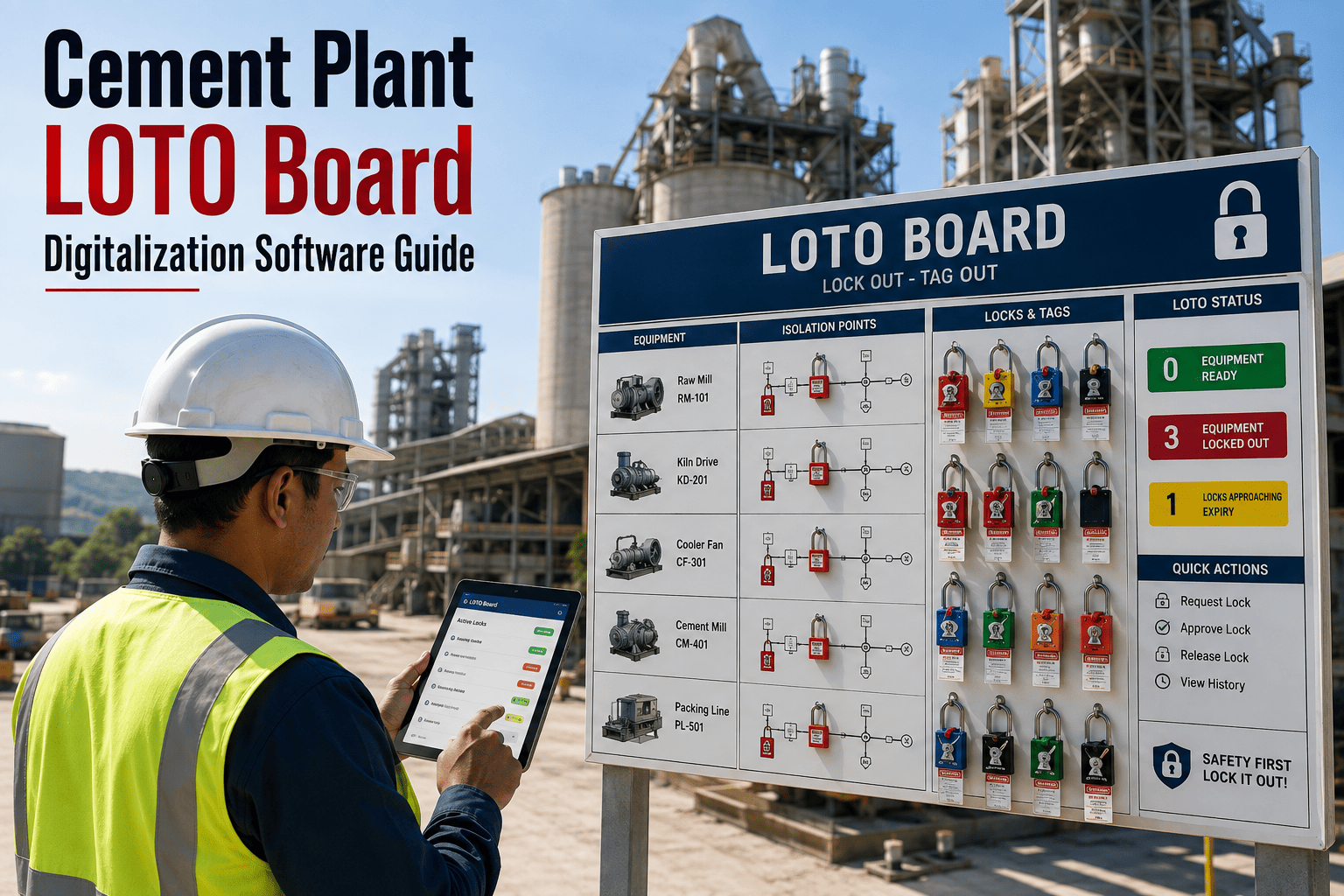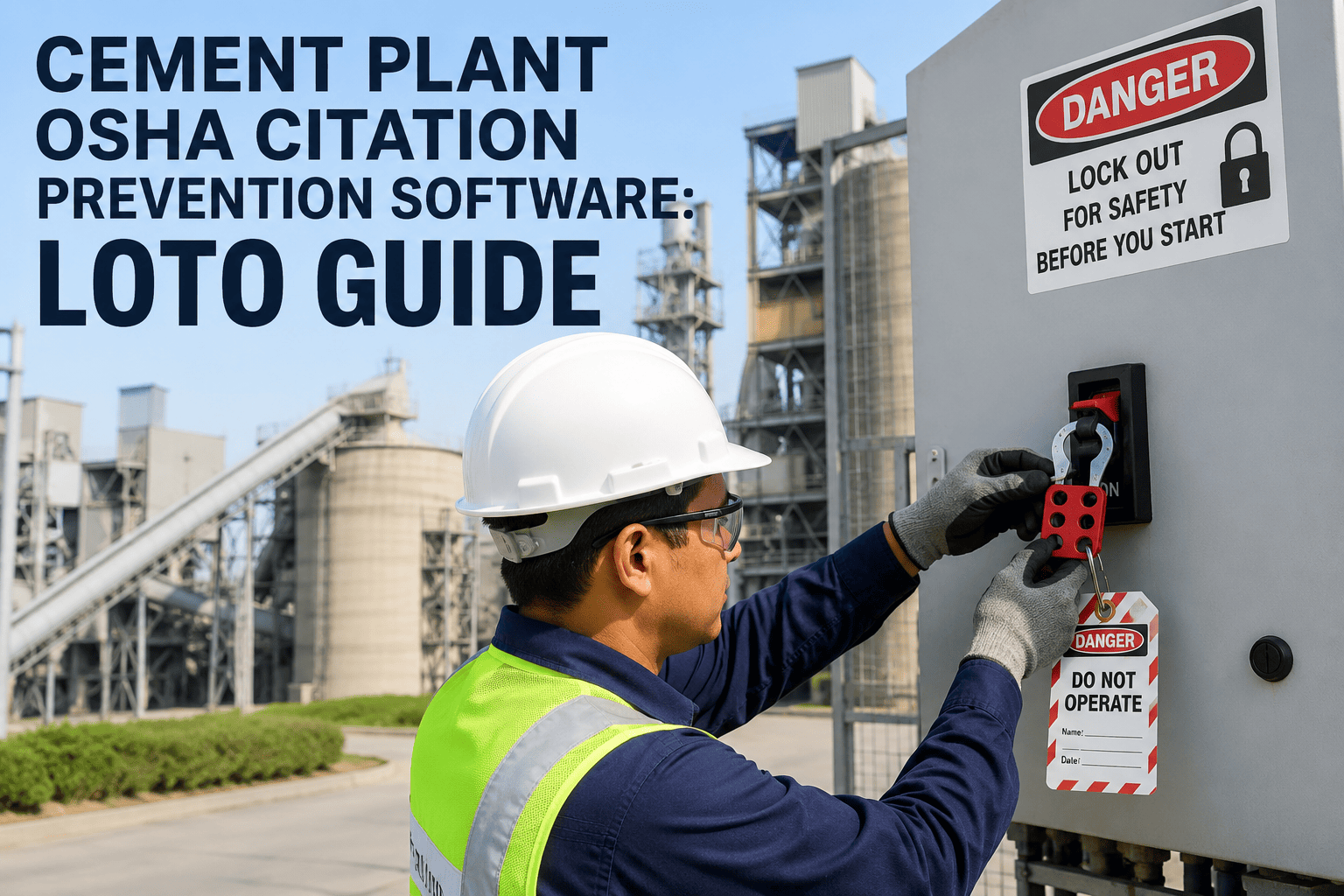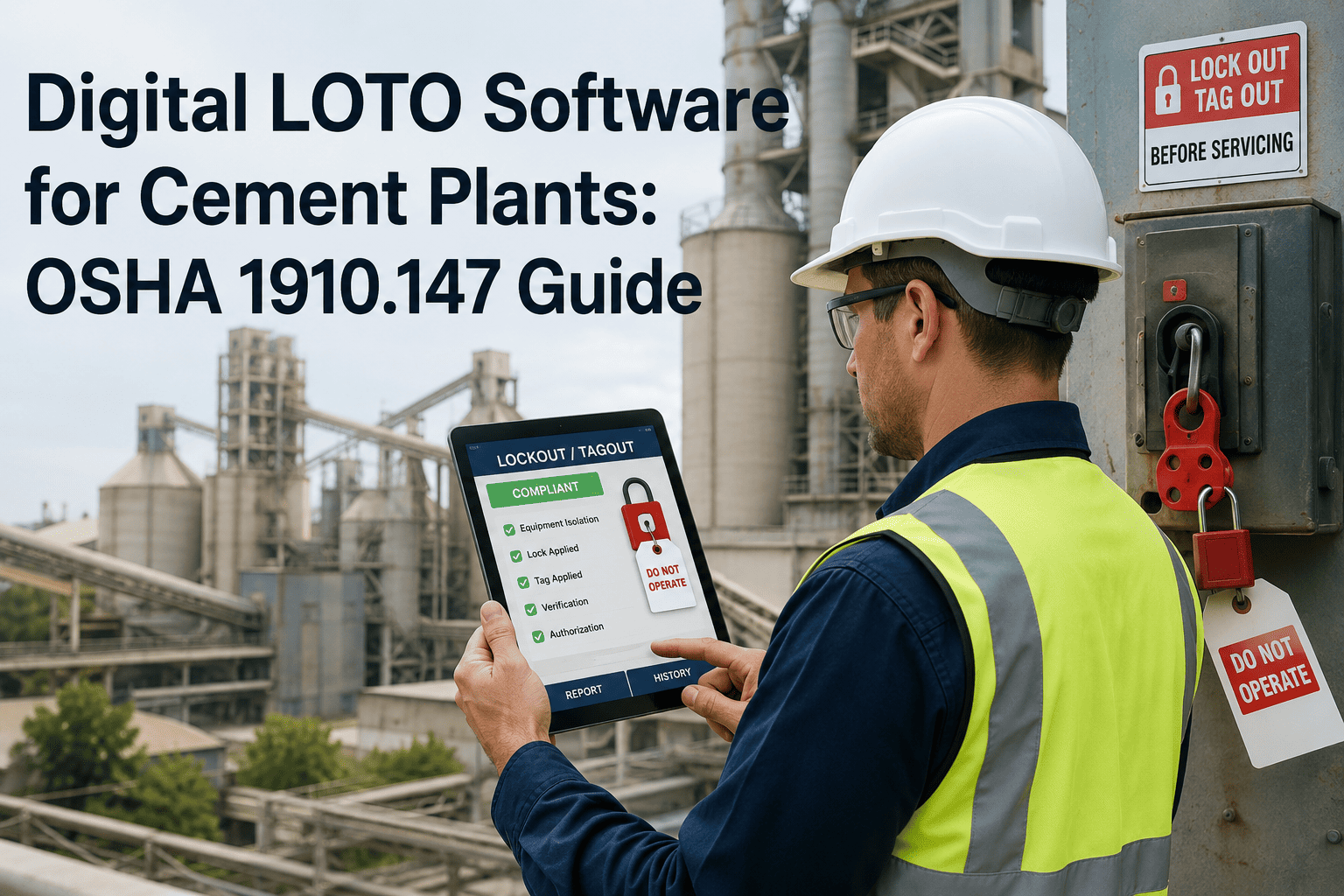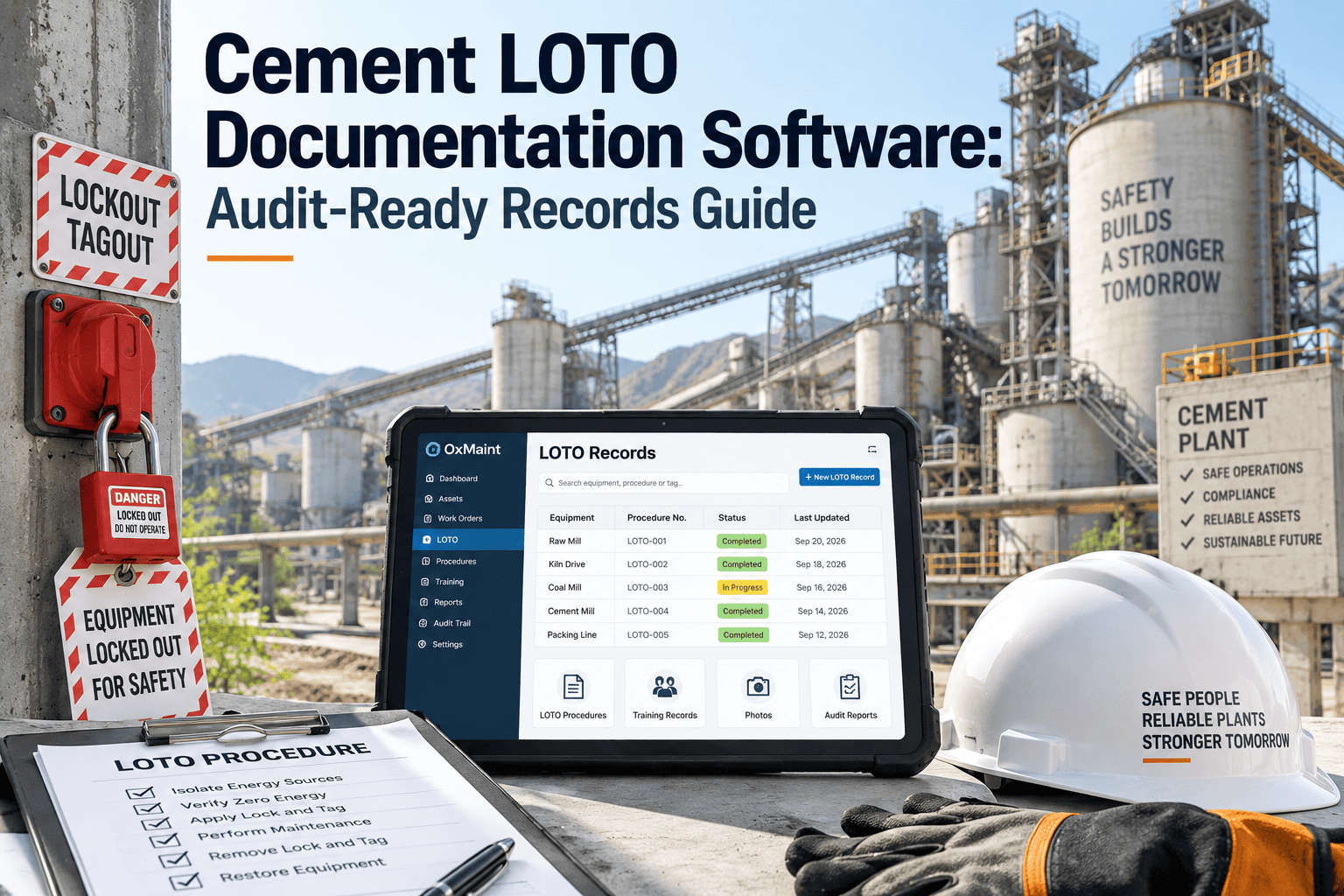
A rotary kiln drive, a raw mill under load, and a clinker cooler fan bank do not stop being dangerous the moment a breaker is thrown — stored thermal, mechanical, and pneumatic energy stays live long after the switch is off. Cement plants routinely run hundreds of isolation points across kilns, mills, crushers, coolers, and conveyors, and every one of them needs its own dated, signed, machine-specific record. When paper logs and whiteboard schedules are the only proof, an OSHA walk-through turns into a scramble, and a single missing signature can turn a routine inspection into a formal citation. This guide covers what cement LOTO documentation actually needs to hold up under audit, and how a connected CMMS turns isolation records into evidence instead of paperwork.
Could you hand an OSHA inspector a complete lockout file for every kiln, mill, and conveyor drive — right now?
Cement facilities isolate more energy sources per shift than almost any other heavy-industry site, running kiln, mill, crusher, cooler, and conveyor isolations in parallel across multiple crews. OxMaint replaces lock-box logs and radio confirmations with timestamped, asset-linked LOTO records that are ready the moment an inspector asks.
Paper LOTO records are the most common reason cement plants get cited
Lockout/Tagout under 29 CFR 1910.147 has sat inside OSHA's most-cited standards for over a decade, and cement plants are especially exposed because a single facility can carry over a thousand assets under the standard.
Inspectors do not walk in looking for good intentions. They ask for a dated, signed, machine-specific procedure for the exact kiln drive, raw mill, or crusher that was serviced — and they ask for the annual inspection record that proves the procedure was reviewed.
A generic, plant-wide energy-control policy with no equipment-specific detail is one of the most common findings behind a willful citation, and willful citations carry the steepest penalties on the books.
The gap rarely comes from a lack of rules. Cement plants generally know 1910.147 well. It comes from the fact that a lockout event happening on a mill floor at 2 a.m. during a turnaround is documented, if at all, on a form that sits in a binder until someone remembers to file it — and by then, details are missing, signatures are illegible, or the try-out verification step was never recorded at all.
The five gaps every paper LOTO file has in common
Illegible or missing signatures
Authorized-employee names on a clipboard fade, get skipped under time pressure, or never get cross-checked against a training register.
No verified energy-isolation step
The try-out step that confirms zero energy state is the step most often skipped — and the one inspectors ask about first.
Shift handover gaps
Locks applied on one shift and removed on another lose their paper trail when tags are transferred by radio instead of a system.
Generic, not machine-specific, procedures
A single plant-wide LOTO policy with no procedure written for the specific kiln drive or raw mill serviced is a common willful-violation finding.
No annual inspection record
1910.147 requires a periodic inspection of every energy control procedure, and undated or unsigned inspection sheets do not satisfy it.
None of these gaps come from carelessness. A maintenance crew working a hot, dusty kiln shutdown at 3 a.m. is focused on getting the job done safely, not on filing paperwork correctly — which is exactly why the documentation system has to make the correct record the easiest option, not an extra task layered on top of already demanding work.
What one cement plant's LOTO documentation set actually covers
Every asset class below carries its own stored-energy profile, which means its own procedure, its own inspection interval, and its own authorized-employee list inside a defensible documentation system. Treating them as interchangeable is where most audit findings begin.
No two isolation profiles are interchangeable — copying a checklist from one asset class to another is where documentation gaps start.
Kiln drives are the clearest example of why generic checklists fail. A girth gear and pinion assembly does not stop rotating instantly when the drive motor is de-energized, and thermal expansion in the shell continues to move stored mechanical energy through the system for a period after shutdown. A LOTO procedure that does not account for that residual rotation, or that treats the kiln the same way it treats a small pump, leaves a documentation gap an inspector will find in minutes.
Raw and finish mills carry a similar but distinct risk through hydraulic accumulators that hold pressure long after the mill motor is locked out.
That is why the release-of-stored-energy step in the procedure has to name the specific accumulator, its bleed-down valve, and the pressure gauge a technician checks before work begins — not a generic instruction to "release residual energy."
| Asset Class | Dominant Energy Types | Typical Isolation Points | Documentation Risk |
|---|---|---|---|
| Kiln drive & girth gear | Electrical, mechanical, thermal | 4–6 per drive | High — residual rotation risk |
| Raw & finish mills | Electrical, mechanical, hydraulic | 5–8 per mill | High — hydraulic accumulator hazard |
| Clinker cooler fans | Electrical, mechanical, thermal | 3–5 per fan bank | Medium — high-heat re-entry risk |
| Crushers & hammer mills | Electrical, mechanical | 2–4 per unit | Medium — stored rotational energy |
| Conveyors & bucket elevators | Electrical, mechanical, gravitational | 2–3 per drive | High — gravity fall-back hazard |
See what an audit-ready LOTO file looks like on your assets
Import your isolation points and watch OxMaint generate timestamped, signed records automatically — before your next turnaround, not after your next citation.
The six-step OSHA sequence, digitally enforced
29 CFR 1910.147 defines six mandatory steps for controlling hazardous energy. OxMaint attaches a record to each one instead of trusting a technician's memory, so the sequence below is not just a safety procedure — it is the audit trail an inspector will eventually ask to see.
Preparation & Notification
Affected employees are notified inside the work order, with a timestamp attached automatically.
Equipment Shutdown
The normal stop sequence for the specific asset is pulled from its digital procedure, not memory.
Isolation
Each breaker, valve, or pin is scanned by QR tag and matched to the authorized technician's lock.
Lockout / Tagout Application
Photo evidence of the applied lock and tag is captured against the asset record in real time.
Stored-Energy Verification
The try-out step is a mandatory checklist item — the work order cannot close without it being confirmed.
Release & Restart Sign-Off
Lock removal and restart require a second authorized signature before the asset returns to service.
What changes when documentation moves off the clipboard
| Documentation Element | Paper-Based Process | OxMaint CMMS |
|---|---|---|
| Isolation point verification | Radio call, unverified | QR scan matched to asset and worker |
| Authorized employee record | Sign-in sheet | Live-linked training and certification register |
| Periodic procedure inspection | Annual binder review | Auto-scheduled inspection work order |
| Multi-crew group lockout | Manual reconciliation | Real-time lock count against active work order |
| Inspector-ready export | Hours of file pulling | Filtered report by asset, date, or crew |
Aligning cement LOTO documentation with the standards auditors actually check
A cement plant's documentation set rarely answers to only one standard. Corporate safety audits, insurance reviews, and multi-site reliability programs each pull from a different framework, and the underlying isolation record has to satisfy all of them at once.
| Standard | What It Requires of LOTO Records | How Digital Documentation Helps |
|---|---|---|
| OSHA 29 CFR 1910.147 | Machine-specific procedure, annual inspection, authorized-employee training log | Auto-scheduled inspections, live training register |
| ISO 45001 Clause 8.1.3 | Documented hazardous-energy control integrated with the OH&S management system | Isolation records linked directly to the work order system |
| MSHA (where applicable) | Task-specific energy control training and equipment tagging | QR-tagged disconnects matched to certified operators |
| Corporate/insurer audits | Consistent, exportable evidence across every plant in a group | Standardized report export by site, asset, or date range |
What digitizing a cement plant's LOTO program actually involves
Moving off paper does not mean rewriting every procedure from scratch. Most plants carry a viable base of written procedures — the work is structuring them against the asset register so each one becomes searchable, trackable, and enforceable.
Import the asset register
Kilns, mills, crushers, coolers, and conveyors are loaded with their existing tag numbers and locations so nothing is re-mapped from scratch.
Digitize existing procedures
Current LOTO documents are converted into structured, step-by-step digital procedures attached to the matching asset record.
Tag isolation points with QR codes
Breakers, valves, and pins receive scannable tags so field verification replaces radio confirmation.
Load the authorized-employee register
Training records and certifications sync so a lock can only be logged against a currently authorized technician.
Run a live turnaround on the platform
The first major outage after go-live becomes the proof point — a full, exportable isolation record generated in real time.
The real cost of an undocumented isolation
The financial exposure of poor LOTO documentation shows up in two very different places, and both hit a cement plant harder than most industrial sites.
Neither cost is hypothetical on a plant running a heavy turnaround schedule. The isolation points most likely to be rushed — the ones deep in a mill housing or high on a kiln shell — are also the ones most expensive to get wrong, which is exactly why documentation discipline matters most in the places paper systems are weakest.
Built for the way cement plants actually isolate energy
Machine-Specific Digital Procedures
Every kiln, mill, crusher, and conveyor carries its own isolation checklist tied directly to its asset record, energy source inventory, and shutdown sequence — not a generic plant-wide policy that an inspector can flag on sight.
QR-Verified Lock Application
Technicians scan the disconnect and their personal lock together in the field, eliminating misplaced tags, unverifiable radio confirmations, and the guesswork that comes with reading someone else's handwriting.
Group Lockout Reconciliation
Multi-crew turnarounds track every active lock in real time across shifts, so no equipment restarts while one technician's isolation is still in place, even when responsibility changes hands mid-outage.
Audit-Ready Report Export
Pull a complete, dated, signed LOTO history for any asset, crew, or date range in minutes, filtered exactly the way an OSHA inspector or corporate safety auditor asks for it.
Work Order-Linked Isolation
Isolation records attach directly to the maintenance work order that required them, so the full history of who isolated what, when, and why lives in one searchable place.
Mobile and Offline Field Access
Kiln decks, mill floors, and remote silo areas often sit outside strong signal coverage, so technicians can log isolation steps offline and have them sync the moment connectivity returns.
Cement LOTO documentation, answered
What records does OSHA expect for cement plant LOTO?
A machine-specific procedure per asset, an annual periodic inspection, and a signed authorized-employee list an inspector can pull on request. Generic, plant-wide policies without equipment-specific detail are the most common gap. You can get started and import existing isolation points in a single session.
How does digital LOTO documentation differ from a paper log?
Each isolation step is timestamped, photo-verified, and linked to the specific asset and technician, rather than relying on a handwritten entry that can be incomplete, illegible, or simply never filed after the outage ends.
Can OxMaint handle multi-crew group lockout during a turnaround, and does it standardize across a multi-site group?
Active locks across every crew are reconciled against the work order in real time, and the same procedures, inspection schedules, and report formats can be standardized across every plant in a group.
How long does it take to digitize an existing LOTO program?
Most cement plants import their asset list and existing procedures and are running digital isolations within a few weeks, with onboarding support included.
Does OxMaint replace physical locks and tags?
No — physical isolation hardware stays exactly as it is. OxMaint verifies, timestamps, and documents each step so the paper trail behind it is audit-ready.
Turn your next OSHA walk-through into a formality, not a scramble
Digitize kiln, mill, crusher, cooler, and conveyor LOTO documentation with OxMaint — audit-ready from day one.
Free trial · No credit card required