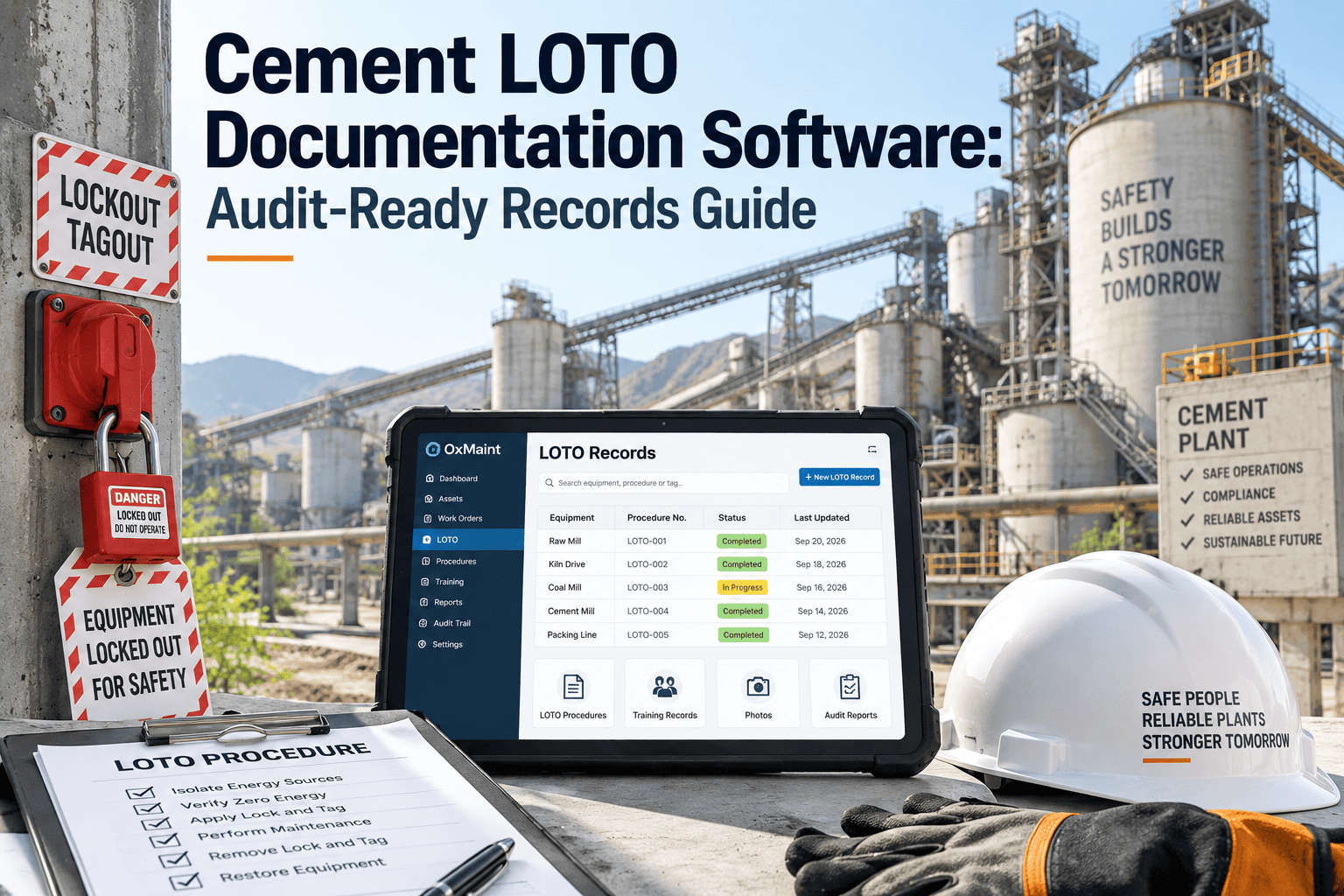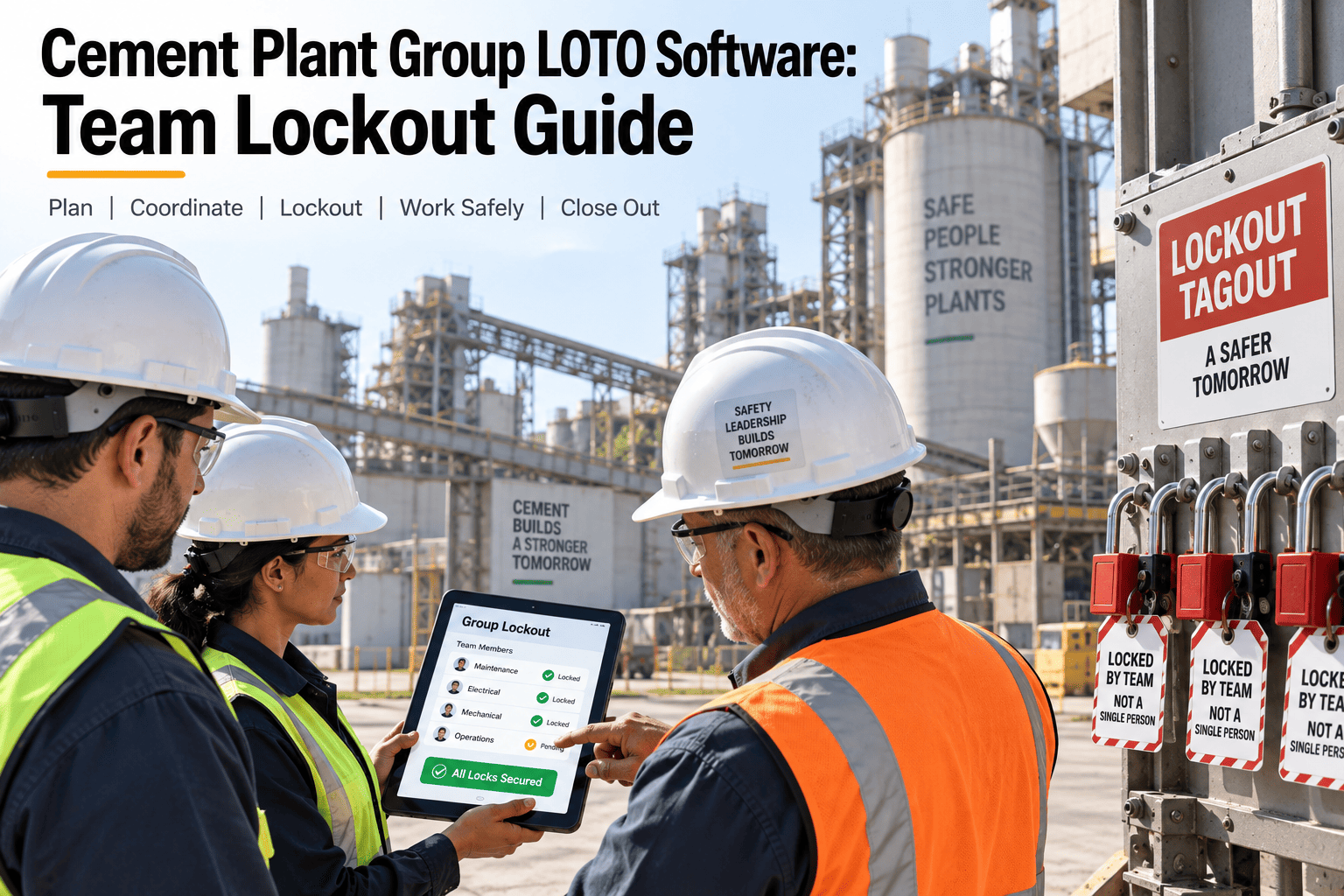
An annual LOTO audit is where a cement plant finds out whether its energy control procedures still match the kilns, mills, crushers, and conveyors they were written for. Under OSHA 1910.147(c)(6), every procedure needs its own periodic inspection, an independent authorized inspector, and a signed certification. Paper binders make that hard to prove across a large plant. A cement plant CMMS keeps procedures, inspections, and certifications connected, and you can start a free Oxmaint trial to see that workflow on your own equipment list.
Annual LOTO audits for cement plants: inspect every procedure, certify every year
Replace the once-a-year scramble for binders and signatures with a scheduled, per-procedure audit that lives next to your asset records, work orders, and training history.
Why annual LOTO audits slip in cement plants
Cement plants are continuous, heavy, and full of stored energy. Those same traits make the annual periodic inspection easy to postpone and hard to document.
The procedure count outgrows the calendar
An integrated plant carries machine-specific procedures across crushing, raw grinding, pyroprocessing, finish grinding, packing, and utilities. Auditing them all in one rushed month guarantees shortcuts.
Procedures drift after equipment changes
New drives, replaced gearboxes, relocated disconnects, and retrofitted conveyors change isolation points. If the written procedure is not revised, the audit tests the wrong document.
Stored energy is easy to miss
Hopper and bin contents, material hung up in preheater cyclones, compressed air in pulse systems, and hydraulic pressure on mill rollers all keep energy after the power is off.
Shutdown labor is hard to track
Kiln outages bring contractors, borrowed crews, and group lockout. Knowing who was reviewed and who was not becomes difficult without a structured attendance record.
Evidence is scattered
Certifications sit in binders, checklists in shared folders, and retraining in an HR system. Pulling them together for an auditor takes days.
Findings are noted but not closed
An audit that records a missing lock point but never creates a corrective task has found a problem and left it in place.
What 1910.147(c)(6) asks you to prove
The periodic inspection is more than a signature. OSHA frames it as two linked checks: the procedure itself, and the people who use it.
| Requirement | What it means on the plant floor | Evidence to keep |
|---|---|---|
| Frequency | Each energy control procedure is inspected at least annually, based on twelve-month intervals. | Inspection date recorded against every procedure |
| Independent inspector | An authorized employee who is not one of the people using the procedure performs the inspection. | Inspector name and authorization status |
| Procedure adequacy | The inspector confirms the steps, isolation points, and verification method still protect workers. | Step-by-step findings and photos |
| Employee review | For lockout, each authorized employee reviews responsibilities with the inspector. For tagout, affected employees are included and tagout limitations are covered. | Attendance list per procedure |
| Certification | The employer certifies the machine, date, employees included, and inspector. | Signed, retrievable record |
| Deficiency correction | Problems found during the inspection are corrected, and retraining follows where deviations are revealed. | Corrective work order and training record |
- Group meetings are acceptable, so the inspector does not need a separate one-on-one session for every employee.
- OSHA interpretations allow procedures used less often than once a year to be inspected when they are next used. Confirm how that applies to rarely used kiln procedures with your safety counsel.
- Quarry and other areas under MSHA jurisdiction follow their own energy isolation rules in 30 CFR. Many sites still run one common program, so confirm which rule governs each area.
Per procedure, not per program
The most common gap is a single annual form signed for the entire plant. Compare the two approaches.
One plant-wide sign-off
- One form titled periodic inspection covers hundreds of procedures
- No proof that each procedure was walked in the field
- Inspector may also be a daily user of the procedure
- Employee review is assumed, not recorded
- Findings stay in a notebook
Procedure-level inspection
- Every procedure has its own inspection record and due date
- Isolation points are verified against the live equipment
- Inspector independence is checked before assignment
- Attendees are named for each procedure reviewed
- Findings become corrective work orders with owners
Audit coverage by plant area
Each production area hides a different mix of hazardous energy. Use this map to brief inspectors before they walk a procedure.
| Plant area | Energy sources to verify | Inspector focus |
|---|---|---|
| Quarry and primary crushing | Electrical, gravity from feed hoppers, hydraulic breakers, conveyor tension | Blocked chutes, hydraulic bleed-down, belt takeup release |
| Raw mill and roller press | Electrical drives, hydraulic grinding pressure, compressed air, gravity | Accumulator pressure, roller position, bin and feeder contents |
| Kiln and preheater | Electrical, thermal, rotation, air cannons, hung-up material | Kiln drive isolation, cyclone cleaning steps, cannon air supply |
| Clinker cooler | Hydraulic grate drives, fans, hot clinker, gravity | Hydraulic isolation, fan lockout, hot material hazards |
| Cement mill and separator | Large drives, rotating inertia, hydraulics, lubrication systems | Coast-down time, gear and clutch isolation, oil pump energy |
| Packing and loading | Pneumatic, rotary packers, conveyors, diverters | Air bleed, pinch points, truck loading arms |
| Dust collection and utilities | Compressed air, pulse valves, fans, electrical distribution | Pulse header pressure, hopper discharge, fan damper position |
A six-step annual audit workflow
Run the audit as a scheduled maintenance activity instead of a year-end project.
Build the audit register
Link every energy control procedure to its asset record, revision number, last inspection date, and next due date.
Schedule around production
Spread recurring inspection work orders across the year and align kiln and mill procedures with planned outages.
Assign an independent inspector
Choose an authorized employee who does not use the procedure, and confirm their qualification is current.
Walk the equipment on a phone
Scan the asset tag, check each isolation point, verify zero energy, and attach photos, even in areas with weak signal.
Review responsibilities with the crew
Record who attended and which procedures were discussed, whether in a group or individually.
Certify and close the loop
Generate the certification, open corrective work orders for gaps, and trigger retraining where deviations appeared.
See your annual LOTO audit before the auditor does
Load a few real procedures, assign inspectors, and watch the certification record build itself.
Paper binder versus connected audit records
- Procedures stored as PDFs and printed binders
- Annual audit planned in a spreadsheet nobody owns
- Inspector assignments decided informally
- Certifications scanned and filed by date
- Retraining tracked separately from findings
- Audit prep takes days of searching
- Procedures attached to the asset they control
- Recurring audit work orders generate automatically
- Inspector independence checked at assignment
- Certification fields captured during the walkdown
- Findings link to corrective work and retraining
- Audit reports pulled on demand
When a finding becomes a retraining event
The standard requires retraining when a periodic inspection reveals deviations from, or inadequacies in, how employees use the procedure. Watch for these signals.
- An employee cannot explain how stored energy is released on a given machine
- A lock point is missing from the written procedure
- Verification of zero energy was skipped or performed out of sequence
- Contract crews are unfamiliar with group lockout on a shared line
- Equipment was modified and the procedure was not revised
- Tags were used where a lockable device was available
- Shift handover left a lock on the machine without an owner
Anatomy of a certification record
The four mandatory fields should be captured automatically, with extra context added for your own program.
Machine or equipment
Pulled from the asset record and tied to the procedure revision inspected.
Date of inspection
Time-stamped when the inspector completes the mobile checklist.
Employees included
Named attendees from the responsibility review, including contractors.
Inspector
The authorized employee who performed the inspection and was independent of the procedure.
- Add the procedure revision, findings, photos, and closure date as extra fields so reviewers see the full story.
- Keep certifications searchable by asset, area, inspector, and year.
- Retain superseded procedure revisions so you can show which version was in force on the day each inspection took place.
- Store attachments such as photos and signed attendance lists with the record instead of in a separate folder.
KPIs that show the program is healthy
| KPI | How to calculate it | What it tells you |
|---|---|---|
| Inspection coverage | Procedures inspected in the last 12 months divided by total procedures | Whether the annual obligation is being met per procedure |
| Overdue inspections | Count of procedures past their due date | Where the schedule is slipping |
| Inspector independence | Inspections performed by someone outside the procedure's regular users | Whether the audit is credible |
| Findings per procedure | Total deficiencies divided by procedures inspected | Procedure quality and field discipline |
| Days to close findings | Average time from finding to completed corrective work order | How seriously gaps are handled |
| Procedure updates after change | Equipment modifications that triggered a revised procedure | Whether management of change reaches LOTO |
Who does what in the annual audit
Clear ownership keeps the audit from stalling between safety, maintenance, and operations.
| Role | Responsibility | How a CMMS supports it |
|---|---|---|
| Safety manager | Owns the program, approves the audit plan, and reviews certifications and trends | Coverage and overdue dashboards by area |
| Maintenance planner | Schedules inspections around outages and production demands | Recurring work orders tied to planned downtime |
| Independent inspector | Walks the procedure, verifies isolation points, and leads the responsibility review | Mobile checklist with photos and attendee capture |
| Area supervisor | Releases crews for the review and closes corrective actions in the area | Assigned findings with due dates |
| Contractor coordinator | Makes sure outside crews are included in group lockout reviews | Named attendee records for contract labor |
| Reliability engineer | Updates procedures after modifications and studies repeat findings | Procedure revisions linked to the asset history |
Shutdown and contractor crews belong in the audit
Kiln outages are when energy control is most complex and when procedures are used most heavily. They deserve deliberate audit attention.
Group lockout
Confirm each crew member holds a personal lock on the group device and that the lead can account for every lock.
Contractor orientation
Check that outside crews received the plant's procedures and that their names appear on the review record.
Shift handover
Verify that locks transfer by a defined process rather than being left on equipment with no owner.
Temporary changes
Review bypasses, jumpers, and rerouted utilities that altered isolation points during the outage.
Pre-audit readiness checklist
Run through these items four to six weeks before the audit window opens so the inspection itself stays focused.
- Every machine has a current written procedure with a revision date
- Procedure list matches the live asset register, including newly installed equipment
- Inspectors are identified and confirmed as authorized employees
- No inspector is assigned to a procedure they use regularly
- Rarely used procedures are flagged for inspection at next use
- Lock, tag, and device inventories are available at each area
- Prior-year findings are closed or have documented reasons for remaining open
- Contractor attendance lists are ready for outage-based reviews
- Use the results to set the audit calendar: high-risk and heavily used procedures first, rarely used ones aligned with planned outages.
- Review the audit outcome in a management meeting so repeat findings turn into procedure changes, not repeated reminders.
What to look for in annual LOTO audit software
Not every tool suits a cement plant. Check these capabilities before you commit.
- Oxmaint combines preventive maintenance, digital LOTO isolations, inspections, and compliance reporting in one cement plant CMMS.
How digital audits are changing LOTO programs
Plants moving from paper to connected records tend to adopt a few shared habits that make the annual cycle lighter.
Annual LOTO audit questions, answered
How often must cement plants audit LOTO procedures?
At least once a year for each energy control procedure, performed by an authorized employee who does not use that procedure.
What must the annual certification include?
The machine, inspection date, employees included, and the inspector. Oxmaint can capture these during the mobile inspection.
Can one signed form cover the whole plant?
No. Each procedure needs its own inspection, so keep a record per procedure and per asset.
Does an audit finding require retraining?
Yes, when the inspection reveals deviations or inadequacies in how employees use the procedure, retraining must follow.
Can a CMMS manage kiln-shutdown audits?
It can schedule them with outage work. You can book a demo to see that setup.
Make next year's annual LOTO audit the easiest one yet
Give every procedure an owner, a due date, and a certification trail, so audit week is a report instead of a hunt.