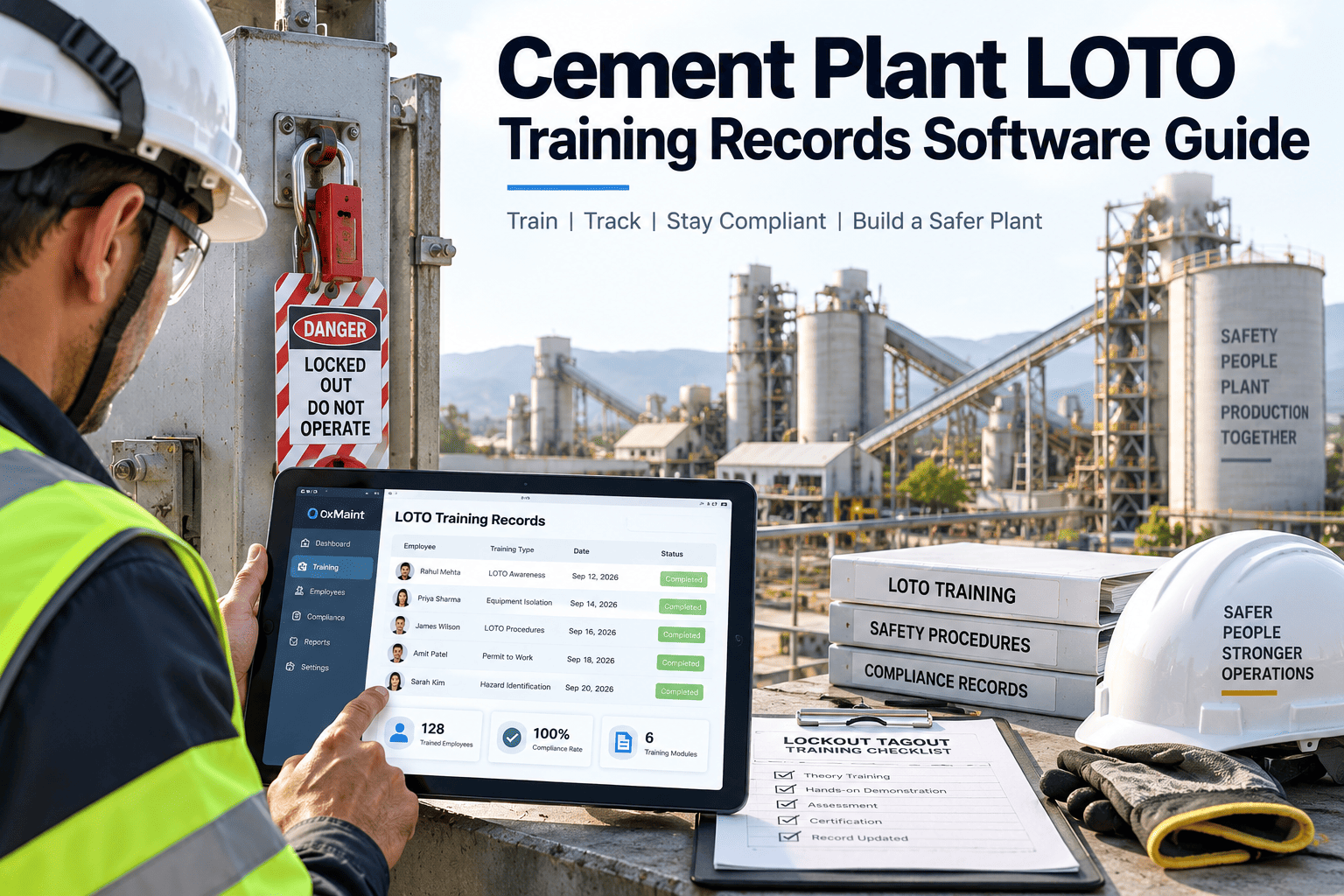
Cement plants run kilns, raw mills, clinker coolers, and high-voltage conveyor drives that can release stored energy the instant a lock slips or a signature goes missing. OSHA 29 CFR 1910.147(c)(7) does not just require lockout/tagout training — it requires a certified, dated, retrievable record proving every authorized, affected, and "other" employee actually received it. Most plants can produce the training folder. Far fewer can produce it in the fifteen minutes an inspector gives them before moving to the next finding. This guide breaks down exactly what a compliant cement plant LOTO training records system looks like, and how a CMMS turns three scattered employee categories into one audit-ready register you can pull up on a tablet on the plant floor.
If OSHA asked for proof today, could you name every trained employee on your kiln line?
1910.147(c)(7)(iv) requires a certification record with each employee's name, the training date, and the specific machinery it covers — for authorized, affected, and other employees separately. A CMMS-based LOTO training register replaces the binder hunt with a search bar.
Training happened is not the same claim as training is documented
Cement plants rarely skip LOTO training itself — toolbox talks and annual refreshers are routine. What fails audits is the paper trail behind it: missing dates, no machine-specific scope, and no way to prove a contractor's affected-employee briefing actually took place before the kiln was opened.
Three categories, one folder
Authorized, affected, and other-employee training gets filed together, so an inspector can't confirm the right depth of training reached the right person.
No retraining trigger
A new VFD bypass on a kiln drive or a near-miss on a raw mill legally requires retraining — most plants have no system flagging when that clock resets.
Contractor gaps
Outside crews brought in for a shutdown are "other employees" under the standard, but their briefing records rarely make it into the plant's permanent file.
Certification without signatures
(c)(7)(iv) requires a certification record with name and date — a sign-in sheet from a group toolbox talk usually does not meet that bar.
OSHA 1910.147(c)(7) trains three different populations to three different depths
Every cement plant training record system has to separate these categories cleanly, because the required training content — and the audit trail behind it — is not interchangeable.
| Category | Who they are on a cement plant | Required training depth |
|---|---|---|
| Authorized | Mechanics and electricians who apply locks on kiln drives, raw mills, crushers, and coolers | Hazardous energy recognition, energy type and magnitude, isolation methods per machine |
| Affected | Kiln operators and process technicians who run equipment authorized workers service | Purpose of the procedure, recognizing when it is in use, prohibition on restart attempts |
| Other | Contractors, lab staff, and visitors whose work may put them near an isolation point | Awareness of the procedure and instruction not to remove or bypass devices |
Stop defending your training records — start producing them
A CMMS-based register ties every certification to the employee, the equipment, and the date, so the next audit is a search, not a scramble.
The fields a CMMS should capture for every trained employee
1910.147(c)(7)(iv) sets the legal floor — name and training date. A defensible cement plant record goes further, tying training to the specific equipment and isolation points the employee is cleared to work on.
- 01Employee name, employee ID, and category — authorized, affected, or other
- 02Training date, trainer name, and method — classroom, hands-on, or refresher
- 03Equipment scope — kiln drive, raw mill, clinker cooler, conveyor, or plant-wide
- 04Assessment or sign-off confirming understanding, not just attendance
- 05Next required retraining date, calculated automatically from the last session
- 06Linked periodic inspection records for the procedures that employee is certified on
Four events that legally reset the training clock
OSHA does not set a fixed retraining interval for LOTO — it requires retraining whenever one of these conditions occurs, which is exactly why a manual system loses track of who is current.
Job assignment change
A technician moves from conveyor maintenance to kiln drive work and needs procedure-specific training for the new equipment.
Equipment or process change
A new VFD bypass, a rewired MCC, or a modified isolation point invalidates prior training on that machine's energy control procedure.
Procedure deviation observed
An annual periodic inspection or a near-miss reveals an authorized employee is not following the documented steps.
Knowledge gap identified
A supervisor spot-check or incident review shows an affected employee no longer recognizes when the procedure is active.
What changes when training records move off the binder
| Dimension | Paper / spreadsheet system | CMMS training register |
|---|---|---|
| Finding a trained employee | Search binders by hand across authorized, affected, other files | Filter by category and equipment in seconds |
| Retraining due dates | Tracked informally, often missed until an incident | Auto-flagged from job change, equipment change, or inspection data |
| Contractor records | Left with the contractor or lost after the shutdown | Logged against the work order and retained in the asset history |
| Audit response time | Days to assemble a complete file | One export covering names, dates, and equipment scope |
Cement plant LOTO training records — five common questions
What does OSHA 1910.147(c)(7)(iv) actually require in a training record?
A certification that identifies each employee by name and lists the date training was completed. Most inspectors also expect the record to show which equipment or procedure the training covered.
Do contractors on a kiln shutdown need their own training records?
Yes. Contractors working near isolation points are "other employees" under the standard, and their awareness briefing should be logged in the plant's own record, not left with the contracting company.
How often must authorized employees be retrained on LOTO?
There is no fixed interval — retraining is required when the job, equipment, or procedure changes, or when an inspection finds a deviation. A CMMS can flag these triggers automatically as they occur.
Can one training session cover multiple pieces of cement plant equipment?
Only if the energy sources and isolation steps are genuinely similar. Kiln drives, raw mills, and clinker coolers typically have distinct isolation points, so most plants train and certify by equipment class.
How fast can we digitize our existing training records?
Most plants import their current authorized, affected, and other-employee lists in a single afternoon. Book a Demo and we'll walk through the import with your existing files.
Turn three scattered employee lists into one certified record
Import your authorized, affected, and other-employee training history, set automatic retraining triggers, and export a complete file the moment an inspector asks.
Free trial · No credit card required