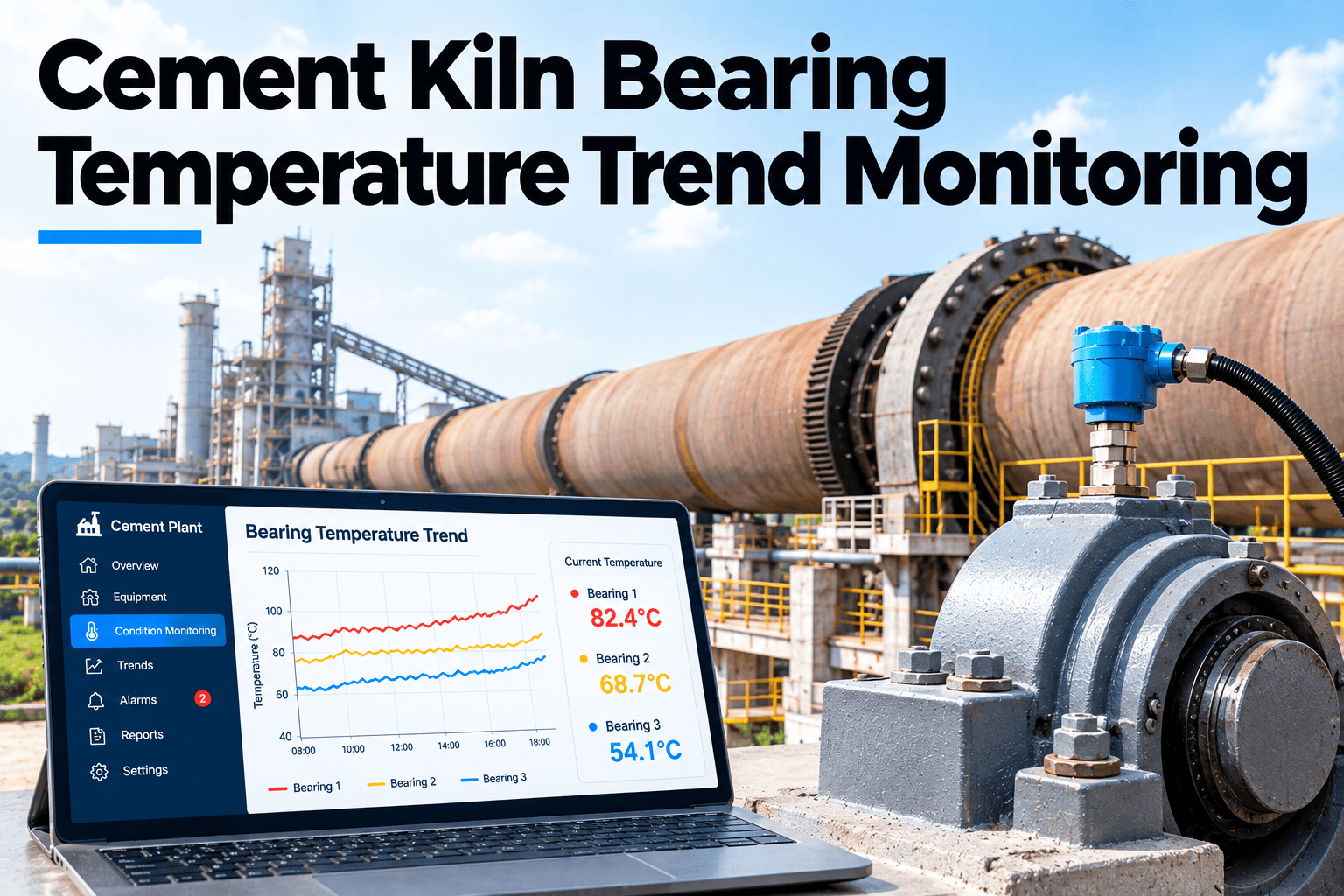
A kiln support roller bearing does not fail without warning. Days or weeks before it seizes, its vibration spectrum starts showing rising harmonic frequencies at the bearing's characteristic defect rates, and its running temperature begins drifting upward in a pattern a rounds sheet checkbox will never catch. The signal is almost always there. The question is whether anyone is collecting it, trending it, and turning it into a work order before the bearing turns into an emergency.
Catch a Failing Bearing Weeks Before It Seizes
Vibration analysis and temperature trending together give cement plants a four to six week window on trunnion, fan, and kiln support roller bearings — long before an audible failure or a tripped alarm. OxMaint turns that early signal into a scheduled repair instead of an emergency crane rental.
Why a Bearing Seizure Costs So Much More Than the Part
The bearing itself is rarely the expensive part. The cost comes from the shaft damage, the crane mobilization, the production stoppage, and the days spent waiting on a part that should have been ordered weeks earlier.
The Bearing Failure Progression, Stage by Stage
Bearing degradation follows a recognizable curve. Each stage has its own detection method, and the earlier a plant catches the signal, the cheaper and less disruptive the fix.
Sub-surface fatigue cracking begins. Only ultrasonic acoustic monitoring and high-frequency envelope vibration analysis detect this stage; temperature and audible sound remain normal.
BPFI, BPFO, BSF, and FTF defect frequencies become visible in FFT spectrum analysis, distinguishable from normal running harmonics by a trained analyst or trending software.
A sustained 3°C to 5°C rise over several days appears, driven by oil-film thinning and increasing friction. This drift is far more reliable than a single temperature spike.
Grinding or knocking sounds become detectable by ear, and inspection reveals spalling or discoloration. Failure is typically days to a few weeks away at this point.
The bearing locks, often damaging the shaft and surrounding components, forcing an unplanned production stop measured in days rather than hours.
Which Bearings Deserve Continuous Monitoring
Not every bearing in a cement plant justifies permanent sensor coverage, and trying to instrument all of them at once usually stalls a monitoring program before it starts. Criticality ranking makes the rollout practical.
Kiln support roller and trunnion bearings sit at the top of the list, since a single failure can halt the entire line for days and repair access requires major crane mobilization. ID fan and preheater fan bearings follow closely, as fan seizures both stop production and risk consequential damage to the shaft and housing. Mill trunnion and girth gear bearings round out the highest tier given the cost and lead time on replacement parts.
Lower-criticality rotating equipment, such as belt conveyor idlers, can often be covered adequately with periodic route-based readings rather than permanent sensors, freeing budget for continuous monitoring where a failure actually stops the plant.
Reading a Vibration Spectrum Without Being a Vibration Analyst
Maintenance teams do not need a certified analyst reviewing every reading to benefit from vibration trending. Modern monitoring software flags the four standard bearing defect frequencies automatically and presents them as a simple trend line.
BPFI marks inner race defects, BPFO marks outer race defects, BSF marks ball or roller spin defects, and FTF marks cage defects. A technician does not need to calculate these frequencies manually — the value of a connected monitoring system is that it does the calculation once during setup and then simply reports when amplitude at any of the four frequencies starts climbing above baseline.
Turn Bearing Drift Into a Scheduled Work Order
OxMaint connects vibration and temperature sensor data to threshold-based work order automation, so a bearing crossing into an alert zone triggers action the same shift, not after the night operator mentions something sounded different.
Bearing Temperature Threshold Framework
Trunnion and slide-shoe bearing temperature is one of the clearest early indicators available, provided it is tracked against a rolling baseline rather than a single fixed alarm point.
| Zone | Temperature Range | Recommended Action |
|---|---|---|
| Zone A — Healthy | 32°C – 45°C | Routine weekly trend review; no intervention required |
| Zone B — Watch | 45°C – 52°C | Daily trend check; verify oil cooler performance and load |
| Zone C — Alert | 52°C – 60°C | Auto-generate inspection work order; sample oil, check alignment |
| Zone D — Trip | Above 60°C | Immediate shutdown for inspection before continued operation |
A single high reading is often noise from ambient load or a brief process upset. A sustained multi-day rise within the same zone is the signature worth acting on.
Why One Detection Method Alone Is Not Enough
Vibration, temperature, and oil analysis each catch a different failure mode, and relying on only one leaves a gap a bearing can fail through.
Vibration Analysis
Detects mechanical fatigue and race or ball defects early through FFT spectrum analysis, but misses lubrication failures that have not yet produced a mechanical signature.
Temperature Trending
Catches lubrication breakdown and friction-driven heating reliably, but can miss sub-surface fatigue that has not yet generated measurable heat.
Oil Analysis
Confirms contamination and wear particle counts with high confidence, but typical lab turnaround of thirty to ninety days is too slow for rapid degradation.
Combining all three closes the gap that any single method leaves open, and is the reason plants running layered monitoring report meaningfully fewer unplanned bearing-related stops per year.
Building a Bearing Monitoring Program That Catches the Signal
The goal is not more data — it is making sure the data that already exists actually reaches a decision before the bearing progresses to the next failure stage.
- Establish a temperature and vibration baseline for every critical bearing during known-healthy operation.
- Set zone-based thresholds rather than a single fixed alarm point, so drift is caught before a spike.
- Route any Zone C or equivalent reading into an automatic inspection work order the same shift.
- Pair vibration trending with periodic oil sampling on the highest-criticality bearings.
- Review bearing history monthly to confirm no reading is being dismissed as noise repeatedly.
- Close the loop by logging the root cause found during every corrective repair against the asset.
How OxMaint Supports Bearing Condition Monitoring
OxMaint connects sensor data on rotating equipment to automated work orders, so the gap between a warning sign and a scheduled repair closes to the same shift instead of the next planned outage.
Condition-Based Work Order Automation
Threshold breaches on temperature or vibration trends automatically generate an inspection or corrective work order tied to the exact bearing asset.
Trend Dashboards
Rolling baselines and zone status for every monitored bearing are visible in one dashboard, so drift is caught before it becomes a spike.
Asset History and Root Cause Logging
Every inspection, oil sample, and repair is logged against the bearing's asset record, building a failure history reliability engineers can trend over time.
Mobile Inspection and Shift Handover
Technicians log readings and observations from the floor, so the night shift's finding is visible to the day shift without relying on a verbal handover.
Bearing Failure Prediction: Frequently Asked Questions
How much advance warning does vibration analysis typically give?
Is a single high temperature reading a reliable failure signal?
Why does vibration alone sometimes miss a bearing failure?
Can OxMaint trigger a work order automatically from sensor data?
How do we see this applied to our own kiln or mill bearings?
Replace the Emergency Bearing Failure With a Scheduled Repair
The signal is almost always there weeks before a bearing seizes. OxMaint makes sure it reaches a work order instead of getting lost between shifts.