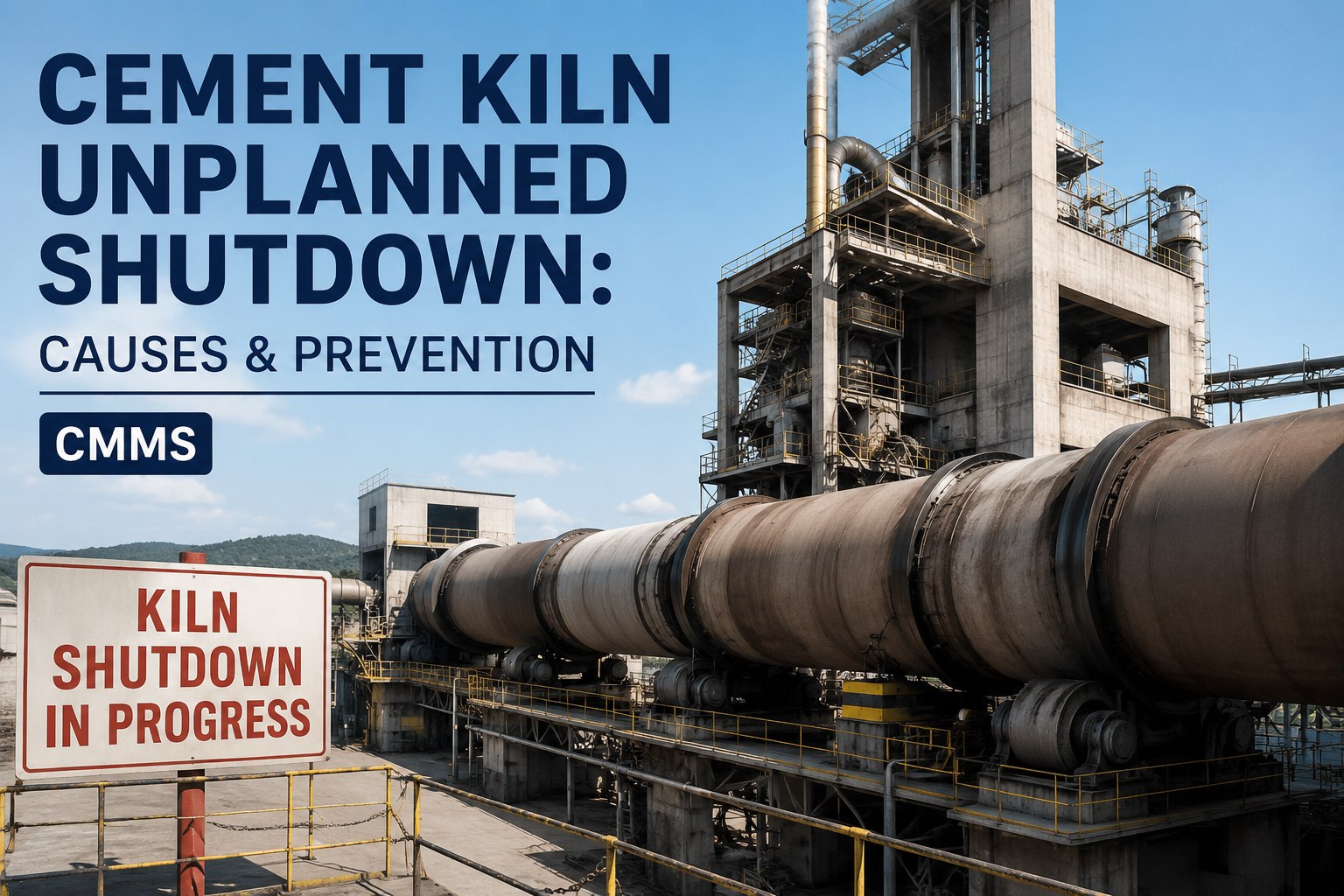
A cement kiln's induced draft fan runs 24 hours a day pulling 400,000 m³/hour of flue gas through the preheater tower — and when it fails without warning, the kiln goes cold in under 40 minutes, triggering a refractory cool-down cycle that takes 18–24 hours to reverse. The real tragedy: dust-induced blade imbalance, bearing race fatigue, and erosion-driven rotor asymmetry all generate detectable vibration signatures weeks before seizure. See how OxMaint connects ID fan vibration data to automated CMMS work orders — start free today. One cement operator tracked $20,000/hour downtime costs from a single unplanned ID fan outage — preventable with structured condition monitoring. When vibration amplitude in the horizontal plane exceeds ISO 10816 thresholds and no CMMS alert fires, the problem is not the fan — it is the maintenance system. A CMMS-linked vibration program closes that gap, and a 30-minute demo shows exactly how it works in a live cement plant environment.
Cement Plant ID Fan Failure: Vibration & Imbalance Prediction
Dust scale, blade erosion, and bearing wear leave vibration fingerprints weeks before catastrophic failure. This guide maps every failure signature to a CMMS-triggered intervention — so your kiln never stops for an avoidable fan breakdown.
Five Failure Modes That Destroy ID Fans — Each With a Detectable Vibration Signature
Every ID fan failure mode leaves a specific vibration fingerprint before it escalates to a breakdown. CMMS-linked condition monitoring catches these patterns 3–8 weeks ahead of failure — the window where a planned repair costs 6x less than an emergency one.
Cement kiln exhaust carries fine clinker dust and raw meal particles. These deposit unevenly on fan blades, progressively increasing rotor mass asymmetry. A detached scale chunk causes instantaneous severe imbalance — this transition is sudden and destructive.
Abrasive particulate in kiln flue gas erodes blade leading edges unevenly. Differential erosion between blades creates permanent mass imbalance that worsens with each operating hour. Unlike dust scale, erosion-induced imbalance cannot be corrected by cleaning — rotor replacement is required.
ID fans carry heavy overhung rotor loads in high-temperature, high-particulate environments — conditions that accelerate bearing race pitting and spalling. Bearing defect frequencies appear in high-frequency acceleration spectra (g-units) weeks before thermal runaway and seizure.
Thermal expansion during kiln start-up and cyclic load changes shift fan shaft alignment from its cold-set baseline. Misalignment accelerates bearing wear, increases seal leakage, and generates coupling fatigue — especially damaging on direct-drive configurations without flexible couplings.
Loose anchor bolts, foundation grout degradation, and structural fatigue shift the fan's natural frequency into its operating speed range. Resonance amplifies all other vibration sources, rapidly accelerating bearing and blade degradation. Missed in simple overall-vibration monitoring — requires frequency analysis.
Stop Treating ID Fan Failures as Inevitable
OxMaint connects real-time vibration readings from your ID fans to automated work orders — triggering maintenance at the right frequency, before the vibration signature crosses into the danger zone.
Vibration Severity Thresholds for Cement Plant ID Fans
ISO 10816-3 classifies large industrial fans and blowers as Group 1 or Group 2 machinery. CMMS alarm setpoints should be configured at Zone B/C boundary — early enough for a planned intervention window, before Zone D damage accumulates.
| Vibration Zone | Velocity (mm/s RMS) | Condition Status | CMMS Action | ID Fan Implication |
|---|---|---|---|---|
| Zone A | 0 – 2.3 mm/s | New/recently serviced | Scheduled monitoring — no action | Normal dust-free operation baseline |
| Zone B | 2.3 – 4.5 mm/s | Acceptable for long-term operation | Increase monitoring frequency | Early dust deposit accumulation — schedule blade inspection |
| Zone C | 4.5 – 7.1 mm/s | Unsatisfactory — investigate | Trigger condition-based work order | Significant imbalance or bearing degradation — plan outage |
| Zone D | > 7.1 mm/s | Damage likely — act now | Emergency work order — shutdown consideration | Secondary damage to bearings and coupling underway |
Research on kiln induced draft fans shows horizontal plane vibration as the most predictive axis — with pre-failure readings increasing more than 120% above Zone B baseline in the horizontal direction before bearing seizure occurs.
How OxMaint Turns ID Fan Vibration Data Into Automatic Maintenance Actions
A vibration sensor on an ID fan without a connected CMMS is just a number on a screen. OxMaint closes the loop — from sensor reading to work order to completed maintenance — without manual intervention at any step.
OxMaint accepts sensor data via OPC-UA, REST API, and IoT gateway feeds from online vibration monitors or manually logged portable instrument readings on mobile work orders. Both online and offline measurement workflows are supported.
Set Zone B/C/D thresholds individually for each ID fan asset based on its ISO class, operating speed, and baseline readings. OxMaint builds a 60–90-day baseline and calculates deviation thresholds as the dataset matures — no upfront manual calibration required.
When a vibration reading crosses the Zone C threshold, OxMaint automatically generates a condition-based work order with pre-populated checklist, required tools, and spare parts. No supervisor review required before dispatch — the alert and the action happen together.
Maintenance technicians receive the work order on mobile devices with full asset history, vibration trend chart, and step-by-step inspection checklist. Findings — blade condition, bearing temperature, lubricant status — are logged in real time against the fan asset record.
Every reading, intervention, and outcome is stored against the ID fan asset — building a failure pattern library that improves maintenance interval accuracy over time. MTBF trends, cost-per-event, and compliance rates are visible in the maintenance manager dashboard.
OxMaint tracks bearing operating hours, blade condition ratings, and lubrication intervals — forecasting replacement component needs before failure probability rises. Bearing sets and balance weights are in stock when the work order fires, not ordered in panic after a breakdown.
CMMS-Driven ID Fan Maintenance Intervals — The Complete Framework
A tiered maintenance cadence — combining time-based preventive tasks with condition-triggered inspections — is what separates cement plants that predict ID fan failures from those that react to them.
| Maintenance Task | Trigger | Work Order Type | Key Parameter to Measure | Skill Level |
|---|---|---|---|---|
| Vibration reading — all bearing positions | Daily or per-shift | Preventive — Auto-generated | Velocity mm/s (horizontal, vertical, axial) | Level 1 Technician |
| Bearing temperature check | Daily | Preventive — Auto-generated | Temperature degC vs. baseline delta | Level 1 Technician |
| Blade visual inspection and deposit assessment | Weekly or 168 operating hours | Preventive — Scheduled | Deposit thickness, erosion at leading edges | Level 2 Technician |
| Lubrication — all bearing points | Weekly or per OEM interval | Preventive — Scheduled | Grease type, quantity per bearing designation | Level 1–2 Technician |
| Fan blade cleaning and balance verification | Monthly or when vibration crosses Zone B | Condition-based — Threshold-triggered | Post-clean vibration vs. pre-clean baseline | Level 2–3 Technician |
| Shaft alignment check — motor to fan | Quarterly or after any thermal cycle | Preventive — Scheduled | Angular and parallel misalignment (mm) | Level 3 Technician |
| Full rotor dynamic balance (in-situ or workshop) | Annually or when Zone C threshold is sustained | Corrective / Preventive | Residual imbalance g·mm per ISO 1940 grade | OEM / Specialist |
| Anchor bolt and foundation grout inspection | Bi-annually | Preventive — Scheduled | Bolt torque, grout voids, structural cracks | Level 2–3 Technician |
We were cleaning ID fan blades on a fixed 30-day calendar — sometimes too early, sometimes dangerously late. After connecting vibration readings to OxMaint's condition monitoring, we now clean when the vibration trend tells us to. In the first year, we reduced unplanned ID fan stops from four to zero and cut our annual cleaning labor cost by 35%.
Cement ID Fan Vibration and CMMS — Common Questions
What vibration level should trigger an ID fan inspection in a cement plant?
How does dust scale imbalance differ from blade erosion imbalance?
Can OxMaint CMMS integrate with online vibration monitoring systems already installed on our fans?
How long before failure can vibration analysis detect ID fan bearing degradation?
What is the ROI of implementing CMMS-linked vibration monitoring on cement ID fans?
Your ID Fan Is Leaving a Vibration Trail to Failure Right Now — Is Your CMMS Watching?
OxMaint connects vibration sensor data to automated work orders, technician dispatch, and spare parts forecasting — so the 4-week warning window before an ID fan failure becomes a planned repair, not an emergency shutdown. Go live in under 60 minutes.