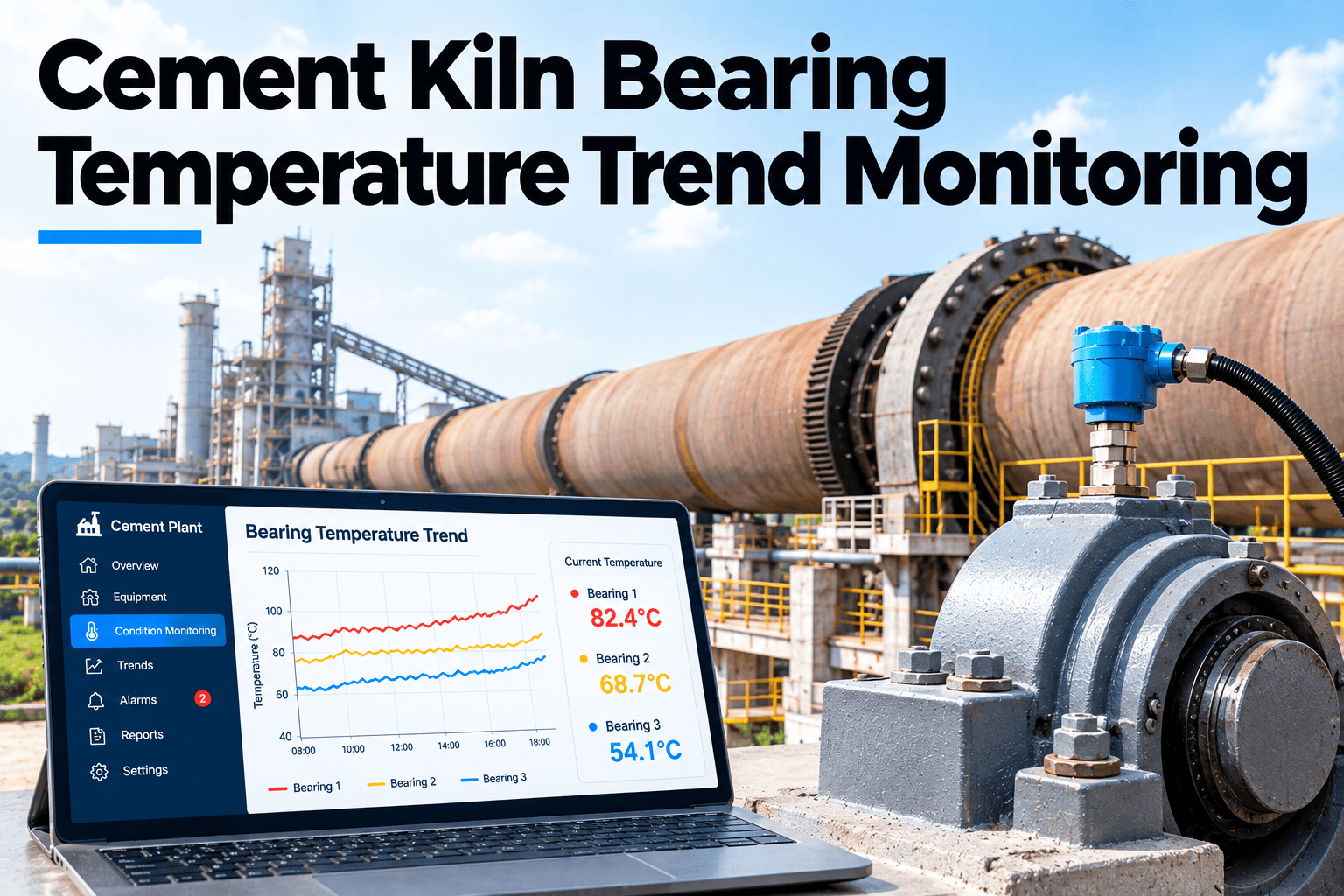
A kiln support roller bearing rarely fails at the moment it crosses an alarm limit. It usually starts drifting warmer than its own history days or weeks earlier, while the absolute reading still looks acceptable. Trend monitoring watches that drift against a baseline, the neighbouring roller and the operating load, so the crew hears about a problem while a repair can still be planned. Turning those trends into scheduled action is where Oxmaint work orders, inspections and asset history connect the reading to the repair.
Kiln and Reliability
Cement kiln bearing temperature trend monitoring: catch the drift before the bearing fails
Fixed alarm limits react late. Tracking how each support roller bearing moves against its baseline, its partner roller and kiln load gives maintenance teams time to plan the stop.
The Pain Point
Why a single alarm limit is the wrong tool for kiln bearings
Kiln support bearings carry an enormous rotating mass, and a failure can force a kiln stop, a costly repair and a long restart. A limit set high enough to avoid nuisance trips may only trigger once damage is well advanced.
Limit-only monitoring
- Alarm fires when the reading crosses one number
- Ambient, load and season shift the reading without any fault
- Operators learn to acknowledge alarms without investigating
- The repair becomes urgent because notice was short
Trend-based monitoring
- Reading compared with its own history at similar load
- Bearing compared with its partner roller on the same station
- Rate of rise flagged before any limit is reached
- Repair timed to a planned stop with parts ready
Where To Measure
Kiln support station bearing points and what to watch at each
Each support station has several bearings with different loads and failure tendencies. Build the trend rules around the position, not just the sensor tag.
| Bearing point | Role | What temperature drift can point to | Useful comparison |
|---|---|---|---|
| Support roller bearings | Carry the kiln weight through the tyres | Lubrication problems, uneven load sharing, misalignment | Partner roller on the same station |
| Thrust roller bearings | Limit axial kiln movement | Excess axial force, poor kiln position, skew | Own history at similar kiln position and load |
| Drive-side stations | Support load near the girth gear | Extra load from drive forces and shell condition | Non-drive stations under the same conditions |
| Stations near the burning zone | Support the hottest part of the shell | Heat soak, cooling shortfall, shell movement | Ambient and shell temperature trend |
| Lubrication and cooling circuits | Supply oil and cooling water to the bearings | Flow, filter and cooler faults that raise bearing temperature | Oil and water temperature in and out |
Follow the manufacturer
Alarm and trip values, measuring positions and lubrication requirements come from the kiln and bearing manufacturer. Trend rules add early warning on top of those limits and never replace them.
Reading The Drift
Temperature drift patterns and the causes they usually point to
The shape of the drift often says more than its size. Use the pattern to choose the first inspection instead of guessing.
| Pattern | What it looks like | Likely causes to check | First action |
|---|---|---|---|
| Slow, steady climb | Weeks of gradual rise at the same load | Bearing wear, ageing lubricant, fouled cooler | Oil sample and cooler inspection |
| One roller runs warmer than its partner | Gap between paired rollers widens | Uneven load sharing, roller skew, alignment change | Check roller alignment and contact pattern |
| Sudden step change | Jump that holds after the event | Loss of oil or cooling flow, sensor fault, kiln position change | Verify sensor, then flow and pressure |
| Rise that follows kiln events | Warm-up after stops, coating loss or feed changes | Thermal shell movement, changed load path | Compare with kiln operating history |
| Rising spikes | Peaks growing in height and frequency | Intermittent lubrication film breakdown, contamination | Inspect oil condition and filters |
| Seasonal pattern | Warmer in summer, cooler in winter | Ambient effect, cooling water temperature | Normalize for ambient before alerting |
Trend Logic
Five checks that turn raw temperatures into a useful alert
Good alerts combine several views of the same reading. Each check removes a common cause of false alarms.
Set a baseline per bearing
Record normal readings for each bearing across load ranges once the kiln is stable and the bearing is known to be healthy.
Normalize for context
Adjust for ambient temperature, kiln speed or feed, and cooling water temperature so seasonal effects do not raise alerts.
Compare partner bearings
A widening gap between paired rollers is often a clearer warning than either reading alone.
Watch the rate of change
A steady climb per day or per week signals developing trouble even when the absolute value looks safe.
Require persistence
Alert only when the deviation holds across several readings, which filters sensor noise and short process swings.
From Signal To Repair
Give every bearing drift an owner, an inspection and a planned repair window
Oxmaint links asset history, inspection tasks and work orders so a rising trend leads to action instead of another dashboard line.
Alert Response
A tiered response from first drift to planned repair
Match the response to how far the trend has moved. The timings below are examples that each plant should set with its reliability team and the manufacturer's guidance.
Watch and verify
Confirm the sensor, check load and ambient, and add the bearing to the next inspection round with a visual and touch check of the station.
Investigate the cause
Raise a corrective work order to inspect lubrication, cooling flow and roller contact, and increase reading frequency.
Prepare the repair
Reserve parts and specialist labour, agree the stop window with production and brief operators on trip conditions.
Escalate to management
Follow the manufacturer's limits, decide on load reduction or a controlled stop, and record the decision.
Data You Can Trust
Sensor and data checks that prevent false confidence
A drift that comes from a failing sensor wastes effort, while a real drift hidden by a bad sensor is worse. Keep the measurement chain under maintenance control.
Sensors
- Calibration schedule per sensor
- Cable and connection inspection
- Flag flat-lined or noisy channels
- Track sensor replacements on the asset
Context data
- Kiln speed and feed rate
- Ambient and cooling water temperature
- Oil pressure and flow
- Kiln stops and restarts
Maintenance records
- Oil changes and filter replacements
- Alignment and roller adjustments
- Past bearing repairs by station
- Inspection findings with photos
Root Causes
What actually makes a kiln support bearing run warmer
Temperature is a symptom. Knowing the usual mechanisms helps the crew read a trend and pick the right first inspection.
Lubrication film problems
Support roller bearings depend on a stable oil film. Degraded oil, contamination, blocked filters or low supply pressure thin the film, raise friction and push temperature up gradually.
- Oil that has aged or picked up dust and water from the kiln environment
- Filters and strainers that restrict flow between scheduled changes
- Pump or pressure faults that reduce oil delivery to the bearing
Cooling shortfalls
Many kiln bearings rely on cooling water to carry heat away from the bush and the oil. A fouled cooler, low flow or warm supply water reduces that margin, and the bearing settles at a higher temperature.
- Scale or debris in cooler passages that limits heat transfer
- Valves partly closed after earlier maintenance work
- Seasonal rise in cooling water supply temperature
Load sharing and alignment
The kiln shell is a long, flexible structure that moves with heat and wear. When roller position or kiln axis changes, one roller can carry more than its share and run warmer than its partner.
- Roller skew that shifts contact along the tyre
- Foundation settlement or roller adjustment history that is not documented
- Thermal bending of the shell during heat-up or after coating loss
Wear and mechanical damage
Late-stage wear of the bearing surface or contamination scoring causes rising and irregular temperatures. By then the repair scope is usually larger, which is why catching earlier drift matters.
Station Rounds
A support station inspection checklist that backs up the trend
Instruments show the trend, and a walk-down explains it. Pair each alert with a short, consistent round so findings are comparable between technicians.
Lubrication
- Oil level and visible condition
- Leaks at seals and covers
- Filter differential indication
- Oil sample taken on schedule
Cooling
- Water flow indication
- Inlet and outlet temperature
- Valve positions confirmed
- Cooler surfaces free of scale or debris
Mechanical
- Roller and tyre contact pattern
- Unusual noise or vibration by touch and ear
- Guard and cover condition
- Thrust roller movement and marks
Record what you see
Findings should be entered against the exact bearing, with photos and the reading at the time. Over months this builds the history that separates a repeating pattern from a one-off event.
Avoid These Mistakes
Common errors in kiln bearing temperature monitoring programs
Most programs disappoint for a few predictable reasons. Fixing them is usually cheaper than adding more sensors.
Frequent errors
- Relying on one alarm limit for every bearing
- Trusting sensors without a verification routine
- Ignoring ambient and cooling water effects
- Letting alerts sit without an assigned owner
- Not recording the outcome of each investigation
Better habits
- Baseline and partner comparison for each bearing
- Scheduled sensor checks tracked as tasks
- Normalization for seasonal and load effects
- Every alert converted to a task with a due date
- Closeout notes that refine future alert rules
Start small and prove it
Begin with the stations that have the worst history or the longest repair lead time. Prove that trend alerts give useful notice, then extend the same rules to the rest of the kiln.
Operational Impact
What a missed bearing warning costs a cement plant
The kiln is the heart of clinker production, so a bearing problem rarely stays a maintenance matter. It quickly becomes a production, cost and safety question.
- Clinker output stops or drops while the kiln is held at reduced speed or shut down
- Repair scope grows when damage is discovered late, including roller, tyre or foundation work
- Thermal cycling from an unplanned stop and restart stresses refractory and shell
- Emergency labour, cranes and specialist contractors cost more than a planned job
- Downstream mills, silos and dispatch schedules absorb the disruption
Why timing matters more than precision
A warning that arrives with enough lead time lets the plant order parts, align the repair with a planned stop and brief the crew. Even an imperfect early warning is more valuable than an accurate alarm that arrives minutes before a trip.
- Use the lead time to pre-position spares and confirm contractor availability
- Agree in advance who can authorise a speed reduction or controlled stop
- Document each decision so the next investigation starts with facts
Rollout Plan
A practical sequence for starting trend monitoring on your kiln
Work through these steps in order. Each one produces something the next depends on.
List every bearing and sensor
Register support, thrust and drive-side bearings with their sensors, lubrication circuits and cooling lines as assets.
Collect a clean baseline
Use stable operating periods to capture normal ranges for each bearing at different loads and seasons.
Define alert tiers and owners
Agree what each tier means, who responds and what task it creates, then write it into the maintenance plan.
Review results every quarter
Check alert precision, missed events and repeat causes, then adjust thresholds and inspection frequency.
Maintenance Workflow
How Oxmaint supports bearing temperature monitoring
Oxmaint does not replace kiln monitoring instruments. It gives the maintenance side a structured place to act on what those instruments show.
- Preventive schedules for lubrication, filters, coolers and alignment checks
- Inventory visibility for bearing shells, seals and critical spares
- Dashboards showing open bearing tasks, repeat issues and overdue inspections
- Compliance records that show what was checked, by whom and when
Measure Progress
Reliability measures for kiln bearing programs
Choose a few measures and review them by station. They show whether monitoring is changing outcomes.
FAQ
Kiln bearing temperature monitoring: common questions
What is bearing temperature trend monitoring?
It tracks how bearing temperatures change over time against a baseline, a partner bearing and operating load to find faults early.
Why does temperature rise before a bearing fails?
Wear, poor lubrication, cooling faults or misalignment increase friction, which shows up as heat before visible damage appears.
Do trend rules replace manufacturer alarm limits?
No. Manufacturer limits stay in force, and trend rules add earlier warning. Book a demo to map alerts to work orders.
How can we reduce false alarms from ambient changes?
Normalize readings for ambient and cooling water temperature and require the deviation to persist before alerting.
Where does a CMMS help?
It turns each alert into an inspection or work order with history and closeout. Get started with Oxmaint on your kiln assets.
Plan The Stop, Not The Emergency
Turn kiln bearing temperature drift into a planned, documented repair
Connect station inspections, condition alerts and work orders in one maintenance workflow for your kiln line.