Cement Plant Conveyor Belt Maintenance and Failure Prevention
By Samuel Jones on March 6, 2026
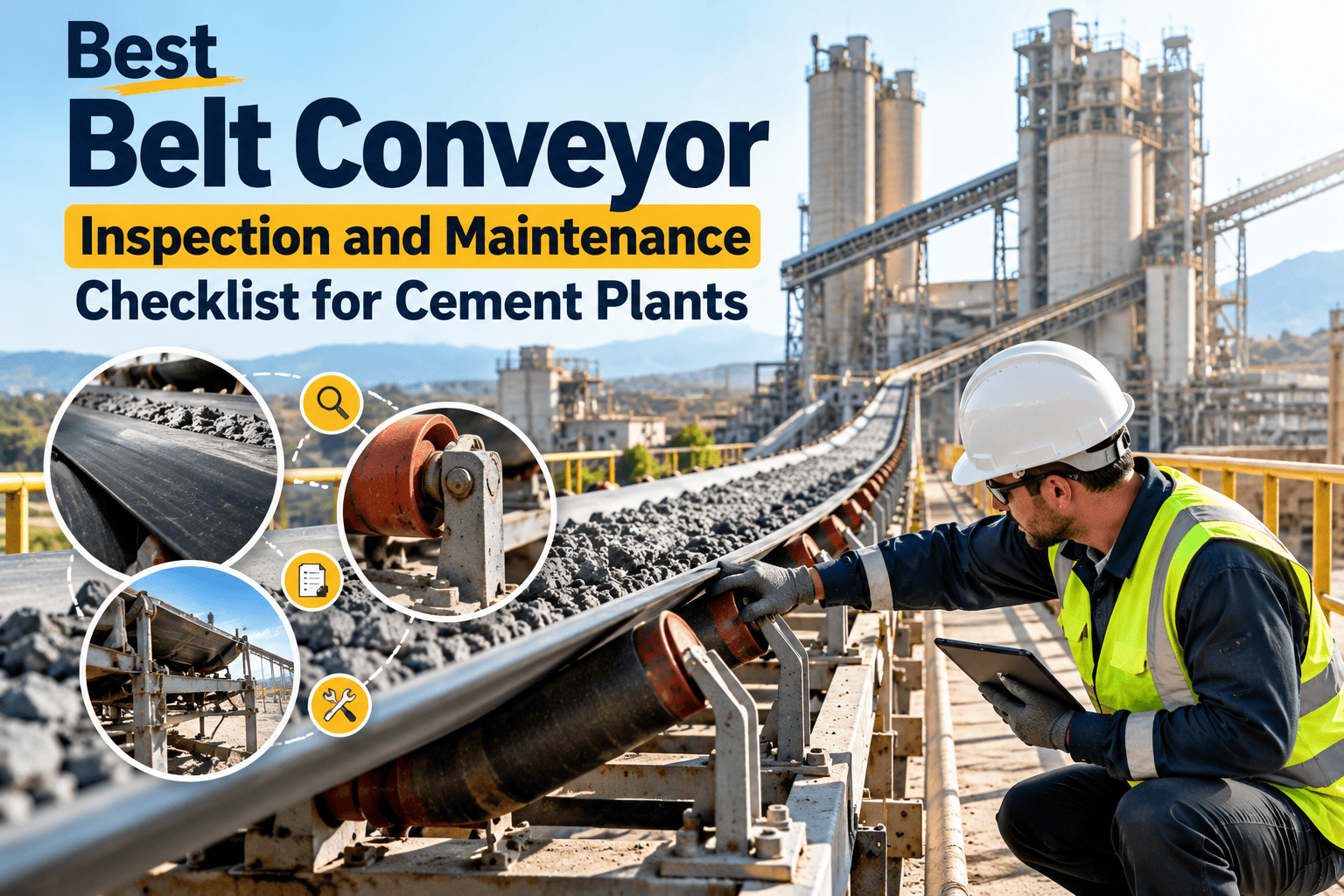
A cement plant's conveyor network is its circulatory system — when a belt stops, everything upstream backs up and everything downstream starves. Across the global cement industry, conveyor systems account for between 50 and 80 individual belt lines per integrated plant, running 20+ hours daily through conditions that destroy ordinary equipment: limestone dust that infiltrates every bearing, clinker temperatures above 200°C that degrade rubber compounds, and impact forces at crusher discharge points that punch through belt covers in months. The global conveyor belt market reached $5.7 billion in 2024 and is projected to hit $8.2 billion by 2034, driven largely by demand from cement, mining, and steel sectors — yet the real cost story is not belt procurement but belt failure. Operations running at full capacity can lose $50,000 to $100,000 per day when a primary conveyor goes offline, and roughly half of all operators report productivity losses tied to unexpected belt damage. Smart conveyor installations using IoT-embedded sensors now reduce unplanned downtime by 35% through predictive maintenance, but the majority of cement plants still rely on reactive repair and fixed-interval schedules that miss developing failures until it is too late. Sign up for Oxmaint to shift your entire conveyor maintenance strategy from reactive firefighting to condition-based prevention with digital checklists, automated alerts, and real-time work order tracking.
Operations Playbook
Cement Plant Conveyor Belt Maintenance & Failure Prevention
A Practical Field Guide for Maintenance Engineers, Reliability Teams & Plant Managers
50–80
Belt conveyors per integrated cement plant
$100K
Daily production loss from a single primary belt failure
35%
Downtime reduction with IoT smart belt monitoring
$8.2B
Projected global conveyor belt market by 2034
Conveyor Landscape in Cement Manufacturing
Before you can prevent failures, you need a complete picture of every conveyor in your plant — where it sits in the production chain, what material it carries, what environment it operates in, and what happens downstream when it stops. Most cement plants lack a single document that maps all conveyors by criticality. Building this map is the foundation of every prevention strategy that follows. Book a demo to see how Oxmaint's asset hierarchy maps every conveyor into a criticality-ranked digital twin of your plant.
Cement Production Conveyor Pipeline
Quarry & Crusher
Heavy-duty multi-ply rubber belts
IMPACT DAMAGEABRASION
Raw Mill Feed
Abrasion-resistant textile belts
DUST INGRESSCOVER WEAR
Kiln Feed System
Heat-tolerant EP composite belts
THERMAL STRESSDUST
Clinker Transport
Heat-resistant EPDM / steel cord (T3–T4)
200°C+SPLICE FAILURE
Cement Mill & Dispatch
Standard EP multi-ply belts
FINE DUSTBEARING WEAR
Critical Failure Modes & Root Cause Analysis
Every conveyor breakdown in a cement plant tells the same story: a detectable condition was developing for days or weeks before the belt stopped. The five dominant failure modes below account for nearly all unplanned conveyor outages — and every one of them produces measurable warning signs that structured inspection programs catch reliably. The difference between a $15,000 planned repair and a $150,000 emergency shutdown is the discipline of looking before things break.
F1
Belt Mistracking
Triggers
Uneven loading, idler misalignment, material buildup on pulleys, belt camber, structural deflection from foundation settlement
Early Signals
Belt drifting to one side, asymmetric edge wear, spillage from one side only, scraping noise against frame structure
Consequence if Missed
Complete belt edge destruction, belt running off pulleys, structural damage to conveyor frame and walkways
Frequency: Very High | Cascade Risk: High
F2
Splice Joint Failure
Triggers
Adhesion degradation from age and thermal cycling, improper vulcanization parameters during original installation, repeated tension overloads
Early Signals
Edge lifting on vulcanized splice, visible elongation at joint, mechanical fasteners pulling through belt fabric, rhythmic vibration pulse at splice frequency
Consequence if Missed
Complete belt separation mid-operation, catastrophic production halt, potential safety hazard from whipping belt ends
Frequency: Medium | Cascade Risk: Critical — ~90% of in-service belt failures start at splices
Grinding or squealing from specific roller positions, roller not spinning when touched, localized heat detectable by thermal camera, flat spots worn into belt surface
Consequence if Missed
A single frozen roller burns through 10mm of belt cover in under 8 hours of operation, creating a replacement-grade belt damage event
Frequency: High | Cascade Risk: Medium-High
F4
Drive Motor & Gearbox Failure
Triggers
Winding insulation breakdown from dust-blocked ventilation, shaft misalignment after foundation movement, gearbox oil contamination from dust and moisture
Early Signals
Rising motor current draw versus baseline, elevated casing temperature, abnormal vibration spectrum at bearing frequencies, gearbox oil analysis showing wear metals
Consequence if Missed
Total conveyor halt with 2–6 week lead time for motor replacement — one of the longest mean-time-to-repair components in the plant
Abrasive material impact at loading points, inadequate cover grade for the material handled, failed belt cleaners allowing carryback abrasion, chemical attack from alkali compounds
Early Signals
Visible cuts, gouges, or pitting on carry-side surface, exposed carcass fabric or steel cords, thickness measurements below minimum specification, grid-pattern surface cracking
Consequence if Missed
Carcass exposure leads to moisture absorption, ply separation, and accelerating structural failure — belt replacement required
Frequency: Very High | Cascade Risk: Medium (gradual if monitored)
Every Failure Mode Above Is Preventable
Oxmaint converts each of these failure signatures into automated inspection triggers — mobile checklists assigned to your maintenance team, threshold-based alerts that generate work orders, and trend dashboards that predict remaining belt life weeks in advance.
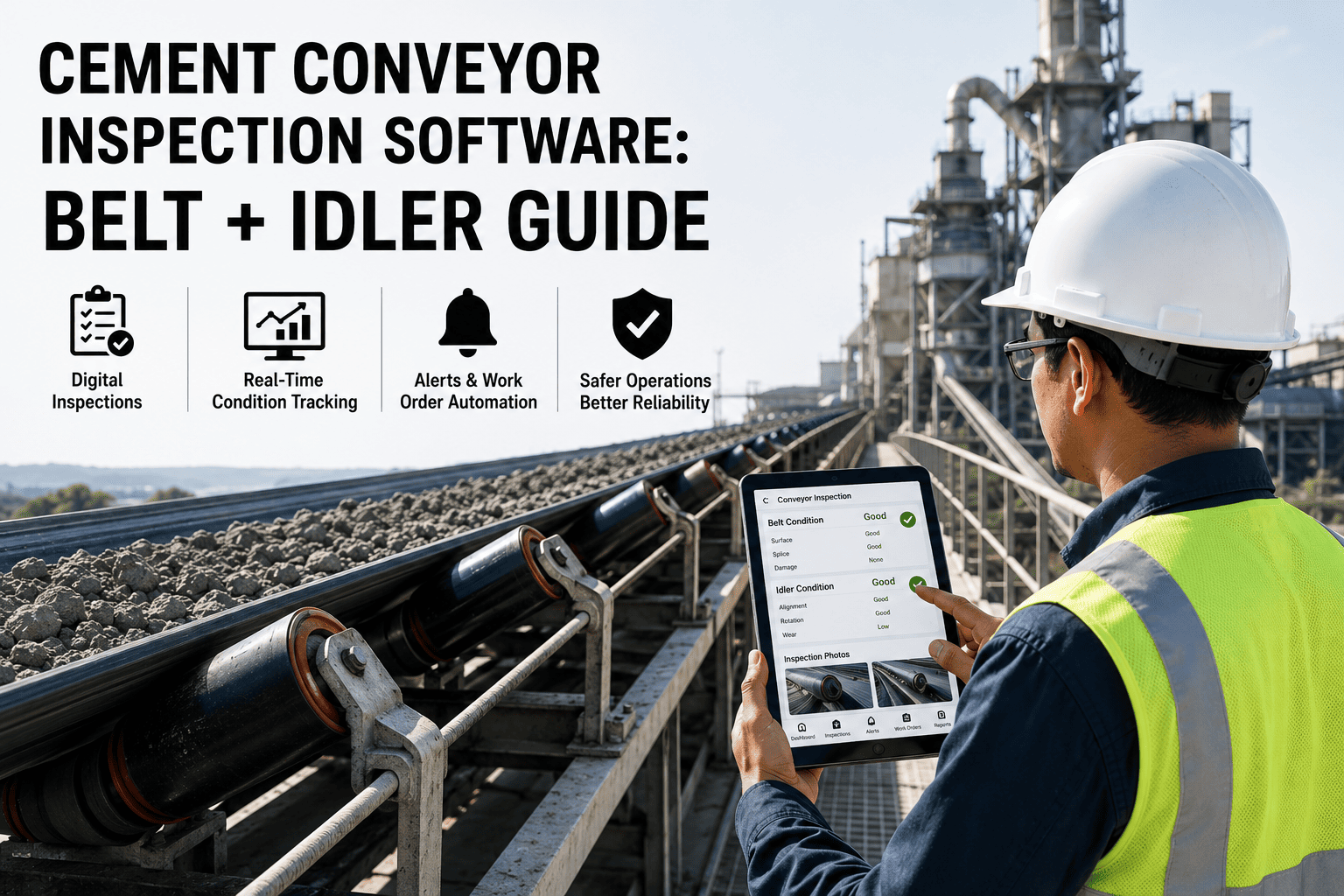
The most expensive conveyor belt in the world will fail prematurely without structured inspection. The most cost-effective conveyor belt will outperform expectations when supported by consistent monitoring. A three-tier inspection regime — daily shift checks, weekly measurement rounds, and quarterly deep diagnostics — creates the safety net that catches every developing failure while it is still a low-cost repair. Sign up for Oxmaint to deploy these three tiers as digital inspection templates with automatic scheduling, photo capture, and real-time completion tracking.
Every Shift
Walk-Around Patrol
10–15 min per conveyor
Observe belt tracking across all pulleys — belt must run centered within 25mm of midline
Listen for grinding, squealing, or rattling from rollers, bearings, and drive components
Check all loading and discharge points for material spillage or buildup on structure
Confirm belt sag between idlers is within 2–3% of spacing distance
Test emergency stop pull-cords and verify all safety guards are in place
Visually scan belt surface for fresh cuts, tears, or edge fraying
Weekly
Measurement Round
30–45 min per conveyor
Measure belt cover thickness at 5 cross-width points at 3 lengthwise stations
Inspect every splice joint — visual and tactile check for lifting, elongation, fastener pull-through
Structural frame and support integrity inspection including walkway condition
Tension system assessment — gravity/hydraulic take-up travel position and condition
Update remaining useful life forecast for belt, splices, and all major components
Predictive Maintenance Technologies for Conveyors
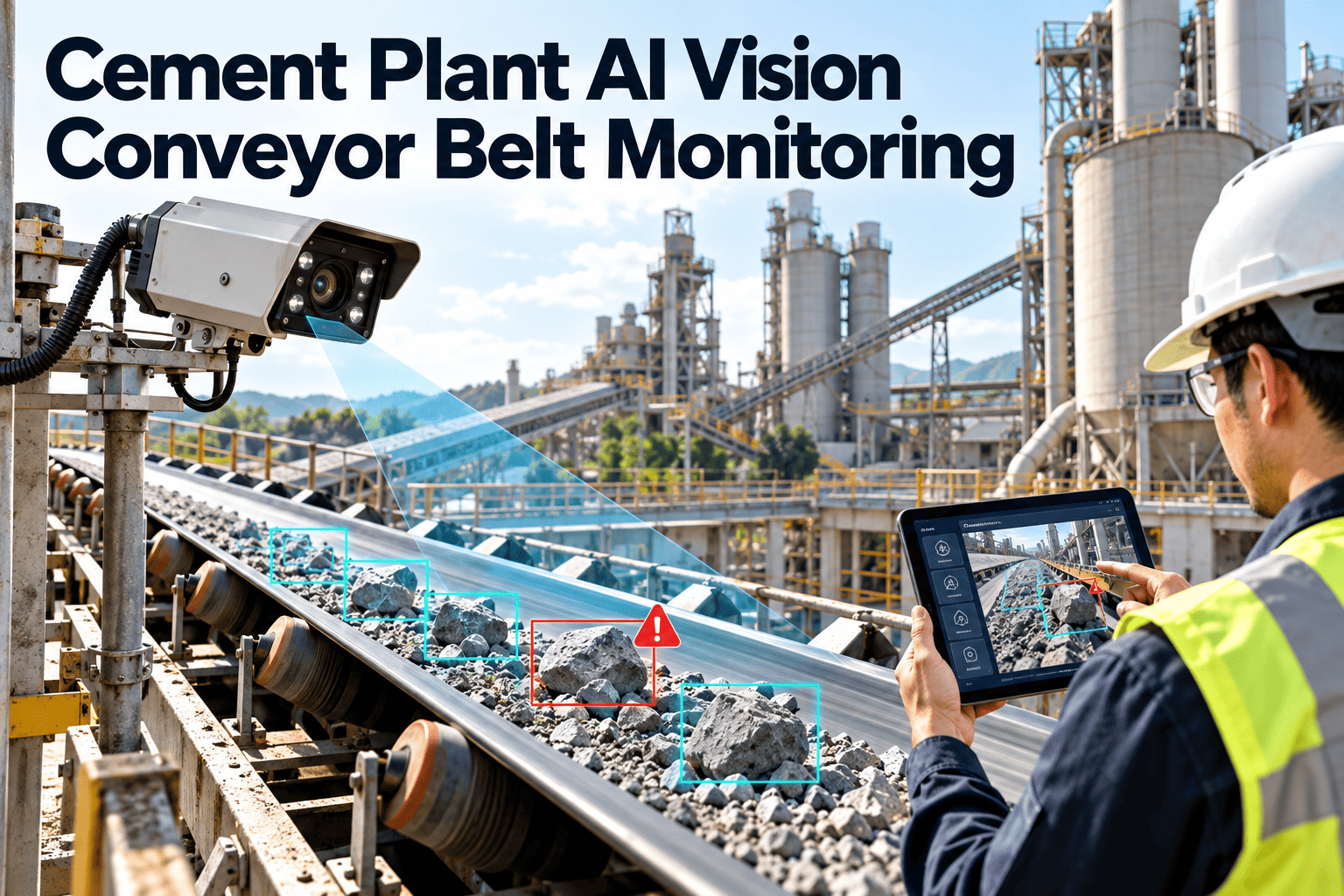
Over 1,200 smart belt installations with embedded sensors are now operational globally, and the results are consistent: 23% reduction in unplanned downtime and 15% extension of operational belt life. AI-integrated monitoring has achieved a 27% reduction in unexpected belt downtimes across large-scale mining operations — and cement plants, with their more predictable operating conditions, can expect equal or better outcomes. The technology stack for conveyor predictive maintenance has matured to the point where the question is no longer whether it works, but which sensors deliver the highest ROI for your specific conveyor fleet. Book a demo to see how Oxmaint integrates sensor data streams with automated CMMS work orders.
Belt surface condition, real-time tracking position, splice integrity via camera
Surface damage, mistracking events, material spillage, splice deformation
Lead time: Real-time to days in advance
Component-Level Prevention Strategies
Generic maintenance intervals designed for light-duty applications will not protect conveyors operating in cement plant conditions. Each major component requires prevention strategies calibrated to the specific threats it faces — heat, abrasion, dust, and continuous loading. The following playbook delivers the highest failure-prevention ROI based on documented cement plant failure patterns.
Belt Surface & Cover
Install impact cradles at every loading point to absorb material drop energy and prevent belt gouging
Specify cover grade matched to material: Grade N (general), Grade D (abrasive limestone), Grade T (clinker zones)
Deploy primary scrapers at head pulley and secondary scrapers on return side to eliminate carryback
Plot quarterly thickness measurements on wear-rate curves to predict replacement 3–6 months ahead
Rollers & Bearings
Specify sealed-for-life bearings with labyrinth seals in all dust zones — standard contact seals fail within 6 months
Implement thermal spot-checks on high-criticality idler sets to catch seizure before belt damage
Replace any seized roller immediately — one frozen roller burns through 10mm of cover in 8 hours
Use CEMA C6+ rated rollers on clinker and raw limestone conveyors for extended heavy-duty service life
Splice Joints
Mandate vulcanized splices on all conveyors over 100m or in high-temperature zones — mechanical splices are temporary only
Log splice installation date, type, and exact location — track age against manufacturer replacement intervals
Measure elongation monthly on critical belts — exceeding 1.5% of original splice length signals imminent failure
Align all splice replacements with planned kiln shutdowns to avoid dedicated conveyor outages
Motors & Gearboxes
Install vibration monitoring on every drive motor above 75 kW — replacement lead times run 2–6 weeks
Schedule gearbox oil sampling every 500 operating hours — track iron, copper, and silicon contamination
Keep motor ventilation clear of dust buildup — blocked cooling is the leading cause of winding failure
Re-verify alignment of motor-gearbox-pulley couplings after any foundation work or component swap
Cost-of-Failure Analysis & ROI of Prevention
The most powerful argument for preventive investment is not theoretical — it is the documented cost gap between planned and unplanned conveyor repairs. When maintenance teams present only parts and labor costs, leadership sees a small number. When they present the full picture — lost production, idle equipment chains, overtime premiums, rush freight, and quality impacts — the ROI of prevention becomes self-evident. Sign up for Oxmaint to auto-calculate true failure costs from your own downtime and work order data.
Reactive Failure Cost Stack
Replacement Parts$8K–$25K
Emergency Labor (OT rates)2–3x standard
Rush-Order Premium+30–60%
Lost Production Output$50K–$100K/day
Collateral Equipment DamageVariable
Per-Event Total: $75K–$200K+
VS
Planned Intervention Cost
Parts (standard order)$5K–$15K
Scheduled LaborStandard rate
Downtime WindowAligned to kiln stop
Per-Event Total: $5K–$15K
10–15x
Cost multiplier of reactive vs. planned repair per conveyor event
60%
Reduction in belt-related downtime with structured monitoring programs
45%
Drop in annual conveyor maintenance spend after condition-based strategies
Build Your Business Case with Real Numbers
Oxmaint logs every conveyor downtime event, calculates actual failure costs from your data, and generates executive-ready reports that make the ROI of preventive maintenance impossible to ignore.
What is the typical lifespan of a conveyor belt in a cement plant?
Lifespan varies dramatically by conveyor zone. Overland limestone conveyors on steel-cord belts can operate for 7–12 years. Clinker handling belts exposed to sustained high temperatures typically require replacement every 3–5 years. Crusher discharge belts — the most punishing position — may last only 18–36 months. The dominant factor across all zones is not belt quality alone but inspection consistency: plants that catch mistracking events early and maintain splice integrity routinely extend belt life 30–50% beyond the performance of plants using reactive maintenance.
How frequently should cement plant conveyor inspections be conducted?
A three-tier approach is the industry standard for high-performing cement plants. Daily shift-level walk-arounds (10–15 minutes per conveyor) check tracking, noise, spillage, and belt surface condition. Weekly structured inspections measure belt thickness, splice condition, roller function, and motor current. Quarterly deep diagnostics deploy vibration analysis, thermography, and oil sampling on drive systems. Critical conveyors — kiln feed, primary crusher discharge, and clinker transport — should receive daily attention as a minimum.
What are the most common causes of conveyor belt failure in cement manufacturing?
Five failure modes dominate: belt mistracking from uneven loading or idler misalignment, splice joint deterioration from thermal cycling and age, roller seizure from dust-contaminated bearings, motor and drive degradation from overheating and contamination, and belt surface wear from abrasive impact at loading points. All five produce detectable warning signals days or weeks before catastrophic failure, making them preventable with structured inspection programs and immediate corrective response to detected anomalies.
How does CMMS software improve conveyor belt maintenance in cement plants?
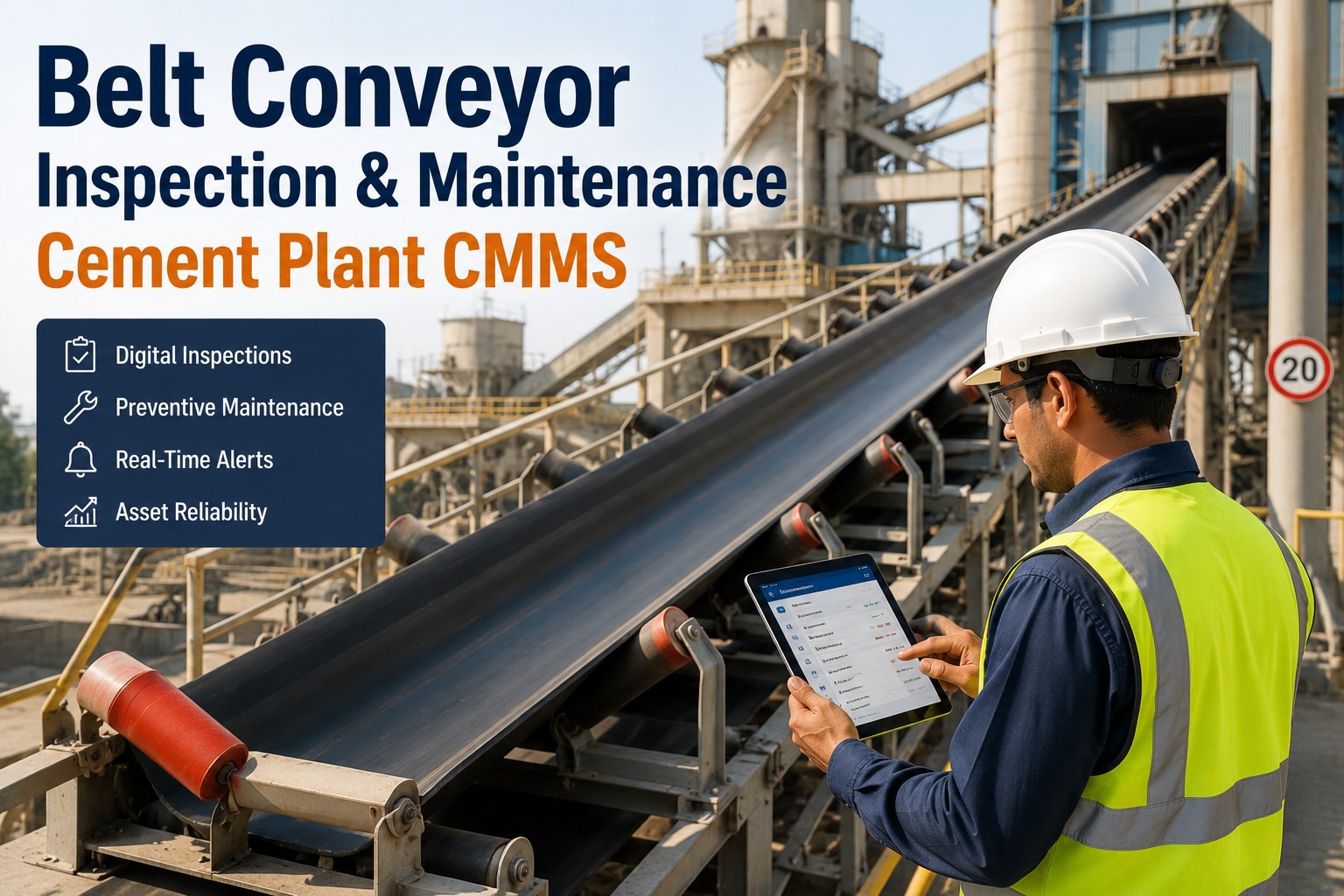
A CMMS like Oxmaint provides the operational backbone for prevention-first conveyor maintenance. It digitalizes inspection checklists so every check runs on schedule with photo documentation and timestamps. It sets automatic threshold alerts — when measured belt thickness, vibration amplitude, or motor temperature crosses a defined limit, a work order is generated and assigned automatically. It aligns preventive tasks with production shutdown windows. And it builds trend data that enables accurate remaining-life forecasting for every conveyor component, turning guesswork into data-driven decisions.
Which belt type is recommended for clinker conveyors in cement plants?
Clinker conveyors require heat-resistant belts rated T2 (150°C) minimum and preferably T3 (200°C) class per ISO 4195. EPDM rubber covers significantly outperform standard SBR compounds under sustained thermal exposure. For long-span clinker transport, steel-cord construction delivers the necessary tensile strength while maintaining dimensional stability at high temperatures. The bonding adhesive between the cover and carcass must also be heat-rated — standard adhesives delaminate under continuous thermal cycling, leading to cover separation and premature belt failure.
Can predictive monitoring sensors survive the harsh conditions inside a cement plant?
Industrial-grade sensors designed for heavy industry are rated IP67 or IP68, providing complete protection against cement dust and temporary water exposure. Vibration sensors, temperature probes, and current transducers all perform reliably in cement plant environments when installed with appropriate protective housings and mounting configurations. Globally, over 1,200 smart belt installations are now operational in comparable heavy-industry conditions. Plants deploying these systems report 23–35% reductions in unplanned downtime — results that are consistent across mining, cement, and steel applications.
What is the expected ROI timeline for a conveyor predictive maintenance investment?
Most cement plants achieve measurable ROI within 3–6 months. The math is straightforward: if a primary conveyor failure costs $50,000–$100,000 per day in lost production, a single prevented 24-hour outage covers the first-year investment in monitoring sensors and CMMS software. Over the longer term, plants implementing structured condition-based programs report 45% reductions in total conveyor maintenance spend and 60% decreases in belt-related downtime as predictive data optimizes replacement timing and eliminates emergency interventions.