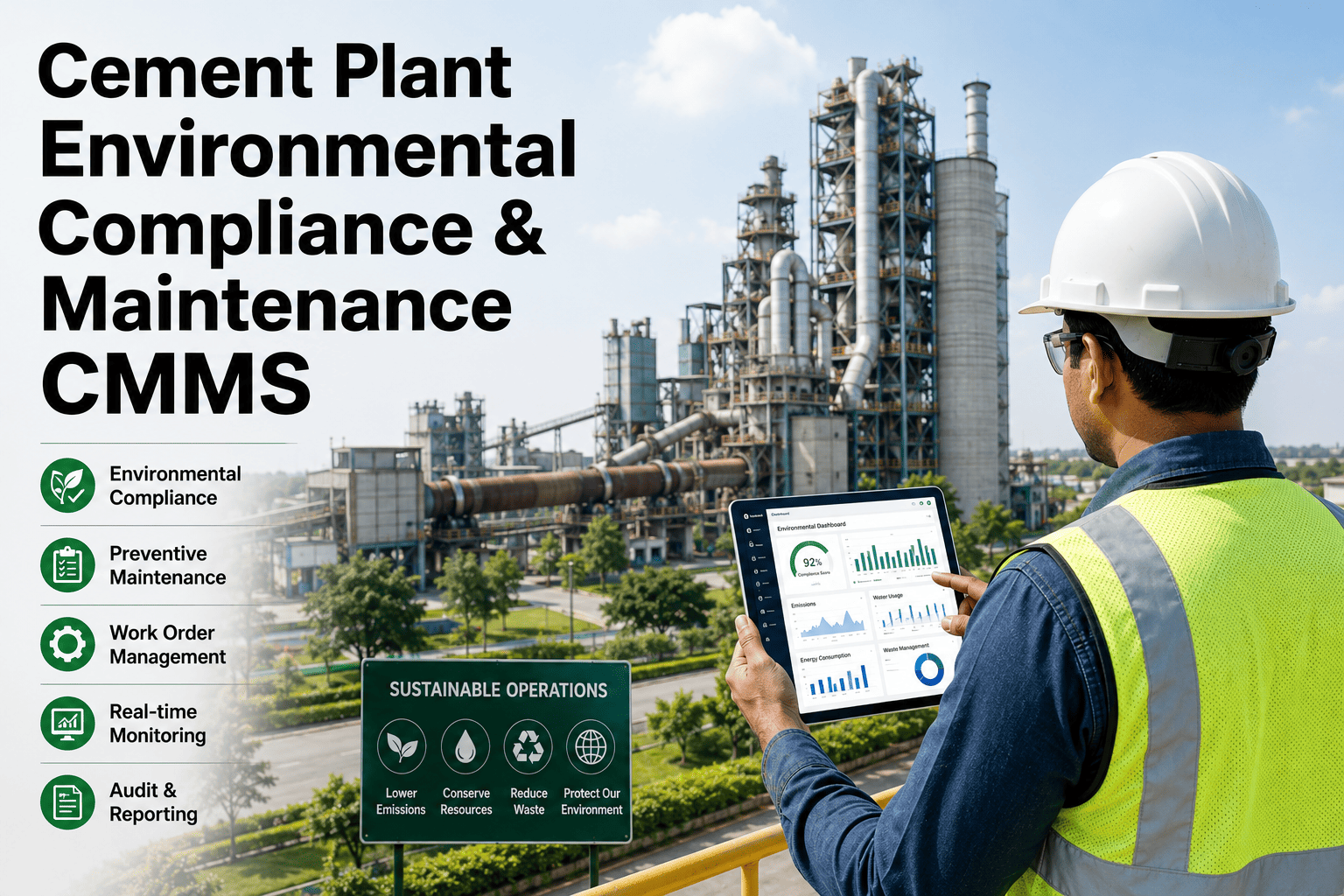
Every equipment failure in a cement plant carries two costs: the repair bill and the safety risk. A kiln bearing that fails without warning does not just stop production — it can injure workers, trigger permit violations, and generate regulatory notices that take months to close. The problem is that most cement plants still manage safety and maintenance as parallel, disconnected functions. EHS reports go into one system, work orders go into another, and nobody sees the connection between an incident and its maintenance root cause until it happens again. EHS-CMMS integration closes this loop permanently. When a safety incident generates a corrective maintenance work order automatically — and when that work order stays linked to the incident until closure — the same failure cannot repeat undetected. This article covers how EHS-CMMS integration works in cement plants, what it prevents, and how OxMaint creates the closed loop that keeps safety and maintenance synchronized. Start your free OxMaint trial or book a live demo to see the EHS-CMMS workflow in your plant's context.
EHS Integration · Cement Industry · CMMS Compliance
EHS and Maintenance CMMS Integration for Cement Plants
Safety incidents and maintenance failures share the same root cause. OxMaint connects them in one closed loop — so the same failure never goes unresolved twice.
79%
of cement plant fatalities trace to 3 preventable equipment-related causes
3–5x
increase in safety reporting volume within 60 days of closed-loop CMMS integration
100%
audit-ready documentation generated automatically on every work order closure
The Core Gap
Why Separate EHS and Maintenance Systems Fail Cement Plants
Cement plants operating with disconnected safety and maintenance systems share a common failure pattern: the incident is recorded, the investigation is conducted, and the corrective action recommendation sits in an EHS report that maintenance never reads. The equipment stays in its degraded state. The next incident follows.
Safety Incident Occurs
↓
EHS Team Logs Report (Separate System)
↓
Investigation Completed
↓
Corrective Action Recommended in Report
↓
Maintenance Never Sees It
↓
Same Incident Repeats
Safety Incident or Near-Miss Logged
↓
CMMS Auto-Generates Corrective Work Order
↓
Work Order Linked to Incident Record
↓
Technician Dispatched with Full Context
↓
Closure Requires Photo Evidence + Sign-off
↓
Incident Closed. Audit Trail Complete.
Cement Plant Hazard Zones
Where Safety Meets Maintenance: High-Risk Zones in Cement Operations
Each area of a cement plant carries distinct hazards directly linked to maintenance status. The zones below account for the majority of incidents — and each has a clear maintenance root cause that EHS-CMMS integration can prevent.
Quarry & Crusher
15–20% of cement fatalities
Primary Hazards
Mobile equipment proximity incidents
Crusher nip point guarding failures
Conveyor entanglement from worn guarding
Maintenance Root: Guard inspection overdue, conveyor PM missed
Raw Mill & Silos
Leading cause: silo engulfment
Primary Hazards
Confined space entry without valid permit
Respirable silica dust exposure
Rotating equipment during maintenance
Maintenance Root: LOTO not enforced, dust suppression PM overdue
Kiln & Pyroprocessing
Extreme heat + toxic gas exposure
Primary Hazards
Shell hot spots from refractory degradation
CO exposure during kiln maintenance
Thermal burns from uninsulated surfaces
Maintenance Root: Shell inspection overdue, refractory PM deferred
Cement Mill & Packaging
Noise 95+ dB, dust, moving machinery
Primary Hazards
Falls from height on elevated platforms
Hearing damage from unaddressed noise
Dust collection system failures
Maintenance Root: Baghouse PM missed, platform inspection overdue
How Integration Works
The 5 Integration Points That Make EHS and CMMS One System
01
Incident Report → Automatic Corrective Work Order
When a safety incident or near-miss is logged in OxMaint, the system automatically generates a corrective maintenance work order against the implicated asset. The work order carries the incident reference number, root cause classification, and required corrective action — so maintenance teams have full context without reading a separate EHS report.
02
LOTO Enforcement Inside Every Work Order
Lockout/Tagout procedures are embedded directly into OxMaint work orders. CMMS prevents work order closure while any active lock remains in the digital registry — eliminating the premature re-energization incidents that OSHA 29 CFR 1910.147 violations consistently trace back to. The LOTO standard ranked sixth in OSHA's most-cited violations in 2023 with 2,539 violations across industry.
03
Digital Permit-to-Work Linked to Maintenance Tasks
Confined space entry, hot work, and work at height permits are generated and validated within OxMaint — tied directly to the maintenance work order they authorize. Permits expire automatically. Atmospheric test requirements trigger before entry authorization. No paper permit logbook can match this reliability for high-consequence tasks.
04
Near-Miss to Preventive Maintenance Pipeline
Near-miss reports identify precursor conditions before incidents occur. OxMaint routes near-miss reports through automatic severity scoring, creates corrective work orders for the physical asset involved, and notifies maintenance planners. Workers who report near-misses receive closure confirmation — the feedback loop that drives 3–5x reporting volume increases within 60 days.
05
Audit-Ready Documentation Generated Automatically
Every work order closure in OxMaint generates a timestamped record with GPS location, photo evidence, technician signature, and LOTO status confirmation. For ISO 45001, OSHA, and EPA NESHAP audits, this documentation is available on demand — not compiled under pressure during an inspection visit.
Connect Safety and Maintenance
Stop Managing Safety and Maintenance as Separate Functions
OxMaint's EHS-CMMS integration puts incident reports, corrective work orders, LOTO enforcement, and audit documentation in one platform. Most cement plants go live in 4–6 weeks without replacing any existing infrastructure.
Compliance Coverage
Regulatory Standards OxMaint EHS-CMMS Integration Addresses
| Standard / Regulation |
Requirement |
OxMaint EHS-CMMS Capability |
| OSHA 29 CFR 1910.147 |
LOTO documentation and procedure verification |
Digital LOTO embedded in every work order; closure blocked while lock active |
| ISO 45001 |
OHS management system with incident investigation and corrective action tracking |
Incident-to-work-order pipeline with closure audit trail and photo evidence |
| EPA NESHAP (40 CFR Part 63) |
Cement plant emission control equipment maintenance records |
ESP, baghouse, and scrubber maintenance records auto-generated per work order |
| MSHA 30 CFR Part 56 |
Quarry and surface mining safety inspections and records |
Mobile inspection checklists with GPS stamping and photo documentation |
| ISO 14001 |
Environmental management with corrective action tracking |
Emission exceedance incidents linked to equipment corrective work orders |
Implementation
Going Live With EHS-CMMS Integration: A 4-Week Deployment
Week 1
Asset Register & Hazard Zone Mapping
Import plant asset hierarchy into OxMaint. Map hazard zones to asset classes. Define incident categories and severity classifications for each zone. Configure LOTO procedure library per equipment type.
Week 2
Workflow Configuration
Configure incident-to-work-order routing rules. Set up permit-to-work templates for confined space, hot work, and work at height. Define escalation paths for critical severity incidents. Link existing EHS platform via API if applicable.
Week 3
Mobile Deployment & Field Training
Deploy OxMaint mobile app to field teams. Train technicians on incident reporting, work order execution, and LOTO digital confirmation. First live work orders completed with photo evidence and GPS stamping captured.
Week 4
Reporting & Compliance Dashboards
Configure TRIR, DART, and near-miss rate dashboards. Set up automated weekly safety reports for plant management. Generate first audit-ready compliance report for ISO 45001 and OSHA record verification.
Frequently Asked Questions
EHS-CMMS Integration — Common Questions
Does OxMaint replace our existing EHS management software?
Not necessarily. OxMaint integrates with existing EHS platforms via API or operates standalone. The critical value is connecting safety observations to maintenance execution workflows — whether your EHS data originates in OxMaint or flows in from a dedicated EHS platform via integration.
Explore OxMaint's integration capabilities.
How does digital LOTO in a CMMS prevent premature re-energization?
OxMaint's LOTO module maintains a digital lock registry for each active isolation. Work orders linked to isolated equipment cannot be marked complete while any lock remains active in the registry. This prevents the most common LOTO violation scenario: a technician closing a work order before confirming energy isolation is removed, or re-energizing before all workers have confirmed safe exit.
See the LOTO workflow in a live demo.
Will workers actually report near-misses if the system creates work orders automatically?
Research consistently shows that reporting volume increases when workers see their reports result in visible action. OxMaint notifies the original reporter when the corrective work order closes — this closure feedback loop is the single most effective driver of sustained near-miss reporting. Plants typically see 3–5x reporting volume increase within 60 days of deployment.
How does EHS-CMMS integration help during regulatory audits?
OxMaint generates audit-ready documentation automatically on every work order closure — timestamped, GPS-stamped, and photo-evidenced. For OSHA, ISO 45001, and EPA NESHAP audits, inspectors receive a complete digital record on demand rather than compiled paperwork. Most cement plants report their first audit after OxMaint deployment takes significantly less preparation time.
Start your free trial and generate your first compliance report.
Can multiple plants share the same EHS-CMMS configuration?
Yes. OxMaint supports multi-site deployment where EHS workflows, incident categories, and compliance standards are configured once and rolled out across the full plant portfolio. Regional EHS managers see cross-plant incident trends and corrective action completion rates in one dashboard. Site-specific regulations and hazard zone configurations remain customizable per plant.
Close the Loop Between Safety Incidents and Maintenance Work Orders
OxMaint EHS-CMMS integration connects incident reporting, corrective maintenance, LOTO enforcement, and compliance documentation in one platform. Live in 4–6 weeks. No replacement of existing systems required.