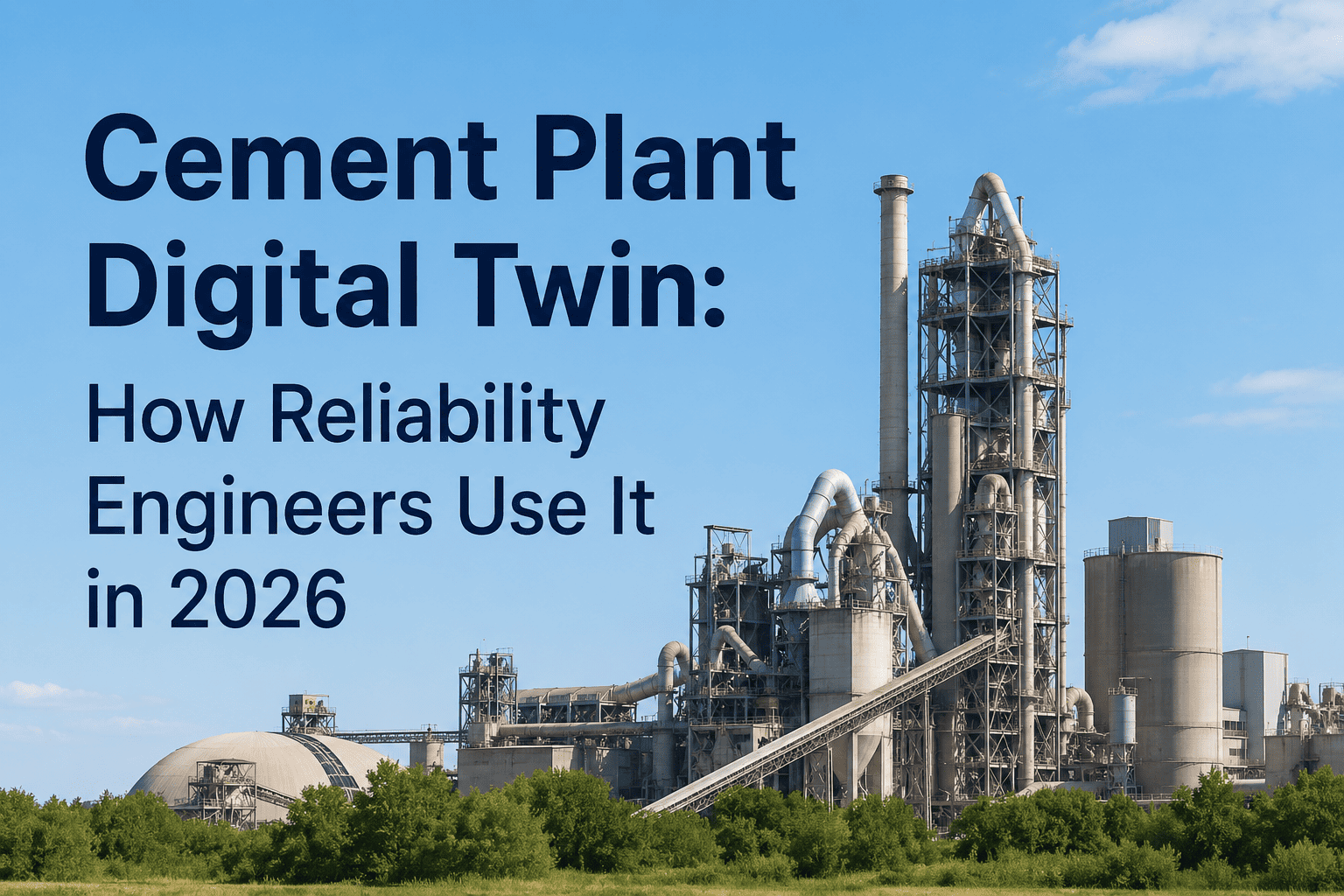
Digital Maintenance Twin: Asset History in Cement Plant CMMS

By Johnson on May 4, 2026

cement-plant-digital-maintenance-twin-asset-history-cmms

Every cement plant asset tells a story — but only if someone is listening. A kiln drive bearing that failed last March, the raw mill separator rebuilt six months ago, the clinker cooler fan that runs 4°C hotter than it did two years ago: each of these facts is a prediction waiting to be made. Without a digital maintenance twin capturing every repair event, part replacement, condition reading, and inspection finding, that prediction never gets made — and the next failure catches your team by surprise, again. OxMaint's CMMS builds individual digital twins for every asset in your plant, turning historical maintenance data into AI-powered failure prediction that grows more accurate over time. See it in action at Oxmaint or schedule a 30-minute session with a cement industry specialist.

Digital Maintenance Twin · Cement Industry · Asset Intelligence · 2025

Your Cement Plant Assets Are Keeping Secrets. A Digital Twin Reveals Them.

AI failure prediction is only as accurate as the asset history behind it. Digital maintenance twins in CMMS build that history — automatically, for every asset, from day one.

85% Failure prediction accuracy with 12+ months of asset twin data

40% Reduction in repeat failures when root cause is captured in asset history

3x Faster troubleshooting when technicians access full asset repair history

What Is a Digital Maintenance Twin?

A digital maintenance twin is not a 3D model or a simulation — it is a living, continuously updated record of every interaction your maintenance team has had with a specific physical asset. Every work order completed, every part swapped, every vibration reading recorded, every inspection finding entered: all of it is tied to a single asset identity in CMMS and never lost. For cement plants where kilns run for 30+ years and equipment spans generations of technicians, this institutional memory is the difference between guessing and knowing.

What a Digital Maintenance Twin Captures — Per Asset, Automatically
W
Work Order History

Every repair event: who did it, what was done, how long it took, what was found — linked to the asset permanently.

P
Parts & Component Log

Every part replaced with date, vendor, cost, and installation condition — enabling accurate component life tracking.

C
Condition Readings

Temperature, vibration, oil analysis, and sensor data stored chronologically — revealing degradation trends invisible in snapshots.

I
Inspection Findings

Every visual check, non-destructive test, and routine inspection result captured with date and inspector — not lost in paper logs.

F
Failure Events & Root Cause

When failures occur, the cause is documented and attached to the asset — preventing the same failure from repeating in 18 months.

R
Runtime & Load Data

Operating hours, production load, and throughput data context-matched to maintenance events — enabling true life-cycle modeling.

Every Day Without a Digital Twin Is a Day of Asset History Lost Forever

Condition data, repair findings, and failure patterns that aren't captured today cannot be recovered tomorrow. OxMaint starts building your asset twins from the moment you connect.

Cement Plant Assets That Need Digital Twins Most Urgently

Critical
Rotary Kiln
30+ year asset life. Refractory history, shell scan data, tire wear patterns, and drive bearing records must span decades — paper cannot hold this. A digital twin predicts refractory replacement need 6–8 weeks early.
Critical
Vertical Raw Mill
Roller wear follows production-load curves. Without condition history, roller replacement is guesswork. Digital twins enable 20–30% extension of roller life through data-guided replacement timing.
High
Cement Mill Separator
Bearing temperature trends and vibration signatures stored over months reveal seal degradation before it causes contamination or failure. History prevents the repeat failures that plague older mills.
High
Clinker Cooler Fans
Blade erosion from clinker dust follows predictable patterns — but only predictable if historical erosion rates are captured per fan. Digital twins enable proactive blade replacement before efficiency drops.
Medium
Bucket Elevators
Chain stretch and bucket wear accumulate gradually. Without a digital twin tracking inspection findings over time, teams replace chains reactively after breakage rather than predictively before it.
Medium
Preheater Tower Fans
Dust buildup on impeller blades causes vibration that worsens over weeks. Digital condition history shows the exact rate of deterioration so cleaning or replacement is timed perfectly.

How Asset Twin Data Powers AI Failure Prediction

1
Historical Baseline Established

The AI learns what normal looks like for each specific asset — using its individual history, not industry averages. A 12-year-old kiln drive has a different normal than a new one.

2
Deviation Pattern Recognized

When current sensor readings begin deviating from the asset's own historical baseline, the AI scores the anomaly by magnitude and rate of change — not just against a fixed threshold.

3
Failure Pattern Matched

The AI cross-references current deviations against previous failure events in the asset's twin — recognizing signatures that preceded past failures and estimating time-to-failure with confidence intervals.

4
Work Order Generated Automatically

When confidence in predicted failure exceeds configured thresholds, a CMMS work order is created with asset history, anomaly data, and recommended action — before failure occurs.

Frequently Asked Questions

Can we import existing maintenance records into the digital twin?
Yes. OxMaint supports bulk import of historical maintenance records from spreadsheets, legacy CMMS exports, and ERP systems. Existing asset history becomes part of the digital twin immediately, giving the AI a head start on baseline learning. Sign up free to explore import options.
How long does it take for AI predictions to become accurate?
Basic anomaly detection begins within weeks. Failure prediction accuracy improves significantly after 6 months and reaches 80–85% confidence after 12 months of asset-specific data. The more history the twin holds, the more accurate the predictions become.
Does each asset need its own sensors for a digital twin?
Not necessarily. Digital twins capture data from existing sensors, manual inspection entries, and CMMS work order outcomes. Even without full IoT coverage, manually entered condition readings build a valuable predictive history. Book a demo to see what's possible with your current sensor coverage.
What happens to the digital twin data when we replace an asset?
Historical twin data is retained and linked to the replaced asset's record for audit and benchmarking purposes. The new asset begins building its own twin from day one, and the system uses fleet-wide data to accelerate baseline learning for the new unit.
Can multiple plants share digital twin learnings?
Yes. OxMaint supports multi-site deployment where failure patterns detected at one plant can inform prediction models at sister plants with similar equipment — compounding the value of the digital twin across your entire fleet. Book a demo for multi-site configuration details.

The Best Time to Start a Digital Twin Was a Year Ago. The Second Best Time Is Today.

Every maintenance event that isn't captured in a digital twin is asset intelligence permanently lost. OxMaint starts building individual asset twins from your first connected work order — and the predictions get more accurate every month.
Share This Story, Choose Your Platform!