Cement plant reliability is not achieved by expanding maintenance crews — it is achieved by empowering production operators to perform first-line maintenance through structured inspection routines, digital checklists, and instant escalation pathways. The most successful cement operations in Japan and Germany achieve 94%+ kiln availability not through reactive maintenance teams, but through Total Productive Maintenance programs where operators inspect equipment daily, detect abnormalities early, and escalate developing failures to reliability engineers within seconds. This checklist gives your operators, shift engineers, and reliability teams a complete implementation framework — covering all 7 TPM pillars, daily inspection workflows, equipment-specific check points, and skill development milestones — structured so every check feeds directly into your OxMaint CMMS autonomous maintenance workflow with a full audit trail.
Cement Plant · TPM · Autonomous Maintenance Checklist
Operator Autonomous Maintenance Checklist for Cement Plants
A field-ready implementation checklist covering all 7 TPM pillars, daily CMMS-guided inspection workflows, critical equipment check points, and operator skill certification milestones — built for cement plants targeting 94%+ kiln availability.
7
TPM Pillars
94%+
Kiln Availability Target
60%
Downtime Reduction
3–4 wks
Earlier Failure Detection
Traditional Reactive Model
- Operators use equipment with no inspection responsibility
- Monthly technician inspections miss developing failures
- Abnormalities progress undetected for weeks until breakdown
- Emergency repairs cost 3–5× planned maintenance
- Specialists overwhelmed with routine tasks
Result: 75–85% kiln availability with frequent unplanned shutdowns
Operator Autonomous Maintenance
- Operators inspect daily using CMMS-guided digital checklists
- Abnormalities detected within 24 hours of onset
- Minor issues corrected immediately without work orders
- Developing failures escalated instantly via CMMS
- Specialists focused on complex repairs and improvement
Result: 92–96% kiln availability with planned maintenance dominance
DDaily
WWeekly
MMonthly
QQuarterly
AAnnual / Per Pillar
Each operator assigned specific equipment — kiln feed section, raw mill, clinker cooler, cement mill, or packing line — with documented ownership and accountability for condition and performance
P1Reliability Engineer · Equipment ownership register in CMMS
Dedicated cleaning event scheduled with production support — cleaning tools prepared, safety equipment issued, reliability engineers assigned to guide operators during initial inspection
P1Maintenance Planner · Cleaning event work order
Operators trained in cleaning-as-inspection methodology — identifying oil leaks, loose bolts, abnormal wear, misalignment, and structural damage during dust removal and surface cleaning
P1Training Lead · Competency sign-off record
Defects tagged digitally using mobile CMMS during cleaning — photo taken, location marked on equipment diagram, severity classified, and work order generated automatically without paper forms
P1Shift Operator · CMMS defect tag log
Defect review session conducted jointly by operators and reliability engineers — determining which defects operators can correct independently and which require specialist repair
P1Reliability Engineer · Defect review meeting record
Baseline equipment condition photos stored in CMMS against each asset record — used for visual comparison in all future inspection rounds to detect progressive deterioration
P1Reliability Engineer · CMMS asset photo archive
Sources of contamination identified and corrective action implemented — dust seals upgraded, access covers installed, and spill containment improved to reduce re-contamination rate
P2Maintenance Tech · Countermeasure implementation log
Visual controls installed at inspection points — min/max oil level marks on sight glasses, normal operating range markings on gauges, and colour-coded indicators for accept/reject conditions
P2Shift Operator · Visual control installation checklist
Cleaning, lubrication, and inspection standards documented for each piece of equipment — procedures, frequencies, acceptance criteria, and reference photos captured in digital CMMS checklists
P3Reliability Engineer + Operator · CMMS checklist template
Provisional inspection standards reviewed and approved by reliability engineer — standards verified against OEM recommendations and plant-specific failure history before deployment
P3Reliability Engineer · Standards approval record
Level 1 (Basic Operator) training completed — equipment function, safe operation procedures, daily visual inspection, basic cleaning, abnormality documentation in mobile CMMS, and escalation protocol
P4Training Lead · Digital competency test + supervised inspection sign-off
Level 2 (Autonomous Operator) training completed — lubrication principles, bolt torque procedures, belt tension adjustment, bearing temperature trending, and minor adjustment authority
P4Training Lead · Practical demonstration + written exam certification
Level 3 (Advanced Operator) training completed for designated operators — vibration analysis basics, thermography interpretation, root cause analysis participation, and new operator mentoring
P4Training Lead · Vibration cert + thermography competency + RCA case study
CMMS operator profiles updated with certified competency levels — system restricts advanced inspection tasks to operators with verified certification, preventing unqualified personnel from making critical decisions
P4CMMS Administrator · Operator competency profile
Refresher training scheduled annually for all certified operators — CMMS tracks certification expiry and alerts Training Lead 30 days before recertification is due
ATraining Lead · LMS training matrix
OxMaint digitizes every pillar — generating daily inspection checklists per operator, capturing abnormality photos in the field, routing escalations to reliability engineers by severity, and tracking certification status so no operator runs an inspection they aren't qualified for.
Daily Operator Inspection Workflow — 7-Step CMMS-Guided Execution
1
CMMS-generated checklist received at shift start
Digital checklist auto-generated based on equipment assignment, shift schedule, and inspection frequency — delivered to operator mobile device without manual assignment or paper forms.
2
Inspection round executed following optimized digital route
CMMS guides operator through optimized inspection sequence — bearings, gearboxes, motors, conveyors, seals, and lubrication points in logical order that minimizes walk time and prevents missed points.
3
Abnormalities documented with photo evidence and timestamp
Operator photographs elevated bearing temperature, oil leak, unusual vibration, or abnormal noise — CMMS captures photo, GPS location, timestamp, and operator ID automatically with no manual data entry.
4
Minor corrections executed independently within operator authority
Issues within operator capability — tightening loose bolts, adjusting belt tension, adding lubrication, clearing minor blockage — corrected immediately and logged in CMMS without raising a formal work order.
5
Developing failures escalated instantly to reliability engineer
Issues beyond operator capability — bearing overheating, abnormal vibration, seal failure, alignment problems — escalated automatically to on-call reliability engineer with photo evidence and full equipment history.
6
Reliability engineer reviews and authorises intervention digitally
Engineer receives mobile alert, reviews operator photos and trend data, determines urgency, and authorises immediate repair or schedules during planned shutdown — all digitally without phone calls or paper work orders.
7
Inspection completion confirmed and next round auto-scheduled
Operator confirms checklist completion digitally — CMMS logs timestamp, schedules next round automatically, and alerts supervisor if any inspection is skipped or delayed beyond its due window.
Kiln support roller bearing temperature checked — normal below 70°C; escalate immediately if above 80°C; lube pump operation confirmed and auto-lubrication system verified active
DShift Operator · CMMS mobile checklist
Raw mill gearbox oil level confirmed at sight glass — temperature below 75°C, no abnormal noise (grinding, knocking, or whining), and no shaft seal leakage exceeding minor seepage
DShift Operator · CMMS mobile checklist
Clinker cooler grate plates inspected for cracks, warping, or missing sections — reciprocating drive confirmed smooth, cooling air distribution even, and clinker spillage within acceptable limits
DShift Operator · CMMS mobile checklist
Bucket elevator chain tension and bucket condition verified — no excessive sag, no cracked or detached buckets, belt tracking centred, and no abnormal rattling indicating chain wear
DShift Operator · CMMS mobile checklist
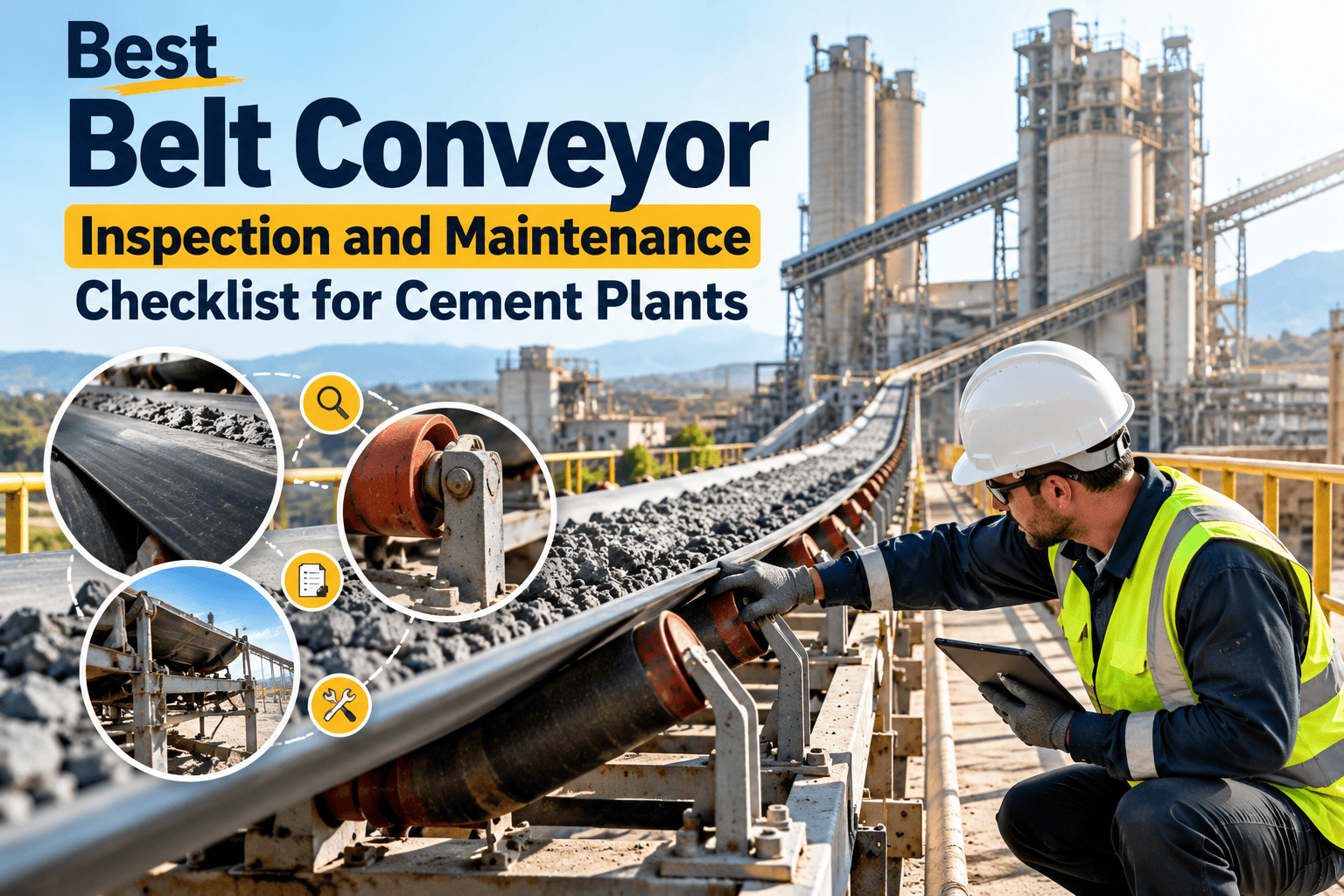
Conveyor belt tracking confirmed centered — no seized rollers causing belt damage, belt splice condition acceptable, and material carryback within normal range indicating scraper is functional
DShift Operator · CMMS mobile checklist
Dust collector differential pressure within 80–120 mmWC — pulse cleaning timer operation confirmed, compressed air supply adequate, no visible dust emissions indicating filter bag failure, hopper discharge valve operational
DShift Operator · CMMS mobile checklist — escalate if dP above 150 mmWC
Inspection round completion confirmed in CMMS with operator digital sign-off — any skipped or incomplete check item flagged automatically to shift supervisor for immediate follow-up
DShift Operator · CMMS completion log
Vibration trend review for all critical rotating equipment — week-on-week increase of more than 0.5 mm/s in any direction on kiln rollers, mill motors, or fan bearings triggers reliability engineer review
WReliability Engineer · Vibration trend dashboard
Inspection compliance rate reviewed across all shifts — any operator with less than 95% completion rate in the past 7 days flagged for coaching session with shift supervisor
WMaintenance Planner · CMMS compliance dashboard
All escalated findings from the month reviewed in reliability meeting — root cause documented, corrective action assigned, and inspection standard updated if a systematic gap is identified
MReliability Engineer · Monthly reliability review minutes
Inspection standards reviewed against the past quarter's failure and near-miss history — any check point that missed a developing failure is updated with a more sensitive detection criterion
QReliability Engineer + Lead Operators · Standards review record
Operator-proposed equipment improvements reviewed — modifications eliminating chronic contamination sources, improving inspection access, or reducing inspection time assessed for implementation
QReliability Engineer · Improvement proposal register
Kiln availability, MTBF, and planned vs unplanned maintenance ratio reviewed at plant management level — targets confirmed and underperforming equipment given additional inspection focus
QPlant Manager + Reliability Team · KPI review dashboard
New operator autonomous maintenance onboarding completed within 30 days of joining — assigned mentor from Level 3 operators, equipment ownership confirmed, and CMMS access provisioned with correct competency level
MTraining Lead · New operator onboarding checklist
Annual autonomous maintenance program audit conducted — inspection compliance, escalation response times, corrective action closure rates, and operator certification status reviewed against world-class benchmarks
APlant Manager · Annual TPM audit report
KPIs
Six Metrics That Prove Autonomous Maintenance Is Working
| Metric |
How to Measure |
Baseline (Reactive) |
Target (Autonomous) |
Review Cadence |
| Kiln Availability |
Running hours / Scheduled hours |
78–82% |
92–96% |
Monthly |
| Unplanned Downtime Share |
Unplanned hours / Total downtime hours |
60% unplanned |
Below 15% |
Monthly |
| Inspection Compliance Rate |
Completed inspections / Scheduled inspections |
— |
Above 98% |
Weekly |
| Mean Time Between Failures |
Operating hours between unplanned stops |
45–60 days |
120–180 days |
Quarterly |
| Escalation Response Time |
Operator escalation to engineer acknowledgement |
Hours to days |
Under 15 mins |
Monthly |
| Operator Certification Rate |
Certified operators / Total operators assigned |
— |
100% |
Quarterly |
Stop tracking autonomous maintenance compliance on spreadsheets. OxMaint logs every inspection round, every escalation, every certification, and every corrective action in one platform — and gives your reliability team real-time visibility across all shifts without manual data compilation.
FAQs
Frequently Asked Questions
What is operator autonomous maintenance in cement plants?
It is a Total Productive Maintenance approach where production operators perform daily equipment inspections, detect abnormalities early, execute minor corrections independently, and escalate developing failures to reliability engineers using CMMS-guided workflows — transforming operators from equipment users into first-line reliability partners. Start deploying autonomous maintenance with OxMaint.
How long does autonomous maintenance implementation take in a cement plant?
The full 7-pillar deployment typically takes 12–18 months. Measurable reliability improvements appear within 6 months. World-class performance — 92–96% kiln availability — is typically achieved after 18–24 months of consistent execution. The CMMS tracks pillar completion milestones automatically so plant management can see exactly where the program stands.
What equipment should cement plant operators inspect daily?
Priority equipment includes kiln support roller bearings, raw mill gearboxes, clinker cooler grate plates, bucket elevator chains, conveyor belt alignment, and dust collector filter systems. CMMS-guided checklists prompt operators to check temperature, vibration, noise, leakage, and alignment at each point with reference photos. Book a demo to see the OxMaint cement plant checklist templates.
How does CMMS support the escalation workflow between operators and engineers?
When an operator identifies an issue beyond their correction authority, the CMMS automatically routes the escalation — with the operator's photo evidence, equipment history, and severity classification — to the on-call reliability engineer's mobile device. The engineer can authorise immediate repair or schedule intervention during a planned shutdown, all without phone calls or paper work orders.
What does the operator skill certification pathway look like?
Three levels: Level 1 (Basic — 2 weeks) covers visual inspection and escalation. Level 2 (Autonomous — 6 weeks) adds lubrication, bolt torque, and belt adjustment authority. Level 3 (Advanced — 12 weeks) includes vibration analysis basics, thermography interpretation, and RCA participation. The CMMS enforces these levels — operators cannot be assigned checks that exceed their certified competency.
Ready to Deploy This Checklist?
Every Operator Check Logged. Every Failure Escalated. Every Kiln Running.
OxMaint empowers cement plant operators to perform first-line autonomous maintenance — executing daily CMMS-guided inspections, detecting abnormalities within 24 hours of onset, escalating developing failures to reliability engineers instantly, and tracking the full 7-pillar TPM program from initial cleaning through full autonomous management, all in one platform.






-in-cement-plants.png)
