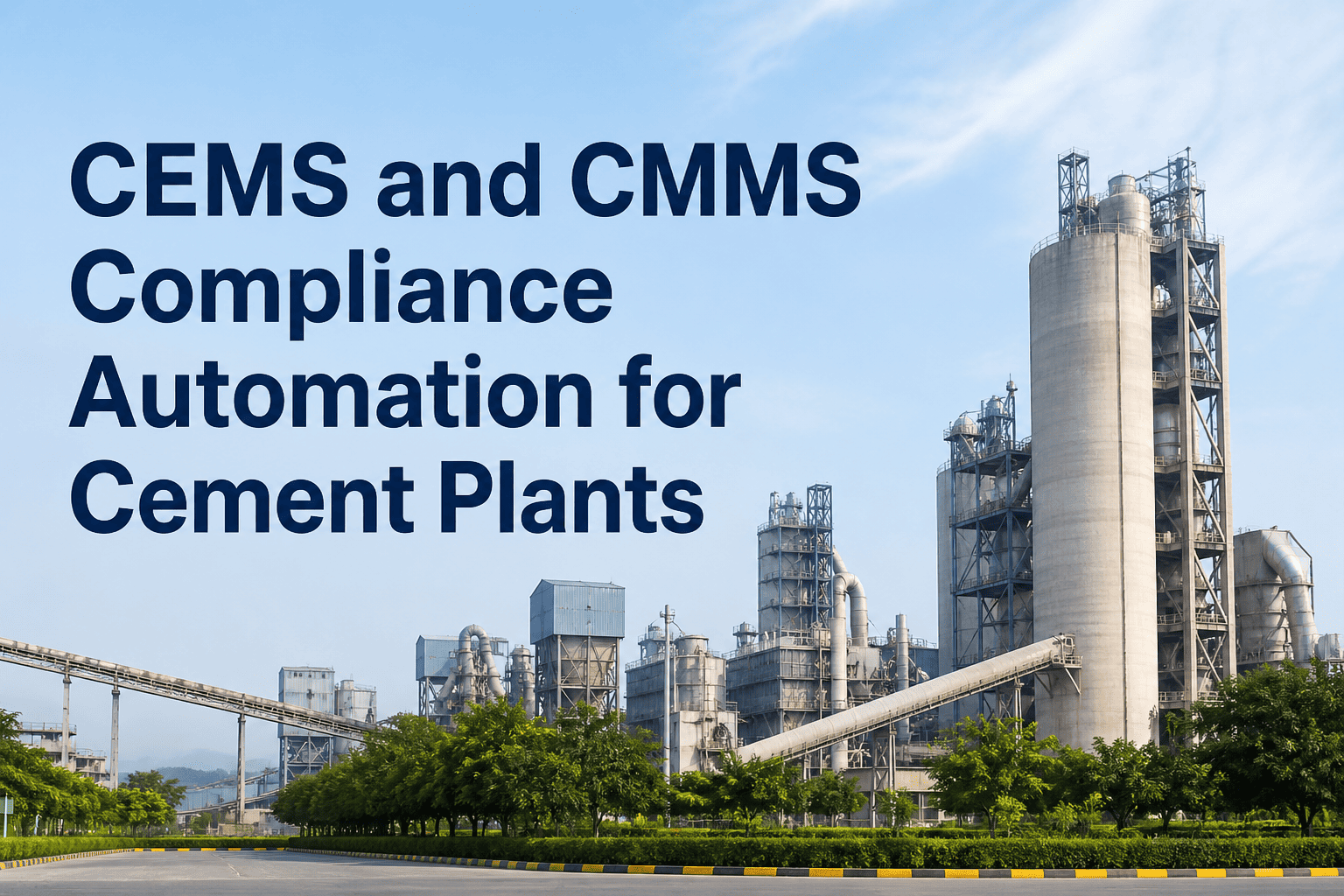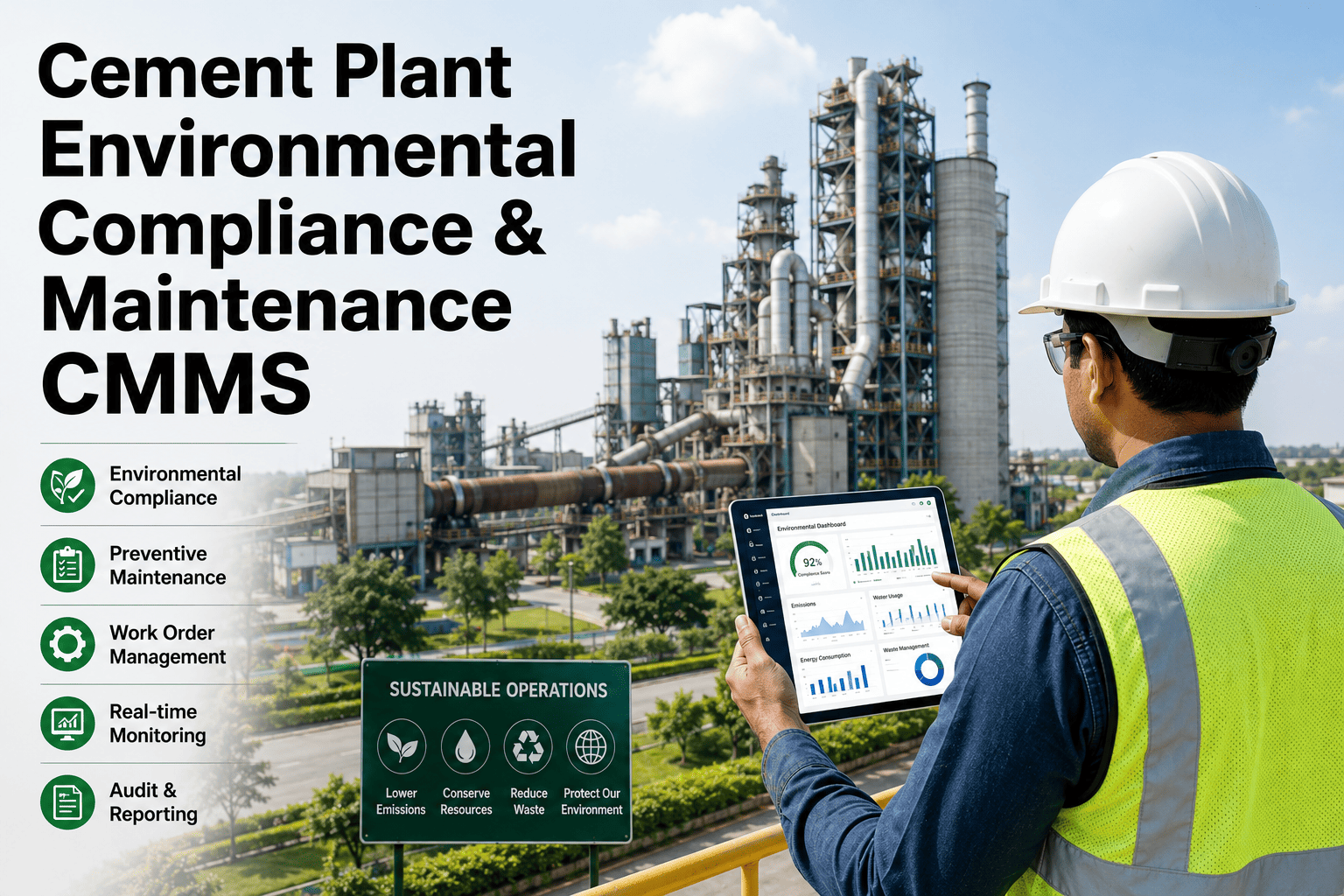
Cement producers now operate under environmental scrutiny that touches every kiln, stack, and stockpile — with CEMS uptime, dust limits, heavy-metal thresholds, and co-processing permits all depending on maintenance records that survive a regulator audit. A purpose-built CMMS turns environmental compliance from a reactive scramble into a documented, survey-defensible workflow tied to each asset, sensor, and permit condition. Plants that adopt this approach typically cut compliance-related downtime by 20–35% and reduce unplanned CEMS failures by half. You can Start Free Trial to see the audit trail structure before your next inspection window closes.
Is your plant audit-ready the morning a regulator walks the gate?
Stack tests, dust opacity logs, heavy-metal reports, waste-derived fuel permits — every environmental obligation in a cement plant traces back to a maintenance record. Without a CMMS that ties each compliance task to an asset and a timestamp, one missing calibration slip can trigger a six-figure penalty or a kiln derate.
Four pressure points where maintenance records decide your permit status
A modern cement plant runs 1,500–4,000 maintenance-relevant assets, and roughly 12–18% of them carry an environmental condition — a sensor to calibrate, a baghouse to inspect, a scrubber pump to service. Below are the four domains where documented maintenance is the difference between clean operations and enforcement.
Continuous Emission Monitoring Systems must log SO₂, NOₓ, CO, and opacity data at 98%+ annual availability. A single failed quarterly calibration audit — often traced to a skipped maintenance task — can invalidate months of data and trigger a stack-test mandate costing $15K–$40K per kiln.
Baghouses, ESPs, and dust collectors must hold emissions inside permit limits that tightened 40% under recent EU BAT and US NESHAP revisions. Filter bag replacement, hopper level checks, and cleaning-cycle tuning are the maintenance levers — and each needs a dated record.
Mercury, cadmium, thallium, and arsenic emission thresholds demand periodic source testing and raw-material input tracking. Without maintenance records on sampling ports, probe cleanouts, and analytical equipment, plants cannot demonstrate the data integrity regulators require.
Alternative fuel and raw material co-processing — tires, RDF, biomass, solvents — cuts clinker fuel cost 15–30% but adds permit conditions on input acceptance, storage, and feeding systems. Every conveyor, magnet, and weigh-feeder on the AFR line becomes a compliance-relevant asset.
What undocumented environmental maintenance actually costs a cement plant
The financial exposure of running environmental compliance through spreadsheets and shift logs is rarely visible until an inspector arrives. Here is a worked scenario grounded in real plant economics.
A 2-million-tonne-per-year cement plant with three kiln lines operates ~2,800 assets, of which 410 carry environmental conditions. Using paper logs and a shared spreadsheet, the plant averages 11 missed or late compliance tasks per quarter — CEMS calibrations, baghouse pressure-drop checks, scrubber pump inspections.
After implementing a CMMS with permit-linked PM schedules, automated calibration reminders, and audit-ready reporting, the same plant reduced missed tasks to under 2 per quarter and eliminated derate events — recovering roughly $165K annually and passing two consecutive regulatory surveys with zero findings.
A four-layer CMMS structure built for survey-defensible cement operations
Environmental compliance does not live in a single CMMS module — it is an architecture that connects permits to assets, assets to tasks, and tasks to evidence. The framework below maps how each layer functions and what it must contain.
| Layer | What It Governs | Critical CMMS Fields | Audit Evidence Produced |
|---|---|---|---|
| L1 · Permit Registry | Operating permit conditions, emission limits, reporting cadences, co-processing authorizations | Permit ID · limit value · regulatory basis · next renewal date · responsible authority | Permit validity proof · limit-configuration baseline for every monitored parameter |
| L2 · Asset Compliance Mapping | Linkage of each environmental asset — CEMS, baghouse, scrubber, AFR feeder — to its permit condition | Asset tag · criticality · linked permit ID · compliance category · sensor/analyser serial | Defensible asset-to-requirement traceability during a walk-through |
| L3 · Permit-Driven PM | Preventive maintenance schedules generated from regulatory intervals, not just OEM recommendations | Trigger type · frequency · procedure SOP · required tool · sign-off role · parts kit | Time-stamped completion records with technician identity and readings |
| L4 · Evidence & Reporting | Calibration logs, inspection photos, deviation reports, automated regulator-ready exports | Reading value · pass/fail · deviation reason · corrective action · document attachment | Filterable audit trail exportable by date, asset, permit, or parameter |
A 12-month environmental maintenance timeline for cement plants
Regulatory obligations follow a predictable rhythm. Mapping them into a CMMS calendar ensures no quarterly calibration or annual stack test slips — and gives plant managers a forward view of resource needs.
Relative Accuracy Test Audit for in-stack gas monitors, opacity monitor calibration, and data acquisition system verification. Budget 3–5 days per kiln line with 2 weeks of CMMS-scheduled prep tasks.
Internal bag/filter inspection, clean-air-plenum leak check, hopper discharge verification, and ESP plate/rapping mechanism audit. CMMS triggers work orders against each collector asset with photo evidence capture.
Stack sampling for Hg, Cd, Tl, As per permit frequency plus a full audit of waste-derived fuel input records, supplier acceptance documentation, and feeding-system calibration logs.
Stormwater outfall sampling, process water recycling system inspection, and compilation of the annual environmental performance report — CMMS auto-assembles the maintenance evidence package.
Why paper and Excel fail environmental audits — and what changes
Most cement plants do not lack environmental intent — they lack a system that proves intent with timestamped, asset-linked evidence. The gap between a spreadsheet and a CMMS is the gap between a citation and a clean survey.
- Compliance tasks buried across 4–6 shared spreadsheets with no single owner
- No automatic escalation when a CEMS calibration is missed — the gap surfaces during an audit
- Asset-to-permit linkage exists only in an environmental engineer's memory
- Photo evidence stored in personal phones, unsearchable by asset or date
- Inspection prep takes 3–5 days of manual record assembly and cross-referencing
- Deviations logged but rarely linked to corrective work orders or closure verification
- Every environmental task in one system, tagged to its permit condition and asset
- Automated reminders escalate to plant manager if a calibration is 48 hours overdue
- Asset registry enforces the link — open any asset and see its compliance obligations instantly
- Photos, readings, and sign-offs attached directly to the work order, filterable on demand
- Inspection prep drops to under 4 hours — one filtered report covers any parameter range
- Every deviation auto-creates a corrective work order with closure tracking and audit trail
After our first regulatory survey using the CMMS, the inspector asked for CEMS calibration records for Kiln 2 over an 18-month window. We had the filtered report with timestamps, technician names, and reading values in front of him in under three minutes. That moment changed how our team thinks about compliance.
Turn environmental maintenance into your strongest audit defense
Deploy a CMMS that links every permit condition to an asset, every asset to a task, and every task to timestamped evidence your inspector can verify in minutes.
Cement plant environmental compliance & CMMS — answered
A CMMS schedules every CEMS calibration, probe cleanout, and analyser drift check against the permit-mandated frequency — not just the OEM interval. It escalates overdue tasks, captures reading values and technician sign-offs on the work order, and produces a filterable audit trail showing 98%+ data availability. When a regulator asks for 12 months of calibration evidence, the report is one filter away instead of a three-day records hunt.
Inspectors typically want CEMS calibration logs and data availability reports, baghouse/ESP inspection records with photos, heavy-metal source test results, AFR input and acceptance documentation, water discharge monitoring data, and proof of corrective actions for any prior deviations. A CMMS stores all of these as linked work-order evidence, retrievable by asset, date, or permit condition. You can Book a Demo to see the evidence-export workflow in action.
A focused rollout covering CEMS, dust control, and co-processing assets typically takes 6–10 weeks: 2 weeks for permit and asset registry mapping, 3–4 weeks for PM schedule configuration and procedure loading, and 2–4 weeks for team training and parallel running. Plants with a clean existing asset list and engaged environmental staff move fastest, sometimes going live in under 5 weeks.
Yes — every conveyor, magnet, weigh-feeder, and storage bunker on the AFR line becomes a tracked asset with its own permit-linked maintenance schedule. The CMMS records supplier acceptance data, fuel characterization sampling, and feeding-system calibration checks, then ties them to the co-processing permit condition. This creates the input-to-stack traceability regulators increasingly require for waste-derived fuel operations.
Most mid-sized cement plants recover $120K–$200K annually through avoided penalties, eliminated derate events, reduced inspection prep labor, and prevented stack-test re-runs. The payback period is typically 3–5 months once permit-linked PM schedules are live. The cost of not acting — a single CEMS data-invalidation finding can exceed $200K in penalties plus mandatory third-party stack testing — dwarfs the implementation investment.
Build a maintenance system that makes environmental audits a formality, not a threat
Join cement plants using permit-linked CMMS workflows to cut compliance gaps, pass surveys cleanly, and protect their operating permits year after year.
Free 14-day trial · No credit card