Continuous Emission Monitoring Systems generate thousands of compliance data points every day — SO₂, NOₓ, CO, CO₂, particulate matter, and stack flow readings logged every minute across every emission point in the plant. Under EPA 40 CFR Parts 60 and 75, Europe's Industrial Emissions Directive, and equivalent frameworks across India, the GCC, and Australia, that data must be legally defensible, fully documented, and reportable on demand. The problem most cement plants face is not the hardware — it is that CEMS data sits in a monitoring silo while the maintenance team responsible for keeping those analysers accurate and compliant works from a separate paper log with no automated escalation. When an EPA regional inspector arrives, data assembly alone can take 40–80 staff hours. Connecting CEMS to a CMMS closes that gap permanently: emission trends predict impending permit exceedances, maintenance work orders are auto-generated before the exceedance occurs, and the compliance report is assembled in under 30 minutes. Start your free OxMaint trial and connect your plant's CEMS data to a live CMMS compliance layer, or book a 30-minute demo to see CEMS-triggered work orders active in a live cement plant environment.
Environmental Compliance / CEMS + CMMS
CEMS and CMMS Compliance Automation for Cement Plants
When CEMS emission data routes directly into a CMMS, maintenance work orders are auto-generated before permit exceedances occur — turning thousands of daily data points into actionable maintenance intelligence rather than a compliance liability.
40–80 hrs
Staff hours to assemble data for EPA inspection without CMMS integration
<30 min
Compliance report assembly time with CEMS-to-CMMS integration active
2.3 avg
Permit violations per plant per year before CMMS-linked CEMS monitoring
Zero
Permit violations at plants running OxMaint CEMS integration for 12+ months
The Compliance Gap Every Cement Plant Has — And Doesn't Know About
A cement plant that has maintained its bag filter correctly but cannot produce timestamped records during an unannounced inspection is treated identically by regulators to one that has not maintained the filter. Good maintenance without documented evidence is the same as no maintenance in a compliance context. This is the gap that CEMS-to-CMMS integration closes: every calibration, every maintenance event, and every emission reading becomes a timestamped, auditor-ready record — automatically.
Without Integration
CEMS data in monitoring system silo — maintenance team cannot see it
Calibration records in paper logs — no automated escalation when overdue
Emission trend degradation visible only after permit exceedance occurs
Compliance report assembly takes 40–80 staff hours per inspection
RATA preparation is a manual scramble across scattered maintenance records
Average 2.3 permit violations per plant per year
With CEMS-to-CMMS Integration
Emission trends auto-generate maintenance work orders before exceedance
Calibration PM scheduled per analyser — mobile work order to technician on due date
Threshold alerts fire below permit limits — giving maintenance a response window
Compliance report assembled in under 30 minutes with pre-formatted export
RATA pre-audit readiness report auto-generated from CMMS service history
Zero permit violations at plants 12+ months post-deployment
What CEMS Actually Monitors in a Cement Plant
Cement plant CEMS obligations are broader than most plant managers realise. Every emission point — kiln stack, raw mill exhaust, clinker cooler, coal mill, and cement mill baghouses — carries its own permit conditions, monitoring frequencies, and calibration requirements. Managing these across a large plant on paper is where compliance risk accumulates.
SO₂
Sulphur Dioxide
Primary source: fuel sulphur content and raw material sulphur compounds
Regulated under: EPA NESHAP, EU IED, CPCB (India), SASO (GCC)
CMMS trigger: Rising trend at kiln stack triggers fuel quality investigation work order
NOₓ
Nitrogen Oxides
Primary source: high-temperature combustion in kiln — thermal and fuel NOₓ
Regulated under: EPA 40 CFR Part 63, EU ETS, BIS (India), HSE (UK)
CMMS trigger: NOₓ trend above alert band triggers burner maintenance work order
PM
Particulate Matter
Primary source: bag filter breakthrough, grate cooler exhaust, finish mill discharge
Regulated under: EPA Method 9, EU ETS, CPCB, BetrSichV (Germany)
CMMS trigger: PM opacity trend triggers bag filter inspection and DP check work order
CO
Carbon Monoxide
Primary source: incomplete combustion in kiln and calciner — burner and process indicator
Regulated under: EPA MACT, EU IED, RIDDOR (UK), TUV (Germany)
CMMS trigger: Elevated CO trend triggers combustion system inspection work order
CO₂
Carbon Dioxide
Primary source: calcination of limestone and fuel combustion — unavoidable process emissions
Regulated under: EU ETS carbon allowances, EPA GHG reporting, ESG disclosure frameworks
CMMS trigger: Specific CO₂ per tonne trend triggers combustion efficiency review work order
Flow
Stack Flow Rate
Primary source: measured at each stack for mass emission calculation — data integrity critical
Regulated under: EPA Part 75, EU IED — flow data gaps trigger substitution data rules
CMMS trigger: Flow meter calibration drift triggers QA work order before data gap event
Connect Your CEMS Data to Automated Maintenance Work Orders
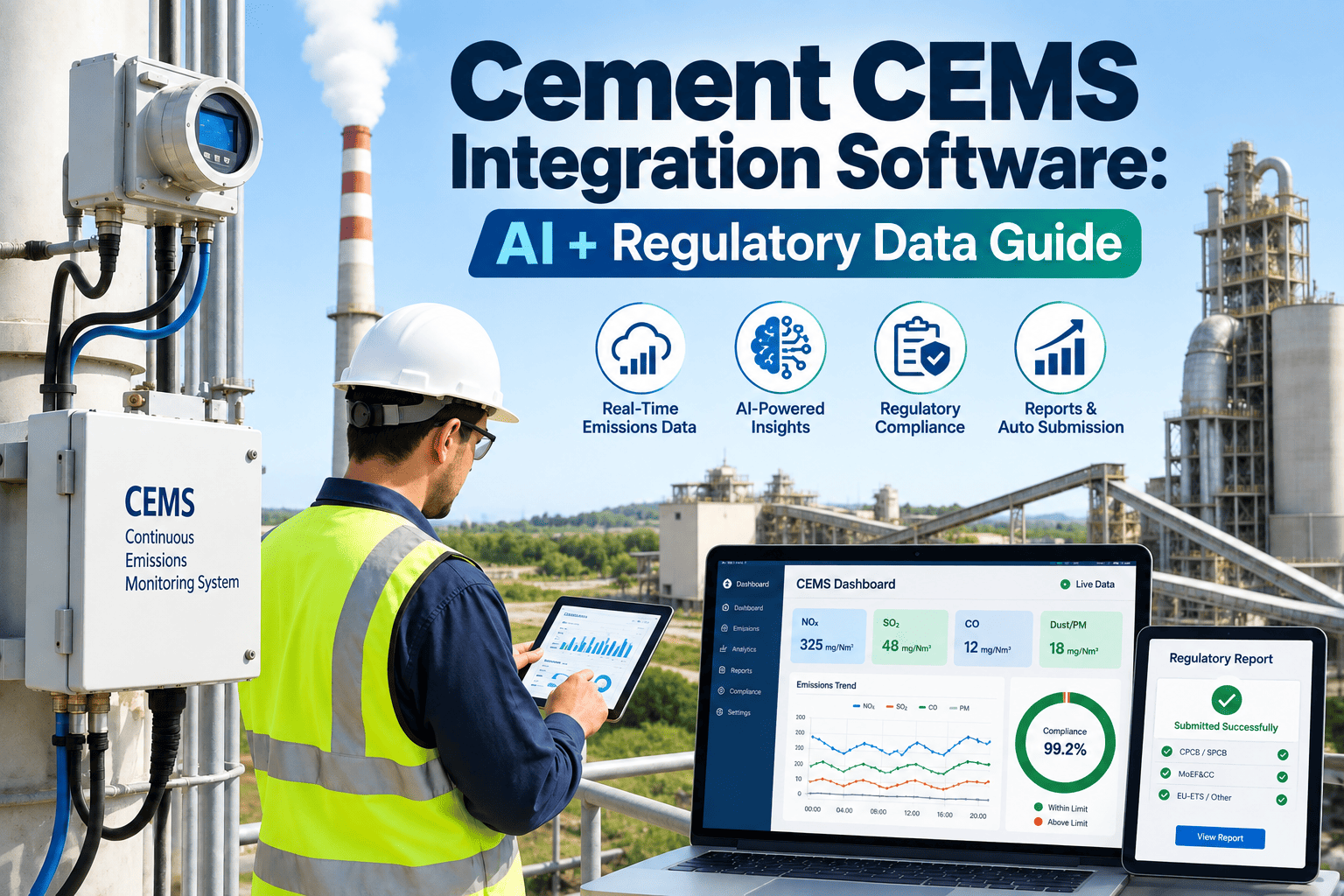
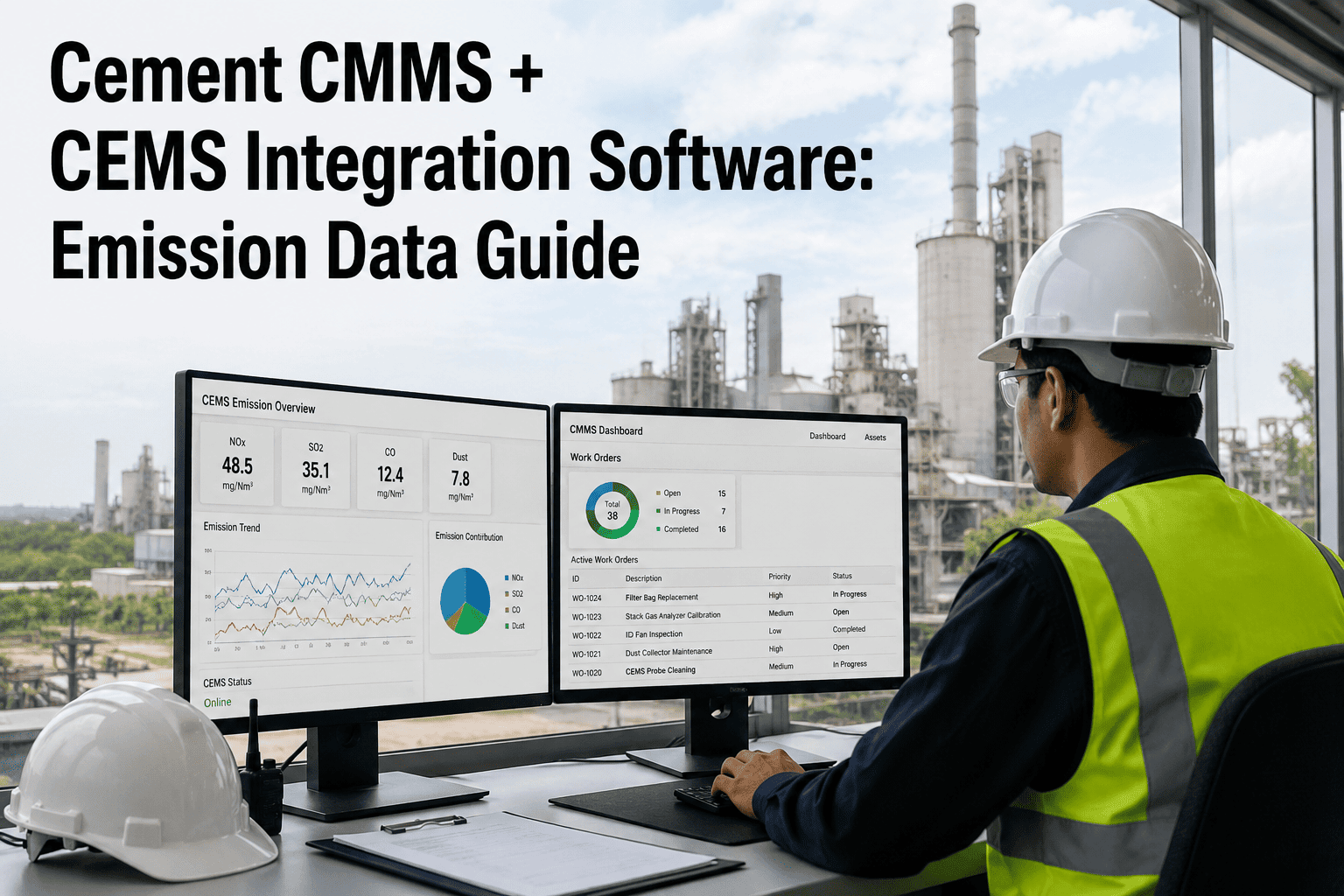
OxMaint integrates with DAHS platforms and DCS systems via OPC-UA, REST API, and MODBUS — no replacement of existing monitoring infrastructure. Emission trends that cross alert thresholds auto-generate maintenance work orders in minutes, not after a permit exceedance is logged.
The CEMS-to-CMMS Workflow — How Emission Trends Become Work Orders
The core value of CEMS-to-CMMS integration is not data visualisation — it is the automated maintenance response that fires before a permit exceedance occurs. Here is the complete workflow, from emission signal to closed work order with compliance record attached.
CEMS Data Ingestion — Real Time
SO₂, NOₓ, CO, CO₂, PM, and flow readings stream from each emission point into OxMaint via OPC-UA, REST, or MODBUS. The DAHS continues to manage real-time acquisition and reporting. OxMaint adds the maintenance and compliance layer the DAHS does not handle — calibration scheduling, threshold alerting, and work order generation.
Every minute — all emission points simultaneously
Alert Threshold Configuration — Below Permit Limits
Alert thresholds in OxMaint are set below permit limits — not at them. A permit limit of 200 mg/Nm³ PM triggers a maintenance alert at 160 mg/Nm³, giving the maintenance team a response window before the exceedance clock starts. Threshold configuration is per emission point, per pollutant, and referenced against the specific permit condition it satisfies.
Early warning — not post-exceedance notification
Work Order Auto-Generation — Maintenance Context Attached
When a threshold is crossed, a CMMS work order is auto-generated with the specific emission point, the pollutant and current reading, the most probable maintenance cause from the failure library (bag filter DP, burner condition, analyser drift, seal failure), required parts from storeroom inventory, and assigned technician by skill code. No planner intervention required.
Automated — zero manual dispatch step
Field Execution — Mobile, Photo-Evidenced
Technicians receive the work order on mobile. Task completion is captured with photographic evidence, actual parts consumed, technician sign-off, and timestamp. For calibration work orders, cylinder certificate reference and acceptance check readings are captured on-device. All records immediately available to the compliance officer — not in a paper file cabinet.
Timestamped, signed, and photo-evidenced
Compliance Report Assembly — Under 30 Minutes
Every maintenance event, calibration record, and emission reading is pre-formatted for EPA Method 9 opacity logs, EU ETS monitoring reports, CPCB records, and equivalent regional authority submissions. When an inspector arrives, the complete compliance package is assembled in under 30 minutes from the CMMS — not 40–80 staff hours from scattered records across three departments.
Audit-ready on demand — any regulatory framework
CEMS Maintenance Schedule — What the CMMS Must Enforce
CEMS hardware reliability is the foundation of compliance data quality. Analysers that drift, probes that plug, and calibration cylinders that expire produce invalid data — and invalid data under EPA Part 75 triggers substitution data rules that assume worst-case emissions. The CMMS enforces the CEMS maintenance programme that keeps every data point legally defensible.
| CEMS Component |
Daily / Shift |
Weekly |
Quarterly |
Annual |
| Gas Analyser (SO₂, NOₓ, CO) |
Zero and span drift check, response time check |
Calibration gas cylinder pressure, sample line integrity |
Relative Accuracy Test Audit (RATA) preparation, linearity check |
Full analyser service, probe replacement, RATA certification |
| Extractive Sample Probe |
Filter check, heated line temperature verification |
Probe cleaning cycle, filter weight or differential check |
Probe condition inspection, heated line integrity test |
Full probe replacement, heated line inspection, conditioner service |
| Stack Flow Monitor |
Flow reading vs. process cross-check |
Pitot tube blockage check, signal cable continuity |
Flow calibration against reference method, temperature compensation check |
Full flow monitor replacement or recertification, stack traverse test |
| Opacity Monitor (PM) |
Zero and span check, purge air flow |
Lens cleaning, alignment verification |
Method 9 correlation check, calibration audit |
Full optical alignment, reflector and lens replacement, recertification |
| Data Acquisition System (DAHS) |
Data integrity check — no missing periods |
Clock synchronisation, data backup verification |
QA audit of calculated values, substitution data review |
Software update, hardware inspection, full audit trail review |
| Calibration Gas Cylinders |
Cylinder pressure check before each calibration use |
Expiry date review against schedule |
Replace cylinders approaching expiry — CMMS auto-reorder alert |
Full cylinder inventory audit, certification file update |
Global Regulatory Frameworks — What Your CMMS Must Document
Cement plants operate across multiple regulatory environments simultaneously. A plant in India exporting to the EU faces CPCB obligations domestically and EU ETS disclosure requirements for Scope 1 emissions in buyer supply chains. The CMMS compliance layer must handle all of them without manual reformatting.
United States
EPA 40 CFR Parts 60, 63, 75
Quarterly electronic reports to EPA CAMPD in XML format
Relative Accuracy Test Audit (RATA) — annual or biennial
NESHAP cement plant MACT standards for PM, SO₂, NOₓ, HCl, THC
Title V operating permit condition compliance verification
European Union
Industrial Emissions Directive / EU ETS
24/7 validated data for SO₂, NOₓ, CO, CO₂, PM, mercury
Annual verified emission reports for EU ETS allowance reconciliation
EN 15267 and EN 14181 QAL1, QAL2, AST audit requirements
Best Available Techniques (BAT) compliance documentation
India
CPCB / MoEFCC Standards
Online CEMS connectivity to CPCB central server — mandatory for large cement plants
12-month retrievable emission records for unannounced inspections
PM, SO₂, NOₓ limits under Environment Protection Act
Calibration records submitted with each quarterly compliance report
GCC / Middle East
SASO / Civil Defence / Local EPA
Plant-specific emission limit compliance per environmental licence
Inspection-ready maintenance and calibration records
Stack emission reports aligned with local authority submission schedules
Safety and environmental management system integration
Frequently Asked Questions
What does CEMS-to-CMMS integration actually do in a cement plant?
It routes real-time emission readings from your CEMS into a CMMS that auto-generates maintenance work orders when readings trend toward permit thresholds. Calibration schedules are enforced automatically per analyser. Every maintenance event, calibration record, and emission reading is pre-formatted for your regulatory authority — turning 40–80 hours of inspection prep into under 30 minutes.
Does OxMaint replace our existing DAHS or CEMS hardware?
No. OxMaint integrates with existing DAHS platforms and DCS systems via OPC-UA, REST API, and MODBUS — adding a maintenance and compliance layer that the DAHS does not provide. The DAHS continues to manage real-time data acquisition and regulatory reporting. OxMaint manages calibration scheduling, threshold alerting, work order generation, and audit document assembly.
How are CEMS alert thresholds set to avoid permit exceedances?
Alert thresholds in OxMaint are configured below permit limits — typically at 80% of the permit value for the primary pollutants. This gives the maintenance team a response window to complete corrective work before the reading reaches the regulatory limit. Threshold configuration is per emission point, per pollutant, and referenced against the specific permit condition it satisfies.
How does OxMaint help with RATA preparation?
OxMaint maintains a complete service and performance history for every analyser. Before a RATA, the platform auto-generates a pre-audit readiness report covering recent calibration results, response time test history, and any open anomaly flags. Maintenance teams close all outstanding work orders through the CMMS before the third-party auditor arrives — dramatically reducing RATA failure risk.
Can OxMaint generate EPA Part 75 quarterly electronic reports automatically?
Yes. OxMaint generates Part 75 quarterly submissions in the required XML format for EPA's Clean Air Markets Division Data system. The platform validates data against Part 75 quality assurance criteria before report generation and flags any data gaps or exceedances requiring disclosure — so the submission is accurate before it leaves the plant.
From Compliance Liability to Compliance Confidence
OxMaint connects your cement plant CEMS data to automated calibration scheduling, emission threshold alerting, maintenance work order generation, and audit-ready compliance documentation — in one platform, for every regulatory framework your plant operates under.