ISO 55001 certification is not a documentation exercise — it is proof that your cement plant manages assets as a governed system, not a reactive maintenance function. The standard requires documented asset strategies, lifecycle cost models, risk-based maintenance rationale, and continuous performance monitoring across every asset in scope. When auditors arrive, they don't accept verbal assurances — they request records. Asset management plans, corrective action logs, KPI trend data, maintenance history, and evidence that PM schedules were executed on time for the past 12 months must all be producible on demand. For most cement plants operating on paper-based systems or disconnected spreadsheets, this evidence doesn't exist in a retrievable form. A purpose-built CMMS changes the compliance posture entirely: rather than assembling evidence before each audit cycle, your plant generates ISO 55001-conforming documentation automatically as part of daily maintenance operations. Explore how OxMaint maps to ISO 55001 clause by clause — and why organisations that embed compliance into their CMMS reduce audit preparation time by over 60%.
Asset Management Compliance · Cement Plant · ISO 55001
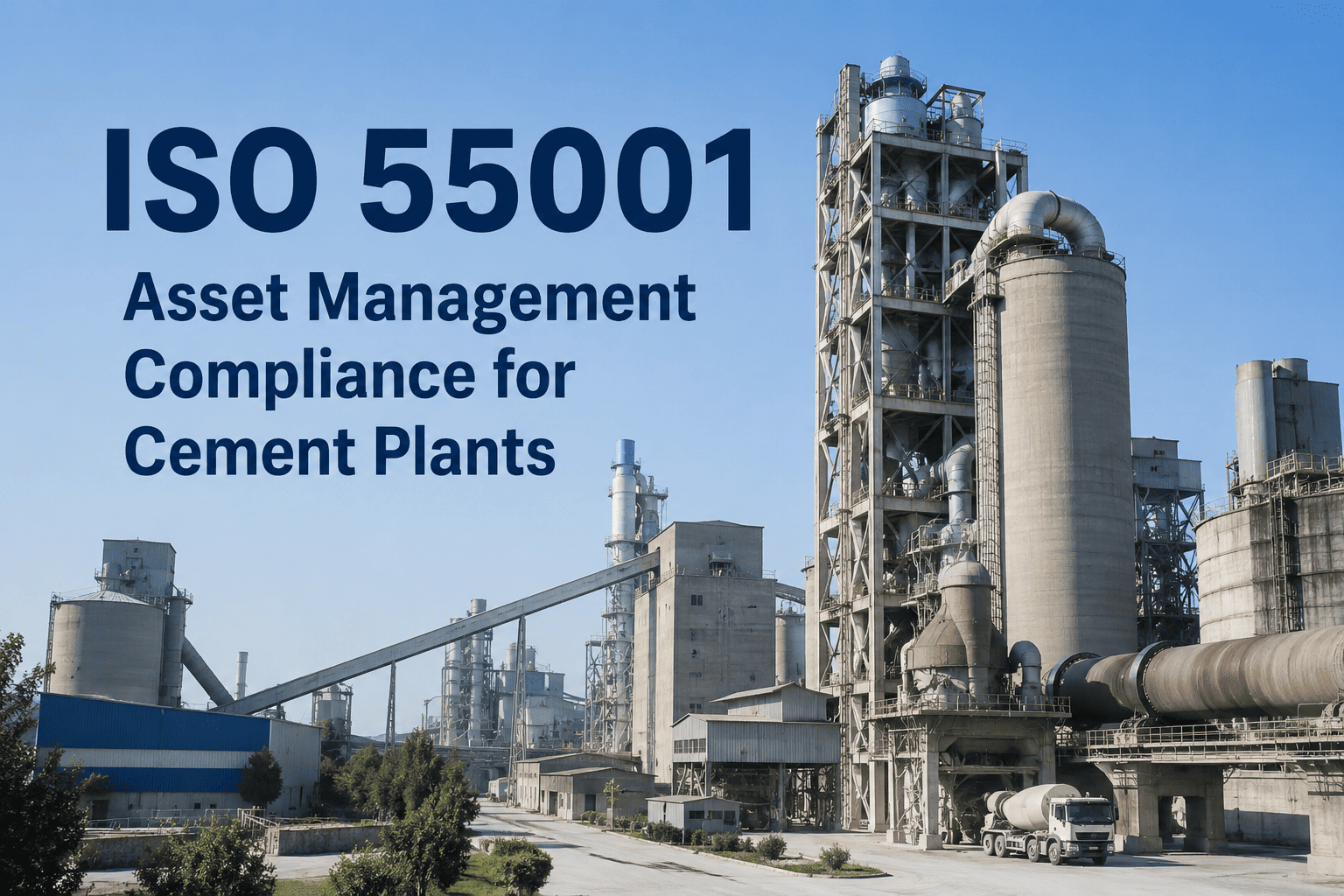
ISO 55001 Asset Management Compliance for Cement Plants
ISO 55001 certification demands documented asset strategies, lifecycle cost models, and continuous performance monitoring. A purpose-built CMMS delivers all of this out of the box — generating ISO 55001-conforming evidence automatically from daily maintenance operations, not from a pre-audit scramble.
The Standard Explained
What ISO 55001 Actually Requires — In Plain Language
ISO 55001 is the international standard for Asset Management Systems (AMS). It specifies requirements for establishing, implementing, maintaining, and improving the way an organization manages physical assets across their full lifecycle — from acquisition to disposal. Unlike pure maintenance standards, it requires alignment between asset management activities and organizational objectives, with documented evidence at every level.
4
Context of the Organization
Documented understanding of internal and external factors affecting asset management. Stakeholder requirements defined and recorded. Scope of the AMS formally established.
5
Leadership & Asset Policy
Asset management policy signed by top management, communicating objectives and commitments. Strategic Asset Management Plan (SAMP) linking asset strategy to organizational goals.
6
Planning
Risk-based asset management plans for all assets in scope. Lifecycle cost models. Documented rationale for maintenance strategy decisions — why this asset gets this maintenance approach.
7
Support
Competence records for all personnel involved in asset management. Asset information system (CMMS) capable of maintaining documented information required across all clauses.
8
Operation
Evidence that asset management plans are being executed. Work order records, inspection logs, corrective action documentation. Maintenance history against every asset in the registry.
9
Performance Evaluation
KPIs tracked continuously against targets — not pulled at audit time. PM compliance, unplanned downtime, MTBF, maintenance cost per unit. Internal audit records and management review minutes.
10
Improvement
Documented corrective actions for recurring failures. Evidence of closed-loop improvement cycles. PM schedule changes logged with rationale and the performance data that drove the decision.
Audit Reality
60%+
reduction in audit preparation time for plants that embed ISO 55001 compliance into CMMS workflows rather than assembling evidence separately before each audit cycle
WITHOUT CMMS
72+ hours of file-hunting before audit
Missing records discovered during audit
Inconsistent documentation quality
Evidence assembled manually per clause
WITH OXMAINT CMMS
15-minute one-click audit package generation
Complete records always maintained
Consistent structured documentation
Evidence generated from daily operations
See ISO 55001 Evidence Generated Automatically From Your Daily Maintenance Operations
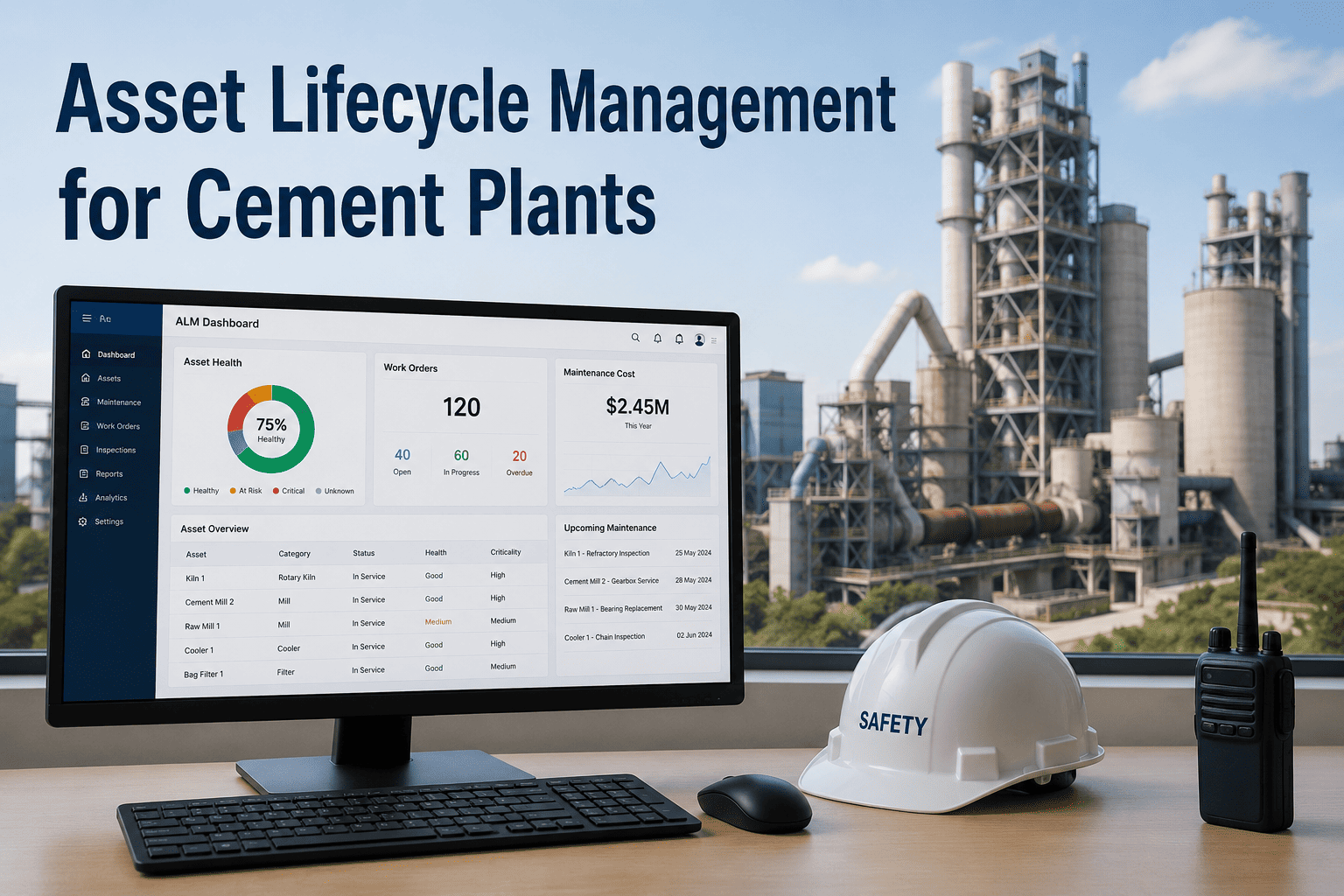
OxMaint structures asset data exactly the way ISO 55001 auditors require — hierarchy, lifecycle records, condition history, risk rationale, and KPI tracking built into every work order. No separate documentation system. No audit scramble.
CMMS-to-Standard Mapping
Exact CMMS Capabilities Cement Plants Need for ISO 55001 Conformance
Every ISO 55001 clause that requires documented evidence maps to a specific CMMS capability. Here is what auditors look for and what OxMaint delivers automatically.
| ISO 55001 Requirement |
What Auditors Request |
OxMaint CMMS Delivers |
| Asset registry and hierarchy |
Structured inventory with criticality classification — not a flat spreadsheet |
Hierarchical asset register with criticality tiers, condition records, and full lifecycle history |
| Maintenance plans with documented strategy rationale |
Why is this asset on a 3-month PM interval? What evidence supports that decision? |
PM plans with configurable rationale fields, strategy codes, and linked failure history |
| Maintenance execution evidence |
Work order records proving planned maintenance was performed, by whom, on schedule |
Complete work order history with technician, timestamp, parts used, and completion notes |
| Risk assessment documentation |
Documented hazard identification and risk treatment decisions per asset |
Risk register linked to asset records with treatment actions tracked to closure |
| KPI performance monitoring |
Continuous KPI data — not a snapshot assembled at audit time |
Real-time dashboards for PM compliance, MTBF, downtime, and maintenance cost — always current |
| Corrective action records |
Documented root cause analysis and corrective actions for recurring failures |
Failure analysis workflows with root cause fields, corrective action assignment, and closure evidence |
| Continuous improvement evidence |
Proof that the AMS identifies and acts on improvement opportunities over time |
PM schedule change history with rationale logged — automatic closed-loop improvement records |
Cement Plant Context
Why ISO 55001 Is Particularly Demanding for Cement Plant Asset Managers
Cement plants present ISO 55001 implementation challenges that most other industries don't face at the same scale. Understanding these challenges is the first step to addressing them through the right CMMS configuration.
01
Asset Count and Complexity
A single cement plant routinely contains 2,000–5,000 maintained assets across kiln, raw mill, cement mill, packing, and utilities circuits. Documenting asset management plans for all of them — with strategy rationale — is impossible without a CMMS that supports bulk configuration and inheritance of maintenance strategies from asset templates.
02
Lifecycle Cost Modeling Across Long-Life Assets
Kiln refractories, main drive gearboxes, and preheater cyclones have lifecycle spans of 10–25 years. ISO 55001 requires documented lifecycle cost models — acquisition, operation, maintenance, and disposal cost projections — for assets within the AMS scope. Without a CMMS tracking actual maintenance costs per asset over time, these models are fabrications rather than evidence.
03
Shutdown and Turnaround Documentation
Annual and major kiln shutdowns involve hundreds of concurrent work orders, external contractors, and critical path interdependencies. ISO 55001 requires that all maintenance activity — including shutdown work — is documented in the asset record. Shutdown work managed in spreadsheets or external project tools creates compliance gaps that auditors will find.
04
Regulatory Overlap with Safety Standards
Cement plants typically operate under concurrent requirements from ISO 55001, ISO 45001 (safety), and national environmental regulations. ISO 55001's risk-based approach must integrate with safety risk assessments without creating duplicate documentation systems — a challenge that requires a CMMS capable of linking asset records to permit workflows and safety records in a single system.
Implementation Roadmap
The ISO 55001 Certification Path for a Cement Plant — Stage by Stage
ISO 55001 certification follows a structured two-stage audit process. The implementation work before Stage 1 determines how smoothly certification proceeds — and whether your plant passes with findings or without.
Phase 1
Gap Analysis (Weeks 1–4)
Compare current asset management practices against each ISO 55001 clause. Identify where documented processes, roles, or evidence records are missing. This shapes the CMMS configuration work and determines implementation effort. Plants with existing CMMS data typically close gaps significantly faster than those starting from spreadsheets.
→
Phase 2
SAMP and Policy Development (Weeks 4–10)
Establish the Asset Management Policy and develop the Strategic Asset Management Plan linking organizational goals to asset strategy. Configure CMMS asset hierarchy, criticality classification, and maintenance strategy templates. Define KPIs and reporting structure aligned with ISO 55001 Clause 9.
→
Phase 3
Evidence Accumulation (Minimum 3 Months)
ISO 55001 requires at least 3 months of evidence that the AMS is operating as documented before the Stage 2 audit. During this period, CMMS generates work order records, PM compliance data, corrective action logs, and KPI trends that form the audit evidence package.
→
Phase 4
Stage 1 + Stage 2 Audit
Stage 1 reviews documentation and readiness. Stage 2 (within 3 months of Stage 1) assesses on-site conformance against the full standard. Annual surveillance audits and recertification every 3 years maintain the certification. CMMS evidence must remain current between cycles — not rebuilt before each visit.
Common Questions
ISO 55001 for Cement Plants — FAQs
Does OxMaint CMMS map to ISO 55001 clause by clause?
Yes. OxMaint structures asset data, maintenance records, risk documentation, KPI monitoring, and corrective action workflows to align with ISO 55001 clauses 4 through 10. The platform generates the documented information auditors need from normal maintenance operations — not from a pre-audit documentation exercise.
Book a demo for a clause-by-clause walkthrough.
Can we use OxMaint for ISO 55001 while also managing ISO 45001 safety compliance?
Yes. OxMaint manages both asset maintenance records and safety permit workflows in one system. Asset records link to confined space permits, LOTO records, and safety inspections — allowing ISO 55001 and ISO 45001 evidence to draw from the same data source without duplicate documentation.
Start a free trial to explore the integrated compliance framework.
How long does ISO 55001 certification take for a cement plant?
Most cement plants require 6 to 12 months from gap analysis to Stage 2 certification, depending on the current state of asset documentation and CMMS adoption. Plants with existing structured CMMS data move through implementation significantly faster. The mandatory minimum is 3 months of AMS operation before the Stage 2 audit can occur.
What happens at the annual surveillance audits after initial certification?
Annual surveillance audits verify that the AMS continues to operate as documented — KPIs are being tracked, corrective actions are being closed, and PM compliance is maintained. Plants with CMMS-generated continuous evidence pass surveillance audits without additional preparation. Manual systems require significant effort to reconstruct the prior year's evidence before each visit.
Build the ISO 55001 Evidence Base Your Auditor Needs — From Today's Work Orders Forward
OxMaint generates ISO 55001-conforming asset records, maintenance history, KPI data, and corrective action documentation automatically from daily operations. No separate documentation system. No pre-audit scramble. See it live in a 30-minute demo.