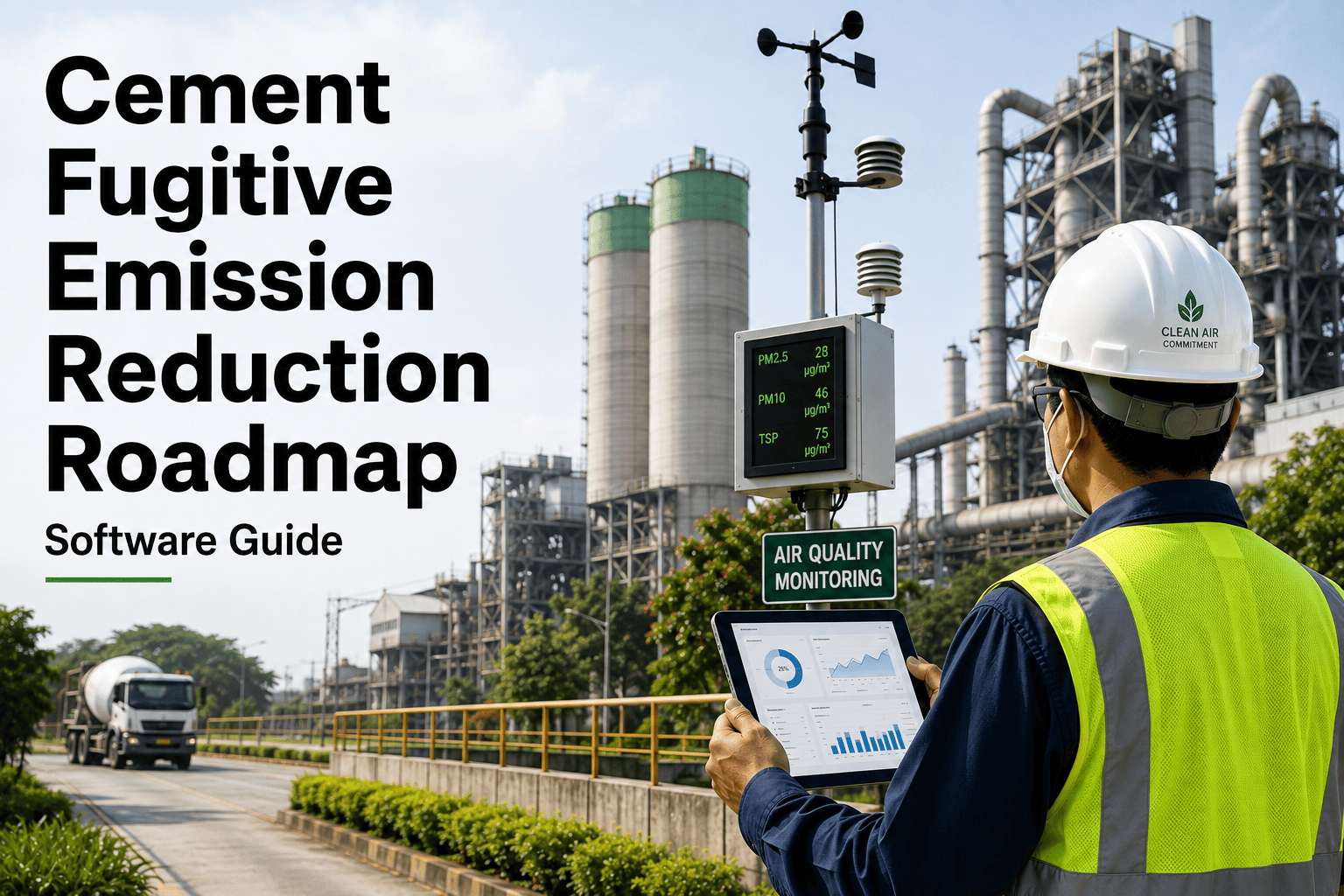
Fugitive dust at a cement plant rarely announces itself — it escapes between the 06:00 and 14:00 rounds, when a clinker conveyor seal weeps, a raw-mill fan damper drifts, or a silo-level indicator sticks and overfill begins. Manual visual-emission walks, even when run twice per shift, miss the 8 to 40 minutes of opacity that triggers an OSHA or MSHA citation, a community complaint, or a stack-test failure. A digital CMMS closes that gap by tying inspection rounds, LOTO isolations, and corrective work orders to the exact asset and timestamp, so every visible-emission event becomes traceable, repairable, and auditable. OxMaint's cloud-based cement plant CMMS gives maintenance managers, reliability engineers, and multi-site groups the framework to schedule preventive tasks, run digital inspections on kiln decks and silo platforms, and generate compliance reports in minutes. Start Free Trial to see how quickly the visible-emission observation gap closes once rounds go digital.
The 27-minute gap that turns a dust wisp into a citation
Manual rounds catch what an operator can see from the walkway — but opacity events rarely wait for the clipboard. OxMaint digitizes the visible-emission observation framework so every fugitive release across kilns, mills, crushers, coolers, conveyors, and silos is logged, isolated, and repaired before the next inspector arrives.
Inspector walks every 4 hrs; events between rounds go unlogged.
Clipboard notes transcribed 24–48 hrs later, often after the citation.
No LOTO-to-asset linkage; isolation records live in a binder.
~27 min average detection lag
QR-tagged asset rounds + IoT opacity inputs flag events in < 90 sec.
Work order, LOTO, and RCA auto-created the moment opacity exceeds threshold.
Full audit trail: who saw it, what isolated it, when it closed.
~1.5 min average detection lag
Four structural blind spots in clipboard-based dust inspection
A typical cement plant runs 2 to 4 visible-emission walks per shift across kiln decks, mill floors, quarry sites, packing plants, and remote silos. Even disciplined teams lose fugitive events to four recurring failures of the manual framework.
Time-between-rounds gap
With 4-hour intervals, an event that starts 20 minutes after a round persists undetected for up to 3 h 40 m. At a 5,000 TPD plant, that window can release 60–120 kg of particulate before anyone logs it.
Line-of-sight limitation
An operator on the kiln deck cannot see a clinker cooler damper leak, a remote silo vent, or a conveyor transfer point 300 m away. Roughly 40% of cement-plant assets sit outside any single walking round.
Subjective opacity reading
Method 22 visible-emission observation depends on the observer's training, lighting, and angle. Two inspectors at the same stack frequently record 10% versus 40% opacity on the same plume.
Delayed documentation
Paper rounds get transcribed 24–48 hours later. By the time an RCA is opened, the conveyor seal has been replaced, the damper re-trimmed, and the root cause is already buried — leaving the next event to repeat the cycle.
Where fugitive dust events actually originate
Across cement plant assets, fugitive events are not randomly distributed — they cluster around six high-wear zones. Knowing the distribution is the first step to scheduling preventive maintenance that prevents the next citation.
| Asset Zone | Share of Fugitive Events | Typical Trigger | Manual Detection Lag | CMMS Detection Lag |
|---|---|---|---|---|
| Kiln exhaust / preheater | 22% | Seal-air fan failure, expansion joint crack | 2–4 hrs | < 2 min |
| Clinker cooler dampers | 18% | Damper drift, actuator linkage wear | 4 hrs | < 1 min |
| Raw mill / finish mill cyclones | 16% | Cyclone choke, rotary valve bypass | 4–8 hrs | < 2 min |
| Conveyor transfer points | 14% | Skirt seal wear, belt mis-tracking | 8 hrs | < 3 min |
| Silo venting / level control | 17% | Level indicator stick, overfill event | 4–12 hrs | < 2 min |
| Crusher dust collection | 13% | Baghouse plenum leak, hopper bridging | 4 hrs | < 1 min |
Benchmarks aggregated from OSHA and MSHA cement-sector enforcement records and OxMaint deployment data across 180-asset and 320-asset plants. Detection lag = time from event onset to logged work order.
What a fugitive event actually costs a cement plant
OSHA citation + abatement + downtime at a mid-size plant
From kiln slowdown for inspection to restart stabilization
Combined fines, community complaints, and permit review costs
Share tied to seal, damper, and baghouse tasks already on the schedule
A 5,000 TPD plant, one conveyor seal, one missed round
Operator logs "clear" on the clinker conveyor transfer point during the morning round. Skirt seal is at 30% wear — not yet visible from the walkway.
Belt speed increases to meet kiln demand. The worn seal begins passing fines. Fugitive dust is now visible from the packing plant road — but no round is scheduled for 2 hours.
A delivery driver photographs the plume and files a community complaint. MSHA is notified within 72 hours. The plant has no timestamped record of the event onset.
Afternoon round finally logs "dust visible." Maintenance is dispatched, LOTO is isolated by hand, and the seal is replaced — 2 hours and 18 minutes after the leak began.
With OxMaint, the same plant would have received an automated work order at 09:43 — the moment the seal-wear PM flagged 30% — and the conveyor would have been scheduled for a 20-minute seal swap during the next planned outage. Total cost: roughly $1,200 in planned labor and parts.
The digital fugitive-dust inspection framework
OxMaint replaces the clipboard with a structured, asset-tagged inspection framework. Each check below is assigned to a specific asset, a frequency, and a corrective work-order template — so the moment a threshold is breached, the next action is already queued.
- Inspect kiln hood seal for visible dust escape
- Verify seal-air fan differential pressure within 0.4–0.6 kPa
- Check preheater expansion joints for cracking
- Confirm ID fan inlet damper position matches setpoint
- Walk all clinker conveyor transfer points for seal wear
- Check cooler damper actuator response time < 8 sec
- Inspect belt mis-tracking tolerance within 25 mm
- Verify dust-collection pickup velocity at 18–22 m/s
- Inspect raw mill cyclone underflow for choking
- Check rotary valve seal-air differential
- Verify finish mill discharge temperature within range
- Log baghouse cleaning-cycle frequency against baseline
- Confirm silo level indicator calibration within 2%
- Inspect vent filter pressure drop under 1.2 kPa
- Check packing plant spout seal integrity
- Verify truck-loadout dust-collection interlock active
From one missed event to a 3-month payback
The OxMaint CMMS framework pays for itself by preventing a single fugitive event at most mid-size cement plants. The formula below uses real ranges from 180- to 320-asset deployments.
E = fugitive events per year · C = cost per event · F = fines and complaint costs · D = downtime hours
S = annual software subscription · 0.73 = share of events preventable through scheduled PM and digital inspection
| Plant Profile | Events / Year (Missed) | Avg. Cost / Event | Annual Loss (A) | OxMaint Subscription | Payback (Months) |
|---|---|---|---|---|---|
| Single-site, 180 assets | 6 | $40,650 | $243,900 | $18,000 | 1.2 |
| Single-site, 320 assets | 9 | $48,200 | $433,800 | $27,000 | 1.0 |
| Multi-site group (4 plants) | 34 | $44,000 | $1,496,000 | $86,000 | 1.0 |
Stop logging dust events after the citation. Start logging them at onset.
OxMaint turns every kiln deck, mill floor, and remote silo into a timestamped, audit-ready inspection point — with mobile apps, offline mode, QR asset tags, and IoT opacity integrations.
Cement fugitive dust framework — what plant teams ask
How does a CMMS catch a fugitive dust event that happens between manual rounds?
OxMaint ties each inspection check to a QR-tagged asset and a frequency, so rounds happen on a defensible schedule. When an IoT opacity sensor, differential-pressure transmitter, or seal-wear threshold breaches, the CMMS auto-generates a work order with the asset, timestamp, and LOTO isolation steps — typically within 90 seconds of event onset, far faster than the 2–4 hour gap between clipboard rounds.
Can OxMaint replace our Method 22 visible-emission observation program?
No — Method 22 is a regulatory requirement and stays in place. OxMaint complements it by digitizing the observation log, certifying observer credentials, and linking each observation to the asset and weather conditions at the moment of reading. You can Book a Demo to see how the audit trail holds up under an MSHA review.
Does the mobile app work on kiln decks and remote silos with no signal?
Yes. OxMaint's mobile app runs in offline mode on iOS and Android, caching the asset register, inspection checklists, and LOTO procedures locally. Inspectors scan a QR tag on the kiln hood or silo vent, complete the check, and the data syncs automatically the moment the device reconnects — so no round is ever lost to a dead zone.
How long does it take to roll out OxMaint across a 180-asset cement plant?
Most single-site plants are live in 4 to 6 weeks. The timeline covers asset import, QR-tag installation on kilns, mills, crushers, coolers, conveyors, and silos, LOTO template configuration, and inspector training. Multi-site groups typically stagger sites at 3-week intervals. You can Start Free Trial with a pilot zone to validate the framework before a full rollout.
What compliance reports does OxMaint generate for OSHA and MSHA audits?
The platform produces timestamped inspection logs, LOTO isolation records, root-cause analyses, and asset performance summaries for kilns, mills, and conveyors — exportable as PDF or CSV in minutes. Each report links the fugitive event to the asset, the observer, the corrective work order, and the closure verification, giving auditors a complete chain of custody from onset to abatement.
Give your fugitive-dust framework the audit trail it deserves
Join the cement plant maintenance managers, reliability engineers, and multi-site groups who use OxMaint to reduce kiln downtime, extend asset life, control repair costs, and stay ahead of every OSHA and MSHA audit.
Free 14-day trial · No credit card