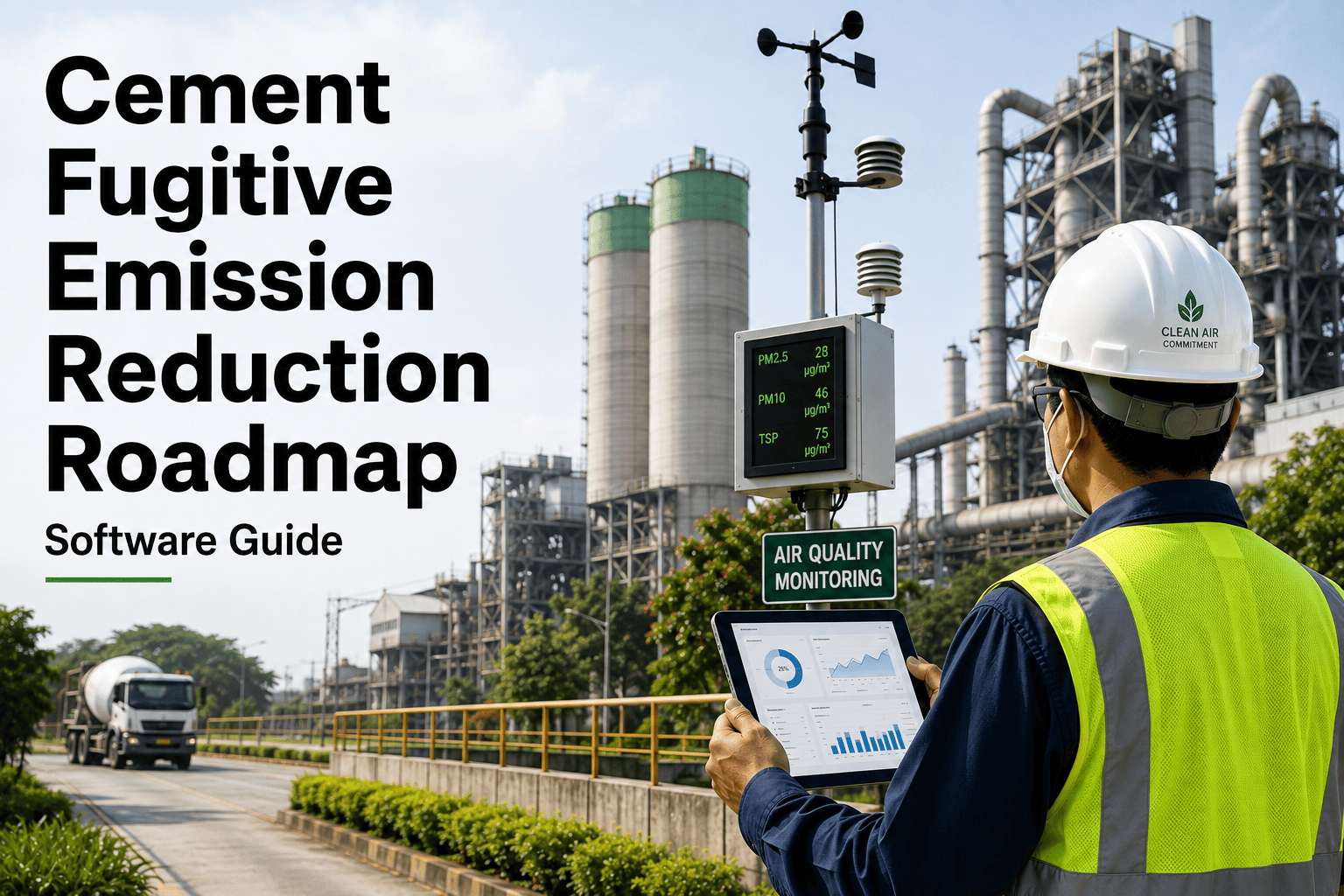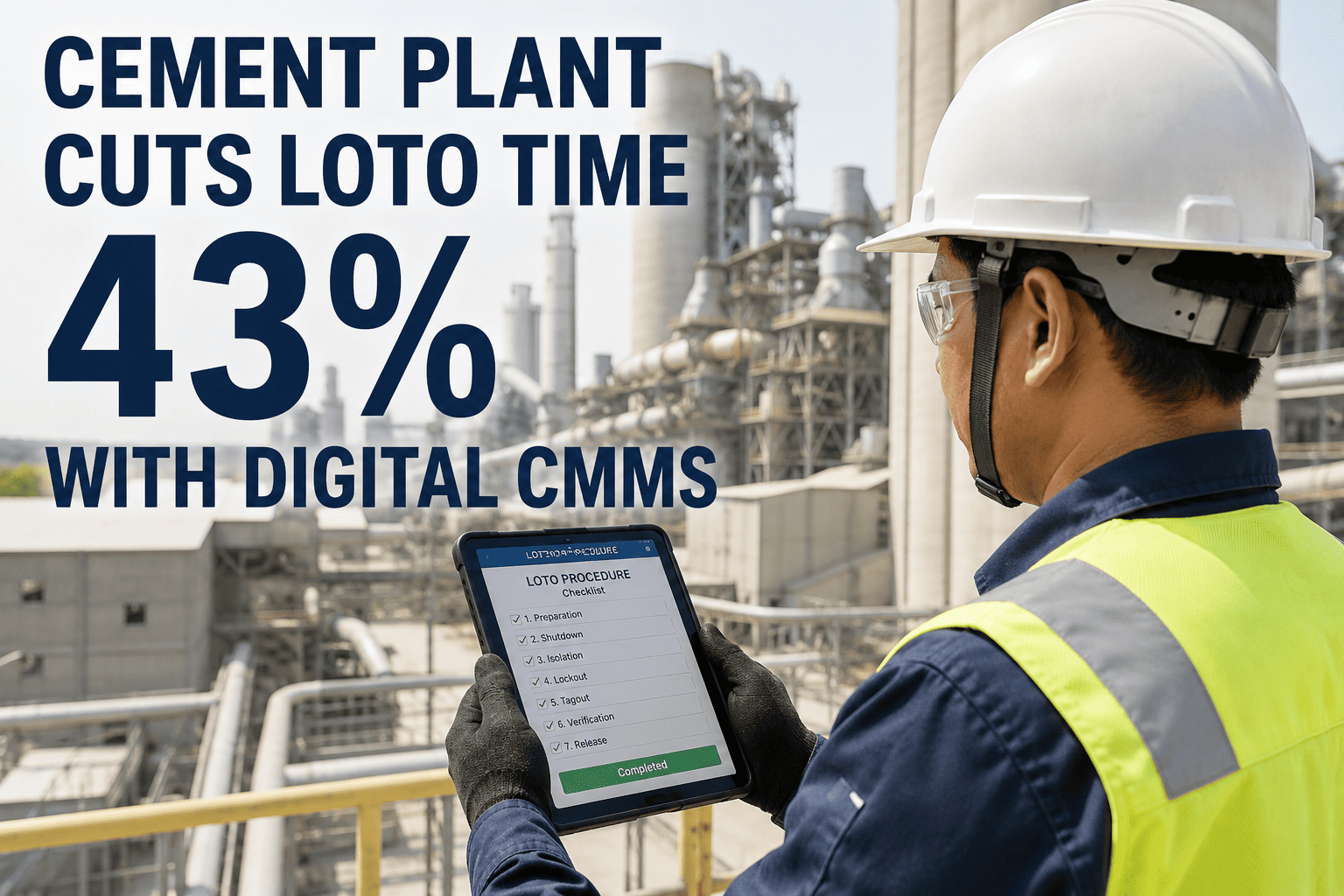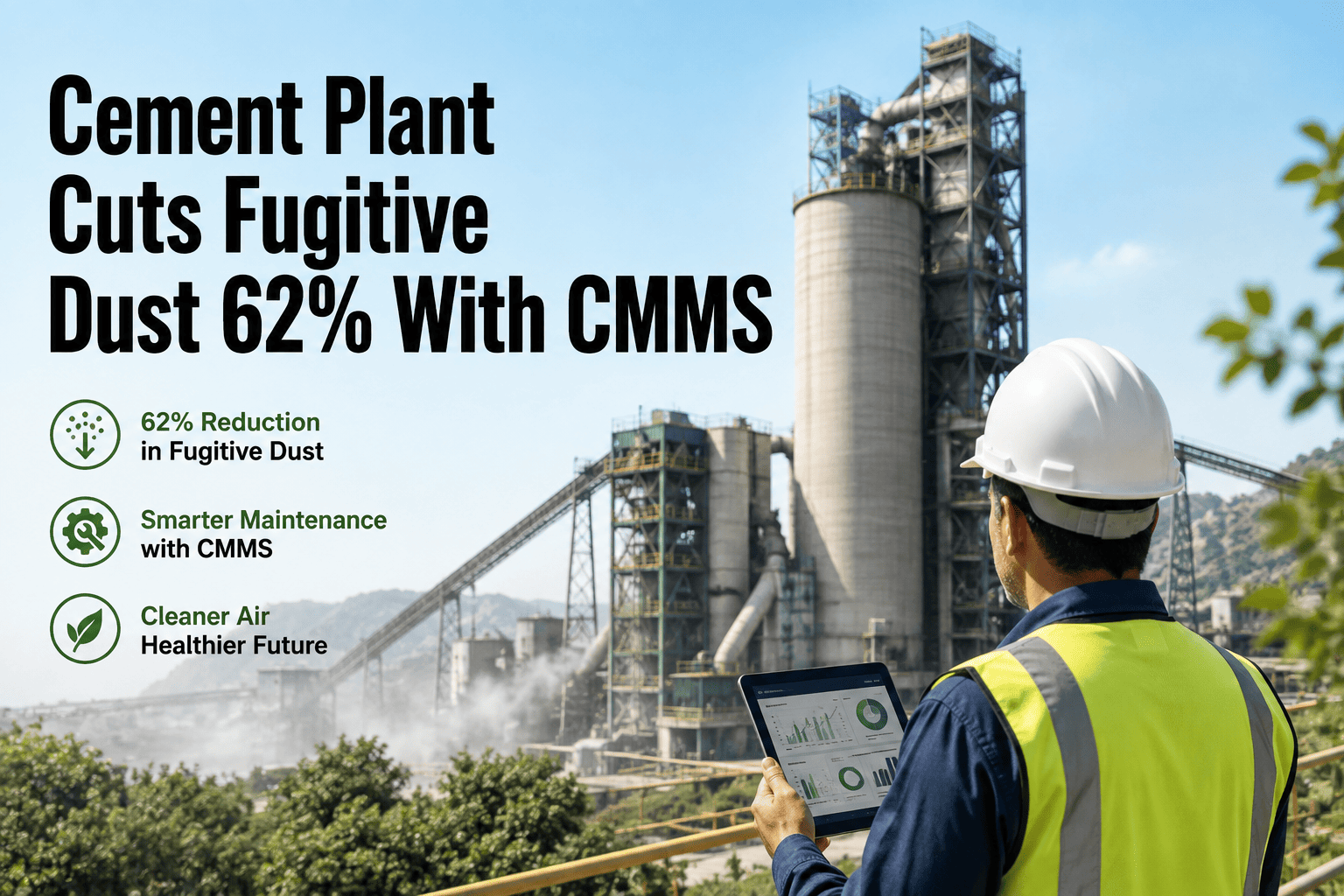
When a Title V renewal audit turns up three fugitive dust exceedances in eighteen months, an environmental team stops trusting paper logs. That was the reality inside a 4-million-ton-per-year integrated cement plant before it rebuilt its maintenance program around a digital CMMS. Baghouse inspections that used to happen whenever someone remembered became scheduled, tracked, and tied directly to differential pressure readings. Eighteen months later, fugitive dust events were down 62 percent and the Title V renewal closed without a single corrective action. This case study breaks down exactly how that turnaround happened, and you can start the same platform on a free trial to see it for yourself.
How a 4-Million-Ton Cement Plant Cut Fugitive Dust Events by 62%
A field breakdown of the baghouse, CEMS, and mobile inspection rollout that turned a chronic Title V compliance risk into an audit-ready operation in under six months.
A 4-million-ton-per-year cement plant is not a small operation to keep clean. Between the quarry haul roads, the raw material stockpiles, the crushing and grinding circuits, the kiln line, and the finish mills, there are dozens of points where fine particulate can escape if a single piece of dust-control equipment falls even slightly behind its maintenance schedule. Most plants know this in theory. Very few plants can say, on any given day, exactly which baghouse compartment is trending toward trouble before it actually does. That gap between knowing dust control matters and being able to prove it in real time is what this case study is really about.
The Plant Before: A System That Said Yes When the Shelf Was Empty
The plant runs two dry-process kilns, a raw mill, a finish mill, and a clinker cooler, each with its own baghouse or electrostatic precipitator standing between production and the stack. On paper, the environmental program looked complete. In practice, baghouse inspections were logged on clipboards that sat in a site office for days before anyone typed them into a spreadsheet. Differential pressure readings were recorded but rarely trended, so a bag going into cake buildup looked identical to a bag running clean until the moment it blinded out and pushed particulate past the permit line. The plant was averaging eleven fugitive dust events per quarter, most traced back to the same six or seven root causes repeating month after month.
The environmental coordinator described the old process as reading tea leaves. A dP chart update meant walking to the control room, asking an operator to read a gauge, and writing the number on a form that would not be reviewed for another week. By the time a trend was visible to a human being, the underlying filter had usually already failed. Maintenance work orders followed the same lag. A blocked suppression nozzle spotted during a shift walkaround could sit unreported for days if the inspector forgot to mention it at handover, because there was no mobile system to capture the finding on the spot.
None of these six problems were unusual. Ask almost any maintenance manager at a mid-size cement plant and they will recognize every card above from their own operation. What made this plant different was not that the problems went away on their own. It was the decision to treat them as a maintenance data problem first, rather than an environmental compliance problem to be solved with more paperwork and a bigger binder at renewal time.
The Rollout: Five Phases From Baseline to Go-Live
The environmental and maintenance teams did not attempt a plant-wide overhaul on day one. Instead, they mapped every dust-relevant asset, connected the highest-risk systems first, and expanded coverage in structured phases so that field staff were never asked to learn two workflows at once. Leadership set one condition on the whole project: nothing could slow down kiln throughput during the rollout, which meant every integration step had to run in parallel with normal production rather than requiring a dedicated shutdown window.
Inside the Baghouse Program: What Actually Changed
The single biggest shift was moving bag replacement from a calendar-based guess to a data-triggered decision. Differential pressure readings on every compartment were trended against clinker tonnage, not the calendar, so a mill running above rated capacity triggered an earlier inspection window automatically. Bag life forecasting flagged filters approaching end-of-life weeks in advance, which let the maintenance team schedule replacements during planned kiln shutdowns rather than mid-shift emergencies. Within two quarters, the share of bag replacements happening as unplanned emergency work dropped from roughly sixty percent to under twenty percent, and every one of those planned swaps cost a fraction of the rush-contractor rate the plant had been paying.
CEMS calibration followed the same logic. Instead of a technician manually tracking calibration due dates across a dozen analyzers, the system generated the schedule itself and logged every quality assurance check against the specific permit clause it satisfied. When a sensor did drift, the plant caught it during a routine calibration cycle rather than during a surprise regulator visit, which is exactly the scenario that turns a maintenance gap into a six-figure notice of violation.
| Metric | Before CMMS | After 18 Months |
|---|---|---|
| Fugitive dust events per quarter | 11 | 4 |
| Baghouse bypass incidents per year | 7 | 2 |
| Average CEMS data availability | 91% | 99.2% |
| Opacity notices of violation | 3 in 18 months | 0 |
| Compliance package prep time | 3 days | 25 minutes |
| Unplanned emergency bag swaps | 61% | 19% |
| Annual penalty exposure | $290,000 | $0 |
The Cost of Waiting: Why Early Detection Pays for Itself
Every fugitive dust program eventually runs into the same math. A filter caught early is a routine line item. The same filter caught late is a production stoppage, a rush order, and possibly a regulatory notice. The plant's own incident history mapped almost exactly onto this curve, and it became the argument that got the rollout funded in the first place.
Finance leadership did not approve the project because of an environmental appeal. They approved it after the maintenance team laid out five years of incident cost data and showed that the plant was spending roughly the same amount reacting to failures that it would cost to prevent them, minus the two notices of violation that reactive spending could not avoid. The chart below is a simplified version of the case they presented, built from the plant's own repair and penalty history rather than an industry average.
The insight was not that emergencies are expensive, which every plant already knows. It was how steep the curve gets between stage three and stage five. A plant that catches a problem one stage late does not pay a little more, it pays an order of magnitude more, and the difference between those stages is almost entirely a question of whether a data trend was visible before or after the filter failed.
The Title V Renewal: What the Auditor Actually Asked For
Renewal season is where a paper-based dust program usually falls apart, because the reviewer is not asking for a summary, they are asking for the underlying record. This plant's renewal package needed six categories of evidence, and every one of them traced back to a maintenance transaction rather than a narrative written after the fact.
None of this documentation was assembled specifically for the renewal. It existed already, as the ordinary byproduct of running the maintenance program day to day. That is the real difference between a plant that treats compliance as a filing exercise and one that treats it as a maintenance discipline: the paperwork is a side effect of doing the work correctly, not a separate project that starts the week before the auditor arrives.
Results Beyond Dust: What Changed Operationally
Fugitive dust was the headline metric, but the same discipline that closed that gap also touched adjacent parts of the operation. Planned maintenance now accounts for the large majority of bag filter work, which freed up the contractor budget that used to absorb emergency callouts. Kiln downtime tied to dust-control equipment fell as bags stopped failing mid-run. And because every environmental record now lives in the same system as the rest of the maintenance program, the insurance carrier's annual audit, which had flagged incomplete housekeeping documentation the year before, closed without findings and the plant qualified for a reduced premium tier tied to documented preventive maintenance rates.
The mobile inspection habit spread past dust control within a few months, almost on its own. Crews who got used to logging a blocked nozzle from a handheld device during a baghouse walkaround started using the same app for general housekeeping findings, lubrication checks, and combustible dust layer measurements around the mill areas. None of that expansion was part of the original project plan. It happened because the field team found the tool faster than the clipboard it replaced, and once that trust was established, it carried into every corner of the plant where a paper log had been the default.
The environmental team also stopped treating each regulatory framework as a separate project. CEMS calibration records that satisfy Title V data availability requirements are the same records that support ISO 14001 environmental aspect tracking and NFPA 654 combustible dust housekeeping evidence. Once the underlying maintenance data existed in one structured system, pulling it into three different compliance formats became a matter of filtering the same dataset three different ways, not running three separate documentation efforts in parallel.
Perhaps the most durable change was cultural rather than technical. Maintenance technicians who once viewed environmental compliance as a separate department's paperwork now see a rising differential pressure reading as their own early warning system, because the alert appears in the same queue as every other work order they are responsible for. Compliance stopped being something that happened to the maintenance team during renewal season and became something the maintenance team produces automatically, every single shift.