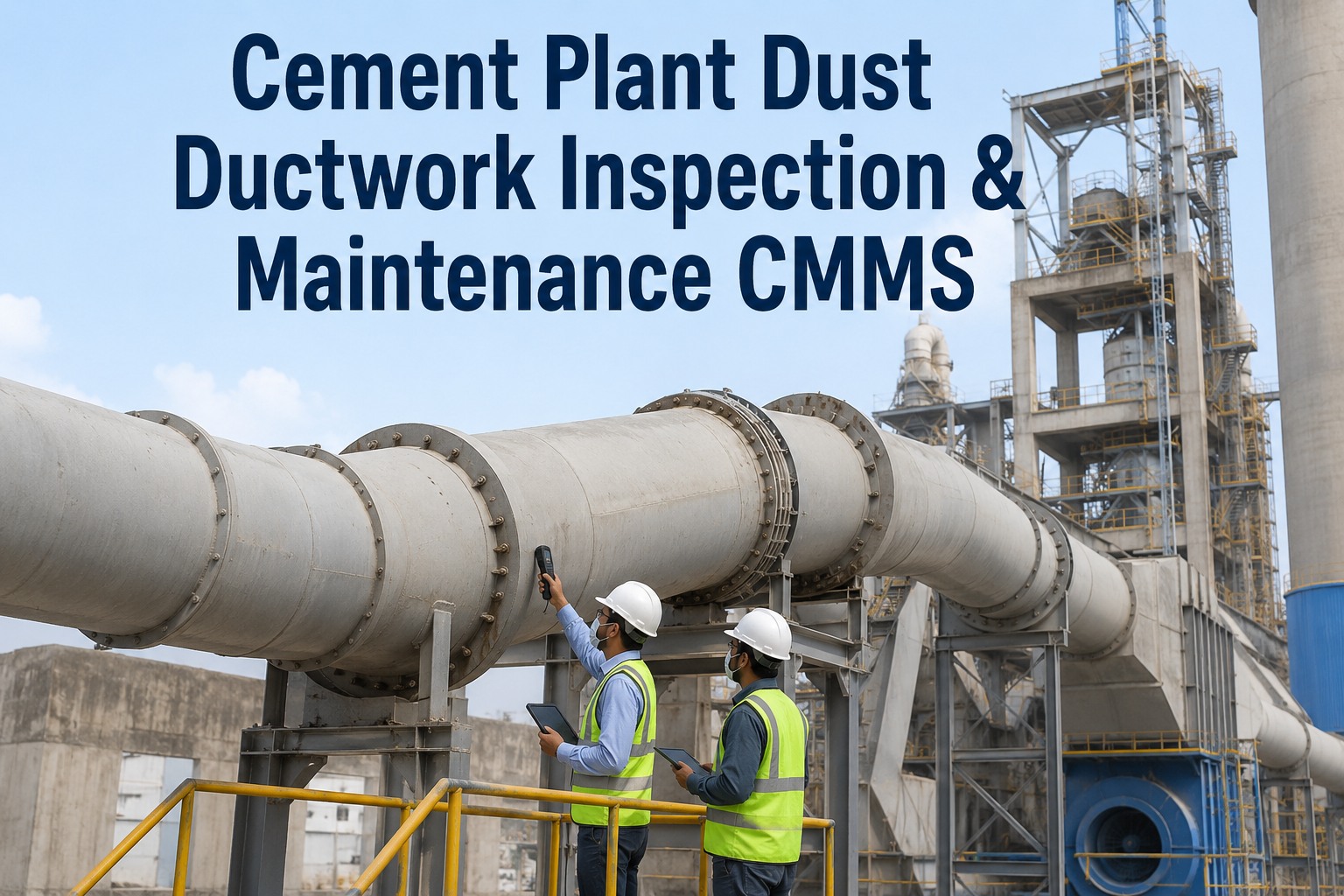
Cement plant dust ductwork is the silent backbone of conveying, dedusting and emission control — yet most plants only inspect it after a leak, a buildup blockage, or an unscheduled shutdown reveals the damage. Abrasive cement dust moves at 18–22 m/s through carbon-steel runs, wearing 3 mm wall thickness down to razor-thin in 18–36 months, while flange gaskets harden and expansion joints crack open under continuous 120–180 °C service. A CMMS-driven ductwork inspection program catches these failures weeks before they escalate, converting reactive firefighting into scheduled 20-minute interventions. Ready to stop ducting surprises? Start Free Trial and build your ductwork register today.
What if your next shutdown was triggered by a 3 mm wear-through you could have caught at 1.2 mm?
Dust ductwork failures rarely arrive with warning — they arrive as a hot spot on the duct wall, a puff of kiln dust at a flange, or a sudden draft loss across the baghouse. A CMMS-structured inspection program turns those surprises into 90-day, 180-day and 365-day scheduled tasks.
Three failure modes that quietly drain cement plant OEE
Across a typical 5,000 TPD cement plant running 12–18 km of dust ducting, three mechanisms account for over 85% of unplanned ductwork events. Each is predictable, measurable, and CMMS-trackable — if the inspection cadence is enforced.
A 180-asset plant in Rajasthan spent roughly $42,000/yr on emergency duct repairs — six unplanned interventions averaging 7 hrs of kiln downtime each. After migrating to a CMMS-driven quarterly ultrasonic thickness (UT) inspection and semi-annual flange torque audit, unplanned duct events dropped to one per year within 14 months, saving an estimated $31K in labor and lost production. Payback on the CMMS seat licenses: under 11 weeks.
The CMMS ductwork inspection checklist — by frequency and component
Build these as recurring work orders inside the CMMS. Each task links to the asset record, the inspection form, the acceptance criteria and the spare-part kit — so a 20-minute field check becomes auditable data, not a clipboard note.
Visual & Operational Checks
- Walk all main duct runs for visible dust leaks at flanges and joints — flag any >5 cm dust accumulation.
- Verify expansion joint fabric integrity — no tears, bulging, or heat discoloration beyond 200 °C rated zone.
- Inspect dampers and diverter valves for full travel and positive seating — record actuator cycle count.
- Check support hangers, guides and sliding bases for binding — flag any visible distortion or corrosion.
- Record differential pressure across each baghouse/cyclone tie-in — trend against CMMS baseline.
Flange Seal & Joint Service
- Re-torque flange bolts to spec (typically 40–70 Nm for M12–M16) using a calibrated torque wrench — log values in CMMS.
- Replace any gasket showing compression set >30% or edge cracking — use ISO 15156-compliant materials for sour service.
- Inspect expansion joint internals via access ports — confirm liner integrity and purge air flow where fitted.
- Clean out dust buildup at low-velocity zones (horizontal runs <15 m/s) — record depth and location.
- Verify flex-element travel indicators — confirm movement within design range at operating temperature.
Wear Liner & Thickness Survey
- Ultrasonic thickness (UT) survey at 12 and 6 o'clock positions on every bend, reducer and T-branch — minimum 3 readings per location.
- Map readings to the CMMS asset record — flag any wall below 1.5 mm on 3 mm parent material for replacement planning.
- Inspect ceramic tile and basalt wear liners for spalling, debonding and impact fracture — replace sections with >20% loss.
- Internal boroscope inspection of long straight runs — document buildup, scaling and any internal weld cracking.
- Update the criticality ranking of every duct segment — feed results back into the next year's inspection frequency.
Wear-liner, gasket and expansion-joint thresholds at a glance
These are the pass/fail limits that should auto-generate a corrective work order inside the CMMS the moment an inspector enters a value. Setting them as conditional triggers removes debate and shortens the repair-request loop from days to minutes.
| Component | Inspection Method | Green — OK | Yellow — Monitor | Red — Replace / Repair |
|---|---|---|---|---|
| Duct wall (3 mm CS) | UT thickness gauge | > 2.2 mm | 1.5 – 2.2 mm | < 1.5 mm |
| Wear liner (basalt/tile) | Visual + tap test | < 10% surface loss | 10 – 20% loss, no debond | > 20% loss or debond |
| Flange gasket | Visual + torque check | No leak, full recovery | Minor dust trace, 20% set | Visible leak, > 30% set |
| Expansion joint fabric | Visual + thermal imaging | No tears, even color | Surface discoloration | Tear, bulge, hot spot |
| Damper / diverter | Stroke + seat check | Full travel, sealed | Sluggish travel | Binding or pass-through |
| Dust buildup | Depth gauge at access ports | < 10% cross-section | 10 – 25% | > 25% — flow restricted |
From inspection trigger to verified repair in under 48 hours
A CMMS doesn't just store inspection forms — it enforces the loop. The timeline below shows the six stages a typical ductwork finding moves through, from the inspector's tablet to a closed, verified work order with parts consumed and labor logged.
Inspection form submitted
Inspector enters UT reading of 1.3 mm at the kiln exhaust bend — the CMMS auto-flags the asset Red against the 1.5 mm threshold and creates a corrective work order.
Planner assigns & kits parts
Maintenance planner reviews the WO, attaches the pre-built duct-splice kit from inventory, and schedules the job for the next available 4-hour window in the kiln's low-load period.
Field execution
Two fitters cut out the worn bend section, weld in a 6 mm replacement spool with a ceramic-tile-lined interior, and re-torque the flanges to spec — labor and consumables logged on the WO.
QA verification
Inspector re-measures wall thickness at the repair, confirms flange torque values, and signs off the WO in the CMMS — asset status returns to Green.
Criticality re-ranking
The CMMS automatically raises the next UT survey on this bend from 365 to 180 days — feeding the wear-rate trend back into the inspection schedule.
KPI dashboard updates
Mean time-to-repair, percent inspections completed on schedule, and duct-related downtime hours all roll up to the reliability dashboard for the next morning's production meeting.
What a CMMS-driven ductwork program actually returns
The cost of a CMMS seat is trivial against the cost of one unplanned kiln stop. The numbers below are illustrative for a mid-size cement plant running 12 km of dust ducting with 220 duct assets in the register.
Combines kiln downtime (7 hrs × $1,200/hr), emergency labor premium, and expedited spare procurement.
Includes mobile inspection licenses, one-time UT equipment amortized over 5 years, and inspector certification refresh.
Payback period under 11 weeks. 4.2× return in year one, improving as the inspection history matures and failure predictions sharpen.
| KPI | Baseline (Reactive) | Year 1 (CMMS) | Year 2+ (Mature) |
|---|---|---|---|
| Unplanned duct events / yr | 6 | 2 | ≤ 1 |
| Mean time to repair | 11 hrs | 5 hrs | 3.5 hrs |
| Inspections on schedule | ~45% | 88% | 97% |
| Duct-related downtime hrs/yr | 66 | 14 | ≤ 6 |
| Spare parts inventory turn | 1.1× / yr | 2.4× / yr | 3.1× / yr |
Stop treating ductwork as invisible infrastructure
Build your cement plant's ductwork register, inspection forms and acceptance thresholds in OxMaint — and turn the next wear-through into a planned 4-hour job instead of a 7-hour kiln stop.
Cement plant ductwork CMMS — what teams ask first
How often should cement plant dust ductwork be inspected?
A tiered cadence works best: visual walkdowns every 90 days, flange seal and expansion-joint service every 180 days, and a full ultrasonic thickness survey plus wear-liner inspection every 365 days. High-criticality segments — kiln exhaust, raw-mill discharge, and clinker-cooler dedusting — should run the 180-day UT survey instead of annual. The CMMS enforces these frequencies automatically and escalates any segment that trends toward the yellow threshold. Book a Demo to see the scheduling engine in action.
What wall thickness triggers duct replacement in a cement plant?
For standard 3 mm carbon-steel ducting, the red-line replacement threshold is 1.5 mm — roughly 50% wall loss. Between 1.5 and 2.2 mm the segment enters a monitoring state with a shortened UT interval. Below 1.5 mm the CMMS should auto-generate a corrective work order because erosion rates accelerate non-linearly once the wall thins, and a wear-through can develop in weeks under high-velocity dust load.
Can a CMMS predict duct failure from inspection history?
Yes. By logging UT thickness readings against the same asset tag over multiple inspections, the CMMS calculates a wear rate in mm per month and projects a remaining useful life date. A bend losing 0.12 mm/month from a 3 mm wall will hit the 1.5 mm red-line in roughly 12 months — the system can schedule a planned replacement 60 days before that date, during a planned kiln outage, instead of reacting to a leak.
How long does it take to set up a ductwork inspection program in OxMaint?
Most cement plants complete the initial duct-asset register, inspection form templates and acceptance-threshold triggers within 2–3 working days. The fastest path is importing your existing duct isometric drawings or asset list as a CSV, then attaching the pre-built cement ductwork inspection form. You can Start Free Trial and have your first 90-day walkdown live on mobile tablets the same week.
What is the typical payback period for a ductwork CMMS program?
For a mid-size plant with 12–18 km of ducting and 6+ unplanned duct events per year, payback typically falls between 8 and 14 weeks. The avoided cost of a single kiln stop — roughly $9,600 in downtime, labor and expedited spares — often exceeds the entire annual CMMS seat cost for the maintenance team. Year-two returns improve as the wear-rate data matures and predictions become accurate enough to shift more repairs into planned windows.
Your ductwork has a story. Let the data tell it before it fails.
Build the register, set the thresholds, enforce the cadence. OxMaint turns cement plant ductwork from a hidden liability into a managed asset — in days, not months.
Free 14-day trial · No credit card