A cement plant consuming $4M–$12M in MRO supplies annually — bearings, lubricants, conveyor belts, refractory materials, electrical components, and mechanical consumables — is making hundreds of individual procurement decisions per month with no coordinated strategy behind them. The average cement plant runs 200–400 active MRO suppliers, pays list price on 60–70% of purchases, holds 18–24 months of slow-moving inventory in the maintenance warehouse, and processes emergency purchases at 25–50% cost premiums every time a production-critical part is not stocked when needed. Strategic MRO procurement — built on supplier consolidation, blanket purchase order frameworks, CMMS-integrated requisitioning, and consumption-driven inventory replenishment — consistently delivers 15–25% reduction in total MRO spend within 18 months of structured implementation. Book a demo to see how Oxmaint integrates procurement workflows, supplier management, and inventory replenishment across cement plant MRO operations.
The Financial Scale of Cement Plant MRO Procurement
Compliance Standards by Region: Procurement and Supply Chain Management
Cement plant procurement operations are subject to import documentation, supplier qualification, hazardous materials procurement, and financial reporting obligations that vary by region. Oxmaint automates purchase order documentation, supplier qualification records, inventory audit trails, and procurement compliance reporting — keeping every plant's purchasing programme current across all applicable frameworks without manual administration.
| Region | Key Frameworks | Oxmaint Coverage |
|---|---|---|
| USA | OSHA hazardous materials procurement requirements, EPA REACH substance restrictions, SOX internal controls for purchasing, Trade Agreements Act compliance | Hazardous material supplier documentation, purchase order audit trails, inventory valuation records, supplier qualification tracking |
| UAE | UAE Federal Customs Authority import documentation, Civil Defence approved supplier requirements, ADNOC supply chain standards, In-Country Value programme | Import documentation records, approved supplier registers, local content tracking, multi-site procurement dashboards |
| India | GST procurement compliance, Ministry of Commerce import licensing, BIS product certification for specified items, Factories Act maintenance procurement safety requirements | GST-linked purchase order records, BIS certification tracking per supplier, import licence documentation, statutory procurement audit trails |
| Germany | EU REACH chemical procurement regulations, Lieferkettensorgfaltspflichtengesetz supply chain due diligence, EU machinery directive approved parts sourcing, BetrSichV replacement part documentation | REACH substance compliance documentation, supply chain due diligence records, approved parts certification tracking, BetrSichV replacement part audit trails |
| UK | UK REACH post-Brexit substance regulations, Modern Slavery Act supply chain requirements, COSHH hazardous materials procurement documentation | UK REACH compliance records, supplier modern slavery statement tracking, COSHH substance documentation, digital audit trail exports |
| Canada | CEPA hazardous substance procurement requirements, Provincial OHS maintenance parts safety standards, CBSA import documentation requirements | Hazardous substance compliance tracking, import documentation records, provincial safety standard supplier qualification, multi-site procurement reporting |
Oxmaint delivers purchase order documentation, supplier qualification tracking, hazardous materials compliance records, and procurement audit trail management for cement plant MRO programmes across every region above — accurate records available at every financial or regulatory audit, without manual data assembly.
What Is MRO Procurement Optimisation in Cement Manufacturing?
MRO procurement optimisation is the structured approach to sourcing, purchasing, and replenishing all maintenance, repair, and operations supplies in a cement plant — from critical rotating equipment spares such as bearings, coupling elements, and gearbox components through to consumables including lubricants, filter elements, welding materials, and electrical supplies — with the objective of reducing total procurement cost, eliminating stockout risk on production-critical items, and minimising working capital locked in slow-moving inventory. In cement manufacturing, where unplanned equipment failures triggered by stockouts cost multiples of the parts savings from an unoptimised procurement strategy, MRO procurement is a direct driver of plant availability and production cost. Book a demo to see how Oxmaint connects CMMS work orders, inventory management, and procurement workflows in a live cement plant environment.
Strategic Sourcing and Supplier Consolidation
Rationalising 200–400 active MRO suppliers to 40–80 preferred suppliers with negotiated pricing, service level agreements, and quality standards — concentrating spend to achieve volume-based pricing, preferred customer service levels, and reduced transaction costs across the purchase order cycle. Supplier consolidation consistently delivers 8–15% unit cost reduction and 30–50% reduction in purchase order processing cost per transaction.
Blanket Purchase Order Frameworks
Annual or multi-year blanket purchase orders with preferred suppliers for high-volume, predictable MRO items — bearings, belts, lubricants, filter elements, and refractory consumables — establishing pre-negotiated unit prices and delivery commitments that eliminate repetitive tendering cycles. Blanket orders reduce purchase order processing cost from $80–$150 per transaction to $15–$30 per call-off, while locking in pricing against market volatility for the contract period.
CMMS-Integrated Procurement Workflows
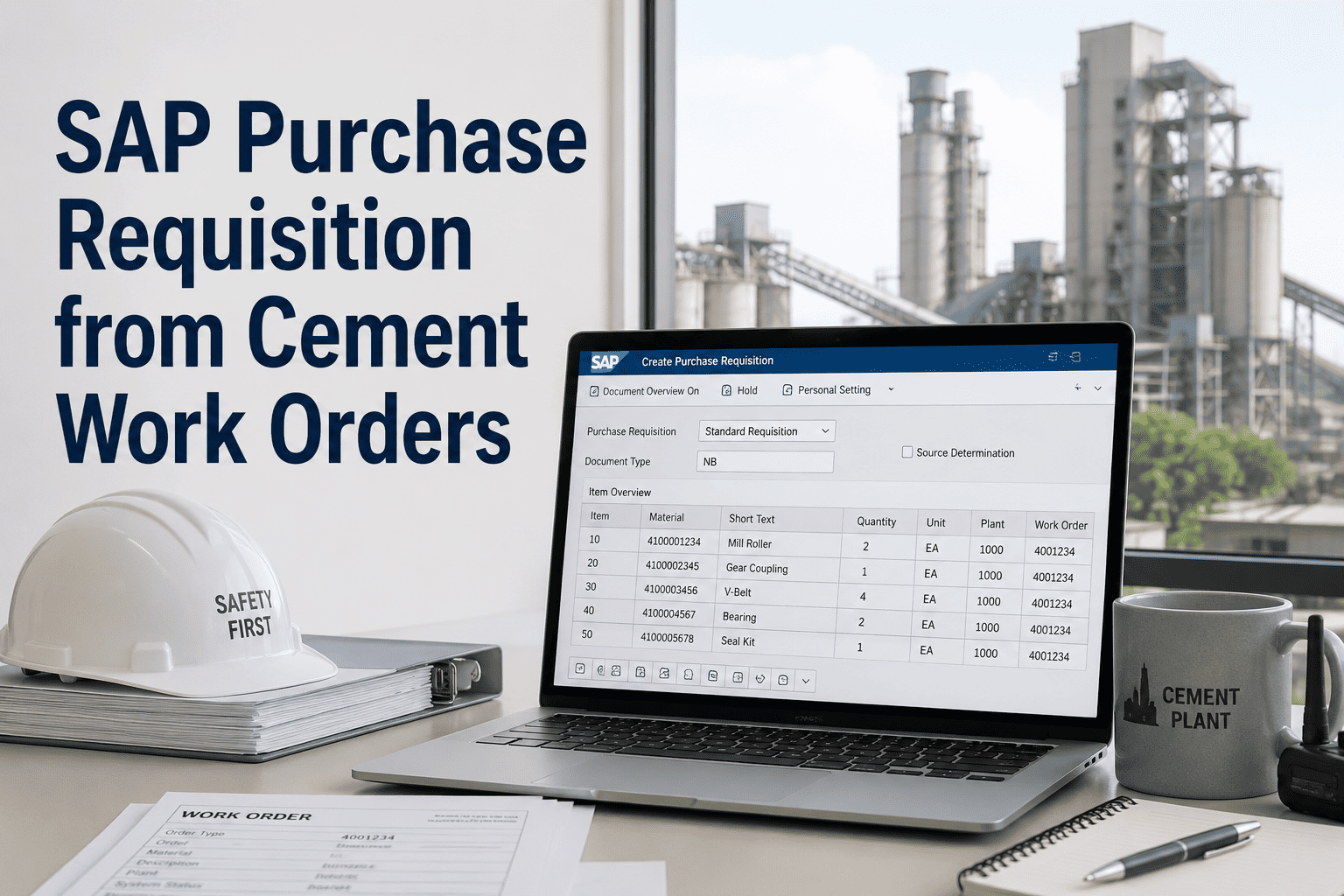
Work order-driven material requisitions that link maintenance demand directly to procurement — eliminating the manual translation step between CMMS-identified parts needs and purchasing department action. When a CMMS work order identifies a required spare part below minimum stock level, a purchase requisition is generated automatically and routed through the approval workflow, reducing procurement response time from days to hours and eliminating the manual re-keying errors that generate wrong-part deliveries.
Inventory Replenishment Optimisation
Minimum and maximum stock level settings calibrated to actual consumption rates and supplier lead times — not historical rules of thumb — with automated reorder point alerts generated when stock falls to the reorder level. Economic order quantity calculations applied to high-volume consumables to minimise the combined cost of ordering frequency and holding capital. Slow-moving inventory identified for disposal or return, releasing working capital frozen in parts that no longer match current equipment asset registers.
See Oxmaint Running Integrated MRO Procurement for Cement Plants
Our team will walk you through a live demo with CMMS-linked procurement workflows, supplier performance dashboards, inventory replenishment management, and purchase order analytics built for cement manufacturing — in under 30 minutes.
Four MRO Procurement Failures Inflating Maintenance Cost in Cement Plants
These four structural failures are the root cause of inflated MRO spend, unnecessary production stoppages, and excessive working capital locked in maintenance warehouses across cement plants worldwide — and all four are directly addressable through structured CMMS-integrated procurement management.
Fragmented Supplier Base with No Volume Leverage
A cement plant with 300 active MRO suppliers is buying the same bearing types from six different distributors at six different list prices, running separate purchase orders to each, managing six different invoice streams, and holding no volume relationship with any of them. Each supplier provides standard list pricing because no single order is large enough to justify discount negotiation. The cumulative premium paid across a fragmented supplier base versus a consolidated programme with three to four preferred bearing distributors typically exceeds 12–18% of total bearing procurement spend annually — representing $80,000–$200,000 in avoidable cost for a medium-sized plant.
Emergency Purchases on Every Critical Failure
When a kiln drive gearbox bearing fails and the same bearing is not in stock, the plant faces a choice between an emergency express delivery at 25–50% cost premium plus courier cost, or a production shutdown while standard lead time procurement is processed. Most cement plants without structured critical spares programmes experience 15–25 emergency purchase events per year on rotating equipment alone — each carrying the unit cost premium plus 3–8 hours of kiln downtime cost while the procurement is processed. The total annual cost of emergency purchasing consistently exceeds the entire inventory carrying cost that would have prevented it.
Procurement Disconnected from CMMS Work Orders
When the CMMS identifies a required spare part during work order planning and the technician manually communicates that requirement to a purchasing clerk by phone, email, or paper requisition — with no direct system link — errors multiply at every step. Wrong part numbers are transcribed, quantities are rounded up arbitrarily, approval routing is bypassed under time pressure, and no automatic connection is made between the work order consuming the part and the inventory record being decremented. The result is systematic inventory inaccuracy, parts ordered twice, and procurement decisions made without visibility of current on-hand stock or pending deliveries.
Slow-Moving Inventory Accumulating for Decades
Cement plants accumulate MRO inventory that no longer matches their current asset register — spare parts for equipment that was replaced or decommissioned, over-ordered quantities from projects long completed, and speculative purchases made during equipment shutdowns that were never consumed. Slow-moving and obsolete inventory in a typical unmanaged cement plant maintenance warehouse represents 25–40% of total inventory value — between $500,000 and $2,000,000 in frozen working capital generating zero operational value. Without CMMS linkage between parts records and active asset registers, this accumulation continues indefinitely and is never systematically identified for disposal or return.
How Oxmaint Structures Cement Plant MRO Procurement Optimisation
Oxmaint connects the CMMS work order system, inventory management, and procurement workflows into a single integrated platform — ensuring that every maintenance demand drives accurate parts consumption, every consumption event drives replenishment, and every replenishment event is executed through preferred supplier channels at pre-negotiated pricing. Book a demo to walk through the full procurement integration with your plant's maintenance spend profile and supplier base.
Ready to Reduce Your Cement Plant MRO Spend by 15–25%?
Oxmaint deploys across a cement plant's procurement and inventory management workflows in 60–90 days. Start with the parts register linked to asset records, activate automated reorder alerts, and build the supplier performance data that drives consolidation. Book a personalised 30-minute demo — your procurement data, our platform, zero obligation.
Oxmaint Platform: Purpose-Built for Cement Plant MRO Procurement and Inventory
Each module addresses a specific failure point in cement plant MRO procurement — from parts register accuracy to supplier consolidation analytics. Together they form a closed operational loop where every work order drives accurate parts consumption, every consumption event triggers calibrated replenishment, and every supplier interaction builds the performance record that enables strategic sourcing decisions. Book a demo to walk through each module with real cement plant procurement and inventory data.
Reactive MRO Procurement vs. Oxmaint: The Cost and Efficiency Gap
| Factor | With Oxmaint | Manual Management |
|---|---|---|
| Supplier Base Size | 40–80 preferred suppliers with negotiated pricing, SLAs, and consolidated spend. Volume leverage drives 8–15% unit cost reduction versus fragmented list pricing. | 200–400 active suppliers with no volume relationships. Every supplier charges list pricing. Purchase order processing cost multiplied across hundreds of transaction streams annually. |
| Emergency Purchase Frequency | Critical spares stocked to lead-time-calibrated minimum levels. Automated reorder alerts prevent stockouts before they occur. Emergency purchases reduced by 80–90% within 12 months. | 15–25 emergency spot purchase events per year on rotating equipment alone. Each carrying 25–50% unit cost premium plus courier charges and production downtime cost while processing. |
| Procurement Lead Time | Work order material requirements trigger automatic requisitions. Approval routing by value threshold. Blanket order call-offs processed in hours. Critical parts on-site within agreed lead time windows. | Manual requisition raised by technician, communicated to purchasing by phone or email, re-keyed by purchasing clerk, routed manually for approval. Average 2–5 day internal processing before supplier order is placed. |
| Inventory Accuracy | Every work order part consumption decrements inventory automatically. Stock records reflect actual on-hand quantities. Reorder alerts based on accurate data — not reconciled monthly from physical stocktakes. | Manual consumption recording missed under time pressure. Stock records diverge from physical inventory within weeks. Monthly stocktakes required to reconcile — and always find discrepancies requiring investigation. |
| Slow-Moving Inventory | Parts with 12-month zero consumption flagged automatically. Obsolescence analysis against current asset register. Working capital release quantified for finance team — $200,000–$600,000 typical first-year release. | Slow-moving inventory accumulates for years without identification. Warehouse space consumed by parts for decommissioned equipment. Physical annual stocktake is the only discovery mechanism — if it is done at all. |
| Supplier Accountability | Delivery performance, price versus contract, and quality rejection tracked per supplier. Consolidation and renegotiation decisions backed by 12-month delivery data. Underperformers exited with documented rationale. | Supplier performance tracked informally through personal relationships and complaints. Renegotiation happens when a contract expires — not when performance data justifies it. No evidence base for consolidation decisions. |
Cement Plant MRO Procurement Optimisation Performance Benchmarks
These performance improvements represent average outcomes from cement plants that transitioned from reactive MRO procurement to structured Oxmaint-integrated programmes within 18 months of deployment.
Your MRO Cost Reduction Programme Starts Here
Oxmaint delivers measurable MRO procurement improvements within 60–90 days of deployment. Book a 30-minute demo to map your current procurement spend profile against best practice benchmarks — and build a business case for your finance and operations leadership teams.
MRO Category Profiles: Procurement Strategy by Maintenance Supply Type
Optimal procurement strategy — supplier selection, stocking policy, order frequency, and contract structure — differs significantly across the major MRO categories consumed in cement plant operations. A single procurement approach applied uniformly across all categories is one of the most common causes of both stockout risk on critical parts and overstocking on low-value consumables. Book a demo to see how Oxmaint manages procurement strategy differentiation across your plant's full MRO category structure.
Rotating Equipment Spares — Bearings and Seals
Every bearing mapped to its installed equipment asset in Oxmaint — minimum stock levels calibrated to failure frequency and lead time per size class. A-class bearing sizes on critical kiln and mill equipment held at one replacement plus lead time coverage. Blanket orders with two preferred distributors covering 90% of size range — call-offs placed automatically when reorder point is reached. Consumption from each work order decrements stock in real time, preventing the phantom inventory problem that drives emergency purchases.
Refractory Materials — Bricks, Castables, Mortars
Refractory procurement linked directly to kiln zone condition data in Oxmaint — zone thickness measurements from annual inspections drive quantity forecasts for the next shutdown procurement cycle. Framework agreements with preferred refractory suppliers structured around shutdown schedule commitments rather than spot purchasing. Materials ordered 8–12 weeks before shutdown commencement based on zone-by-zone condition assessment, eliminating both under-ordering that delays shutdown start and over-ordering that generates disposal cost on unused specialised grades.
Lubricants, Oils, and Greases
Lubrication types rationalised to minimum product range in Oxmaint parts register — cross-reference between previous multi-brand specifications and consolidated single-brand equivalents mapped by equipment asset. Vendor-managed inventory programme possible with preferred lubricant supplier managing tank levels directly. Consumption tracked by PM work order closure — lubrication task completion linked to lubricant stock decrement, giving procurement accurate monthly consumption data per product for replenishment and supplier performance review.
Conveyor Belts, Drives, and Mechanical Consumables
Belt replacement intervals linked to PM schedules in Oxmaint — procurement call-offs triggered by PM due date rather than reactive stock replenishment. Belt size and specification confirmed against current conveyor drive asset record before each purchase, preventing the accumulation of wrong-specification belts that becomes slow-moving inventory. Mechanical consumables consumption tracked per shift and per equipment type — identifying where consumption rates differ from expectations and driving investigation into application conditions causing accelerated wear.
ROI From Structured MRO Procurement Optimisation in Cement Plants
Frequently Asked Questions: MRO Procurement Optimisation for Cement Plants
QWhat is the typical MRO spend reduction achievable in a cement plant and over what timeframe?
QHow does CMMS integration with procurement actually work in practice?
QHow should critical spare parts minimum stock levels be calculated for cement plant rotating equipment?
QWhat procurement compliance obligations apply to cement plant MRO purchasing globally?
QHow long does it take to implement CMMS-integrated MRO procurement management in a cement plant?
QCan Oxmaint procurement data integrate with SAP MM or Oracle Fusion procurement modules?
Continue Reading: Cement Plant Supply Chain and Inventory Resources
Explore these in-depth guides to build a complete picture of warehouse management, vendor management, logistics optimisation, and procurement strategy across cement manufacturing operations.
Start Optimising Your Cement Plant MRO Procurement Today
Oxmaint deploys across your cement plant's procurement and inventory workflows in 60–90 days — no heavy implementation fees and no long onboarding. Start with the parts register linked to asset records, activate automated reorder alerts, and build the consumption and supplier performance data that drives 15–25% MRO spend reduction within 18 months. Book a 30-minute demo — your procurement data, our platform, zero obligation.