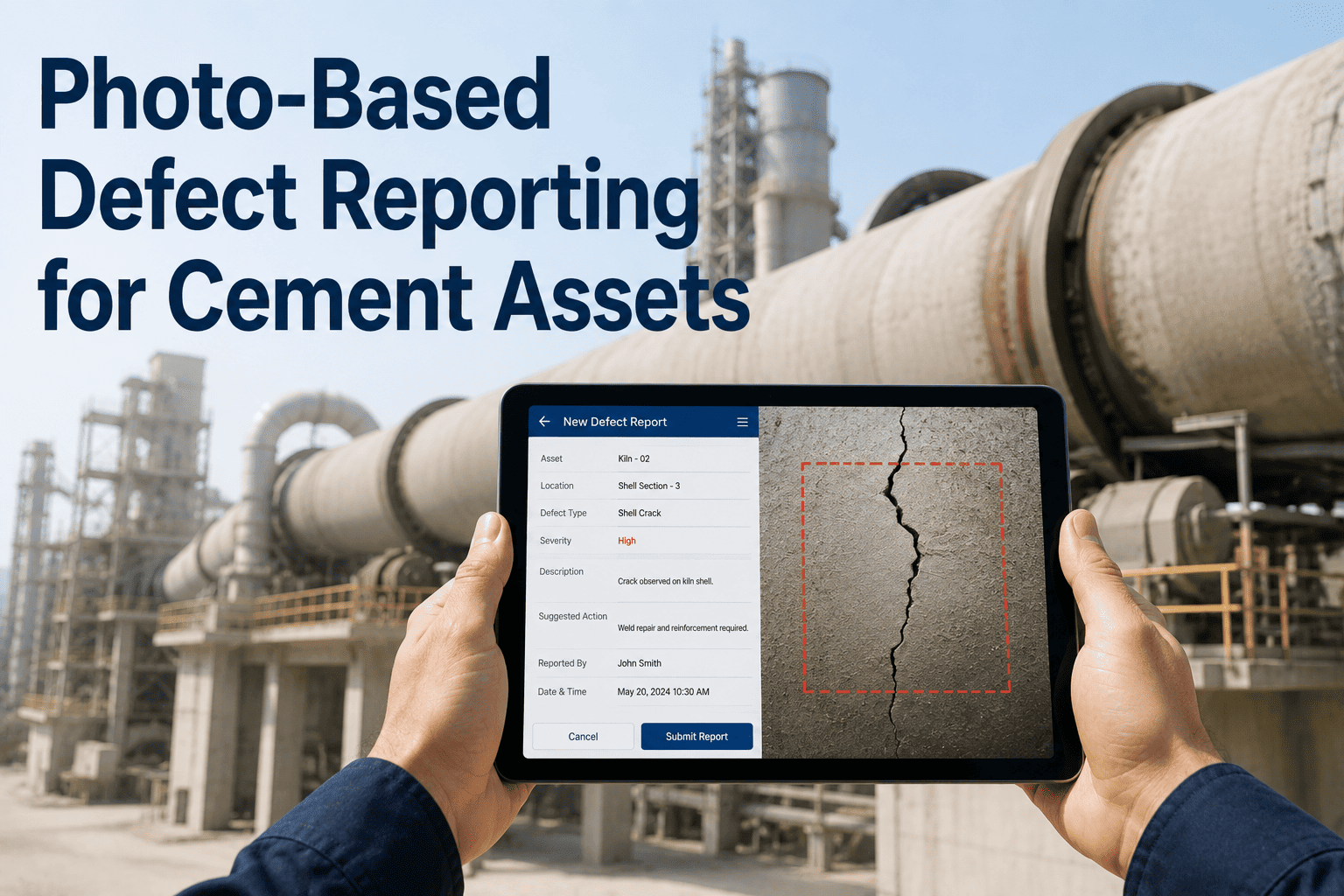
Cement plant equipment fails visibly before it fails completely — a crack in a kiln shell, oil weeping from a bearing housing, a misaligned conveyor belt. But when defects are reported in text-only work requests with no photo, no asset tag, and no priority, the maintenance team spends more time locating the problem than fixing it. OxMaint's photo-based defect reporting gives field operators a mobile-first workflow to capture what they see, tag the asset, attach images, and set a priority — so the right technician arrives with the right parts. Deployed at cement plants managing kilns, mills, conveyors, and fans, it turns a verbal report into a traceable corrective work order in under 60 seconds. Sign up free to see how it works, or book a demo for a live walkthrough.
MOBILE CMMS · CEMENT PLANTS · DEFECT REPORTING
See It. Shoot It. Fix It.
Photo-based defect reporting for cement plant assets — from kiln shell to conveyor belt, every defect captured with context, priority, and an auto-generated corrective work order.
60s
Average time to log a photo defect report with asset tag and priority
3x
Faster technician response when defects include photo and location context
Zero
Lost defect reports — every photo ties to an asset, a timestamp, and a work order
THE PROBLEM
Why Verbal Defect Reports Fail Cement Plants
A cement plant runs hundreds of rotating and static assets simultaneously. When an operator spots a defect and reports it verbally or on a paper log, four things typically go wrong before anyone fixes anything.
01
No visual context
The technician dispatched to "check the bearing on the raw mill" arrives with no idea whether it's a leak, a noise, or a visible crack — and no parts staged.
02
No asset tag link
Defect reports that don't tie to a specific asset ID don't build equipment history. Repeat failures on the same asset go undetected until a breakdown forces the issue.
03
No priority signal
Without a priority level, every report sits in the same queue. A minor lubrication drip and an imminent gearbox failure receive equal urgency — until one of them stops a kiln.
04
No traceable record
Paper logs get misplaced. Verbal reports aren't documented. When an asset fails catastrophically, the maintenance team can't reconstruct what was known and when.
HOW IT WORKS
Four Steps from Defect Spotted to Work Order Created
1
Capture the photo on mobile
The operator opens OxMaint on their phone and photographs the defect in place — no separate camera app, no upload later. The image is attached instantly to the new report.
2
Tag the asset by scan or search
The operator scans the asset's QR code or searches by name — kiln shell section 3, raw mill fan, belt conveyor C-12. The defect ties to that asset's full maintenance history.
3
Set priority and describe
Low, medium, high, or critical — one tap. A short description field captures what the operator observed. The combination of photo, asset tag, and priority contains everything a technician needs to act.
4
Corrective work order auto-generated
OxMaint creates a corrective work order from the report — timestamped, attributed to the reporting operator, assigned to the relevant technician or team, and visible to supervisors in real time.
OXMAINT · PHOTO DEFECT REPORTING · CEMENT ASSETS
Every Defect Your Operators See Should Become a Work Order — Not a Verbal Note
OxMaint's mobile defect reporting deploys in days. No IT project. No hardware. Field operators start logging photo reports the same day they're onboarded.
CEMENT ASSET COVERAGE
Works Across Every Critical Asset in Your Plant
| Asset Type |
Common Defect Types Captured |
Priority Level Typical |
| Rotary Kiln |
Shell cracks, tyre migration, riding ring wear, seal damage |
High / Critical |
| Raw Mill |
Bearing oil leaks, liner wear, gear vibration, fan blade erosion |
Medium / High |
| Belt Conveyor |
Belt misalignment, idler seizure, splice damage, chute spillage |
Low / Medium |
| Preheater Tower |
Refractory spalling, cyclone blockage, gas duct corrosion |
High / Critical |
| Cement Mill |
Separator bearing temperature, diaphragm plate cracks, girth gear wear |
Medium / High |
| Bag Filter / ESP |
Bag leaks, rapper failures, hopper corrosion, discharge electrode damage |
Medium |
FREQUENTLY ASKED
Questions About OxMaint Photo Defect Reporting
Do field operators need training to use the photo reporting feature?
Most operators are productive within a single onboarding session. The workflow — open app, photograph, tag asset, set priority, submit — mirrors how people already use their phones. OxMaint provides onboarding guides and the interface works in low-connectivity environments common in cement plants.
Try it free to see the operator experience.
Can multiple photos be attached to a single defect report?
Yes — operators can attach multiple images per report, covering different angles of the same defect or a before/after sequence. All photos are stored permanently in the asset record and visible within the work order.
How does photo defect reporting connect to preventive maintenance history?
Every photo defect report links to the tagged asset's full history — past PMs, previous defects, corrective work orders. If the same asset has recurring defects, the pattern surfaces automatically in OxMaint's asset history view.
Can supervisors see incoming defect reports in real time?
Supervisors and planners get live visibility of all open defect reports, filterable by asset, priority, and area. High and critical priority reports can trigger instant notifications.
Book a demo to see the supervisor dashboard.
Does this work offline in areas of the plant with no signal?
OxMaint supports offline-first mobile operation. Reports created without signal are queued locally and synced automatically once connectivity is restored — without losing photos, asset tags, or priority data.
OXMAINT · MOBILE CMMS · CEMENT PLANT MAINTENANCE
Stop Losing Defect Reports Between the Field and the Maintenance Office
OxMaint photo defect reporting turns what operators see into timestamped, asset-tagged corrective work orders — before the defect becomes a breakdown.