Calendar-based preventive maintenance made sense when condition data was impossible to capture reliably between inspections. For high-temperature assets in cement plants — kilns, clinker coolers, preheater systems, and pyroprocessing fans — calendar PM is now the more expensive and less reliable option. Replacing refractory on a fixed 6-month interval regardless of actual wear is leaving money on the table. Waiting 30 days to lubricate a kiln drive when vibration data says it needs it now is accepting preventable failure risk. OxMaint integrates inspection readings, sensor thresholds, and technician observations into a single condition-based trigger system that schedules PM when the asset condition demands it — not when the calendar says so. Start building condition-based triggers free on OxMaint or book a demo to see how cement plants are replacing fixed PM cycles with condition-driven maintenance.
Predictive Maintenance · Condition Monitoring · Cement Kiln · High-Temperature Assets
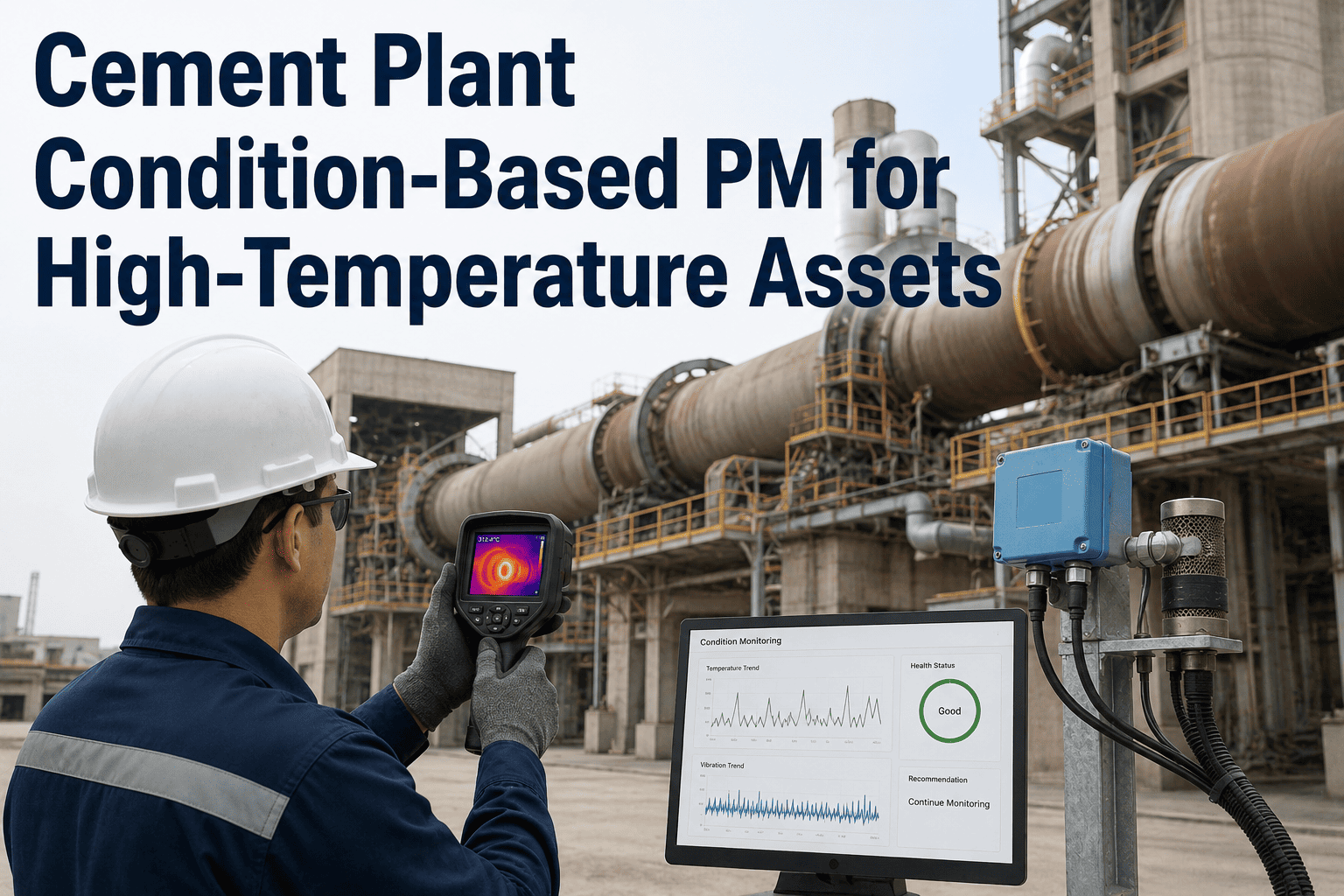
Cement Plant Condition-Based PM for High-Temperature Assets
Kilns, coolers, and preheater fans don't care what date it is. They need maintenance when their condition says they do — and OxMaint gives you the system to know when that is.
Calendar PM
30–45%
of calendar PM tasks performed on equipment in good condition — wasted resource
VS
Condition-Based PM
18–25%
reduction in total PM labour cost when condition-based triggers replace fixed intervals
Why High-Temperature Assets
Why Kiln, Cooler, and Pyroprocessing Assets Need Condition-Based PM — Not Fixed Cycles
High-temperature cement assets operate in conditions where wear rates are non-linear, unpredictable, and highly sensitive to process variables. Kiln shell temperature, feed chemistry, clinker throughput, and raw material abrasivity all affect how quickly refractory degrades, bearings wear, and fan blades erode. A fixed 90-day refractory inspection interval developed for average operating conditions will be too early 40% of the time and too late 20% of the time. Condition-based PM closes this gap by replacing the calendar with actual asset condition as the maintenance trigger.
Rotary Kiln
Calendar PM risk
Refractory replaced early by 3–6 weeks in good operating conditions; late by 2–4 weeks in high-alkali feed
Condition indicators
Shell scanner temperature, tyre slip measurement, kiln axis deviation, refractory thickness gauge
Trigger threshold example
Shell hot spot above 280°C or tyre slip exceeding 0.8% triggers refractory inspection PM
Clinker Cooler
Calendar PM risk
Grate plate replacement based on fixed intervals misses accelerated wear from high-quartz clinker or high throughput periods
Condition indicators
Cooler exit temperature, grate differential pressure, fan motor current, clinker red river events
Trigger threshold example
3 red river events in 30 days or grate DP exceeding design by 15% triggers grate plate inspection
Preheater ID Fan
Calendar PM risk
Impeller imbalance from alkali dust buildup builds faster than fixed inspection intervals account for
Condition indicators
Vibration velocity at fan bearing, motor current trend, bearing temperature, duct pressure drop
Trigger threshold example
Fan bearing vibration above 7.1 mm/s RMS (ISO 10816 Zone C) triggers balancing inspection PM
Kiln Main Drive Gearbox
Calendar PM risk
Oil change interval set at 6 months is too conservative when oil analysis confirms good condition at month 5, too late when contamination occurs at month 3
Condition indicators
Oil temperature, particle count (online), vibration at input and output shaft, pinion tooth wear visual
Trigger threshold example
Oil particle count exceeding ISO cleanliness 18/16/13 or oil temperature above 72°C triggers oil change PM
How OxMaint Works
Three Condition Data Sources OxMaint Uses to Trigger PM
OxMaint creates condition-based PM triggers from three complementary data sources. Each source contributes a different layer of condition visibility — and all three can be active simultaneously on the same asset.
01
Sensor Integration
OxMaint connects to online sensors — vibration transmitters, temperature probes, oil condition monitors, and process instruments — via OPC-UA, MQTT, or REST API. When a measured value crosses a defined threshold, OxMaint automatically generates a PM work order assigned to the relevant technician. No manual monitoring. No missed alerts during shift changes.
Vibration transmitters
Thermocouple arrays
Oil condition sensors
Shell scanners
OPC-UA / MQTT
02
Structured Inspection Readings
During scheduled inspections, technicians enter measurement readings directly into OxMaint checklists — vibration readings from handheld instruments, thermography results, oil sample values, visual condition scores. OxMaint evaluates these entries against pre-set condition thresholds in real time. If the entered value exceeds the limit, a triggered PM work order is created automatically.
Handheld vibration
IR thermography
Oil sample results
Visual condition score
Auto-trigger on entry
03
Technician Observations
OxMaint mobile allows technicians to flag condition observations during any work order or inspection round — unusual sounds, visible wear, abnormal heat, oil leaks. These observations are classified by severity and can trigger PM work orders based on observation type. Technician knowledge — historically the least-captured source of condition intelligence — becomes systematic input to the PM trigger system.
Structured observation codes
Severity classification
Photo attachment
Auto-PM trigger by code
Mobile capture
Configuration Guide
Setting Up Condition-Based PM Triggers in OxMaint — Asset by Asset
Condition-based PM configuration in OxMaint follows a standard 4-step setup process for each asset. This table summarises the recommended configuration approach for the highest-priority high-temperature assets in a cement plant.
| Asset |
Condition Parameter |
Trigger Threshold |
Data Source |
PM Task Triggered |
Applicable Standard |
| Kiln shell |
Hot spot temperature |
Above 280°C |
Shell scanner |
Refractory inspection and thickness gauging |
ISO 15187 |
| Kiln tyre |
Tyre slip rate |
Above 0.8% |
Sensor / inspection |
Tyre migration check and pad inspection |
FLSmidth / KHD OEM spec |
| ID / PA fans |
Vibration velocity (bearing) |
Above 7.1 mm/s RMS |
Vibration transmitter |
Impeller inspection and rebalancing |
ISO 10816-3 |
| Kiln gearbox |
Oil particle count (ISO) |
Exceeds 18/16/13 |
Oil analysis / sensor |
Oil change and filter replacement |
ISO 4406 |
| Cooler grate |
DP across grate section |
15% above design |
DCS / OPC-UA |
Grate plate inspection and replacement plan |
OEM design envelope |
| VRM roller bearings |
Bearing temperature |
Above 85°C |
Thermocouple |
Bearing lubrication and seal inspection |
ISO 7919 |
| Preheater cyclones |
Differential pressure |
Drops 20% from baseline |
DCS / inspection |
Cyclone blockage and wear inspection |
Process baseline |
Scroll horizontally on mobile · Thresholds are indicative — calibrate to your specific OEM specs and operating baseline
Ready to Replace Calendar PMs with Condition Triggers?
Book a 15-minute demo and we will walk through exactly how to configure your first condition-based PM trigger in OxMaint — using a high-temperature asset from your plant as the example.
Transition Roadmap
Phased Transition from Calendar PM to Condition-Based PM in Cement Plants
Transitioning from calendar-based to condition-based PM is not a single-day event. A phased approach allows your team to build confidence with condition monitoring data while maintaining coverage on assets not yet fully instrumented.
Phase 1
Baseline and Identify (Months 1–2)
Continue all existing calendar PMs. Add OxMaint condition monitoring checklists to the top 10 high-temperature assets to establish reading baselines. Identify which assets have sensor data already available in DCS and configure OPC-UA connections. No PM tasks are yet condition-triggered — this phase builds the baseline data needed to set meaningful thresholds.
Output: Condition reading baselines for top 10 assets · DCS integration map · Threshold draft
Phase 2
Parallel Run (Months 3–4)
Configure condition-based triggers in OxMaint for the top 5 assets while continuing existing calendar PMs in parallel. This allows comparison between calendar-triggered and condition-triggered PM timing — and surfaces cases where the condition approach would have triggered earlier or later than the calendar. Threshold values are refined based on observed asset behavior.
Output: Trigger timing comparison data · Refined thresholds · Technician confidence built
Phase 3
Condition-Led with Calendar Safety Net (Months 5–8)
Replace calendar triggers with condition triggers on assets where threshold data is validated. Retain calendar PM as a backstop for assets with insufficient sensor coverage — if a condition trigger has not fired within 1.5x the previous calendar interval, the calendar PM fires anyway. This hybrid approach ensures no asset falls through the gap during the transition.
Output: Condition-triggered PMs for 5–8 assets · Calendar backstop maintained · PM cost trend tracked
Phase 4
Full Condition-Based Programme (Month 9+)
Extend condition-based PM to all instrumented high-temperature assets. Complete sensor installation programme for remaining assets. Review PM cost per tonne trend versus the calendar baseline period to quantify the programme's financial impact. Calendar backstop intervals are widened as confidence in condition data grows.
Output: Full CBM programme · PM cost reduction quantified · CapEx case for remaining sensors
FAQ
Frequently Asked Questions
Does our plant need online sensors installed to use condition-based PM in OxMaint?
No — condition-based PM in OxMaint can be implemented without any online sensors. The inspection reading trigger approach (Source 02) uses readings entered by technicians during scheduled rounds to fire condition-based PM work orders. Vibration readings taken with a handheld probe, temperature readings from an IR thermometer, and oil sample results entered manually all function as condition triggers in OxMaint. Online sensor integration adds real-time automation, but the core condition-based PM capability is available from day one using your existing inspection instruments.
Start free to configure your first reading-based condition trigger without any hardware investment.
How do we set accurate thresholds for condition triggers if we have no historical condition data?
OxMaint's implementation approach starts with an industry-standard baseline using published OEM alarm limits and ISO standards (ISO 10816 for vibration, ISO 4406 for oil cleanliness, ISO 15187 for kiln shell temperature). These provide conservative starting thresholds that are safe in the absence of plant-specific data. Over the first 2–3 months of reading collection, OxMaint's baseline analytics identify your plant's actual operating norms — and thresholds are refined accordingly. Most plants see their thresholds stabilise within one quarter, at which point false-trigger rates drop significantly.
Book a demo to see how threshold calibration works in the OxMaint dashboard.
Can condition-based and calendar-based PMs coexist in the same OxMaint deployment?
OxMaint supports simultaneous calendar-based PMs, condition-triggered PMs, and hybrid PMs (condition trigger with calendar backstop) across different assets in the same plant. This is the recommended approach during the transition phase — maintaining calendar coverage on assets not yet fully instrumented while enabling condition-based triggers on assets with reliable data. The PM schedule view in OxMaint clearly distinguishes trigger type for each scheduled task, so maintenance planners always know which PMs are calendar-driven and which are condition-driven.
Start free and configure your first hybrid PM asset today.
Which cement plant sensors and data sources does OxMaint integrate with?
OxMaint integrates with plant DCS systems via OPC-UA (Siemens PCS 7, ABB System 800xA, Honeywell Experion, and others), OSIsoft PI historians via the PI Web API, direct MQTT streams from IIoT edge devices, and REST API from standalone sensor systems. Standard sensor integrations include vibration transmitters (SKF, Emerson, Brüel and Kjaer), shell scanner systems (Thermoteknix, Testo), and oil condition monitors. For cement-specific DCS integrations, OxMaint's implementation team handles the configuration with your DCS team typically in 2–3 sessions.
Book a demo to review integration compatibility with your specific control system.
What is a realistic PM cost reduction target for a cement plant switching to condition-based PM?
Cement plants that have implemented structured condition-based PM programmes using OxMaint typically see 18–28% reduction in total PM labour hours within 12 months of full implementation, and 12–20% reduction in spare parts consumption from fewer unnecessary component replacements. The reduction is largest on high-frequency assets where calendar PMs were set conservatively — kiln gearbox lubrication cycles, cooler fan bearing inspections, and VRM seal replacements are commonly cited. A 1 MTPA plant spending ₹12 crore annually on maintenance can expect ₹1.8–3 crore in annual savings from a well-implemented condition-based PM programme.
Start free to begin tracking your PM cost baseline for comparison.
Your High-Temperature Assets Are Telling You When They Need Maintenance. Is Your CMMS Listening?
OxMaint turns kiln shell temperatures, fan vibration readings, and oil analysis results into automatic PM work orders — so your maintenance programme responds to what assets actually need, not what the calendar says.