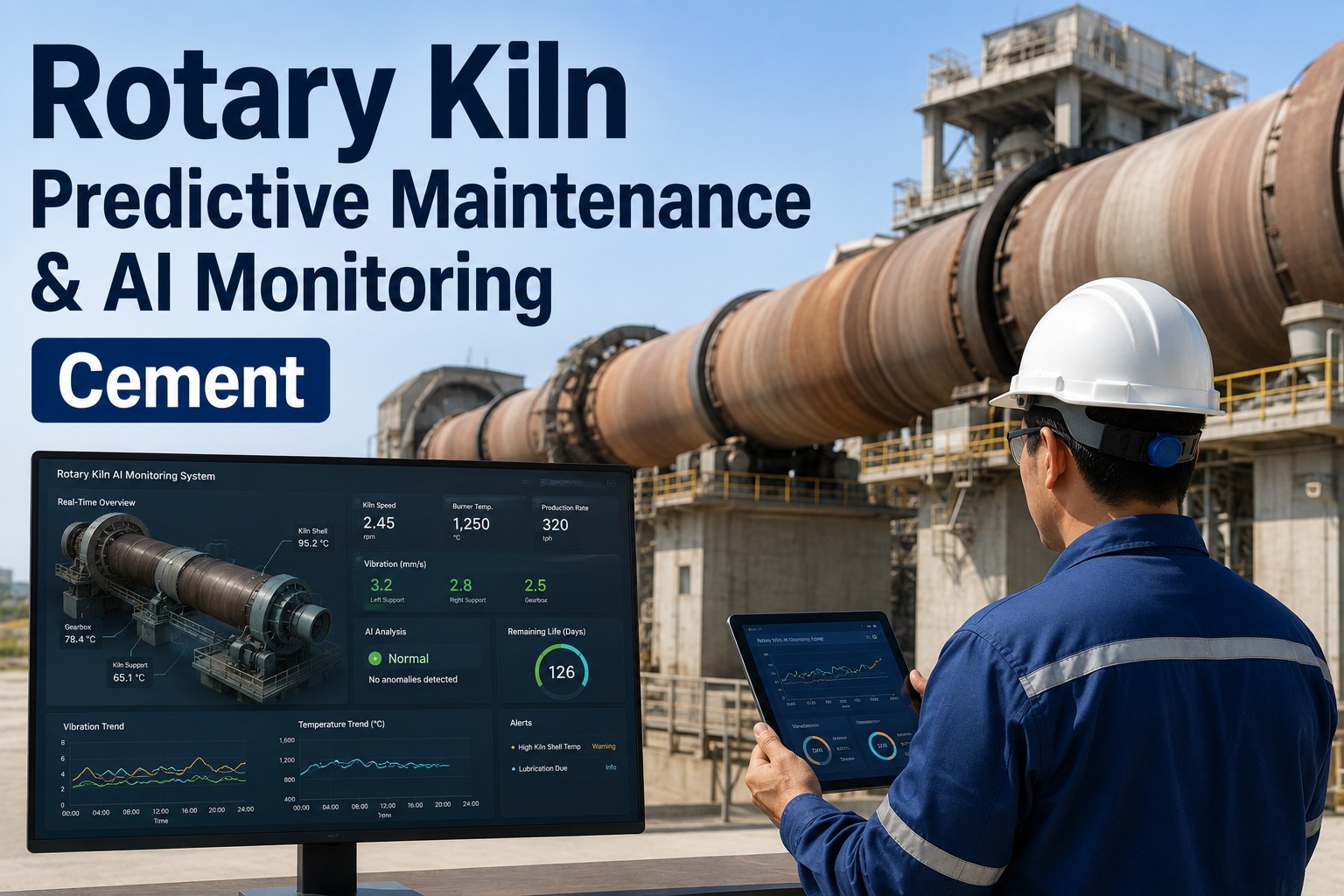
Cement producers lose an estimated $50 billion annually to unplanned downtime, and a single rotary kiln trip can cost upwards of $80,000 per day in lost clinker output. Predictive maintenance has shifted from a competitive edge to a baseline operational standard, driven by shell temperature mapping, tyre and roller condition tracking, and drive train vibration analytics that together feed real-time reliability programs. This guide walks through how AI-based monitoring of bearings, girth gears, and refractory linings—integrated directly with CMMS workflows—converts kiln data into scheduled work orders before failures cascade. Ready to stop reacting and start predicting? Start Free Trial and see the difference on your kiln within 14 days.
What if your kiln could warn you 21 days before a bearing failure?
Modern rotary kiln predictive maintenance fuses shell scanner telemetry, tyre creep data, and drive-train vibration into a single reliability signal — automatically issuing CMMS work orders before a $200K refractory collapse or girth gear crack takes your line offline.
Why predictive kiln maintenance is now standard practice
A modern 5,000 TPD kiln generates over 12,000 data points per hour across shell temperature, thrust rollers, drive amperage, and exhaust gas composition. Plants that still rely on calendar-based PM capture less than 15% of that signal — and pay for it in emergency outages.
The shift is not theoretical. A mid-size single-kiln plant in Southeast Asia spending roughly $42K per year on condition-monitoring contractors saw a $1.3M avoidance credit in year one after deploying an AI monitoring layer — the model flagged a developing crack on a girth gear tooth 18 days before it would have propagated into the root, a failure that typically costs $400K–$700K in gear replacement plus 9–14 days of lost production. The math, in other words, is no longer close.
The five AI monitoring streams feeding your CMMS
Predictive kiln maintenance is not one sensor — it is a fusion of five independent data streams, each with its own failure mode, threshold, and work-order trigger. Here is how they stack up in a fully integrated AI + CMMS workflow.
Shell temperature scanning
Infrared shell scanners sample every 30 seconds, building a thermal map that catches hot spots above 380°C — the early signature of refractory thinning or coating loss. AI trend models predict brick breakthrough 7–14 days out and auto-create a refractory inspection work order in the CMMS.
Tyre and roller condition
Tyre creep, surface spalling, and roller taper are tracked with laser displacement and acoustic emission sensors. AI correlates creep deviation against kiln speed and load, flagging lubrication starvation or bore wear before the tyre begins to crush the riding ring — a failure that costs $250K+ to remediate.
Drive train vibration
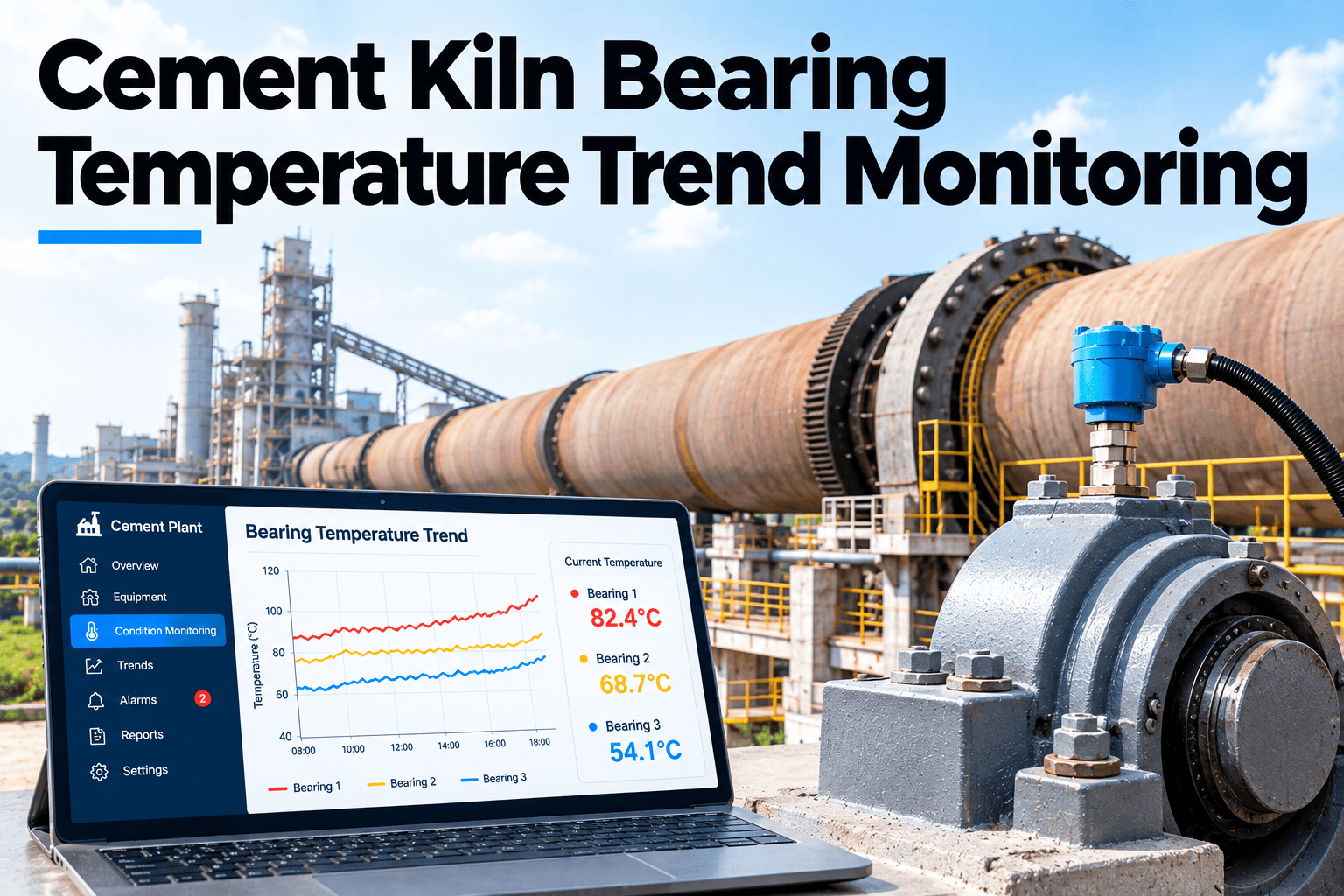
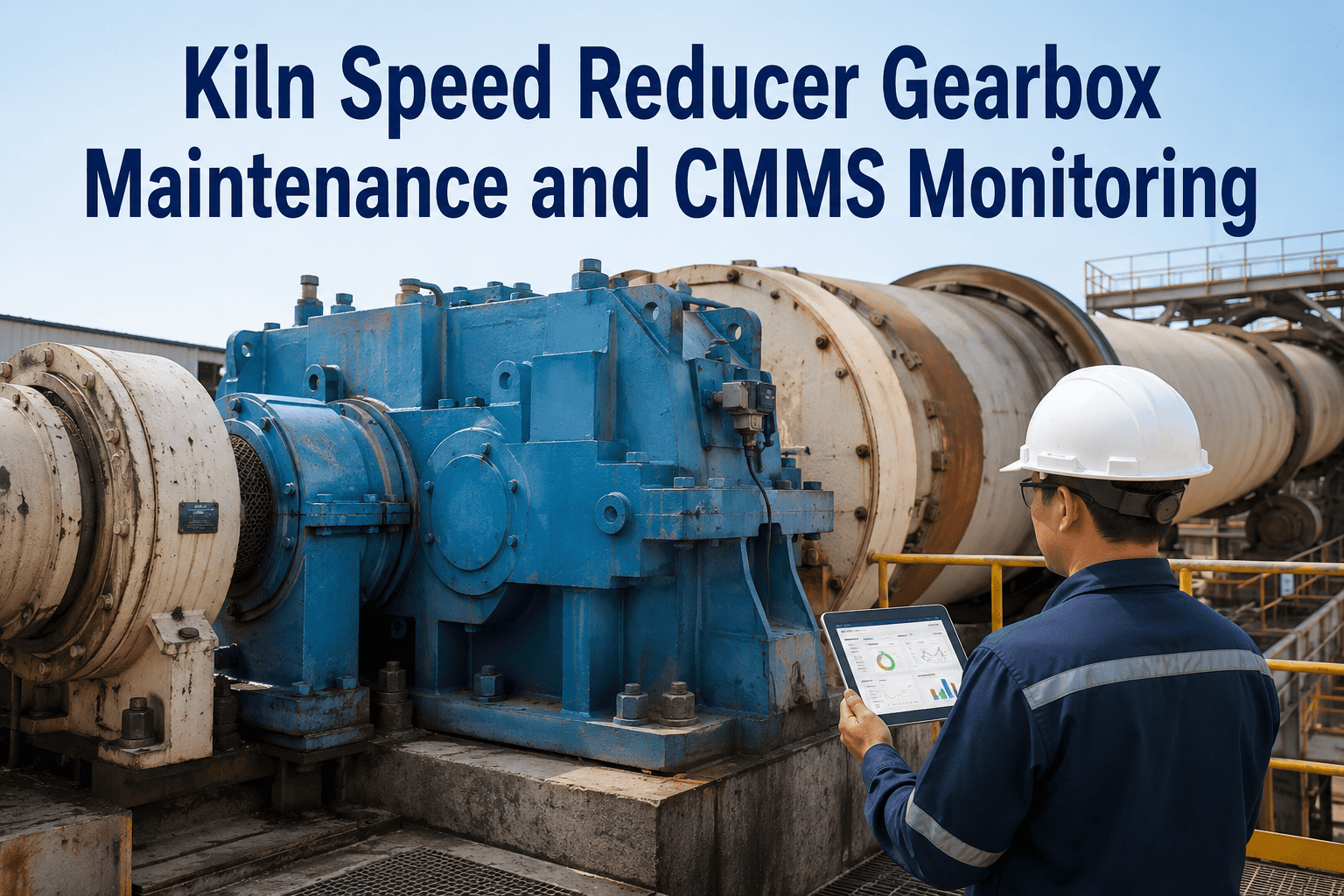
Tri-axial accelerometers on the main drive, girth gear, and pinion capture 0–10 kHz vibration signatures. Bearing degradation (inner-race spalling, cage fracture) shows up as distinct sidebands 3–6 weeks before catastrophic failure — long enough to order parts and schedule a planned 8-hour stop.
Girth gear wear prediction
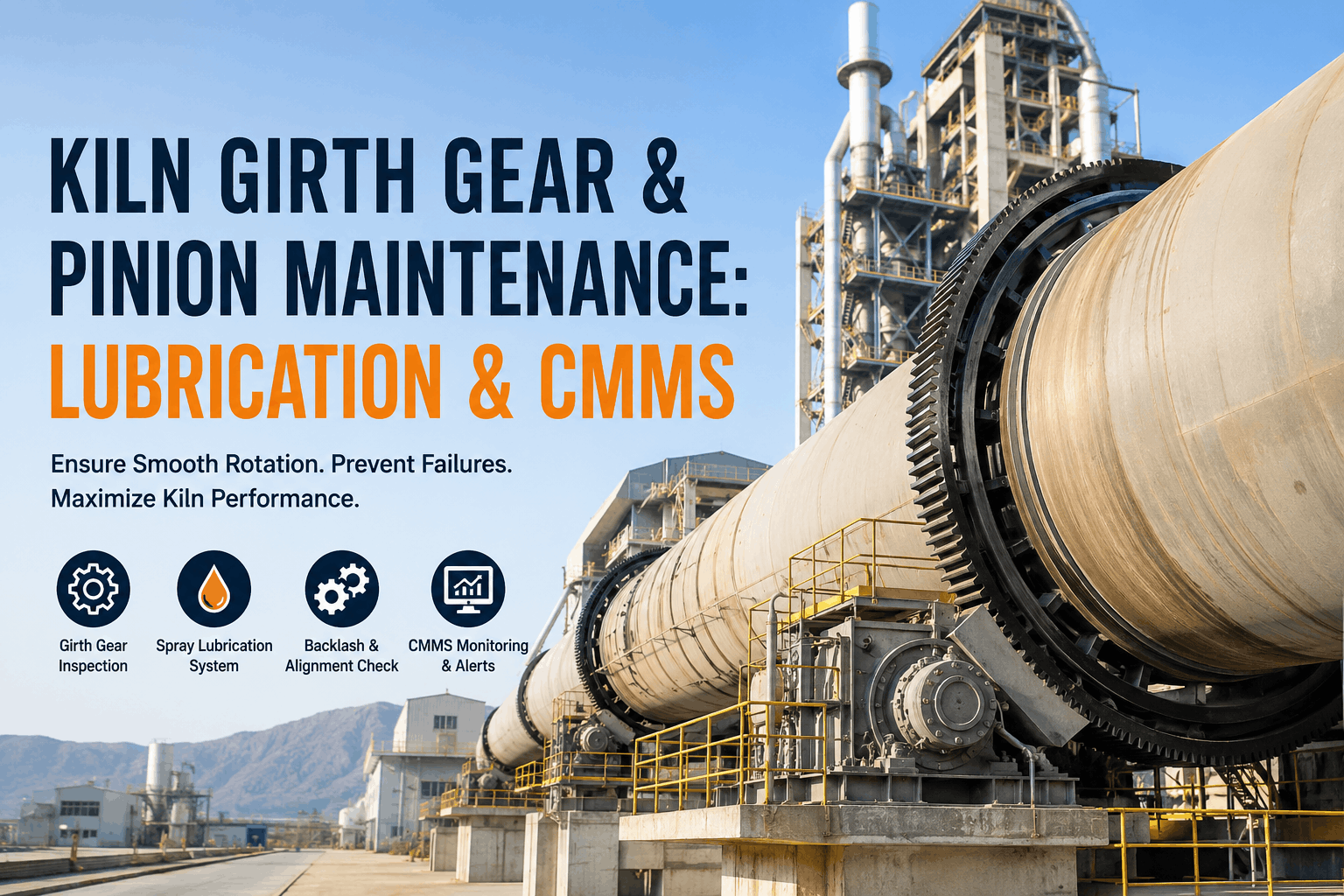
Backlash measurement, tooth-mesh frequency analysis, and lubricant particle counts feed a wear model that extrapolates remaining useful life (RUL) to within ±9%. When RUL crosses the 60-day threshold, the CMMS auto-generates a flank alignment and relubrication order.
Refractory AI monitoring
Shell temperature gradients, kiln feed chemistry, and coating thickness models combine to predict brick lining life per zone. The AI issues zone-specific gunning or brick-replacement recommendations timed to planned outages — cutting refractory consumption by 12–18% and eliminating mid-campaign collapses.
What predictive kiln maintenance pays back — and how fast
A 180-asset cement plant running two kilns typically invests $85K–$140K in sensors, AI platform licensing, and CMMS integration in year one. Here is the payback math, using defensible industry benchmarks.
| Cost / Saving Line | Reactive Baseline | AI Predictive (Year 1) | Annual Delta |
|---|---|---|---|
| Unplanned kiln trips (days/yr) | 11 days | 4 days | +$560K |
| Refractory brick consumption | $680K/yr | $564K/yr | +$116K |
| Girth gear & pinion replacement | $420K (every 7 yr) | $420K (every 10 yr) | +$60K/yr |
| Spare-parts inventory carrying cost | $95K/yr | $61K/yr | +$34K |
| AI platform + sensors (year-1) | — | −$112K | −$112K |
| Net Year-1 Benefit | +$658K | ||
That puts payback at roughly 2.1 months for a typical two-kiln plant — and year-two net benefit climbs above $770K because the platform cost drops to a recurring license only. Plants that extend the model to mills, crushers, and preheaters see the ROI multiply further.
How AI monitoring plugs into your existing CMMS
The predictive layer only creates value if it reaches the maintenance planner. Here is the 4-step data path from sensor to scheduled work order — no spreadsheets, no manual re-entry.
Ingest
Edge gateways collect 12,000+ data points/hour from PLCs, SCADA, vibration sensors, and shell scanners via OPC UA and MQTT. No rip-and-replace of existing DCS required.
Analyze
AI models run anomaly detection, RUL extrapolation, and failure-mode classification. Confidence scores above 0.82 trigger alerts; below that, the signal is logged but not actioned.
Generate
The platform auto-drafts a CMMS work order with asset ID, failure mode, recommended action, parts list, and suggested timing window — sent via REST API to SAP PM, Maximo, Fiix, or eAM.
Verify & Close
After the work order is executed, the model compares post-work sensor data to the pre-work baseline, confirming the fix and feeding the learning loop for tighter future predictions.
We caught a thrust roller bearing fault 19 days before it would have seized. The work order was already in Maximo before my planner had his morning coffee. That single catch paid for two years of the platform.
Aligned with ISO 17359 and ISO 55000 reliability frameworks
Predictive kiln monitoring is not a rogue practice. It maps directly onto ISO 17359 (Condition Monitoring and Diagnostics of Machines) and the ISO 55000 asset-management standard. Plants certified to ISO 50001 (energy) also benefit — a kiln running on predicted, planned stops consumes 4–6% less fuel per tonne of clinker than one cycling through emergency outages, because thermal ramps are controlled rather than shocked.
Turn kiln data into work orders before failures cascade
Deploy AI monitoring on one kiln in under 30 days. Connect your CMMS, ingest 12 months of historical data, and see your first predictive alert within week two.
Rotary kiln predictive maintenance, answered
How quickly can an AI monitoring layer be deployed on an operating kiln?
Most single-kiln deployments go live in 21–35 days. Non-intrusive vibration sensors and infrared shell scanners mount while the kiln runs, and the AI platform ingests 6–12 months of historical SCADA data to calibrate baseline models. Full CMMS integration via REST API typically takes one additional week. You can Book a Demo to see a live deployment timeline tailored to your plant.
Do I need to replace my existing DCS or SCADA system?
No. The predictive layer sits on top of your existing control system, reading data via OPC UA, Modbus TCP, or MQTT. Edge gateways handle protocol translation and buffering, so there is zero disruption to the DCS. If your kiln already has a shell scanner and at least one vibration sensor, you are 60% of the way to having the data the AI models need.
Which CMMS platforms does the system auto-generate work orders for?
The platform sends structured work orders via REST API to IBM Maximo, SAP PM, Fiix, eAM, UpKeep, and most modern CMMS platforms that expose an open API. Each work order includes asset ID, failure mode, recommended action, parts list, priority, and suggested execution window — no manual re-entry by the planner.
What is the typical prediction lead time for the most common kiln failures?
Bearing degradation is flagged 3–6 weeks out via vibration sideband analysis. Refractory breakthrough is predicted 7–14 days ahead via shell temperature trend models. Girth gear tooth wear provides the longest runway — often 60–90 days — because the wear model extrapolates from backlash and particle-count trends. That lead time is what converts a $200K emergency into a $35K planned stop.
How much does the platform cost and what is the realistic payback?
Year-one investment for a single kiln ranges from $85K to $140K, covering sensors, edge hardware, AI platform licensing, and CMMS integration. Recurring annual cost drops to $30K–$55K thereafter. Median payback across surveyed cement plants is 2.1 months, driven primarily by avoided unplanned downtime ($80K/day) and refractory savings (12–18%). You can validate the math on your own kiln — Start Free Trial for 14 days, no credit card required.
Start predicting kiln failures before they happen
Join 40+ cement plants using AI monitoring to cut unplanned downtime by 37% and extend refractory life by 12–18%. Deploy on one kiln, see results in 14 days.
Free 14-day trial · No credit card