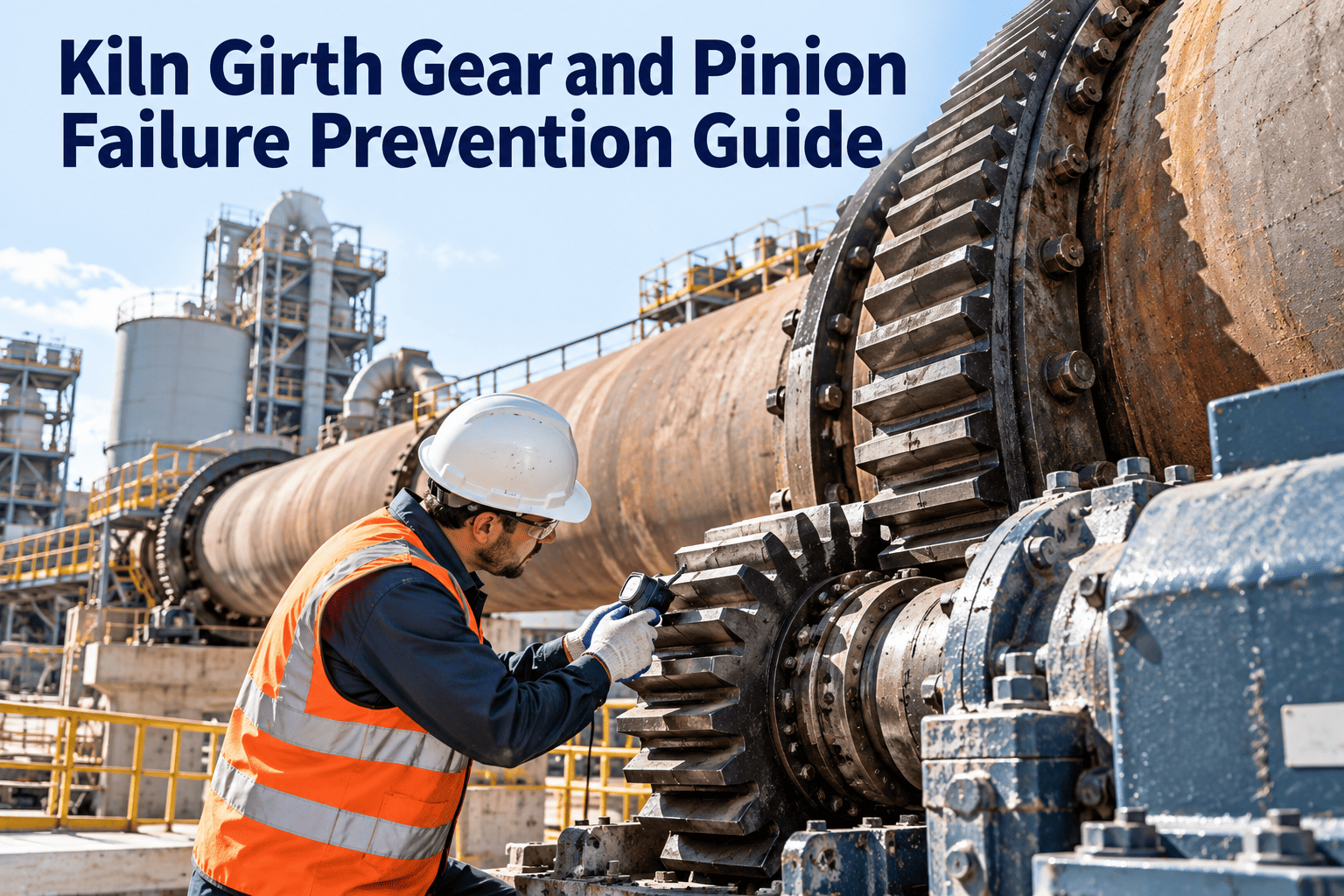
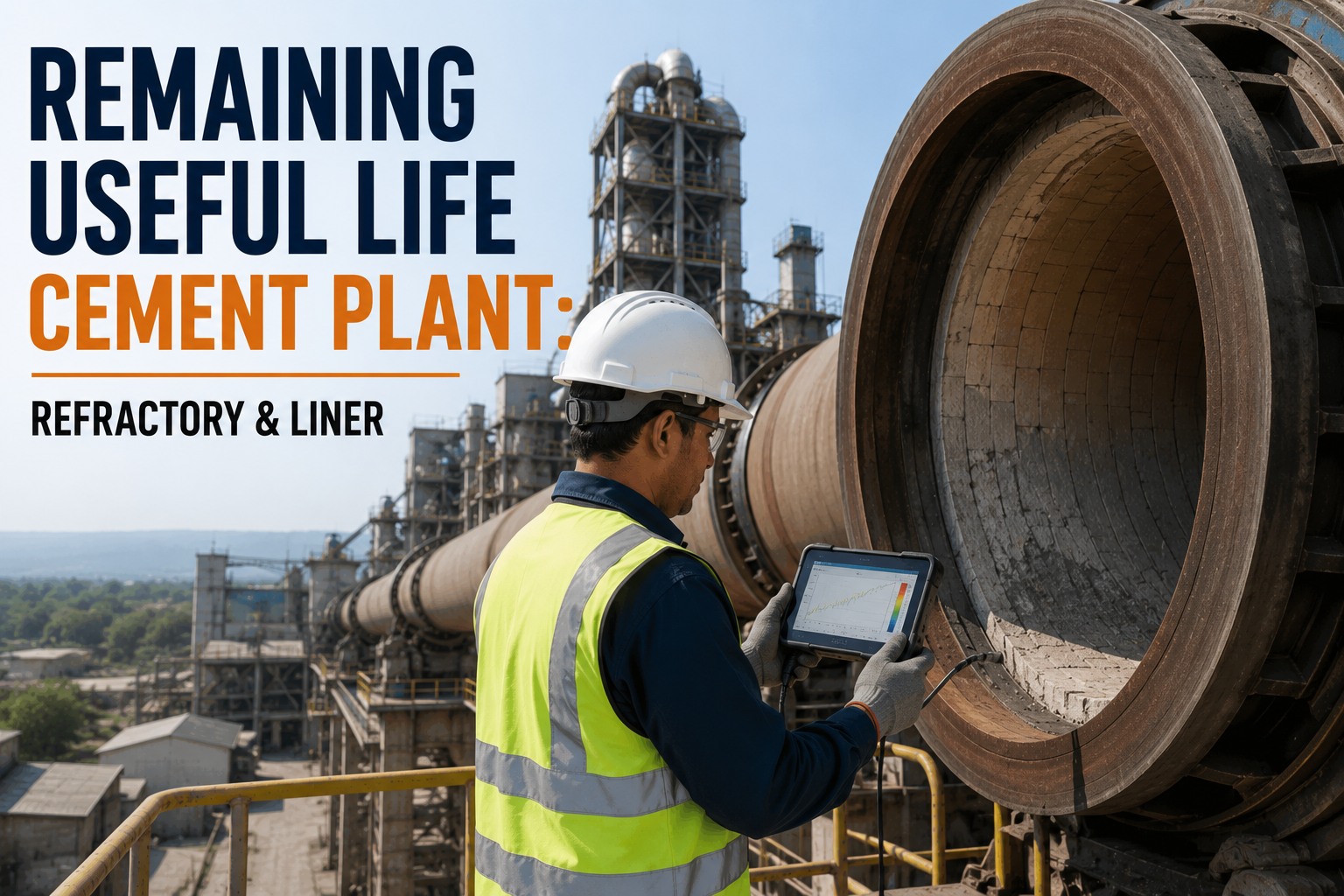
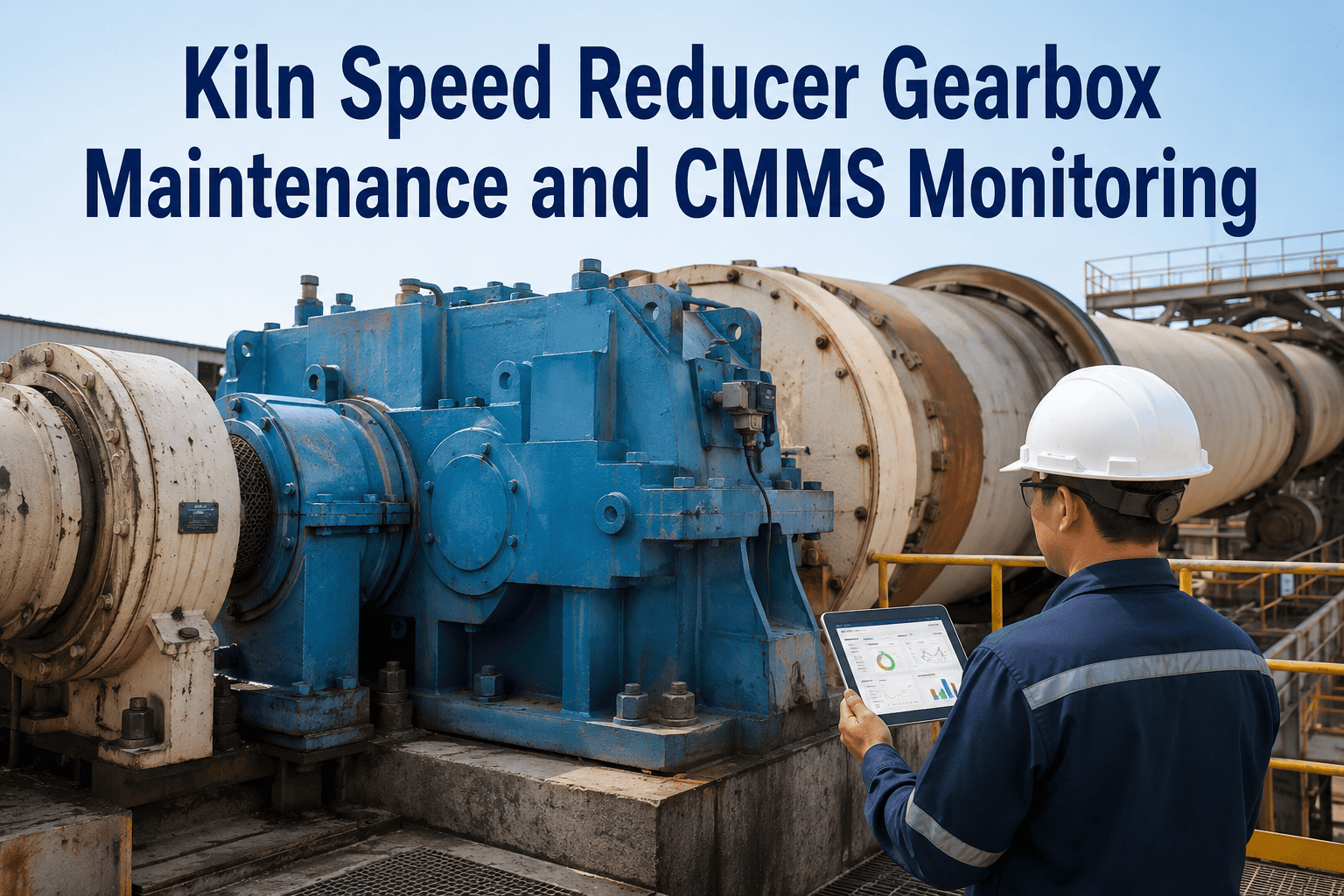
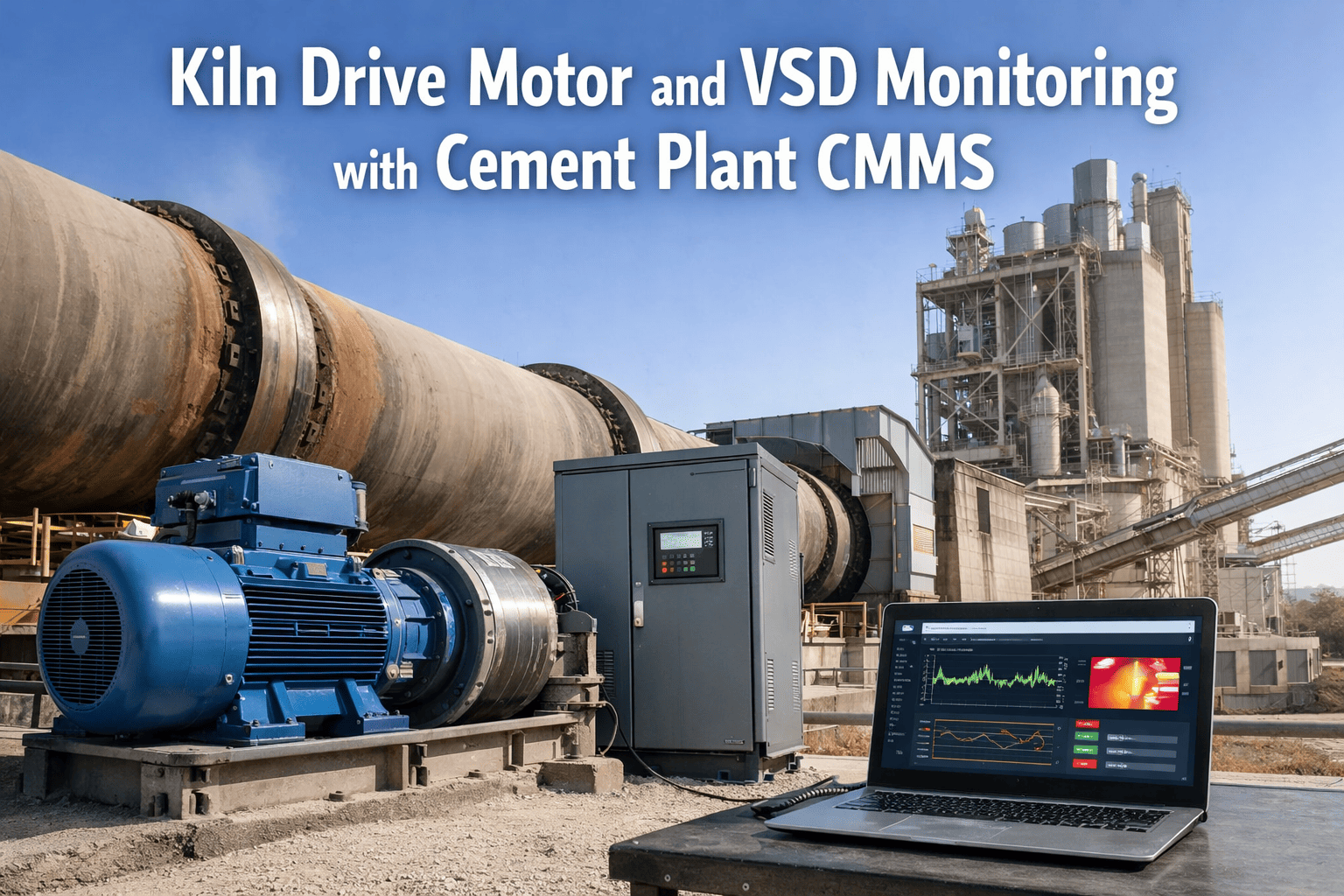
A cement kiln girth gear failure does not announce itself — it sends warnings for weeks through vibration harmonics, thermal signatures, and mesh pattern changes that conventional inspection cycles miss entirely. When the gear finally fails, the bill arrives fast: Sign in to OxMaint to deploy AI girth gear wear monitoring that reads those signals 4 to 8 weeks early and converts them into a planned work order — or book a demo to see the AI prediction engine running on live cement kiln girth gear data, with remaining useful life estimates, failure probability scores, and automatic CMMS work order generation configured for your plant.
Cement Kiln Asset Reliability · AI Predictive Maintenance
AI Girth Gear Wear Monitoring — Predict Failure 4–8 Weeks Before It Stops Your Kiln
A single unplanned girth gear failure costs $180,000–$420,000 per event in parts, specialist labour, and lost production. AI continuous monitoring detects the wear signatures weeks ahead — converting multi-million dollar emergencies into planned, scoped, budgeted repairs.
4–8 Weeks
advance warning AI delivers before girth gear failure
73%
lower repair cost when failure is AI-detected vs reactive
$420K+
average avoided cost per prevented girth gear event
6–12 Wks
girth gear tooth wear detectable via spectral analysis
Why Girth Gear Failure Is the Highest-Consequence Event in Your Cement Plant
The rotary kiln girth gear is among the largest open gears in industrial manufacturing — a precision-machined assembly that transfers drive power from the pinion to the kiln shell, rotating continuously under massive load, 24 hours a day, in a dusty, high-temperature environment. When it degrades, the consequences cascade through the entire plant. When it fails catastrophically, the kiln stops, and every downstream operation — clinker cooler, cement mill, packing — stops with it.
Unplanned Girth Gear Failure — Total Cost Per Event
Emergency gear segment procurement
$80K – $180K
Specialist installation contractor + mobilisation
$40K – $90K
Production loss (avg. 14-day stop at $50K–$100K/day)
$700K – $1.4M
Secondary damage — pinion, drive motor, kiln shell
$50K – $200K
Total event cost (realistic range)
$870K – $1.87M
AI-Detected, Planned Intervention — Total Cost
Gear segment sourced 6 weeks ahead at standard lead time
$60K – $130K
Planned contractor booking (no premium mobilisation)
$25K – $55K
Planned shutdown (coordinated with refractory cycle)
$120K – $280K
Secondary damage — none (intervened before failure)
$0
Total planned intervention cost
$205K – $465K
The Girth Gear Degradation Timeline — What AI Sees That You Cannot
Girth gear failure does not happen suddenly. It follows a degradation trajectory that begins with subtle surface fatigue and progresses through measurable stages — each generating distinct sensor signatures. The problem is that most cement plants only check vibration monthly, using handheld collectors on a schedule that guarantees the critical 4–6 week warning window is missed entirely. AI continuous monitoring watches every stage, 24 hours a day.
12 Weeks Before Failure
Early Surface Fatigue
Microscopic pitting begins on tooth flank surfaces. Lubrication film starts to thin unevenly. Gear mesh frequency harmonics rise by 2–4 dB above baseline. Visible only through high-frequency vibration spectral analysis — invisible to manual inspection.
AI Signal: Mesh harmonic shift at 2–4 dB above baseline
8 Weeks Before Failure
Progressive Pitting and Wear
Pitting coalesces into measurable wear tracks. Gear mesh vibration signature becomes statistically significant above normal operating range. Thermal camera shows localised temperature rise at contact zone. Monthly handheld rounds miss this window — it lasts 10–14 days before accelerating.
AI Signal: Mesh vibration 8–12 dB above baseline + thermal hot zone
4–6 Weeks Before Failure
Accelerated Tooth Degradation
Multiple tooth surfaces showing measurable wear. Sideband energy in vibration spectrum increases sharply. Motor current signature shows load variation spikes. This is the AI intervention window — enough lead time to procure parts, book contractors, and schedule a planned shutdown without premium costs.
AI Signal: Sideband energy spike + motor current variation — work order auto-generated
1–2 Weeks Before Failure
Critical Degradation — Emergency Zone
Widespread tooth spalling. Severe vibration audible to operators. Drive system at risk of secondary damage. At this stage, even detection cannot prevent significant cost — emergency procurement, premium contractor rates, and minimum 14-day unplanned kiln stop are unavoidable. This is where monthly inspection programmes discover problems.
Without AI: First detection. With AI: Intervention already complete.
Catch Girth Gear Wear at Week 8. Not at Week 1.
OxMaint's AI continuous vibration monitoring tracks gear mesh harmonics, thermal signatures, and motor current deviation 24 hours a day — generating a CMMS work order the moment degradation trends cross your configured alert threshold, with enough lead time to plan, procure, and schedule at standard rates.
How OxMaint AI Monitors Girth Gear Health — The Four-Signal Method
No single sensor type can reliably predict girth gear failure across all wear patterns and operating conditions. OxMaint fuses four independent signal streams simultaneously — each catching failure modes the others may miss — to produce a failure probability score updated continuously and calibrated against your kiln's specific operating baseline. Sign in to OxMaint to configure multi-signal girth gear monitoring for your kiln drive assembly.
01
Vibration Spectral Analysis
High-frequency accelerometers on the girth gear housing and pinion bearing capture the full frequency spectrum. AI isolates gear mesh frequency, sidebands, and harmonics — detecting early tooth pitting at 12 weeks when overall vibration levels still appear normal to threshold-based alarms.
Detects: Tooth pitting · Surface fatigue · Mesh irregularity
02
Thermal Imaging Analysis
Fixed infrared cameras on the gear contact zone create a continuous thermal map of the mesh interface. Localised temperature rise above the lubrication film zone indicates inadequate lubrication or misalignment — a leading indicator of accelerated wear 6–8 weeks ahead of mechanical failure.
Detects: Lubrication breakdown · Contact zone hot spots · Misalignment
03
Motor Current Signature Analysis
The kiln drive motor current waveform encodes the mechanical load variation from the gear mesh directly — without any physical sensor contact on the rotating gear assembly. AI identifies load spikes, rotational irregularities, and torque variation patterns that correspond to specific wear stages on individual tooth faces.
Detects: Load variation · Tooth-by-tooth wear · Drive system stress
04
Oil Analysis Integration
Wear particle concentration and composition in the gear lubrication system is the most direct measurement of material removal from gear tooth surfaces. AI cross-references oil particle trends with vibration and thermal data — confirming developing wear before it progresses to spalling and connecting part size to failure stage classification.
Detects: Material removal rate · Wear particle composition · Failure stage
Remaining Useful Life Prediction — From Sensor Data to a Maintenance Date
A failure probability alert tells you something is wrong. Remaining Useful Life (RUL) prediction tells you exactly when to intervene — giving your maintenance planner a concrete date to work with for contractor booking, parts procurement, and shutdown scheduling. This is the difference between an alarm and a maintenance plan.
Week 1–12 of Degradation
RUL estimate: 8–12 weeks remaining. Confidence interval wide. AI flags as "monitor — no action required." Planner is informed but no work order generated.
Week 5–8 of Degradation
RUL estimate: 4–6 weeks remaining. Confidence narrows to ±5 days. AI generates CMMS work order automatically. Parts list pre-populated. Shutdown window recommended.
Week 9–11 of Degradation
RUL estimate: under 2 weeks. Alert escalated to plant director. Emergency mode — intervention cannot wait for planned shutdown. Planned intervention should have occurred.
What the CMMS Work Order Contains
Asset
Kiln No. 2 — Girth Gear Assembly
Failure Mode
Progressive tooth surface wear — mesh harmonic + thermal confirmation
Failure Probability
73% within 22 days (AI confidence: high)
Recommended Window
Intervention by [date] — coordinates with planned refractory cycle
Parts Required
Gear segment [spec] — procurement order auto-raised
Contractor
Drive system specialist — booking initiated
Estimated Cost
$185K planned vs $920K+ unplanned
Girth Gear Failure Modes — What AI Monitors and What Each Costs Without Detection
Girth gear assemblies fail through five primary mechanisms — each with a distinct sensor signature, detection window, and cost consequence. OxMaint monitors all five simultaneously through multi-signal fusion, with alert thresholds configured to your specific gear geometry, operating speed, and load profile. Book a demo to see failure mode monitoring configured for your kiln drive specification.
Scroll to view >
| Failure Mode |
Primary Signal |
Detection Window |
Cost if Reactive |
Cost if AI-Detected |
| Tooth surface pitting |
Gear mesh harmonic shift — vibration spectral analysis |
6–12 weeks |
$400K–$900K (tooth-to-tooth cascade) |
$60K–$140K (targeted surface correction) |
| Misalignment wear |
Thermal contact zone asymmetry + vibration sidebands |
4–8 weeks |
$300K–$700K (full segment replacement) |
$40K–$80K (realignment + minor repair) |
| Lubrication failure |
Oil particle count rise + thermal hot zone |
2–6 weeks |
$500K–$1.2M (rapid tooth destruction) |
$15K–$30K (lubrication system correction) |
| Pinion–gear backlash change |
Motor current variation pattern + vibration |
4–6 weeks |
$250K–$600K (pinion + gear damage) |
$35K–$75K (backlash adjustment + inspection) |
| Tooth spalling (advanced) |
High-amplitude vibration + acoustic emission |
1–3 weeks |
$800K–$1.8M (catastrophic failure) |
Emergency — earlier AI detection prevents this stage |
Frequently Asked Questions
How does AI detect girth gear wear earlier than conventional vibration monitoring?
Conventional threshold-based vibration monitoring only alerts when overall vibration velocity exceeds a fixed limit — by which point the gear is already in the critical failure zone. AI spectral analysis monitors the gear mesh frequency and its sidebands specifically, detecting changes of 2–4 dB above the established baseline that are statistically significant but invisible to overall vibration thresholds. By fusing spectral vibration data with motor current signature analysis and thermal imaging, OxMaint identifies developing failure signatures 6–12 weeks before overall vibration levels reach alarm thresholds.
Sign in to configure AI spectral monitoring for your girth gear assembly.
What sensors are required to start AI girth gear monitoring with OxMaint?
Minimum instrumentation for meaningful AI girth gear monitoring is a triaxial high-frequency accelerometer mounted on the girth gear housing, a thermal camera or IR sensor at the gear mesh contact zone, and motor current monitoring on the kiln drive motor. Most cement plants already have 40–60% of this instrumentation installed — OxMaint's deployment team conducts a sensor gap assessment before installation. For plants with oil analysis programmes already running, integration of oil particle data adds a fourth independent signal stream.
Book a demo to walk through the sensor configuration for your specific kiln drive layout.
How accurate is the remaining useful life prediction for cement kiln girth gears?
OxMaint's RUL model accuracy for girth gear assemblies improves as the AI trains on your specific kiln's operating patterns. In the early monitoring period, RUL estimates carry a ±1–2 week confidence interval — sufficient for planning procurement and contractor booking. After 60–90 days of calibration against your kiln's baseline, confidence narrows to ±3–5 days for the critical 4–6 week intervention window. Failure probability scores above 70% with two or more independent signal confirmations trigger automatic CMMS work order generation.
Sign in to OxMaint to see how RUL prediction is configured and displayed for rotating kiln assets.
Can OxMaint integrate with our existing kiln drive monitoring system?
Yes. OxMaint connects to existing kiln monitoring infrastructure through OPC-UA, Modbus TCP/IP, and direct historian connections including OSIsoft PI. Siemens, ABB, Rockwell, and Schneider drive systems are all supported through standard industrial protocols. Most cement plants have existing vibration transmitters and drive monitoring outputs that OxMaint can connect to without additional hardware — integration typically completes within 3–6 weeks. Where sensor gaps exist, OxMaint's deployment team specifies the minimum additional instrumentation required.
Book a demo to review the integration path for your specific drive system.
Your Girth Gear Is Sending Signals Right Now. Is Anyone Listening?
OxMaint's AI continuous monitoring reads gear mesh harmonics, thermal signatures, and motor current patterns 24 hours a day — detecting girth gear wear 4 to 8 weeks before failure and converting that warning into a planned, scoped, fully budgeted CMMS work order before the emergency bill arrives.