More than 60% of cement manufacturers still plan maintenance from spreadsheets and paper logs, and the bill for that habit rarely shows up as a clean line item — it shows up as a kiln stop nobody saw coming. Sign up for Oxmaint to see how live work order data, asset history, and compliance records replace the spreadsheet your team has outgrown, or book a demo to walk through your own asset list with our team.
Spreadsheets Record Maintenance. CMMS Prevents It.
A spreadsheet tells you what happened last month. It can't tell you a girth gear is overheating right now, or that the same PM task has been pushed back three times in a row — and that gap is exactly where unplanned kiln stops come from.
Manual entry happens hours after the work is done
No alert when a PM task gets missed
Asset history scattered across shift folders
Work orders logged the moment work happens
Automatic alert before a PM task is overdue
Full asset history in one searchable record
What Spreadsheet Maintenance Is Actually Costing
These figures aren't projections — they reflect documented patterns across cement plants still running maintenance on paper and spreadsheets, compared against plants operating a structured CMMS.
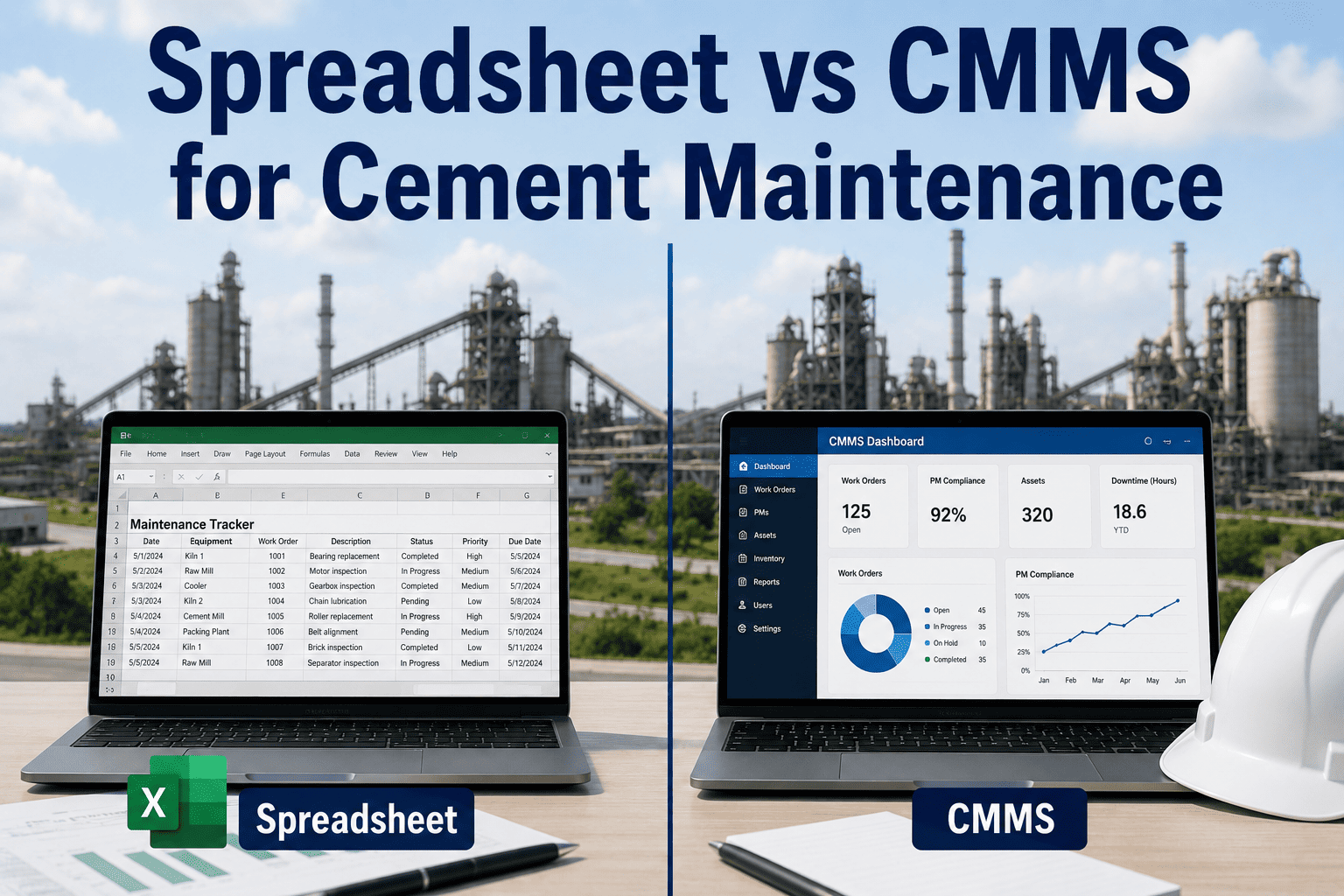
Spreadsheet vs Oxmaint CMMS, Function by Function
The differences below aren't cosmetic. Each row is a point where a spreadsheet creates a delay or a blind spot that a connected CMMS removes entirely.
| Maintenance Function | With Spreadsheets | With Oxmaint CMMS |
|---|---|---|
| Work Order Creation | 5–15 minutes per form, manual asset lookup, physical routing | Logged in seconds from a mobile device on the floor |
| Asset History Access | Search filing cabinets or ask the last technician | Full equipment history searchable in one record |
| PM Task Tracking | Missed tasks go unnoticed until the asset fails | Automatic alert generated before a task is overdue |
| Compliance Documentation | Manual entry hours or days after the work is done | Timestamp-verified record created the moment work closes |
| Downtime Cost Visibility | Calculated at month-end, after the loss is locked in | Live dashboard showing cost as it happens |
| Planned vs Reactive Ratio | Global average sits at 60–70% planned | Plants reach 80%+ planned within 12–18 months |
See Your Own Asset List on Oxmaint
Bring your current spreadsheet and we'll show you exactly how it maps into a structured, searchable CMMS — live, in 30 minutes.
From a Missed Update to a $273,000 Failure
This is the same chain of events behind most unplanned kiln, mill, and crusher stops at plants still running on spreadsheets — five quiet steps with one expensive ending.
A scheduled inspection sits on a spreadsheet row. No one on the floor gets notified that it's due today.
With no automatic alert, the inspection gets pushed to "next week" three shifts in a row.
A vibration or temperature drift that would have flagged the problem goes unrecorded anywhere searchable.
The asset fails mid-shift, with no accessible history to tell the technician what to check first.
Direct repair, lost production, and quality deviations push the true cost to an average of $273,000 per event.
What Changes Once the Spreadsheet Is Gone
These are the results plants typically track in the first year after moving maintenance off spreadsheets and onto Oxmaint.
| Metric | Result |
|---|---|
| Time to First Digital Work Order | Within 48 hours of setup |
| PM Compliance Rate | Above 95% with mobile alerts |
| MTTR Reduction | Up to 44% within 6 months |
| Avoided Downtime, Year One | $1.4M+ at integrated plants |
Plants that hold onto spreadsheets aren't choosing to save money — they're choosing to find out about a failure after it's already expensive. The plants I've seen move fastest toward top-quartile reliability are the ones that stopped treating maintenance data as paperwork and started treating it as an early warning system.
Arvind Mehta — Maintenance Reliability Consultant, 16 years in cement plant operationsSpreadsheet vs CMMS — Common Questions
Yes. Oxmaint imports your asset list, PM schedules, and historical work order data during onboarding, so your team doesn't start from a blank system. Most plants have their full asset register live within 48 hours. Sign up to start the import directly.
Administrative time savings show up in the first 60–90 days, mainly from less parts-hunting and fewer lost work orders. Deeper gains in downtime reduction and MTBF build over the following 6–12 months as the system accumulates enough history to surface predictive patterns.
It replaces the manual entry step, not the requirement itself. Every inspection, signature, and work order closure is timestamp-verified automatically, which is the part spreadsheets and paper logs consistently get behind on before an audit. Book a demo to see a compliance audit trail generated live.
Nothing happens to the data itself, but the gap it creates keeps compounding — missed PM tasks stay invisible, and asset history keeps fragmenting across more files and more shifts. The cost of that gap is what shows up later as an unplanned stop.
Oxmaint is built around cement plant asset structures, from kiln and mill systems down to component level, with PM triggers tied to operating hours and throughput rather than calendar dates alone. Sign up for Oxmaint to see your own kiln-to-packer asset hierarchy configured.
Your Maintenance Data Deserves Better Than a Spreadsheet
Every missed PM task on a paper schedule is a kiln stop waiting to happen. Move your asset history, work orders, and compliance records into one connected system built for cement plant reliability.