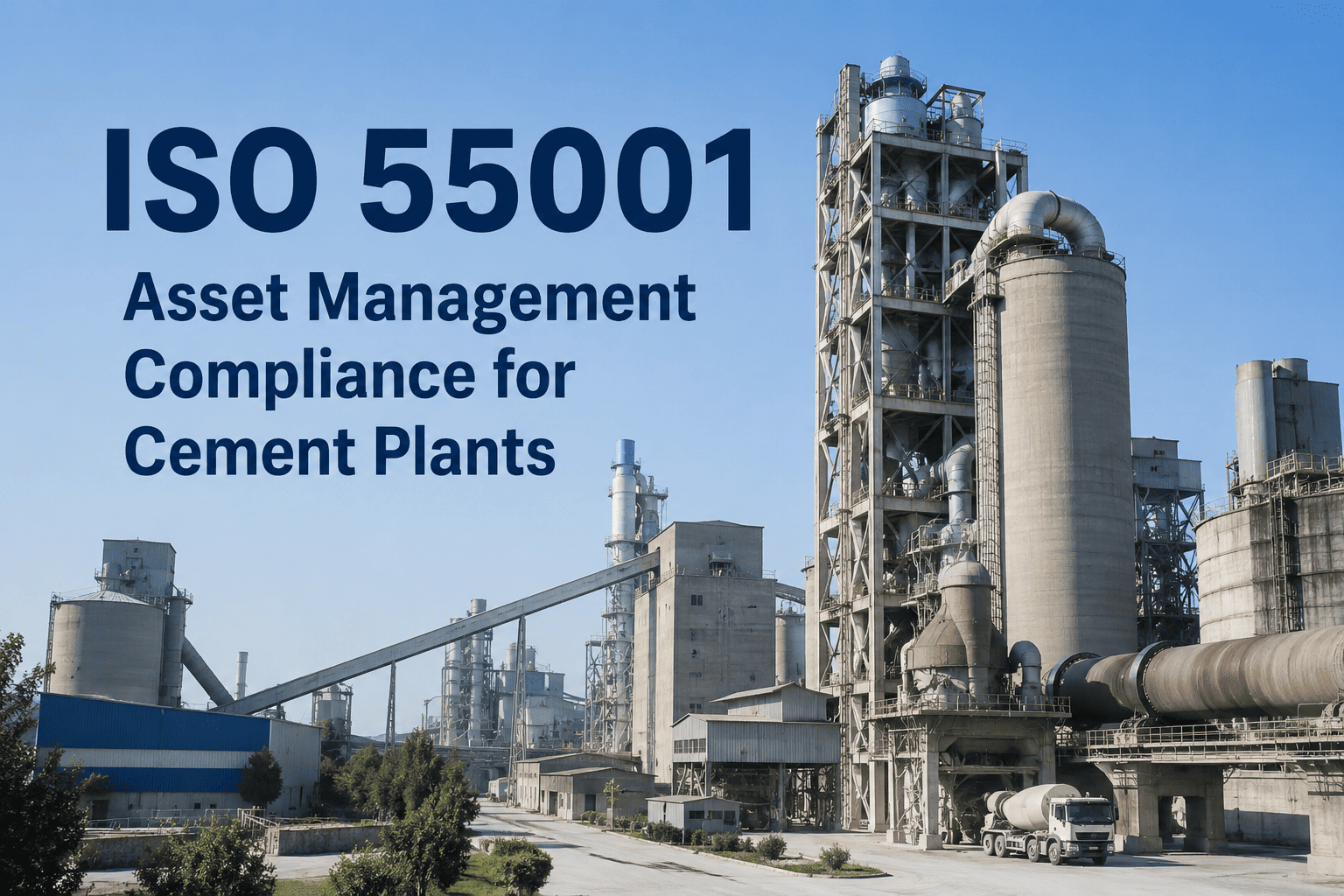
In cement manufacturing, a maintenance professional's credentials are the single most visible signal of technical credibility — to hiring managers, to regulatory inspectors, and to the production teams who rely on their judgment at 2 AM when a kiln drive bearing starts running hot. The six certifications reviewed here are the most respected, most career-relevant, and most practically useful credentials for cement plant maintenance and reliability professionals in 2026: the CMRP and CMRT from SMRP, the CWBP from SMRP for reliability engineers, the IRIS qualification for railway-adjacent cement equipment specialists, the ASNT NDT certification for inspection professionals, and the ISO 55000/55001 Asset Management designation for plant-level asset managers. Each credential opens different doors — from frontline technician advancement to reliability engineering leadership to compliance-facing asset management roles. If your plant is building the systems these certifications validate — structured work orders, PM schedules, condition-based maintenance workflows, and asset registers — Oxmaint provides the CMMS platform to practice and document everything the certification bodies test for.
2026 Career Guide · Cement Maintenance Professionals
Top 6 Certifications for Cement Plant Maintenance Professionals in 2026
CMRP, CMRT, CWBP, IRIS, ASNT NDT, and ISO 55000 — what each one earns you, what it takes to get there, and which role it fits.
Why Certification Matters in Cement Maintenance
65%
CMRP First-Attempt Pass Rate
Only 65% of candidates pass the CMRP exam on their first attempt — making preparation discipline a real differentiator among certified professionals.
60+
Countries Recognizing SMRP Credentials
SMRP has 7,000+ members across 60+ countries. CMRP and CMRT are recognized across North America, Europe, Asia, and the Middle East in heavy industrial hiring.
$300
SMRP Member Exam Fee (2026)
CMRP exam costs $300 for SMRP members and $470 for non-members in 2026 — a low-cost credential for the career uplift it delivers in asset-intensive industries.
3 yrs
Recertification Cycle
All major maintenance certifications operate on 3-year recertification cycles requiring continuing education — keeping certified professionals current with evolving best practices.
The 6 Certifications — Full Breakdown
01
CMRP — Certified Maintenance & Reliability Professional
Issued by: SMRP (Society for Maintenance & Reliability Professionals) • ANSI-Accredited
Maintenance Managers • Reliability Engineers • Asset Leaders
The CMRP is the gold standard credential for maintenance and reliability professionals globally — and the single most recognized certification in cement plant maintenance hiring in 2026. ANSI-accredited and endorsed across heavy industrial sectors, it validates competence across five pillars of the SMRP Body of Knowledge: Business and Management, Equipment Reliability, Manufacturing Process Reliability, Organization and Leadership, and Work Management. For cement maintenance managers, reliability engineers, and anyone moving into plant-level asset leadership, the CMRP is the credential that separates candidates from applicants.
Exam Format
110 multiple-choice questions • 2.5 hours • Closed book • Computer-based at Pearson VUE
Prerequisites
No formal prerequisites — 3 to 5 years of practical maintenance experience strongly recommended
Cost (2026)
$300 SMRP member / $470 non-member • Recertification every 3 years
Pass Rate
65% — requires mastery across all five BoK pillars, not just one specialty area
Cement Plant Value
Directly maps to cement plant reliability roles — Work Management and Equipment Reliability pillars cover kiln scheduling, rotating equipment PM, and failure analysis workflows
Prep Tip: The Work Management pillar typically generates the most exam questions. Use a CMMS like
Oxmaint daily to practice work order structuring, PM scheduling, and KPI tracking — these are exactly the scenarios the exam tests.
02
CMRT — Certified Maintenance & Reliability Technician
Issued by: SMRP • ANSI-Accredited
Maintenance Technicians • Multi-Craft Tradespeople • Senior Operators
The CMRT is the technician-level counterpart to the CMRP — the leading credentialing program for multi-skilled maintenance technicians who carry out preventive, predictive, and corrective maintenance work. For cement plant technicians running vibration checks on kiln bearings, performing bag filter inspections, or executing LOTO procedures on ball mill circuits, the CMRT validates the hands-on competencies that cement plants need documented in their workforce capability registers. It is the clear next-level credential for technicians who want to advance into reliability or supervision roles.
Exam Format
Computer-based multiple-choice • Pearson VUE testing centers • 2 hours
Prerequisites
No formal prerequisites — practical hands-on maintenance experience is the foundation
Coverage Areas
Preventive maintenance, predictive techniques, corrective maintenance, safety practices, work order execution
Cement Plant Value
Validates technician competency for cement plant ISO 45001 workforce capability documentation and contractor qualification processes
Prep Tip: SMRP exam scheduling will be temporarily unavailable May 28 – June 22, 2026 due to a system upgrade. Schedule your CMRT exam before May 28 or after June 22 to avoid delays.
03
CWBP — Certified Wellness & Benchmarking Professional
Issued by: SMRP • Maintenance Benchmarking Specialty
Reliability Engineers • Maintenance Planners • Plant Performance Managers
The CWBP (Certified Wellness and Benchmarking Professional) is SMRP's specialty certification for maintenance performance measurement and benchmarking. For cement plant reliability engineers and maintenance planners responsible for tracking MTBF, MTTR, OEE, planned maintenance percentage, and cost per unit produced, the CWBP validates the ability to conduct maintenance performance assessments, benchmark against industry standards, and drive improvement programs using quantitative data. This is the credential for professionals who translate maintenance data into capital investment decisions.
Focus Areas
Maintenance KPI frameworks, SMRP benchmarking metrics, performance gap analysis, improvement program design
Cement Plant Value
Directly supports cement plant reliability programs requiring documented KPI baselines and continuous improvement evidence for ISO 55001 and management review
Ideal Candidate
Maintenance engineers or planners with 3+ years of experience tracking plant reliability metrics and conducting maintenance assessments
Prep Tip: The CWBP exam tests your ability to calculate and interpret SMRP's 26 standard maintenance metrics. Building a live KPI dashboard in your CMMS — tracking planned maintenance %, PM compliance, and MTBF — is the most effective practical preparation.
Start tracking these metrics in Oxmaint free.
04
ASNT NDT Certification (SNT-TC-1A / CP-189)
Issued by: American Society for Nondestructive Testing • Employer-Based Model
NDT Inspectors • QA Engineers • Asset Integrity Specialists
ASNT NDT certification is essential for cement plant inspectors responsible for structural integrity of kiln shells, preheater towers, pressure vessels, and refractory systems. ASNT's SNT-TC-1A framework certifies professionals in specific NDT methods — ultrasonic testing (UT), radiographic testing (RT), magnetic particle testing (MT), penetrant testing (PT), and visual testing (VT) — at Levels I, II, and III. Level II is the standard operating level for certified cement plant inspection technicians. Level III qualifies professionals to write procedures, establish acceptance criteria, and manage plant-level NDT programs.
Certification Model
Employer-based under SNT-TC-1A or ASNT CP-189 (third-party) • Level I, II, III • Method-specific
Key Methods for Cement
Ultrasonic thickness testing (kiln shell), visual testing (refractory), magnetic particle (structural steel), penetrant testing (pressure equipment)
Level III Value
Level III qualifies professionals to manage NDT programs — required for cement plants operating under OSHA PSM and EPA RMP requirements where NDT is part of mechanical integrity programs
Cement Plant Value
Kiln shell hot-spot detection, preheater structural inspection, pressure vessel compliance, and refractory condition assessment all require ASNT-certified inspection personnel
Prep Tip: ASNT SNT-TC-1A certification requires documented hours of experience in your chosen NDT method before examination. Track all inspection activities with timestamps and equipment records — digital inspection logs in a CMMS create the audit-ready experience documentation ASNT requires.
05
IRIS — International Railway Industry Standard Certification
Issued by: UNIFE • Quality Management for Transportation Equipment
Quality Engineers • Equipment Suppliers • Maintenance System Auditors
IRIS (International Railway Industry Standard) is a quality management certification primarily associated with rail transportation but increasingly relevant to cement plant professionals working with large transport equipment — bucket elevators, belt conveyors, and clinker transport systems that share engineering heritage with railway-grade mechanical systems. IRIS-certified professionals and suppliers meet a quality management standard built on ISO 9001 with railway-grade additions for failure mode and effects analysis (FMEA), reliability data management, and maintenance system documentation. For cement plants sourcing transport and materials handling equipment, IRIS-certified suppliers provide a higher baseline of maintenance documentation quality.
Standard Base
ISO 9001 foundation with IRIS Rev. 03 additions — FMEA, RAMS (Reliability, Availability, Maintainability, Safety), and maintenance documentation requirements
Cement Plant Value
Relevant for QA managers and procurement teams evaluating suppliers of conveying, crushing, and clinker transport equipment — IRIS certification signals superior maintenance documentation standards from the supplier
Ideal Candidate
Quality engineers, supplier auditors, and maintenance system managers at plants with complex materials handling infrastructure
Prep Tip: IRIS certification audits assess the completeness and traceability of maintenance records. Professionals preparing for IRIS audits benefit from operating within a structured CMMS where all asset records, PM histories, and corrective actions are traceable to specific work orders.
Book a demo to see how Oxmaint structures audit-ready asset records.
06
ISO 55000 / ISO 55001 Asset Management Certification
Issued by: ALN (A55K) / PECB • International Standard for Asset Management Systems
Plant Asset Managers • Maintenance Directors • Capital Planning Leaders
ISO 55000 / ISO 55001 is the international standard for organizational asset management systems — not a personal credential in the traditional sense, but the leading professional qualification for individuals who lead or audit plant-level asset management programs. Individual certifications (notably the A55K from the Asset Leadership Network and PECB's ISO 55001 Lead Implementer/Auditor) validate competency in implementing and auditing ISO 55001-compliant asset management systems. For cement plant asset managers responsible for long-term asset strategy, capital investment justification, and whole-lifecycle cost optimization, ISO 55001 competency is increasingly a baseline expectation.
Standard Scope
Physical asset lifecycle management, asset strategy alignment with organizational objectives, risk-based asset decision-making, and asset management system audit
Individual Credentials
A55K (Asset Leadership Network) • PECB ISO 55001 Lead Implementer • PECB ISO 55001 Lead Auditor
Cement Plant Value
ISO 55001 certification supports ESG-linked financing applications, capital budget justification, and integration with ISO 14001 and ISO 50001 compliance programs already active at most large cement plants
Ideal Candidate
Plant asset managers, maintenance directors, and reliability engineers with 5+ years of plant-level asset management experience
Prep Tip: ISO 55001 audit evidence requires a live, documented asset register with verifiable maintenance histories and risk assessments. A CMMS that generates asset-linked audit trails — rather than spreadsheet-based records updated before audits — is the practical foundation for ISO 55001 certification readiness.
Oxmaint's asset register and PM history features are built for exactly this evidence requirement.
Every certification on this list tests work order management, PM scheduling, and asset documentation. Oxmaint is the CMMS where cement maintenance professionals practice — and prove — exactly these competencies every day. Start free.
Quick Comparison: Which Certification Is Right for Your Role?
| Certification |
Best Role |
Level |
Cost (2026) |
Renewal |
| CMRP |
Maintenance Managers, Reliability Engineers |
Senior |
$300–$470 |
3 Years |
| CMRT |
Maintenance Technicians, Senior Operators |
Technician |
SMRP Fee |
3 Years |
| CWBP |
Reliability Engineers, Planners |
Senior |
SMRP Fee |
3 Years |
| ASNT NDT |
Inspection Technicians, QA Engineers |
L1 / L2 / L3 |
Varies by method |
5 Years |
| IRIS |
Quality Engineers, Auditors |
Management |
Org-level |
3 Years |
| ISO 55001 |
Asset Managers, Maintenance Directors |
Leadership |
PECB / ALN fee |
3 Years |
Frequently Asked Questions
Should I pursue the CMRP or the CMRT first as a cement plant maintenance professional?
Choose based on your current role. If you are an active maintenance technician with hands-on craft skills and want a credential that validates your technical execution, start with CMRT. If you are already in a supervisory, planning, or reliability engineering role — or targeting one — the CMRP is the stronger career investment. Many professionals earn CMRT first, then advance to CMRP within two to three years.
Oxmaint's CMMS practice environment supports preparation for both.
Is the CMRP exam hard to pass for cement industry professionals specifically?
Cement industry maintenance professionals typically perform well on the Equipment Reliability and Work Management pillars, which align closely with daily kiln and rotating equipment work. The Business and Management pillar — covering ROI calculations, maintenance budgeting, and strategic alignment — is the most common difficulty area for technically focused candidates. Study the full BoK, not just the areas that feel familiar. The 65% pass rate reflects candidates who underinvested in the business-facing pillars.
Can ISO 55001 individual certification help with cement plant ESG reporting requirements?
Yes, significantly. ISO 55001 provides the structured asset management system documentation that ESG-linked financing providers and CBAM compliance auditors increasingly require. Professionals with ISO 55001 Lead Implementer credentials are positioned to build the asset register and lifecycle documentation that supports both internal capital planning and external sustainability reporting.
Book a demo to see how Oxmaint's asset register supports ISO 55001 audit preparation.
How does ASNT NDT certification connect to cement plant compliance requirements?
Cement plants with pressure vessels, kiln shells operating under mechanical integrity programs, and structural steel subject to OSHA inspection require personnel certified in specific NDT methods to perform and document inspections. ASNT Level II is typically required for operating inspection roles; Level III is needed to establish and approve inspection procedures. NDT findings documented in a CMMS create the inspection history that survives regulatory audits.
When should cement plant maintenance professionals schedule CMRP or CMRT exams in 2026?
SMRP exam scheduling will be unavailable from May 28 through June 22, 2026 due to a system upgrade. Plan to schedule your exam before May 28 or after June 22. Already-scheduled exams in this window will proceed, but results and certification activation will be delayed until the system transition is complete. Extension of exam authorization windows during this period is automatic — no action is required on your part.
The Best Certification Prep Happens On the Job
CMRP, CMRT, and CWBP exam content maps directly to work order management, PM scheduling, asset criticality, and maintenance KPIs — the systems your plant should already be running. Oxmaint gives cement maintenance teams the CMMS platform that makes certification preparation a byproduct of doing the job right. Start free today.