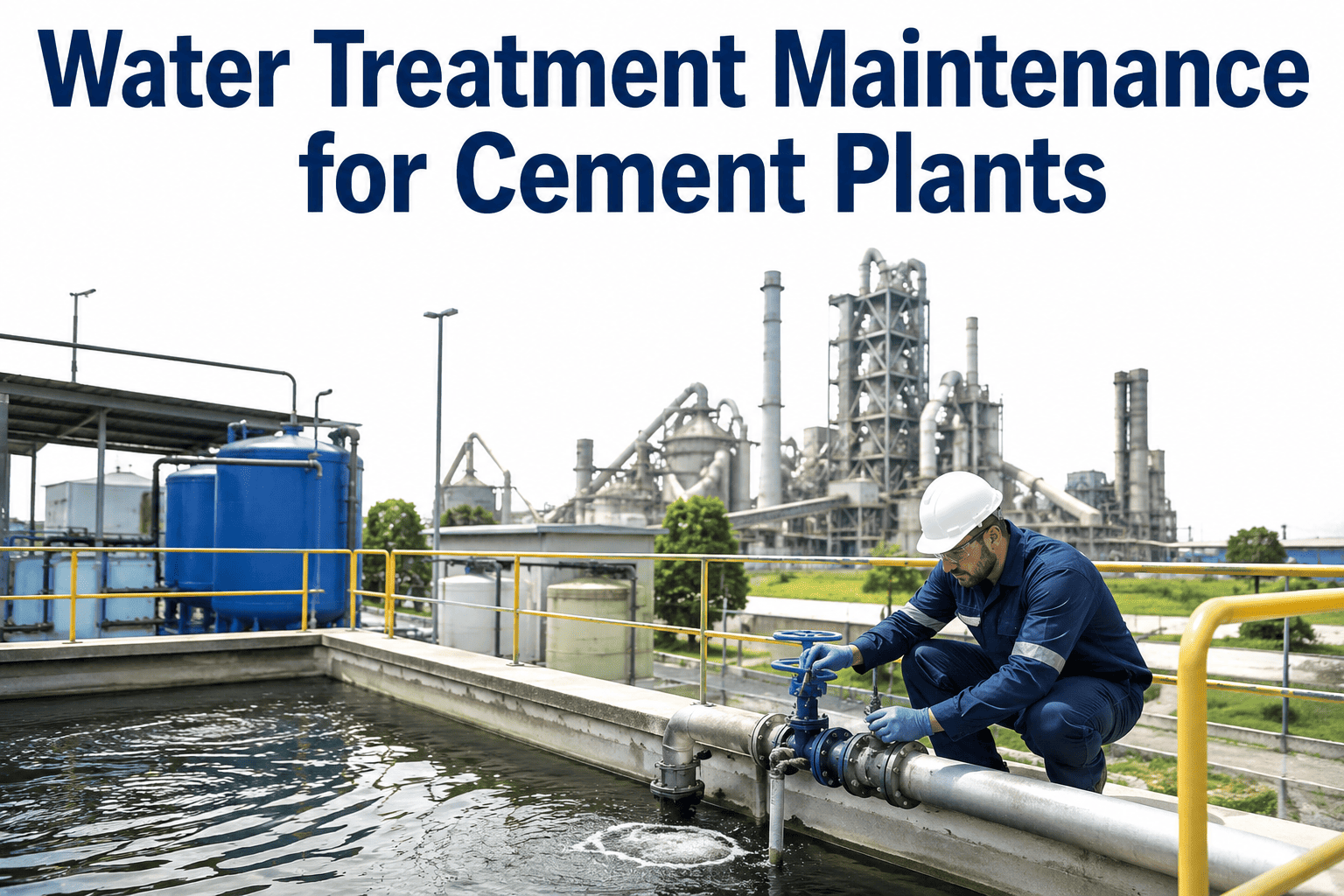
Water is the unsung hero of cement production. It cools extreme equipment, mitigates dust, and forms the core of gas conditioning in preheater towers. However, the industry is waking up to a stark reality: water scarcity is no longer a future risk; it is a present operational constraint. With many global cement facilities located in water-stressed regions, managing every drop is as critical as managing fuel.
This executive brief outlines how forward-thinking cement plants are shifting from open-loop consumption to closed-loop water management using advanced sensing and digital maintenance. By detecting leaks early, optimizing cooling cycles, and treating wastewater onsite, facilities can secure their operational license to operate. Start your water optimization pilot today.
The Water Scarcity Crisis in Heavy Industry
Managing water in a cement plant is mechanically demanding. A typical 1M ton/year facility requires hundreds of thousands of liters daily, primarily for machine cooling (bearings, drives, compressors) and gas conditioning (cooling hot kiln gases before the baghouse). When local water tables drop, plants face forced production curtailments. Assess your plant's water risk exposure.
How Digital Tools Detect and Prevent Water Loss
Modern water management utilizes ultrasonic flow meters, pressure sensors, and conductivity probes. CMMS platforms analyze this data stream to detect hidden leaks, track cooling tower efficiency, and predict pump failures before they cause massive spills. See the leak detection model in action.
□ Pressure drop during non-operational hours = Valve Failure
□ Abnormal pump vibration = Cavitation/Seal Degradation
□ Rising return temperature = Heat Exchanger Fouling (Requires scaling maintenance)
□ Predict chemical dosing requirements based on evaporation rates
□ Wet bottom in the tower = Incomplete Evaporation (Adjust flow vs. gas temp)
□ Prevents water pooling, which causes catastrophic refractory or structural damage
Digital Work Orders: The Water Conservation Backbone
Sensor data is useless without action. Digital work orders bridge the gap between detecting a pressure drop and fixing the broken flange. When the system flags an anomaly, the CMMS automatically creates a work order, assigns it to the mechanical team, and provides P&ID (Piping and Instrumentation Diagram) locations. Automate your fluid workflows today.
From Open-Loop to Closed-Loop: Financial Comparison
Moving to a closed-loop, digitally monitored water system lowers the Total Cost of Ownership (TCO) while securing the plant's operational future in drought-prone areas. Request a customized ROI calculation.
Implementation Roadmap for Water Independence
Transitioning to a zero-liquid discharge (ZLD) or closed-loop system requires mapping current flows and systematically eliminating waste. Get your plant's water roadmap.
Deliverable: Plant Water Balance Diagram
Success Metric: 100% of water flow accounted for
Deliverable: Leak-free baseline
Success Metric: 15-20% immediate drop in intake
Deliverable: Near-Zero Liquid Discharge
Success Metric: >80% reduction in freshwater draw. Start your journey
Case Study: Arid Region Cement Plant
Secure Your License to Operate
Water conservation in cement production isn't just an environmental initiative; it is a fundamental requirement for business continuity. By leveraging digital maintenance and closed-loop infrastructure, plants can insulate themselves from water scarcity and regulatory overreach.
Don't wait for the local water table to drop or the mandate to arrive. Take control of your fluid infrastructure with data-driven insights. Schedule your water optimization briefing or start your digital maintenance pilot today.