AI Reduces Delivery Fleet Downtime Case Study

By Johnson on June 3, 2026

ai-reduces-delivery-fleet-downtime-case-study

Delivery fleets run on tight margins — every hour a vehicle sits in the shop is a missed route, a late customer, and a dispatching headache that ripples through your entire operation. OxMaint.ai worked with a regional courier network operating 340 vehicles across six depots to quantify exactly what AI-driven maintenance automation delivers when it replaces reactive repair habits with predictive intelligence. The numbers are significant, the shift is permanent, and the operational case is clear. If your fleet still relies on drivers reporting faults and mechanics working from whiteboards, this case study shows what you are leaving on the table — and how fast the gap closes once you act. Start your free trial on OxMaint and see the same results in your fleet within 60 days.

Case Study · Delivery Fleet · OxMaint AI

How AI Maintenance Cut Delivery Fleet Downtime by 43% in One Operating Year

A 340-vehicle regional courier network replaced reactive repairs with predictive intelligence — and rebuilt its entire maintenance operation around data, not guesswork.

43% Downtime Reduction
61% Fewer Emergency Repairs
2.4x Faster Repair Response
$380K Annual Cost Saved
The Challenge

A Fleet That Knew Something Was Wrong — But Could Not See It Coming

Before OxMaint, the fleet operated the way most mid-size courier operations do: drivers submitted paper defect reports, mechanics triaged by eye, and the maintenance schedule lived in a spreadsheet no one fully trusted. The result was a pattern familiar to every fleet manager — vehicles failing in the field, emergency tows, overnight repairs, and dispatch scrambling to cover gaps.

The fleet director described the core problem plainly: the data existed somewhere across three different systems, but no one could connect it in time to act. By the time a pattern was visible, the failure had already happened multiple times.

68%
of unplanned repair events were preceded by detectable signals in vehicle data — signals no one was reading in time
4.2 hrs
average time from fault report to mechanic assignment — during which vehicles remained parked and routes unserviced
22%
of the monthly maintenance budget consumed by emergency repairs — parts at premium cost, labour at overtime rate
Implementation Journey

From Day One to Full Deployment — 90 Days to Operational Intelligence

Week 1
Data Integration
Vehicle telematics, historical work orders, and parts inventory connected to OxMaint in under 60 minutes per depot. Six depots onboarded in three days without disrupting active operations.
Week 2–3
AI Baseline Calibration
OxMaint analyzed 18 months of historical repair data to establish failure patterns by vehicle type, route profile, and seasonal load. High-risk assets flagged immediately — 14 vehicles prioritized for inspection before the fleet had completed its first scheduled PM cycle.
Week 4–6
Automated Work Orders Live
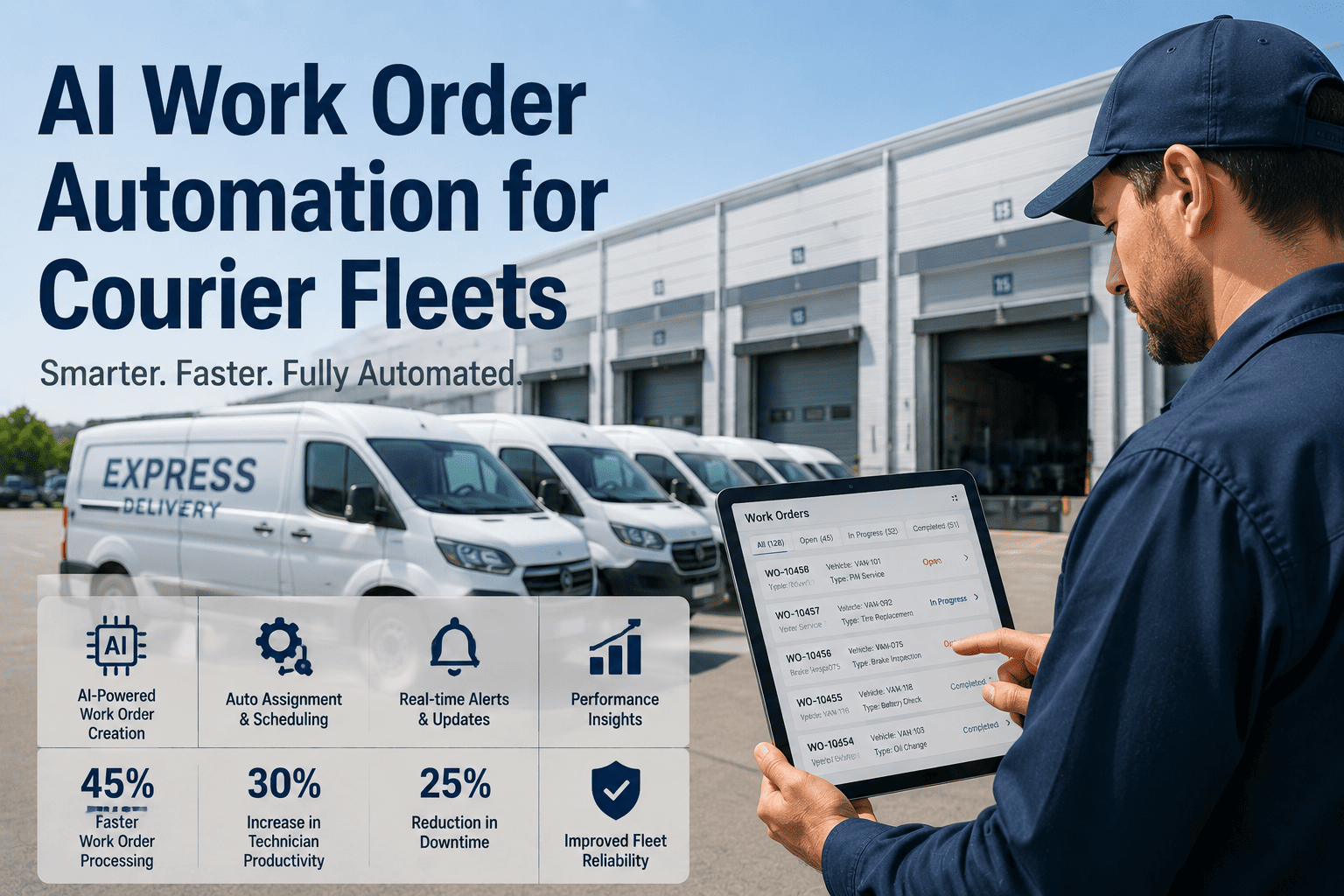
Drivers began logging faults via mobile in plain language. OxMaint AI parsed severity, classified fault type, and auto-generated structured work orders with parts requirements — reducing admin time per work order from 18 minutes to under 3 minutes.
Week 8–12
Predictive Alerts Activated
AI-generated maintenance alerts began surfacing 7–14 days before projected failure windows on brake wear, transmission fluid degradation, and tyre pressure anomalies. Fleet directors received morning briefings summarizing risk by depot — automatically generated, no analyst required.
Measured Outcomes

12-Month Results Across Six Depots — Before and After OxMaint AI

Metric Before OxMaint After OxMaint Improvement
Unplanned downtime per vehicle per month 6.8 hours 3.9 hours 43% reduction
Emergency repair events per month 47 events 18 events 61% reduction
Mean time from fault report to assignment 4.2 hours 1.7 hours 2.4x faster
PM compliance rate 71% 96% +25 points
Work order admin time per event 18 minutes 3 minutes 83% reduction
Monthly emergency repair spend $52,000 $20,400 61% reduction
Vehicle-on-road availability rate 81% 94% +13 points
How It Works

Three AI Capabilities That Drive Every One of These Outcomes

02
Automated Inspection Workflows
Drivers complete digital pre- and post-trip inspections on mobile. AI reads each submission, flags anomalies, and triggers work orders automatically for anything above a defined severity threshold — with zero manual triage required from the workshop.
Inspection-to-work-order in under 3 minutes, 24/7
03
Repair Response Optimization
AI assigns incoming work orders based on mechanic availability, skill match, parts stock, and route schedule impact. The system surfaces which repairs need immediate action and which can be safely deferred — so your workshop prioritizes by operational risk, not by who shouts loudest.
Right repair, right mechanic, right time — every time
Ready to See These Results in Your Fleet?

Your Fleet Is Producing the Same Data. OxMaint Turns It Into Action.

Every vehicle in your fleet is already generating the signals that predict failures. Most fleets just have no system to read them. OxMaint connects to your existing telematics and maintenance records in under 60 minutes — and starts surfacing risk the same day. No long implementation. No specialist required. Free to start.

Fleet Director Perspective

What Changes When Your Maintenance Team Can See the Future

On Emergency Repairs
The biggest shift was watching emergency repair events drop month after month. We used to budget for them as a fixed cost. Now they are genuinely rare — and when they do happen, the post-incident data tells us exactly why the prediction window was missed.
On Inspection Compliance
Drivers actually complete inspections now because the process takes 90 seconds on their phone. Before, paper forms got forgotten or rushed. Now every vehicle produces a clean digital record every shift — and the AI reads all of it before the first mechanic arrives in the morning.
On Dispatch Confidence
Dispatch now sees a vehicle health dashboard before building the morning run plan. If a vehicle is flagged as high-risk, it goes to workshop first. That single change eliminated most of our mid-route breakdowns in the first quarter after go-live.
Common Questions

What Fleet Managers Ask Before Starting

Does OxMaint work with our existing telematics and fleet management system?
OxMaint integrates with the major telematics providers and fleet management platforms via standard data connections. Most fleets complete integration in under 60 minutes without IT project involvement. If you use a less common system, the OxMaint team will assess compatibility before you commit to anything. Book a demo to walk through your specific stack.
How quickly will we see results after going live?
The AI begins providing useful risk alerts within 24 hours of data ingestion by analyzing historical patterns in your existing records. Measurable downtime reduction typically becomes visible within 30–60 days as predictive maintenance replaces reactive repairs. Full operational impact — as shown in this case study — compounds over 6–12 months. Start your free trial today.
Do our drivers and mechanics need training to use this?
Driver inspection workflows are designed for zero training — plain language mobile forms take under 2 minutes per shift. Mechanics receive structured work orders with all asset history attached, so their workflow actually becomes simpler, not more complex. Most teams are fully operational within one week. See the interface live in a 30-minute demo.
What if our historical maintenance data is incomplete or inconsistent?
OxMaint works with imperfect historical data — most fleets have gaps, inconsistent formats, or records spread across multiple systems. The AI builds its baseline from whatever data is available and improves as new data accumulates. Even with limited history, the predictive engine is useful from day one. Try it with your actual data — free trial, no commitment.
Is this only for large fleets, or does it work for smaller operations?
OxMaint is purpose-built to deliver value at any fleet size. Smaller fleets often see faster ROI because a single prevented breakdown represents a higher proportion of their monthly cost base. The platform scales from 20 vehicles to 2,000 without configuration changes. Start a free trial — no minimum fleet size required.


Free Trial · Live in 60 Minutes · No Card Required

Stop Managing Breakdowns. Start Preventing Them.

The 340-vehicle fleet in this case study did not have better vehicles, better mechanics, or a bigger budget. They had better information — delivered faster, to the right people, automatically. OxMaint gives every delivery fleet access to the same AI-powered maintenance intelligence. Your vehicles are already generating the data. The only question is whether you are using it.

Share This Story, Choose Your Platform!