A delivery fleet running 50 vehicles loses an average of $34,000 per month to unplanned breakdowns — not from the repair bills alone, but from the cascade of missed delivery windows, emergency recovery fees, driver idle time, and SLA penalties that follow each roadside failure. The Aberdeen Group puts the all-in cost of an unplanned commercial vehicle breakdown at $448–$760 per vehicle per day. Across a 50-vehicle fleet averaging just two breakdowns per week, that is $465,000–$790,000 in annual reactive breakdown cost — before accounting for the reputational damage of repeated late deliveries. The technology that eliminates this cost is not expensive or complex. It is AI-powered condition monitoring connected to an automated work order engine, and it delivers a documented 60% reduction in unplanned breakdowns within 90 days of deployment.
Real-Time Condition Monitoring · Downtime Analytics · Predictive Alert Engine
Cut Unplanned Breakdowns by 60%. Know Which Vehicle Will Fail — Before It Does.
OxMaint monitors every vehicle in real time, predicts failures 2–4 weeks ahead, and auto-generates repair work orders before a breakdown disrupts your delivery schedule.
60%
reduction in unplanned breakdowns within 90 days of deploying real-time condition monitoring
$760
average all-in cost of a single unplanned commercial vehicle breakdown per day
2–4 wks
advance failure warning from AI condition monitoring — enough time to schedule a planned repair
Why Unplanned Breakdowns Cost So Much More Than the Repair Bill
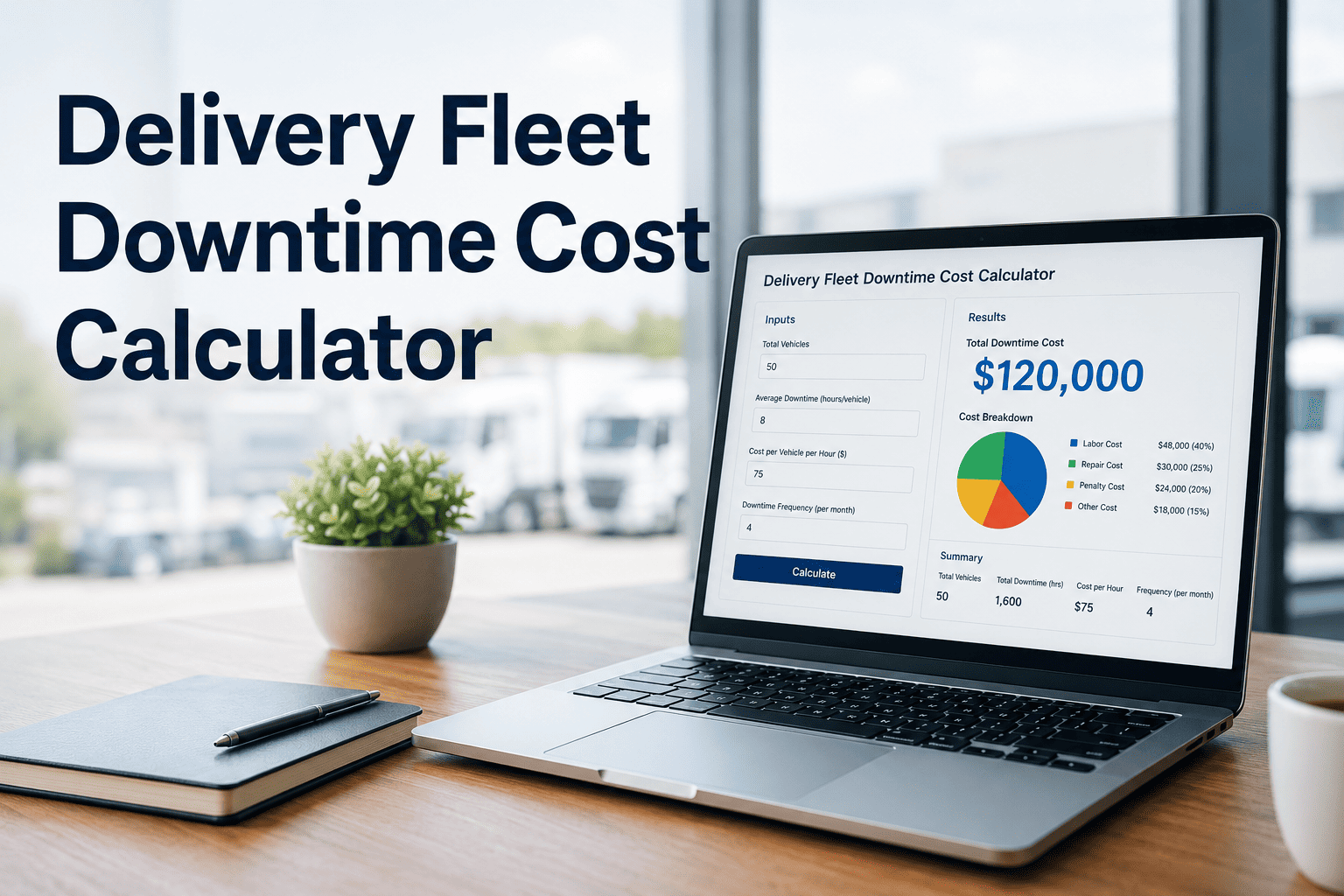
Most fleet managers track vehicle repair costs carefully. Almost none of them track the full cascade cost of a breakdown event — and that gap is where the real money is lost. When a delivery vehicle fails mid-route, the repair is the smallest line item. The recovery fee, the driver sitting idle for 3.8 hours, the missed delivery window, the customer service call, the emergency parts procurement at 2.4× planned cost, and the route replanning overhead for the next day combine to produce a per-incident cost that is three to five times the parts and labour bill. For a fleet manager aged 40 or above who has been managing reactive breakdowns for years, the question is no longer whether predictive maintenance delivers ROI — it is why the transition has not happened yet.
Emergency roadside recovery and tow
$220
Direct cost
Missed delivery windows and SLA penalties
$178
Revenue loss
Emergency parts at 2.4× planned procurement cost
$154
Parts premium
Driver idle time — average 3.8 hours at fully-loaded cost
$118
Labour waste
Route replanning, customer calls, and admin overhead
$90
Ops overhead
The critical insight is that 92% of these breakdowns involve components that showed measurable degradation signals in sensor data before the failure occurred. The component did not fail without warning — the fleet had no system listening to the warning. If your fleet is still operating without real-time condition monitoring, you can start a free OxMaint trial and deploy vehicle health monitoring across your entire fleet within the first week of deployment.
Real-Time Condition Monitoring: What It Measures and How It Works
Real-time condition monitoring is not a dashboard that shows you how many kilometres a vehicle has covered since its last service. It is a continuous data stream from onboard sensors — OBD diagnostics, vibration sensors, temperature probes, and fluid condition monitors — that feeds an AI model trained to identify the multivariate degradation patterns that precede specific failure modes. OxMaint connects to every vehicle via plug-and-play OBD integration. For fleets with existing telematics providers, the data stream connects via API without replacing any hardware. For manufacturing operations running SAP, every vehicle health event and work order syncs bidirectionally with SAP PM and MM modules — no double entry, no data silos. For depot charging infrastructure and shop floor automation, PLC integration feeds machine status and fault codes into the same condition monitoring engine that watches your delivery fleet.
Continuous OBD + IoT Sensor Data Collection
Every vehicle transmits real-time data across six component categories — engine health, brake system, battery and electrical, tyres, transmission, and exhaust/DPF. Data streams continuously throughout every route, not just at scheduled inspection points. OBD adapters are plug-and-play for modern commercial vehicles; existing telematics providers connect via API. A 20-vehicle depot can be fully connected in a single morning.
Output: Continuous health data stream per vehicle across all monitored components
Per-Vehicle AI Baseline and Degradation Profiling
The AI model builds an individual health baseline for each vehicle based on its specific operating pattern — route type, load profile, daily cycle count, and environmental conditions. A delivery van completing 80 urban stops per day has a different degradation baseline than a long-haul truck doing 3 motorway runs. Degradation is measured against the vehicle's own history, not a generic threshold — which is why the prediction accuracy reaches 87–92% for most failure types within 60 days of deployment.
Output: Individual health score 0–100 per vehicle, updated after every route
Multivariate Failure Prediction — 2 to 4 Weeks Ahead
When the sensor pattern for a specific vehicle begins matching the signature that historically preceded a known failure mode, OxMaint generates a prediction alert — with the component identified, a confidence score, and an estimated time-to-failure window. This is not a single threshold alarm that triggers when oil pressure drops below a value. It is pattern recognition across oil pressure, temperature variation, RPM anomaly, and historical failure data simultaneously — which is why it provides weeks of warning rather than seconds.
Impact: 2–4 week repair window vs zero warning in a reactive maintenance model
Automated Work Order — Workshop Notified Within 2 Minutes
The prediction instantly auto-generates a work order populated with vehicle ID, component at risk, recommended repair procedure, required parts, and a suggested repair date. Inventory is checked automatically — if the part is not in stock, a purchase order is triggered with enough lead time to receive the part before the repair date. The workshop gets the work order. The driver gets a scheduled depot visit. The fleet manager sees the action in the downtime analytics dashboard. The breakdown never happens.
Impact: Detection-to-repair gap reduced from 4–96 hours to under 2 minutes automatically
The Downtime Analytics Dashboard: Seeing Your Fleet's Hidden Cost Pattern
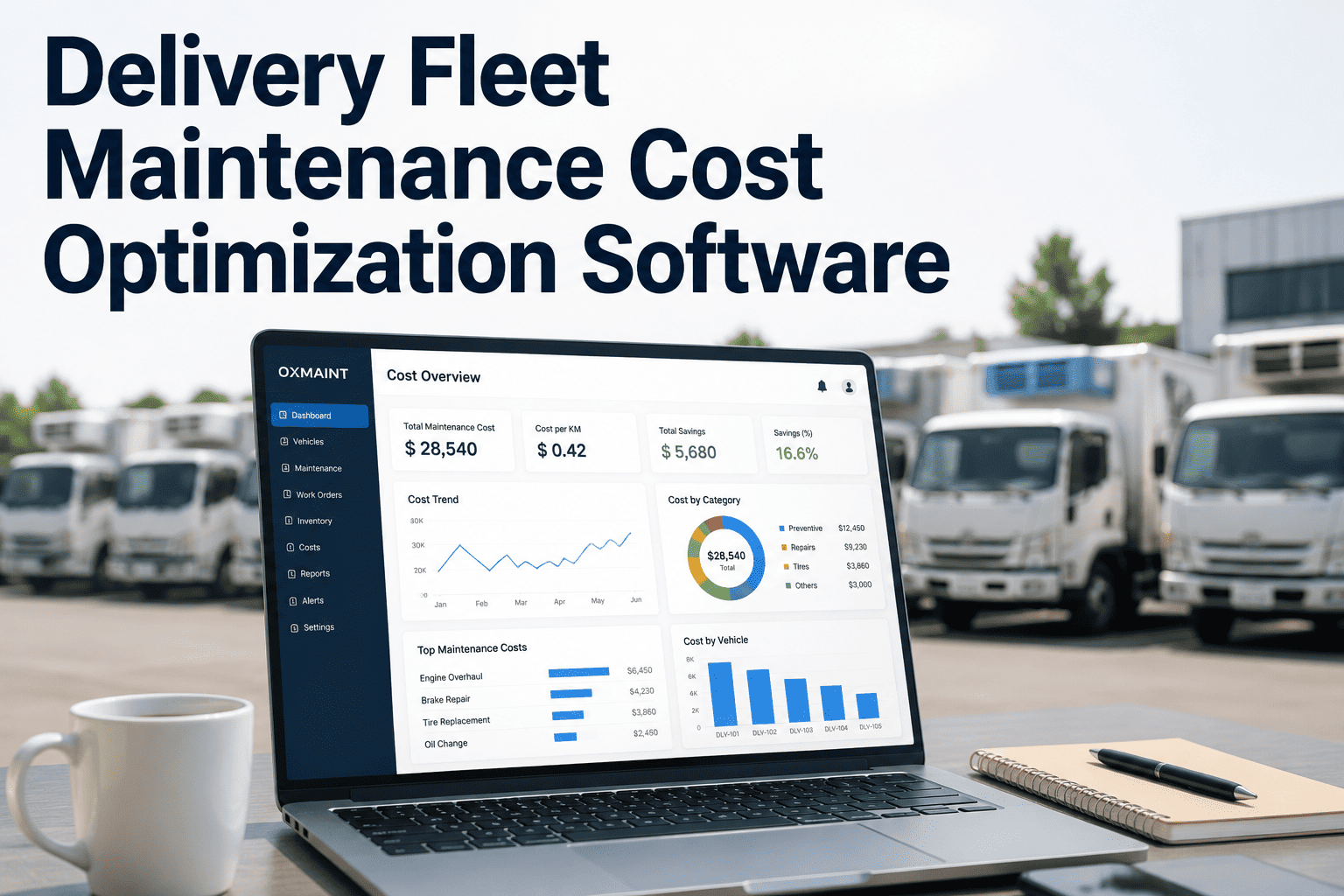
Most fleet managers have a reasonable sense of their total maintenance spend. Very few have a precise understanding of which vehicles, which routes, which components, and which times of year account for the majority of their unplanned downtime cost. The OxMaint downtime analytics dashboard surfaces this pattern — not as a report that takes an analyst half a day to build, but as a live view that updates as new sensor data arrives. Fleet operations directors who have deployed OxMaint's analytics module consistently report the same finding within the first 30 days: 20% of their vehicles account for 65–70% of their total unplanned downtime cost. Addressing those vehicles first — with predictive monitoring and accelerated PM scheduling — delivers the majority of the ROI before the full fleet deployment is complete.
Breakdown cost visibility
Monthly report — backwards looking
Live cost dashboard — updates in real time
Vehicle risk ranking
Not available — all vehicles treated equally
Every vehicle scored and ranked by failure risk
Component failure prediction
Not available — failure discovered at breakdown
2–4 week advance warning per vehicle and component
Work order trigger
Manual — hours or days after fault detected
Automatic — within 2 minutes of prediction alert
Parts procurement lead time
Emergency order at 2.4× cost after failure
Auto-PO triggered weeks before scheduled repair
On-time delivery rate impact
Breakdowns disrupt 1 in 4 delivery schedules
95%+ OTD rate maintained fleet-wide
Compliance record quality
Paper records — incomplete and hard to audit
Auto-generated timestamped records per incident
5 Technologies That Eliminate the Sources of Fleet Downtime
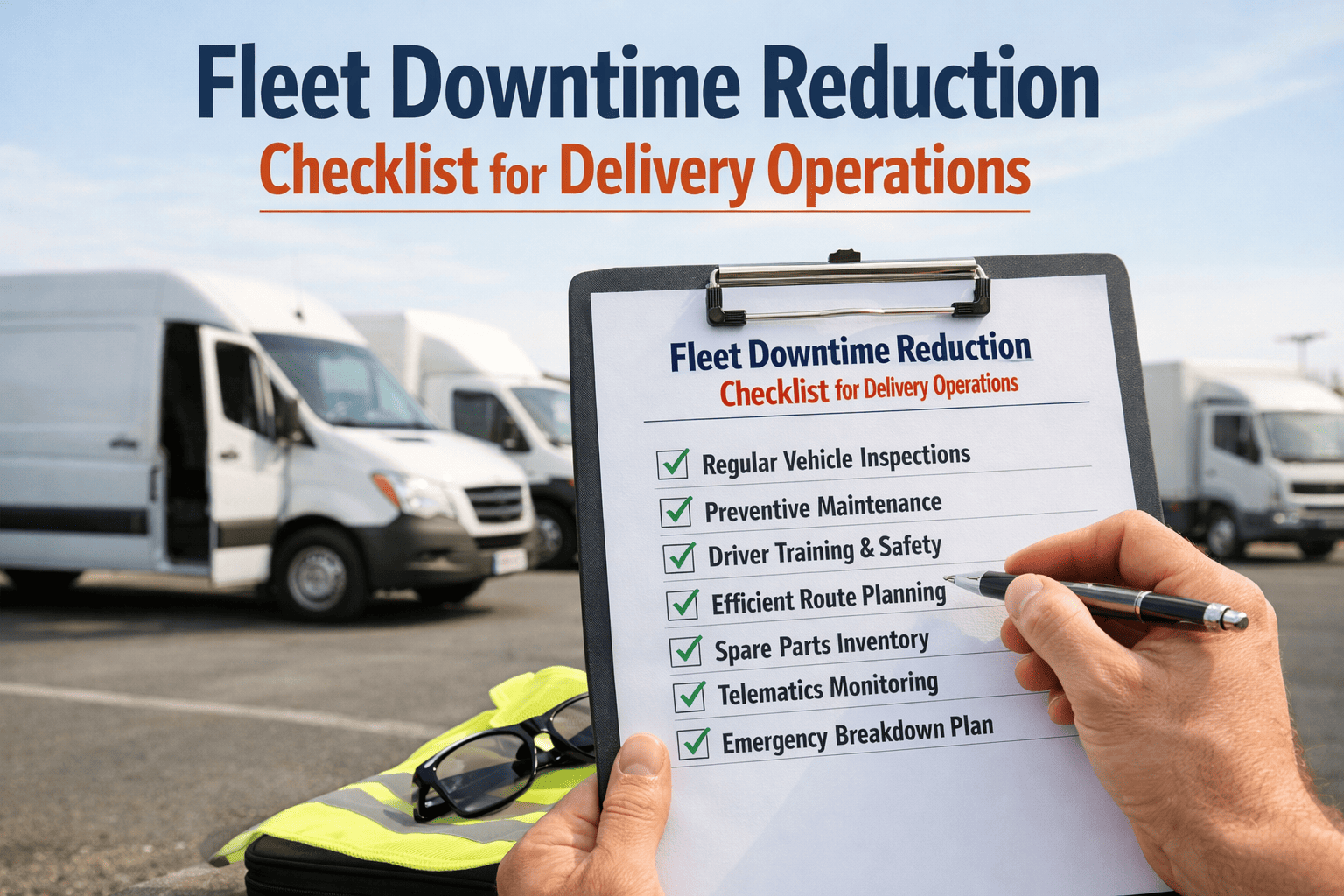
Fleet downtime reduction is not achieved by a single technology. It is achieved by layering five capabilities that each address a different source of vehicle failure and lost route time. OxMaint combines all five into a single platform that connects to the infrastructure your fleet already runs.
01
OBD Real-Time Vehicle Health Monitoring
Plug-and-play OBD integration ingests continuous diagnostic data from every vehicle — engine health, brake wear, battery efficiency, tyre pressure, transmission temperature, and exhaust system load. Data flows into the AI model every few seconds, building a live health score for every vehicle that updates after every route. For fleets with existing telematics hardware, OxMaint connects via API — no replacement of existing devices required. A 50-vehicle fleet can be fully connected within two depot days.
Detects 92% of impending failures before roadside occurrence
02
AI Predictive Maintenance — Pattern Recognition at Scale
The OxMaint AI engine does not simply watch for threshold breaches — it identifies the multivariate degradation signatures that precede specific failure modes across an entire fleet simultaneously. A brake calliper failure does not show a single pre-failure signal. It shows a pattern of brake pressure variance, pad wear rate, and fluid temperature interaction that, when combined, predicts failure 14–28 days in advance. Fleet managers who want to understand exactly how this prediction engine works for their specific vehicle types can book a live demo to see the model in action against their own route data.
87–92% prediction accuracy for major mechanical failures within 60 days
03
AI Camera Vision — Pre-Departure Depot Inspection
AI camera systems mounted at the depot exit gate inspect every vehicle in under 90 seconds as it departs — detecting tyre damage, body impact, fluid leaks, unsecured loads, and visible component wear with a timestamped image record. A 50-vehicle depot goes from 60–70% manual coverage to 100% AI-verified coverage without adding headcount. OxMaint ingests camera inspection outputs directly into the vehicle health record, triggering a work order automatically for any visual anomaly that meets the maintenance threshold. For operations under DVSA, DOT, or NHVL compliance requirements, the camera record provides an evidenced audit trail that a paper tick-sheet cannot.
Pre-departure inspection time: 10–15 min manual → 90 sec AI-verified
04
AI Digital Twin — Simulate Before You Deploy
A digital twin creates a virtual replica of each vehicle, mirroring real-time sensor data and accumulating its complete operational history. Fleet managers use the digital twin to simulate routing and loading decisions against vehicle health before committing — testing whether assigning a vehicle with a health score of 65 to a 400km overnight run creates elevated failure risk, or whether it falls within safe operational parameters. For maintenance teams, digital twins allow testing of new PM intervals and protocols on virtual vehicles before rolling them out across the physical fleet — eliminating the guesswork from PM schedule optimisation without risking a live failure.
Reduces premature failures from over-routing degraded vehicles by ~40%
05
SAP and PLC Integration — One System, No Data Gaps
For delivery operations linked to manufacturing facilities, OxMaint integrates bidirectionally with SAP PM and MM modules and connects to Siemens, Allen-Bradley, and Mitsubishi PLCs on the shop floor. When a production line runs ahead of schedule and more loads are available for dispatch, OxMaint can automatically flag vehicles with lower health scores for pre-dispatch inspection — preventing a high-output production day from being undone by a fleet breakdown on the outbound route. SAP integration is particularly relevant for US, Canadian, Australian, and European operations where SAP is standard enterprise infrastructure. Work orders, asset records, and parts consumption sync in both directions without double entry.
Eliminates data silos between workshop, fleet, and enterprise ERP systems
Before and After: What 60% Downtime Reduction Looks Like in Practice
These figures represent measured outcomes across delivery fleets deploying OxMaint condition monitoring and predictive maintenance — showing the transformation at the 90-day and 12-month marks. The ROI calculation for your specific fleet is straightforward to produce — if you want a personalised breakdown based on your vehicle count and current breakdown frequency, book a 30-minute demo and the OxMaint team will build that calculation against your actual operational numbers.
Unplanned breakdowns/month (50 vans)
8.2 avg
4.8 avg
3.1 avg
Breakdown cost per month
$30,400
$17,900
$11,500
Fleet availability at dispatch
79%
89%
97%
On-time delivery rate
82%
91%
96%
Emergency parts spend/month
$4,200
$2,100
$900
Planned vs reactive repair ratio
25:75
55:45
82:18
The ROI Calculation: What Downtime Reduction Is Worth Annually
Fleet downtime reduction ROI is calculated from four sources: prevented breakdown cost, elimination of emergency parts premiums, improved on-time delivery rates protecting contract value, and labour efficiency from planned versus reactive repair workflows. The calculation below is based on a 50-vehicle delivery fleet averaging 8 unplanned breakdowns per month at $760 per incident, before OxMaint deployment.
Prevented breakdown cost (60% reduction)
$219,000/yr
Emergency parts premium elimination
$43,200/yr
OTD improvement — SLA penalty reduction
$58,000/yr
Labour efficiency — planned vs reactive ratio
$18,000/yr
OxMaint platform cost (50 vehicles)$48,000/yr
Annual value delivered$338,200/yr
7× ROI — Full Platform Payback in Under 7 Months on a 50-Vehicle Fleet
The financial case for fleet downtime reduction software is not marginal. It is decisive. The platform cost is recoverable from prevented breakdown cost alone in under 3 months. Everything after that — the SLA protection, the parts savings, the labour efficiency — is pure operational gain. Fleet managers who want to see this calculation mapped to their own vehicle count and breakdown history can start a free OxMaint account and deploy real-time condition monitoring across their fleet without a credit card or commitment required.
Compliance and Fleet Safety: Records That Build Themselves
Unplanned downtime is not only a cost problem — it is a compliance risk. Commercial fleet operators in the USA under FMCSA Part 396, UK operators under DVSA O-licence requirements, Australian fleets under NHVL Chain of Responsibility obligations, and European operators under StVZO §29 periodic inspection requirements all share the same compliance challenge: the paper trail is as important as the repair itself. Manual maintenance logging creates gaps that only surface during an audit, at exactly the wrong moment. OxMaint generates compliant inspection and maintenance records automatically as a by-product of the condition monitoring and work order process. Every repair, inspection, and component replacement is timestamped, technician-attributed, and photo-evidenced. For a fleet director facing a DOT compliance review or DVSA improvement notice, having 18 months of complete vehicle maintenance records available within minutes — rather than scattered across folders, email chains, and Excel files — is the difference between a smooth audit and a material finding.
Week 1
Asset Register, OBD Installation, and Data Import
Log every vehicle with registration, make, model, mileage, and engine type. Fit OBD adapters — a 20-vehicle depot completes in a single morning without removing vehicles from service. Import the last 12 months of maintenance history. The AI model starts building per-vehicle baselines from existing data immediately and delivers initial health scores within 48 hours.
Week 2
SAP Integration, Compliance Templates, and Workshop Onboarding
Configure SAP PM/MM bidirectional sync if applicable. Set up DOT DVIR, DVSA daily walk-around, or NHVL inspection checklists — records start building automatically from go-live. Train workshop staff on the mobile work order interface: photo evidence capture and completion sign-off are the two critical habits that feed the AI model and build the compliance audit trail simultaneously.
Week 3–4
Parts Inventory Baseline, Alert Thresholds, and Full Go-Live
Load current spare parts stock and set minimum buffer levels for high-turnover components. Configure health score alert thresholds for your dispatch workflow. The downtime analytics dashboard goes live — fleet manager can now see every vehicle's health score, upcoming predicted repairs, and the fleet-wide cost trend. AI prediction alerts begin generating automated work orders within the first 10–14 days of live operation.
Day 30–90
AI Model Calibrates — First Confirmed Prevented Breakdowns
Initial predictions begin within 30 days. Accuracy improves through day 90 as the model accumulates route-specific operational patterns. Most 50-vehicle fleets confirm their first AI-predicted repair completed before a breakdown within 45 days. At day 90, compare unplanned breakdown count and cost against the pre-deployment baseline — the 60% reduction target becomes visible in the downtime analytics dashboard before the quarter ends.
10 Key Takeaways for Fleet Operations Managers
01
The all-in cost of an unplanned commercial vehicle breakdown is $448–$760 per day — three to five times the repair bill alone. Repair cost is the visible fraction. Recovery, missed deliveries, emergency parts, driver idle time, and replanning overhead are the hidden majority.
02
92% of unplanned breakdowns involve components that showed measurable degradation signals before failure. The failure was predictable. The problem was the absence of a system monitoring those signals and acting on them before the route was disrupted.
03
AI condition monitoring does not replace existing telematics — it layers on top via API. Fleets with Samsara, Geotab, or Verizon Connect already have the data. OxMaint provides the AI model and the work order automation that converts that data into prevented breakdowns.
04
The 60% downtime reduction figure is documented at 90 days. Most fleets see the first confirmed AI-prevented breakdown within 45 days — before the model has fully calibrated. The ROI case is visible within the first billing cycle.
05
Emergency parts procurement costs 2.4× the planned procurement rate. On a 50-vehicle fleet spending $4,200/month on emergency parts, eliminating that premium saves over $43,000 per year — from a single line item improvement.
06
AI camera pre-departure inspection covers 100% of vehicles in 90 seconds each — compared to 60–70% coverage in 10–15 minutes each manually. For a 50-vehicle depot, that difference eliminates the daily inspection gap that allows visible defects to enter the road network undetected.
07
Digital twin simulation allows fleet managers to test routing decisions against vehicle health before committing — reducing the premature failures caused by over-routing degraded vehicles by approximately 40%. This is the analytical layer that calendar-based PM scheduling cannot provide.
08
SAP bidirectional integration eliminates the data lag and double-entry overhead that affects every fleet operation running both a maintenance platform and an ERP system. Work orders, parts consumption, and asset records align automatically from go-live day.
09
Compliance record-keeping — DVIR, DVSA walk-arounds, NHVL inspection records — is unsustainable manually at scale. OxMaint generates these records automatically as a by-product of the condition monitoring process. An audit-ready export is available on demand without manual assembly.
10
The 7× ROI on a 50-vehicle fleet makes the financial decision binary: the platform saves $7 for every $1 it costs. The question for any fleet manager reviewing this data is not whether the investment delivers a return — it is how much has already been lost to breakdowns that a monitoring system would have prevented.
Frequently Asked Questions
Q1How quickly does OxMaint begin predicting failures after deployment?
Initial health scores are available within 48 hours of OBD installation using baseline sensor readings. Failure prediction alerts begin generating within 10–14 days as the AI model accumulates operational data. Prediction accuracy reaches 87–92% for major failure types within 60 days. Fleets that import 12–24 months of historical maintenance data at go-live see higher baseline accuracy from the first week. The first confirmed AI-predicted repair — completed before a breakdown would have occurred — typically happens within 45 days for a 20-vehicle or larger fleet. If you want to understand exactly what your fleet's deployment timeline would look like,
book a demo and the OxMaint team will map a deployment plan against your specific vehicle types and telematics setup.
Q2Does OxMaint require replacing our existing telematics hardware?
No. OxMaint integrates with major telematics providers via API — receiving the same vehicle data stream without requiring hardware replacement or contract changes. For vehicles without existing telematics, OxMaint-compatible OBD adapters are plug-and-play and can be fitted across a 20-vehicle depot in a single morning. The integration team confirms compatibility with your specific telematics provider during the onboarding process at no additional cost. Fleets running Samsara, Geotab, Verizon Connect, and most other major providers connect without any hardware changes.
Q3How does OxMaint handle compliance records for DOT, DVSA, and NHVL requirements?
OxMaint generates Part 396-compliant Driver Vehicle Inspection Reports, DVSA daily walk-around check records, and NHVL inspection documentation automatically as a by-product of the condition monitoring and work order process. Every maintenance event — repair, inspection, component replacement — is timestamped, attributed to the responsible technician or driver, and photo-evidenced where applicable. Records are stored in audit-ready format and exportable on demand. For a fleet director facing a scheduled DOT inspection or an unannounced DVSA visit, the full maintenance history for any vehicle is accessible within minutes.
Q4Does OxMaint support EV and hybrid delivery fleets?
Yes. OxMaint has dedicated monitoring profiles for EV and hybrid vehicles that track battery state-of-health per cell group, charge cycle efficiency degradation curves, thermal management system performance, and regenerative braking wear patterns. For depots with PLC-connected charging infrastructure, OxMaint integrates directly with the charging management system to monitor battery health per vehicle from the charge session data. Mixed fleets running diesel and EV vehicles are managed in a single unified dashboard with appropriate monitoring models applied per drivetrain type — no need for separate systems.
Q5What is the minimum fleet size where OxMaint delivers positive ROI?
Fleets of 10 or more commercial vehicles typically see positive ROI within 5–8 months. At 10 vehicles averaging 2 breakdowns per month at $700 each, the annual reactive breakdown cost is $16,800. A 60% reduction saves $10,080 per year before emergency parts premiums and SLA penalties — enough to recover the platform cost within the first year on the smallest fleet size OxMaint is designed for. The 20–50 vehicle range consistently delivers the fastest payback, with most operators reaching ROI-positive within 4–6 months.
Start your free OxMaint trial and deploy condition monitoring across your fleet — no credit card required to begin.
Real-Time Monitoring · Predictive Alerts · Downtime Analytics · Auto Work Orders
Every Breakdown Your Fleet Has Suffered Was Predictable. The Next One Does Not Have to Happen.
60%
breakdown reduction in 90 days
7× ROI
average year-one return
2–4 wks
advance failure warning
Trusted by delivery fleet operators across the USA, UK, Australia, Canada, and Europe. Works with your existing telematics hardware. No credit card required to start.
No credit card required. Deployment support included. Compatible with major telematics providers via API.