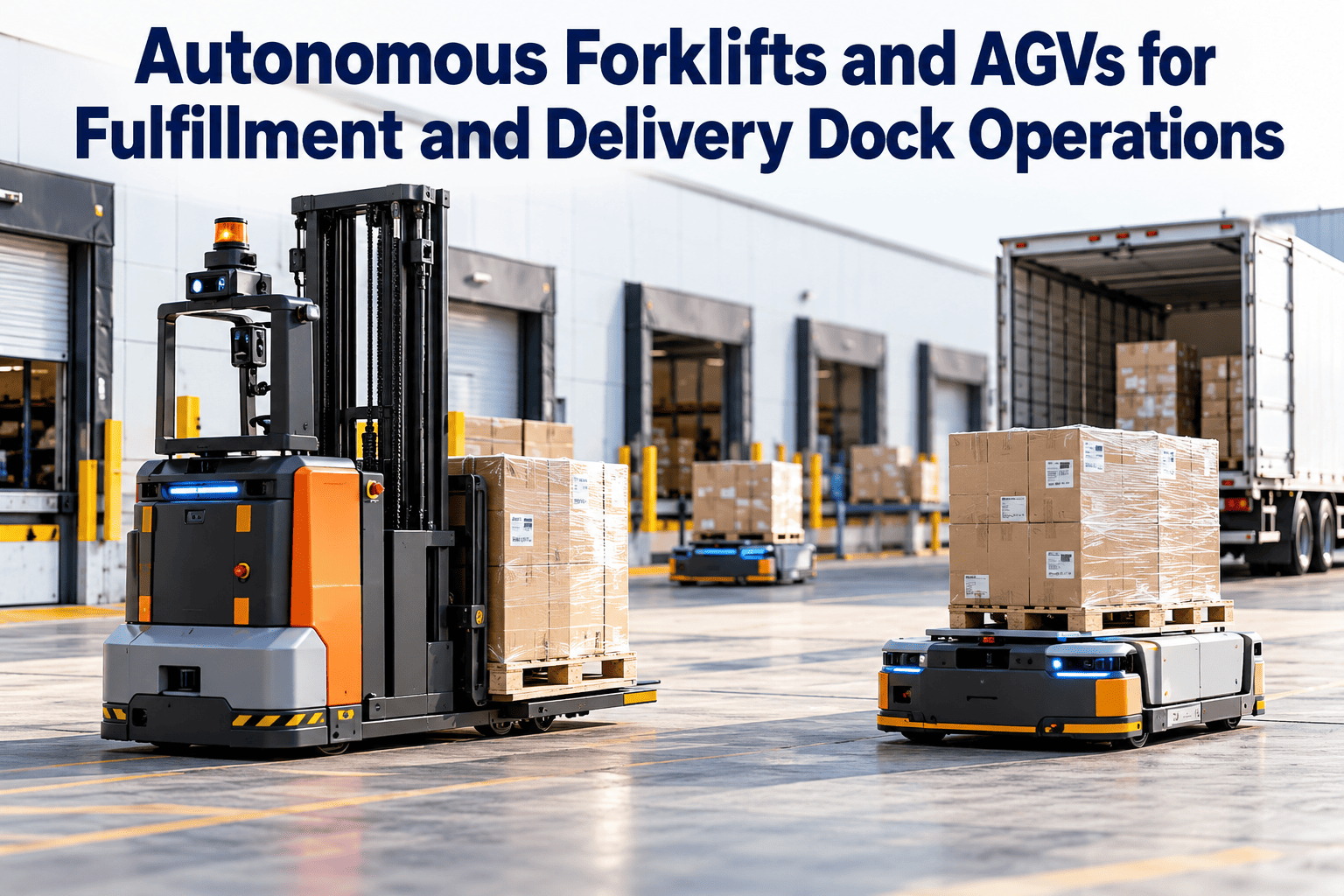
Autonomous forklifts and automated guided vehicles have moved out of showroom demonstrations and into live fulfillment centers, cross-docks and delivery hubs. The attraction is steady, repeatable pallet movement on every shift, with fewer collisions and less dependence on scarce operators. The risk is treating the machines as finished appliances. A driverless truck that stops in an aisle stops everything behind it, so uptime, inspections and parts planning matter more than they did with manual trucks. Teams that plan the maintenance model before go-live, often with maintenance management software holding asset history and preventive tasks, tend to have a smoother transition.
Autonomous Forklifts and AGVs for Fulfillment and Delivery Dock Operations
Plan the transition from manual trucks to autonomous material handling, from use case selection through to the maintenance program that keeps fleets productive.
Why autonomous material handling is moving from pilot to production
Several pressures push operations toward automation at the same time. Labor for repetitive, shift-based driving is harder to hire and retain, order profiles demand steadier throughput, and safety teams want fewer vehicle and pedestrian interactions. Technology has also matured, so more facilities can justify a trial.
What has not changed
- Machines still wear, leak, lose calibration and need cleaning, charging and replacement parts.
- Unplanned downtime still costs the most when it happens at the dock during a departure wave.
- Facilities still need good floors, clear aisles and predictable pallets for any vehicle to perform well.
- People still decide how work is organized, and process discipline remains the largest driver of results.
The technology landscape: matching vehicle type to the task
The labels autonomous forklift, AGV and AMR overlap in marketing. What matters operationally is how the vehicle navigates, what it can carry and how well it handles change in the facility.
| Vehicle type | How it navigates | Typical tasks | Considerations |
|---|---|---|---|
| Fixed-path AGV | Magnetic tape, wire or defined guide paths | Repeated point-to-point transport, tugging carts | Very predictable, less flexible when layouts change |
| Laser-guided vehicle | Reflectors and laser triangulation | Pallet transport in structured facilities | Reflectors must stay clean and unobstructed |
| Autonomous mobile robot | Natural features, maps and onboard sensing | Flexible transport in changing environments | Depends on sensor condition and map accuracy |
| Autonomous pallet truck or forklift | Natural navigation or hybrid guidance | Dock-to-stock, staging, replenishment, loading | Fork, mast and load handling add mechanical wear |
| Autonomous tugger | Path following with onboard safety scanning | Moving carts of parcels or packaging materials | Hitch and cart condition affect reliability |
Choosing the first use case: what makes a good fit
A strong first deployment is simple, repetitive and measurable. Starting with the hardest workflow in the building is the most common reason pilots stall.
- Repeated moves between fixed points, such as dock to staging
- Standard pallets with consistent size, wrap and condition
- Predictable traffic with limited mixing of people and trucks
- Clear aisles, good floors and stable layouts
- Work that runs on multiple shifts or peaks sharply
- Highly variable loads, damaged pallets or loose packaging
- Narrow, congested areas with constant pedestrian crossings
- Ramps, thresholds or uneven floors that stress sensors
- Workflows that change layout weekly
- Processes with poorly defined start and end points
Questions to answer before choosing a vendor
- How many missions per hour must the fleet complete at peak, and what happens when a vehicle is unavailable?
- Which warehouse or yard system will assign tasks, and who maintains that integration?
- What local service response and spare parts support will the vendor commit to in writing?
- What training will your technicians and operators receive, and who maintains the vehicle software?
A phased transition plan
Successful programs advance in stages and confirm readiness at the end of each. The sequence below suits a delivery hub or fulfillment center introducing its first autonomous vehicles.
Assess
Map flows, pallet quality, floor condition and wireless coverage. Define the target workflow and measurable goals.Prepare
Repair floors, standardize pallets, mark zones, and set up charging space and network. Draft the maintenance plan.Pilot
Run a small fleet on one workflow with close monitoring of stoppages, interventions and operator feedback.Stabilize
Resolve recurring issues, finalize preventive tasks and spares, and confirm service levels before adding vehicles.Scale
Add vehicles and workflows in steps, with updated traffic rules, training and dashboards at each step.Optimize
Use mission and maintenance data to refine layouts, charging strategy, intervals and capacity planning.Plan the maintenance program before the first vehicle arrives
Set up asset records, daily inspections, preventive tasks and spares tracking for autonomous equipment, so go-live starts with a working routine.
Preventive maintenance, inspections, inventory and work orders in one platform.Reliability requirements: where autonomous trucks actually fail
Failures in autonomous equipment cluster in a few subsystems. Knowing them lets you build inspection and preventive tasks around real risks rather than generic lists.
| Subsystem | Typical failure or degradation | Preventive focus |
|---|---|---|
| Sensors and scanners | Dirt, film, misalignment, impact damage, calibration drift | Daily cleaning and visual checks, scheduled calibration and verification |
| Battery and charging | Capacity loss, connector wear, charger faults, thermal events | Battery health records, contact inspection, charger checks, charging policy review |
| Drive and steering | Wheel wear, bearing noise, motor or encoder faults | Wheel and tire inspection, lubrication, encoder and drive checks |
| Mast, forks and hydraulics | Chain stretch, fork wear, leaks, slow lift, sensor misreads | Lift and tilt inspection, chain and fork measurement, fluid and hose checks |
| Safety devices | Stop button faults, bumper failures, warning light or alarm issues | Functional safety tests on a defined schedule with signed records |
| Software and network | Connectivity loss, map errors, failed updates, task assignment faults | Wireless coverage surveys, version control, backup and change records |
| Environment | Floor damage, debris, blocked paths, reflective surfaces, poor lighting | Floor and aisle audits, housekeeping routines, incident follow-up |
Designing the maintenance program for a mission-critical fleet
A layered model spreads responsibility sensibly. Operators catch simple issues, technicians handle planned work, and the vendor supports complex diagnostics and software.
- Start-of-shift walk-around and sensor cleaning
- Report damage, odd behavior and blocked paths
- Verify charging connections and parking positions
- Scheduled preventive tasks by hours, cycles or calendar
- Mechanical repairs, battery handling and wear parts
- Safety function tests and records
- Software updates, calibration and map changes
- Advanced diagnostics and warranty repairs
- Training refreshers and engineering support
Spares and support strategy
- Hold critical spares on site, such as scanners, wheels, batteries and charging contacts, based on lead times.
- Agree vendor response times in writing and record actual performance against them.
- Keep a spare vehicle or a documented manual fallback process for periods of unavailability.
- Track parts consumption by vehicle so replacement patterns and defects show up early.
- Review the spares list after the first three months, because real usage usually differs from the initial vendor recommendation.
Common transition mistakes and the safer alternative
Most troubled deployments share the same handful of avoidable errors. They are rarely technical failures. They are planning gaps that appear once the machines meet real shifts.
| Mistake | What happens | Safer approach |
|---|---|---|
| Writing the maintenance plan after go-live | Early faults are handled ad hoc and the same issues repeat | Draft inspections, preventive tasks and spares before the pilot starts |
| Ignoring pallet and floor quality | Vehicles stop for load detection errors and uneven surfaces | Set pallet standards and repair floors during preparation |
| Depending entirely on the vendor | Long response times and little internal knowledge | Train in-house technicians and agree service levels in the contract |
| Under-planning charging | Vehicles queue for chargers during peaks | Model charge cycles against shifts and place chargers near the work |
| Scaling before stabilizing | Problems multiply across more vehicles and workflows | Set exit criteria for the pilot and meet them before adding vehicles |
| Leaving intervention rules vague | Staff improvise recoveries and safety risks rise | Document and train a standard recovery and restart procedure |
What the maintenance system should record for each vehicle
Good records make troubleshooting faster and warranty discussions simpler. A consistent record structure turns a mixed fleet into something technicians can manage the same way.
Operating alongside manual trucks and people
Few sites switch every truck at once, so mixed operations are the norm for years. Clear rules protect both safety and throughput during this period.
Safety, standards and documentation
Driverless industrial trucks are covered by specific safety standards, including ISO 3691-4 internationally and ANSI/ITSDF B56.5 in North America. Requirements and editions change, so confirm current versions and local rules with your vendor and safety team.
- Keep risk assessments, commissioning records and layout changes together in one controlled place.
- Test safety functions such as scanners, bumpers and emergency stops at defined intervals, and keep signed results.
- Record software versions and configuration changes against each vehicle, with the date and the person responsible.
- Treat any near-miss or contact event as a work order and an investigation, not just an incident note.
- Train technicians on lockout procedures specific to autonomous vehicles, including stored energy and remote commands.
Skills and roles for the maintenance team
Autonomous fleets blend mechanical, electrical and software work. Building these skills early reduces dependence on outside help and shortens response times.
Mechanical and hydraulic
Wheels, chains, forks, masts, hoses and fluids, with the same discipline applied to manual lift trucks.Electrical and battery
Battery handling, charging systems, wiring faults and safe work around high-energy components.Sensors and controls
Cleaning, alignment, calibration checks and reading fault logs to separate hardware from software causes.Network and integration
Wireless coverage, access points and the interface to warehouse systems, often shared with IT.Measuring the fleet: reliability and productivity together
Operations and maintenance should look at one shared set of indicators. Each reveals a different side of how well the fleet supports the facility.
Frequently asked questions
Do autonomous forklifts need less maintenance than manual trucks?
Not necessarily. They share the mechanical wear of any lift truck and add sensors, software and safety systems. Their downtime also affects more of the operation.
What should our first preventive tasks cover?
Start with sensor cleaning, safety function tests, battery and charger checks, and mechanical wear items. Build tasks from vendor guidance, then adjust. You can book a demo to see how they are scheduled.
Who should maintain autonomous vehicles, us or the vendor?
Most sites share the work. Technicians handle planned mechanical tasks and the vendor handles software and complex diagnostics, with clear response times in the contract.
How do we record software and configuration changes?
Log them against each vehicle as maintenance records with date, version and approver. You can get started by building asset records for the fleet.
Can small delivery hubs benefit from autonomous handling?
Sometimes, when repeatable moves and enough volume exist. Smaller sites should test one workflow first and confirm service support is available locally.
Treat autonomous material handling as the critical asset it is
Build the inspections, preventive tasks, spares and records that keep driverless fleets moving, and keep every dock lane flowing.
Asset management, inspections, preventive maintenance and reporting in one system.