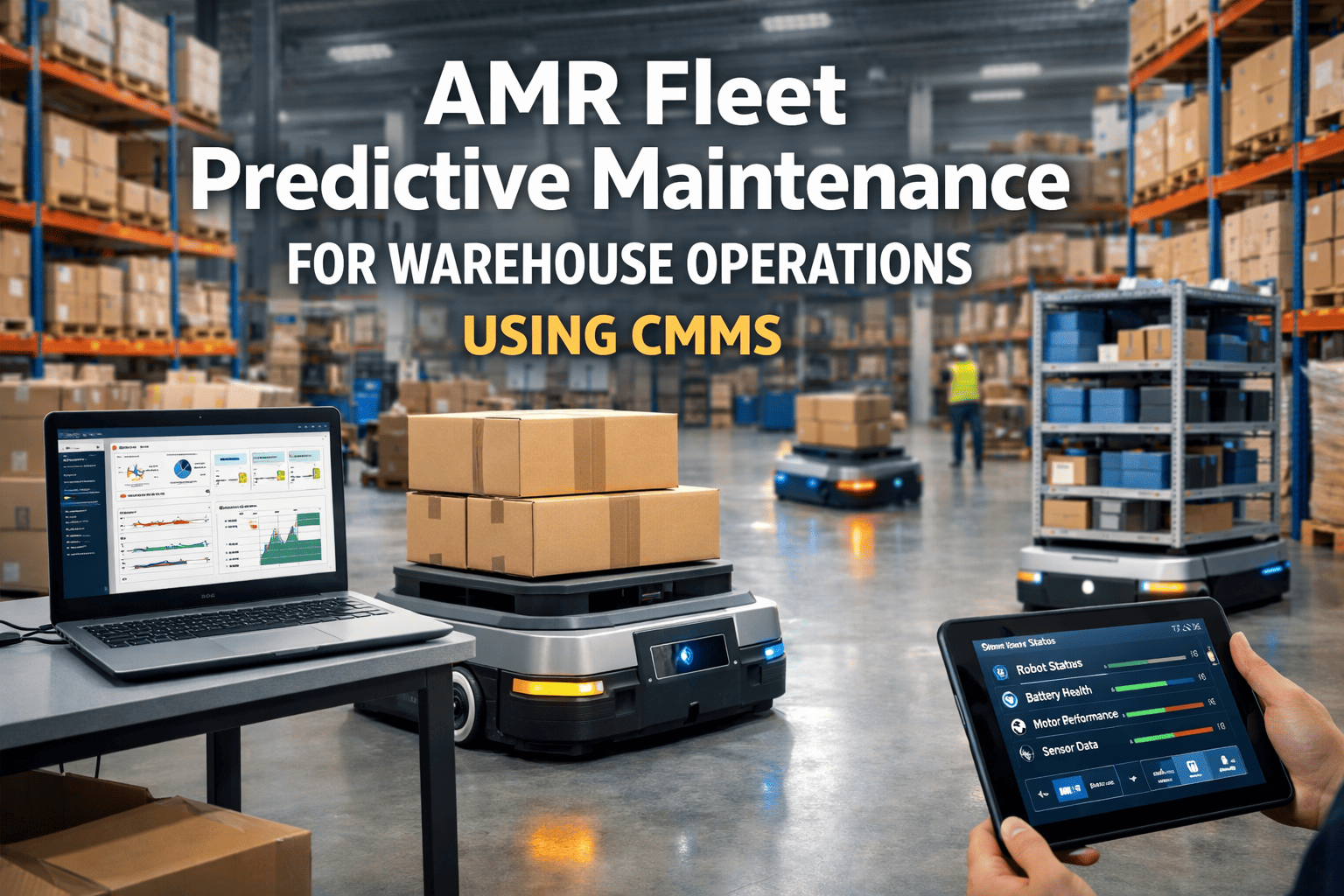
Inbound delivery operations run on tight windows — and a single forklift breakdown during peak staging hours can unravel an entire day's receiving schedule. At warehouse facilities handling high-frequency inbound flows, predictive forklift maintenance with CMMS scheduling is the single most impactful investment a logistics manager can make. If your forklifts aren't maintained proactively, you're not managing operations — you're managing incidents. The difference between a warehouse that ships on time and one that doesn't often comes down to one overlooked hydraulic seal or a battery charge cycle ignored for three shifts straight.
Blog · Warehouse Maintenance · 2026
Warehouse Forklift Maintenance for Inbound Delivery Operations
How predictive maintenance and CMMS task scheduling eliminate forklift downtime, protect safety compliance, and keep inbound staging running at full speed — even during peak delivery windows.
82%
of unplanned warehouse downtime is equipment-related — forklifts top the list
3.5x
higher repair costs when forklift faults are caught reactively vs. predictively
45min
average delay per inbound shift caused by unscheduled forklift failure
91%
of forklift failures are preventable with structured inspection and CMMS scheduling
Why Forklift Failures Hit Inbound Operations Hardest
Inbound staging is time-critical — trucks arrive on fixed windows, dock space is limited, and receiving teams have no buffer. Unlike outbound dispatch where you can resequence loads, inbound delivery failures cascade immediately into receiving backlogs, storage conflicts, and missed SLA windows.
Peak-Hour Breakdowns
Forklifts are used most intensively during inbound peak hours — exactly when failure rates spike. Hydraulic systems, brakes, and tyre wear all degrade faster under high-cycle conditions.
High Frequency Risk
Safety Compliance Gaps
OSHA and regional warehouse safety regulations require documented pre-shift inspections. Skipped or paper-based inspections create compliance gaps that result in fines and audit failures.
Regulatory Risk
Multi-Shift Battery Fatigue
Electric forklifts running across three shifts without monitored charge cycles degrade faster. Battery failure is the leading cause of mid-shift forklift stoppage in modern warehouses.
Energy Management Risk
Untracked Component Wear
Forks, mast chains, and hydraulic hoses have defined service intervals. Without CMMS tracking, teams rely on visual inspection — catching failures after, not before, they become critical.
Asset Life Risk
Operator-Reported Faults Ignored
Operators often report minor faults verbally. Without a structured fault-logging system, these reports are lost between shifts — and minor faults become costly breakdowns within days.
Data Loss Risk
Substitution Delays
When a forklift goes down unplanned, sourcing a replacement unit — even from the same fleet — adds 20 to 40 minutes per incident. Multiplied across a week, this is a significant throughput loss.
Throughput Risk
The Inbound Forklift Inspection Checklist — Built for CMMS
01
Pre-Shift Visual Inspection
Forks, mast, overhead guard, tires, and fluid levels — digitally logged per operator with timestamp and forklift ID in CMMS.
02
Battery & Charge Status
Charge level, electrolyte level for lead-acid units, and charge cycle count — preventing mid-shift outages on electric fleets.
03
Hydraulic System Check
Fluid level, hose integrity, lift and tilt cylinder response — the most common failure point during high-cycle inbound shifts.
04
Brake & Steering Function
Service brake response, emergency brake hold, and steering play — safety-critical checks tied to OSHA compliance records in CMMS.
05
Fork Load Capacity Verification
Fork thickness at heel, tine spread verification, and capacity placard legibility — ensures safe handling of inbound pallet weights.
06
Mast Chain Lubrication & Tension
CMMS-scheduled interval task — mast chains require lubrication every 100 operating hours to prevent the most common mid-shift failure.
07
Warning Light & Horn Functionality
Safety signals verified per shift — CMMS auto-generates the task and captures completion status for safety audit trails.
08
Post-Shift Fault Log
Operators submit digital fault reports at shift end — CMMS routes flagged items to maintenance automatically, closing the gap between report and repair.
Predictive Maintenance Flow for Warehouse Forklifts
Predictive maintenance replaces the "fix it when it breaks" cycle with a data-driven schedule that catches degradation before it becomes downtime. Here is how the four-step flow works in a CMMS environment.
01
Sensor & Operator Data Capture
Usage hours, fault codes, and operator inspection logs feed into CMMS in real time — building the data foundation for predictive triggers.
→
02
CMMS Threshold Monitoring
CMMS tracks usage against service intervals — hydraulic fluid at 250 hours, mast chain at 100 hours, brake inspection at 500 hours — and auto-generates work orders.
→
03
Scheduled Maintenance Window
Work orders are assigned to technicians during low-traffic periods — between inbound peaks — so forklifts are serviced without impacting receiving throughput.
→
04
Compliance Record Auto-Generated
Every completed maintenance task creates a timestamped, technician-signed compliance record — audit-ready for OSHA inspections and insurance documentation.
Reactive vs. Predictive: The Real Cost Difference
Reactive Maintenance
Forklift fails mid-shift — inbound receiving stops for 45+ minutes
Emergency repair costs 3 to 5 times planned maintenance cost
Compliance records incomplete — OSHA fine risk elevated
Operator fault reports lost between shifts — problems recur
Fleet availability unknown until a unit breaks down
No data on component wear — replacements always emergency purchases
Predictive with CMMS
Maintenance scheduled during off-peak hours — zero inbound disruption
Parts ordered in advance — planned repair cost 60% lower than emergency
Digital compliance records auto-generated per task — always audit-ready
Fault logs routed to technicians automatically — no report gets lost
Fleet availability dashboard shows real-time unit status across the warehouse
Component wear tracked — replacements planned and budgeted in advance
CMMS Maintenance Schedule: Inbound Forklift Fleet
60%
reduction in emergency repair spend when CMMS schedules replace reactive maintenance
99%
inspection compliance rate achievable when CMMS auto-assigns pre-shift checks to operators
2.4x
longer average forklift service life with interval-based predictive maintenance vs. run-to-failure
Stop Losing Inbound Hours to Forklift Breakdowns
Oxmaint CMMS auto-schedules every forklift inspection, generates compliance records, routes fault reports, and gives you a real-time fleet availability dashboard — so your inbound staging never stops because of equipment failure.
Frequently Asked Questions
How does CMMS help with forklift maintenance scheduling in a warehouse?
A CMMS like
Oxmaint auto-generates maintenance work orders based on hour-meter readings, calendar intervals, and operator fault reports — so nothing gets missed between shifts. Every task is assigned, tracked, and closed with a compliance record. No spreadsheets, no verbal handoffs, no gaps in your maintenance history.
What are the most critical forklift components to maintain for inbound operations?
Hydraulic systems, mast chains, and batteries cause the highest rate of mid-shift failures in inbound staging. These three components should have CMMS-scheduled intervals — hydraulics at 250 hours, mast chains at 100 hours, and battery cycles monitored weekly. Brake systems are safety-critical and require inspection every 500 hours per OSHA guidance.
Can predictive forklift maintenance really prevent unplanned downtime?
Yes — industry data shows 91% of forklift failures are preventable with structured inspection and interval-based maintenance. Predictive maintenance catches degradation before failure, scheduling repairs during off-peak hours so inbound receiving is never disrupted.
Book a demo to see how Oxmaint builds this schedule automatically for your fleet.
How does Oxmaint handle forklift safety compliance documentation?
Every pre-shift inspection and maintenance task completed in Oxmaint generates a timestamped, technician-signed compliance record stored digitally. Pre-shift inspection forms are auto-assigned to operators at shift start — ensuring OSHA-required documentation is complete every single day without manual follow-up from supervisors.
Your Inbound Operations Deserve a Smarter Maintenance System
Join warehouse teams across logistics hubs using Oxmaint to schedule forklift maintenance, track compliance, and eliminate the breakdowns that cost you hours every week. Get started free — no credit card required.