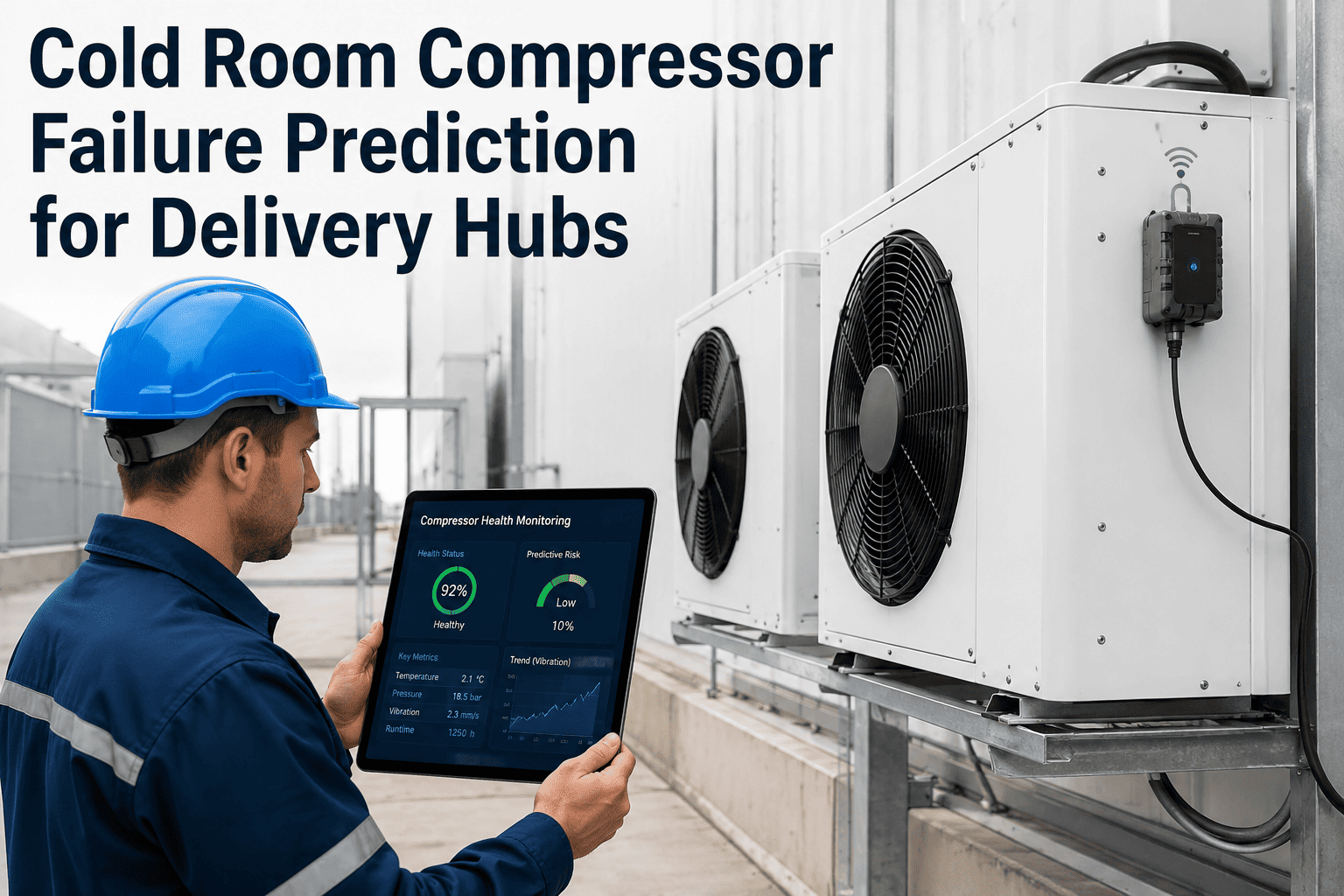
A cold room compressor almost never dies in silence. Weeks before it seizes, it starts telling you — the amp draw creeps up, the suction pressure drifts, the bearings hum at a frequency no one is listening for, and the discharge temperature climbs a fraction of a degree at a time. In a busy delivery hub, no human can watch those four signals across every unit at 3 a.m. So the warning passes unread, and the first anyone hears of it is a warm cold room and a dock of spoiled parcels. OxMaint's compressor failure prediction software reads those signatures continuously and turns drift into a scheduled fix. Book a demo to see it forecast a failure on your own equipment.
Predictive Maintenance
Cold Chain
Delivery Hubs
Cold Room Compressor Failure Prediction for Delivery Hubs
Catch compressor degradation 3 to 8 weeks early. Read sensor trends, score reliability, and turn drift into technician-ready work orders before the cold room ever warms.
3–8 wk
Advance warning a compressor gives before it fails
90%+
AI prediction accuracy on major failure modes after training
3–5x
Cost of emergency compressor work vs a planned fix
$38K
A starved-bearing rebuild — caught early for a filter change
The Four Signals
A Compressor Failure Is a Forecast, Not a Surprise
Compressor failures rarely arrive without warning. The warning shows up as drift across four signals — each small in isolation, but read together they are a forecast. A fixed alarm threshold only fires once a parameter has already crossed the line. OxMaint reads the slope, not just the limit, and sees the failure forming weeks before the cold room is at risk.
Compressor amp draw
A healthy unit pulls steady current. As bearings wear, charge drifts, or coils foul, it pulls more amps to do the same work — the clearest early electrical signature.
Rising
Suction & discharge pressure
Pressure drift on either side of the circuit points to refrigerant loss, coil fouling, or valve wear — long before cooling capacity visibly drops.
Drifting
Vibration signature
A microscopic pit in a bearing race changes the vibration spectrum at known fault frequencies — detectable while the compressor still runs normally.
Shifting
Discharge temperature
A slow climb in differential temperature signals lubrication trouble or rising condensing pressure — the thermodynamic tell that ties the other three together.
Climbing
Failure Signature Map
Each Failure Mode Leaves a Distinct Fingerprint
Compressors fail through a handful of well-understood mechanisms, and each produces its own sensor signature before it stops running. The work of prediction is mapping that fingerprint to the right fix — early enough that it is a parts swap, not a rebuild.
| Failure Mode |
Sensor Signature |
Lead Time |
Early Fix |
If Missed |
| Bearing wear |
Vibration fault frequency + amp rise |
4–8 weeks |
Lubrication, bearing swap |
Compressor rebuild |
| Oil starvation |
Oil pressure drop, temp climb |
Weeks |
Filter change |
$38K airend damage |
| Refrigerant leak |
Suction pressure drift |
2–4 weeks |
Leak repair, recharge |
Loss of cooling |
| Condenser fouling |
Rising head pressure + amp draw |
Weeks |
Coil cleaning |
Compressor overwork |
| Valve wear |
Discharge temp + efficiency drop |
Weeks |
Valve plate service |
Capacity collapse |
| Motor / electrical |
Current signature, phase imbalance |
2–4 weeks |
Electrical correction |
Burnout, total loss |
The Prediction Window
Where the Maintenance Curve Bends in Your Favour
The difference between strategies is not whether the compressor degrades — it is when you find out. Reactive waits for the stop. Calendar-based PM guesses at intervals, often replacing good parts or missing fast faults. Predictive reads actual condition and acts inside the warning window, when the fix is cheapest and the cold room is never at risk.
Reactive
Failure
Find out when it stops. Emergency cost, spoiled product.
Calendar PM
Interval
Fixed schedule. Wastes good parts, misses fast faults.
Predictive
Act here
Act on drift, 3–8 weeks early. Cheapest fix, zero risk.
Wire up your first compressor this afternoon
Connect the sensors you already have, let OxMaint learn each unit's baseline, and watch it forecast failures across your whole hub — automatically, before they happen.
How OxMaint Closes the Loop
From Sensor Drift to a Work Order in the Tech's Hand
Most monitoring tools stop at a dashboard — you see the reading, then still write the work order yourself. OxMaint closes the loop: it learns each compressor's baseline, detects true deviation, and dispatches a diagnosed work order with the failure mode, parts, and procedure already attached.
1
Learn the baseline
Baselines form per compressor, per load state, per season. A unit at 60% load has a different normal than the same unit at 95% — OxMaint learns both.
2
Detect true deviation
Anomaly detection flags drift outside that learned spec — not a blunt fixed threshold — so it alerts on real degradation and ignores normal load swings.
3
Diagnose the mode
The signature is matched to a failure mode — bearing wear, oil starvation, leak, fouling — so the alert names the actual problem, not just a number.
4
Dispatch the fix
A work order is generated with the diagnosis, parts recommendation, and procedure attached, routed to the on-call technician before the failure event.
Two Versions of the Same Night
What the Dashboard Sees vs What the Hub Sees
A reciprocating compressor in a chilled staging room develops a worn bearing. The mechanical reality is identical in both columns. The only difference is whether anyone is reading the signature.
Without prediction
Week 1Vibration shifts. Amp draw ticks up. Nothing visible on the floor.
Week 4Unit works harder, runs hotter. Still holding setpoint.
Week 6Bearing seizes overnight. Cold room warms past limit.
Emergency call-out, rebuild, spoiled parcels, missed routes.
With OxMaint
Week 1Drift flagged. Failure mode diagnosed as early bearing wear.
Week 1Work order dispatched with parts and procedure attached.
Week 2Bearing serviced during planned downtime. Trend resets.
Planned fix, no spoilage, every route on time, full record.
The Payoff
What Prediction Returns to a Delivery Hub
3–8 wk
Warning window to plan a fix instead of reacting to a failure
90%+
Prediction accuracy on major failure modes once baselines settle
<5%
False-positive rate after the unit's normal range is learned
Fleet
Drift caught across every unit no human could watch at once
FAQ
Frequently Asked Questions
Do I need to install new sensors on my compressors to predict failures?
Usually not many. The highest-value signals — motor current draw, suction and discharge pressure, vibration, and discharge temperature — are often already available from your refrigeration controllers or building management system.
OxMaint connects to that existing instrumentation and adds the AI analysis layer that most fleets are missing. Where a critical compressor has a genuine coverage gap, a low-cost wireless current or vibration sensor closes it — the platform will tell you exactly which units need one rather than asking you to instrument everything.
How is this different from the alarm threshold already built into my refrigeration controller?
A controller alarm fires when a parameter crosses a fixed limit — by which point the compressor has often already failed or is hours away. Prediction works on the trend instead of the line: it detects the slope toward failure weeks earlier, when amp draw is still creeping and the bearing is only beginning to wear. Because OxMaint learns each unit's normal range per load and season, it alerts on genuine degradation rather than the routine swings that make fixed thresholds either too noisy or too late. The goal is to fix before the alarm would ever sound.
Does the system create work orders automatically, or just show me readings?
It closes the loop. Most IoT tools treat sensor data as a separate dashboard — you see the numbers but still raise the work order by hand. OxMaint generates the work order the moment degradation crosses a learned threshold, with the diagnosed failure mode, recommended parts, and repair procedure already attached, then routes it to the on-call technician. That means the person who arrives at the compressor already knows what is wrong and what to bring, which is what turns a multi-hour emergency into a planned, short intervention.
Book a demo to see the full loop on your equipment.
How long before predictions become accurate for my specific compressors?
OxMaint begins watching from day one using models pre-trained on common refrigeration compressor behaviour, then sharpens to your equipment as it learns each unit's baseline across daily and seasonal load cycles. Prediction accuracy on major failure modes typically exceeds ninety percent after that initial training period, with false positives falling below five percent once the normal range is established. Because it keeps learning from your fleet's actual behaviour, the forecasting gets more precise the longer it runs — and it improves fastest on the units that run hardest.
Can it monitor compressors across several delivery hubs at once?
Yes. The platform watches drift across an entire fleet of units that no single person could realistically monitor, which is exactly where predictive value compounds. Each hub is configured with its own assets and on-call contacts, so a flagged compressor at one site dispatches to that site's technician while a regional manager sees reliability status across every location from one view. Preventive savings are real but capped at one unit at a time; predictive savings scale because the platform catches degradation across thousands of compressors simultaneously, surfacing the few that actually need attention today.
Stop reacting to compressor failures. Start forecasting them.
OxMaint reads the four signals that precede every cold room compressor failure, diagnoses the fault weeks ahead, and hands your technician a ready work order before the room ever warms. No 3 a.m. seizures. No spoiled parcels. No missed routes.