A refrigerated delivery vehicle has two machines onboard, not one. There is the vehicle that gets the cargo to the door, and the reefer unit that keeps the cargo viable on the way. Standard fleet software watches the first and ignores the second — so the compressor that quietly fails on a Tuesday afternoon takes an entire load of vaccines or frozen goods with it, with no warning anyone could act on. IoT sensors change that by reading the early signals of failure weeks before the cargo is ever at risk. Sign up for OxMaint to put a sensor on every reefer and catch failures before they become spoilage.
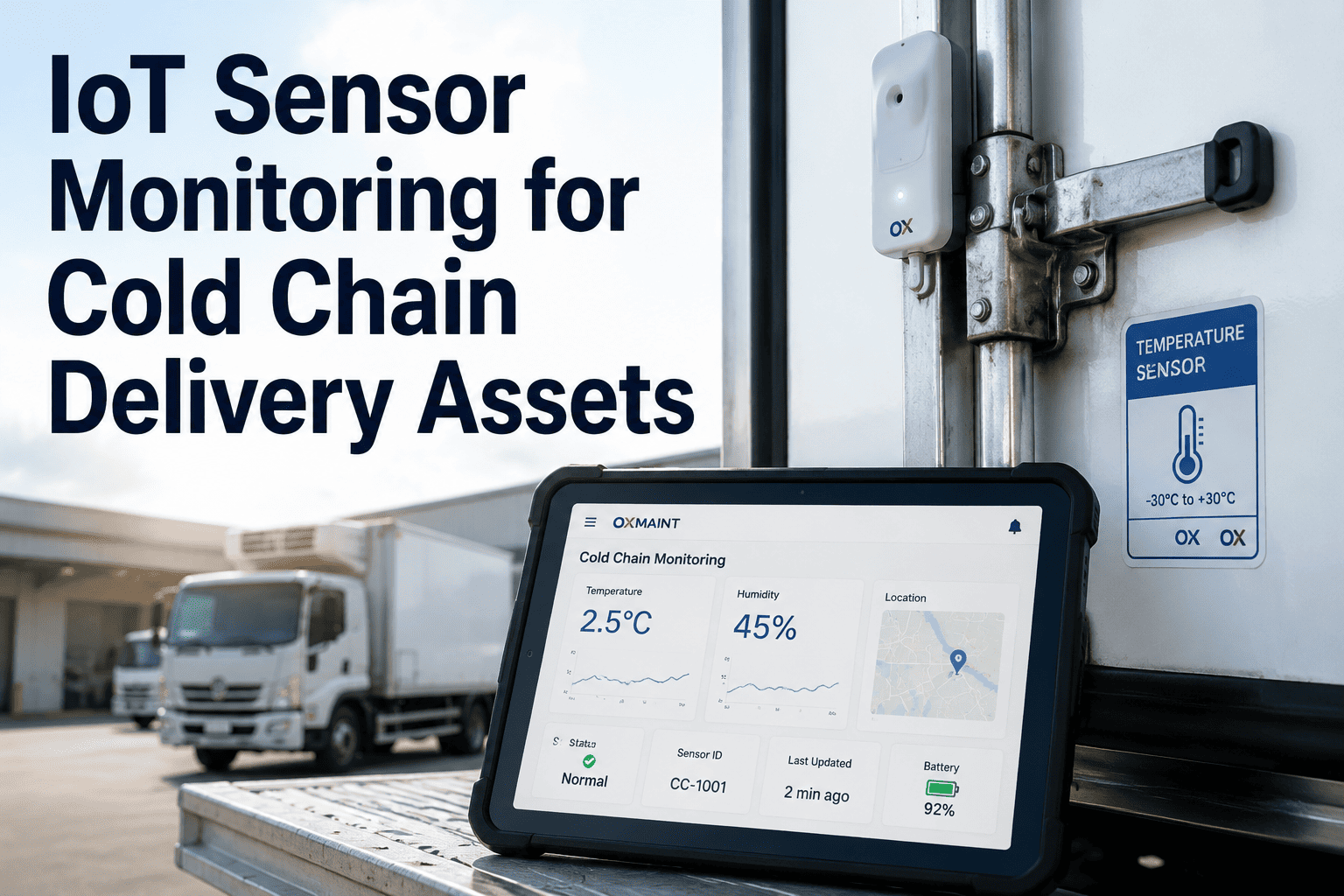
IoT Sensor Monitoring for Cold Chain Delivery Assets
Monitor temperature, vibration, power, and equipment signals on every reefer unit — and turn the earliest signs of failure into a planned work order instead of a ruined load.
Four Signals That Predict a Cold Chain Failure
A reefer breakdown is never truly sudden — it broadcasts warnings across four sensor channels long before the cargo temperature moves. OxMaint reads all four continuously and learns what normal looks like for each unit.
Cargo Integrity
Per-zone temperature, humidity, and door state. Catches excursions, slow drift toward threshold, and doors left ajar during multi-stop last-mile runs.
Lead time: instant alertMechanical Wear
Compressor and motor vibration signatures. Catches bearing wear, imbalance, and misalignment through harmonic shifts long before any audible noise appears.
Lead time: weeks to monthsElectrical Health
Motor current signature analysis. Catches electrical faults, winding stress, and a compressor working harder than it should — typically four to eight weeks early.
Lead time: 4-8 weeksUnit Telemetry
Reefer fault codes, run status, refrigerant suction and discharge pressure, and compressor cycling pulled straight from the unit's own telematics or a retrofit sensor.
Lead time: before pressure alarmsFailure Is a Timeline, Not an Event
A compressor bearing degrades through four predictable stages over six to sixteen weeks. The whole game is catching it in the first half, while the fix is a planned part swap — not a roadside breakdown with cargo on board.
Invisible and silent. Only high-frequency vibration analysis can see it.
Vibration harmonics rise and the current signature begins to shift.
Audible noise starts and cargo temperature begins to drift.
The compressor fails. The load is already compromised.
Every reefer in your fleet is somewhere on this timeline right now. The only question is whether you can see it. Put sensors on every unit and find out.
From Sensor Reading to Work Order
A reading on a dashboard helps no one if nobody acts on it. OxMaint closes the loop automatically — the signal becomes a scheduled job with the fault context already attached.
Stream
Temperature, vibration, and current readings flow in continuously from every unit.
Baseline
AI learns each unit's healthy signature, so it judges drift against that unit — not a generic limit.
Detect
A deviation is flagged the moment the trend turns, weeks before a fixed threshold would trip.
Act
A work order is created and pushed to the technician and driver before the next dispatch.
What a Single Failed Run Really Costs
Cold chain failure is rarely a small problem. One unmonitored compressor can convert a routine delivery day into a write-off, a compliance breach, and a lost customer all at once.
of the world's food is lost after harvest — much of it to cold chain failures that better monitoring would have caught.
is all it takes — a single failed reefer run can mean total cargo loss, a broken audit trail, and a customer who does not return.
most fleets keep vehicle records and reefer records apart, so refrigeration faults hide in the gap until the cargo is already warm.
Fixed Alarm vs AI Predictive Monitoring
A threshold alarm and a predictive model both watch the same unit. Only one of them gives you time to act. Book a demo to see the difference on your own data.
| Aspect | Fixed Threshold Alarm | OxMaint AI Predictive |
|---|---|---|
| Trigger | A reading crosses a hard limit | A trend deviates from the unit's baseline |
| Timing | At or near the point of failure | Weeks before failure, while parts are available |
| What you get | An alert that something is already wrong | A diagnosed fault and a scheduled work order |
| Cargo risk | Temperature is often already drifting | Caught long before cargo is affected |
| Maintenance type | Emergency, reactive, roadside | Planned, in the depot, on your schedule |
| Outcome | Spoilage, downtime, compliance gap | Load protected, unit back in service |
Works With the Units You Already Run
OxMaint is OEM-agnostic. It reads live performance data from major reefer telematics platforms by API, and for older units without a data feed, retrofit IoT sensors fill the gap — so your whole mixed fleet is covered, not just the newest trucks.
Reefer Telematics
Pulls real-time temperature, compressor status, and fault codes from leading reefer telematics systems through a direct API connection.
Retrofit Sensors
For units without native telematics, wireless temperature, vibration, and current sensors add the same monitoring layer to existing hardware.
One Record
Vehicle and reefer maintenance live in a single asset record, so a degradation pattern caught on one unit can be checked across the rest of the fleet.
Bring every reefer onto one monitored fleet — old units and new, any brand — and stop letting refrigeration faults hide between two systems.
We had a compressor fail in spring with zero warning and lost the whole load. After deploying sensor monitoring, the same degradation pattern showed up on a second unit weeks later — the work order was generated before the driver noticed anything at all. We have not had a temperature excursion since.
Fleet Maintenance Lead, Refrigerated Distribution Operator
Frequently Asked Questions
Catch the Failure. Save the Load.
OxMaint puts temperature, vibration, power, and equipment monitoring on every reefer in your delivery fleet, turns the earliest signals of failure into planned work orders, and keeps vehicle and refrigeration records in one place — so cold chain breakdowns become a rare, scheduled event instead of a surprise that costs you a load.