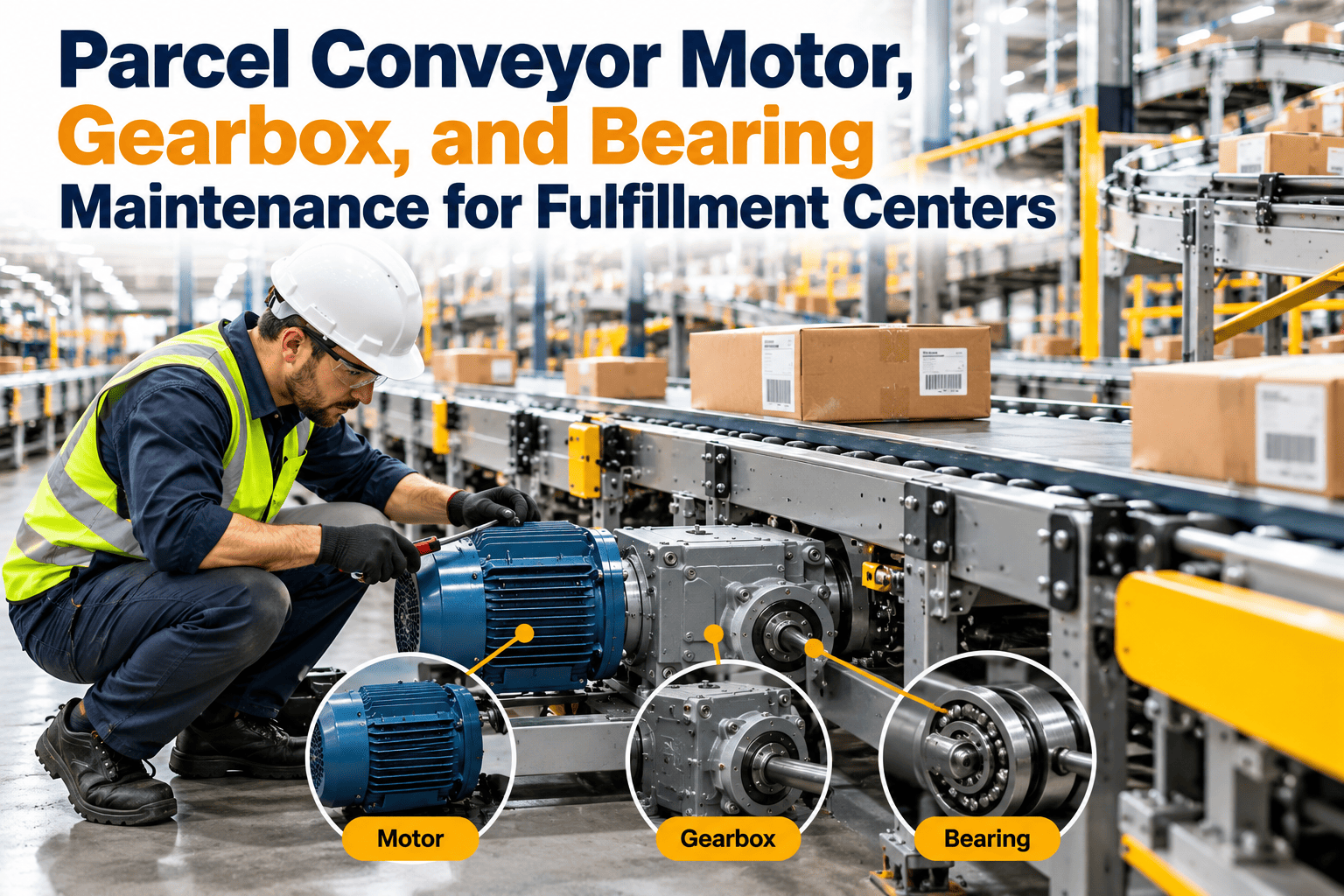
When a parcel conveyor stops, every downstream process waits: sorting, packing, loading, and the dispatch windows that depend on them. The three components behind most long stoppages are the motor, the gearbox, and the bearings that carry the load. Each one fails in a recognizable way if you know what to inspect, lubricate, and measure. This guide covers drivetrain maintenance for fulfillment center conveyors, from lubrication and vibration checks to thermal imaging, and shows how maintenance management software turns those tasks into a schedule the team actually follows.
Parcel Conveyor Motor, Gearbox, and Bearing Maintenance for Fulfillment Centers
Prevent the drivetrain failures that cause the longest conveyor downtime, using lubrication discipline, vibration and thermal checks, and a CMMS that schedules and records the work.
Why Drivetrain Failures Cost the Most Downtime
A broken belt or a jammed sensor is usually fixed in minutes. A seized gearbox or failed motor can take hours or days, because parts are heavy, specialized, and sometimes not in stock.
The good news is that drivetrain components usually give warning through heat, noise, vibration, and oil condition before they fail.
How Each Component Fails
| Component | Common failure modes | Early warning signs |
|---|---|---|
| Electric motor | Winding insulation breakdown, overheating, loose connections, bearing failure | Rising temperature, higher current draw, unusual hum, tripped overloads |
| Gearbox | Low or contaminated oil, worn gears, seal failure, overheating | Oil leaks, metallic particles in oil, noise changes, higher casing temperature |
| Coupling | Misalignment wear, elastomer cracking, loose fasteners | Vibration at running speed, rubber dust, noise during starts |
| Bearings | Lubrication failure, contamination, misalignment, overloading | High-frequency vibration, localized heat, grinding noise, grease discoloration |
| Drive chain or belt | Stretch, wear, poor tension, misalignment | Slack, visible wear, tracking problems, noise |
| Variable frequency drive | Overheating, fan failure, dust buildup, parameter faults | Fault codes, nuisance trips, high enclosure temperature |
Schedule Drivetrain Work Before It Becomes an Emergency
Create preventive tasks for every motor, gearbox, and bearing in your conveyor system, and keep a full history of what was done.
Motor Maintenance for Conveyors
Conveyor motors face frequent starts, variable loads, dust from cartons, and long hours. Most motor failures trace back to heat.
- Check housing temperature and compare it with the baseline for that motor.
- Clean cooling fins and fan covers of dust and packaging debris.
- Verify mounting bolts, base plates, and guards are secure.
- Listen for abnormal hum, grinding, or rhythmic noise.
- Inspect cable glands and terminal boxes for heat marks or loose connections.
- Measure running current and compare it with nameplate values and historic readings.
- Test winding insulation resistance during planned outages.
- Use thermal imaging on terminals, starters, and the motor body.
- Check alignment with the gearbox or coupling after any repair.
- Review drive settings for acceleration time and current limits.
Always follow lockout and tagout procedures before any work on a motor or drive, and record the lockout in the work order.
Gearbox Maintenance: Oil Is the Early Warning System
Gearbox oil protects gears and bearings, and it also carries information about their condition. A regular oil routine catches problems earlier than noise alone.
Bearing Maintenance: Lubrication and Contamination Control
Most bearing failures are caused by poor lubrication or contamination, not by age. Getting grease type, quantity, and timing right prevents the majority of them.
- Use the grease type the manufacturer specifies, and avoid mixing incompatible greases.
- Apply the correct quantity. Over-greasing raises temperature and can damage seals as much as under-greasing.
- Set lubrication points on a route with clear labels, so nothing is missed.
- Keep grease fittings, tools, and guns clean to avoid introducing dirt.
- Replace damaged seals and shields promptly, especially in dusty fulfillment areas.
- Check shaft alignment and belt or chain tension, because overloaded bearings fail early.
What to record for every bearing
- Position, size, and manufacturer part number.
- Last lubrication date, grease type, and quantity.
- Vibration and temperature readings over time.
- Installation date and reason for any replacement.
With this history, repeat failures at the same position point to a root cause such as misalignment or contamination.
Vibration Monitoring and Thermal Imaging
These two techniques detect faults before they are audible or visible. They suit conveyor drives because the equipment is repetitive and readings can be repeated at the same points.
- Take readings at the same location and orientation each time.
- Compare readings with each machine’s baseline and the manufacturer’s limits.
- Look for rising high-frequency energy, which often signals early bearing wear.
- Use the ISO 20816 series as reference for general machine vibration evaluation.
- Scan motors, gearboxes, bearings, starters, and terminals while under normal load.
- Compare similar motors on the same line to spot outliers.
- Record images with date and asset ID in the work order.
- Investigate hot connections immediately, since they can become safety hazards.
Preventive Maintenance Calendar for Drivetrains
| Frequency | Motor | Gearbox | Bearings |
|---|---|---|---|
| Every shift or daily | Visual check, listen for noise | Check for leaks and unusual noise | Check for heat and abnormal sound |
| Weekly | Clean fins and ventilation | Check oil level and breather | Lubricate high-duty points as required |
| Monthly | Check current draw and connections | Inspect seals and mounting | Take vibration readings |
| Quarterly | Thermal imaging scan | Oil sampling for analysis | Review vibration trends and grease schedule |
| Annually or at planned outage | Insulation test and alignment check | Oil change as needed, gear inspection | Replace bearings by condition, verify fits and seals |
Adjust each interval to the duty cycle of the conveyor. A sortation line that runs around the clock needs shorter intervals than a lightly used feeder.
Spare Parts Strategy for Drivetrains
Even good maintenance cannot prevent every failure. The right spares keep a failure from becoming a long outage.
Base stock levels on criticality of the asset, repair lead time, and failure history, not only on purchase cost.
Setting Up the CMMS for Drivetrain Reliability
Oxmaint is maintenance management software that helps fulfillment centers organize drivetrain work. The setup below keeps the program simple and traceable.
- Build an asset hierarchy: facility, conveyor line, drive unit, then motor, gearbox, and bearings as child assets.
- Attach nameplate data, manuals, and lubrication specifications to each asset record.
- Create preventive maintenance tasks from the calendar above, assigned to the right technicians.
- Use mobile inspection checklists for shift checks, with fields for temperature, noise, and leaks.
- Record meter and condition readings, such as current draw and vibration, so trends are visible over time.
- Raise work orders directly from failed inspection items, with priority and required parts.
- Track spare parts in inventory and link them to the assets that use them.
- Review downtime, repeat failures, and overdue tasks in reports and dashboards.
Compliance records such as lockout checklists and completed inspections stay attached to each task, which helps during safety and quality audits.
Reactive Versus Planned Drivetrain Care
- Failures found when the line stops
- Parts ordered after the breakdown
- Greasing done when someone remembers
- Repeat failures with no recorded cause
- Overtime and rushed repairs
- Faults found during rounds and testing
- Parts available before the outage
- Lubrication routes with clear ownership
- History that reveals root causes
- Repairs scheduled in low-volume windows
KPIs for Conveyor Drivetrain Reliability
| KPI | What it tells you |
|---|---|
| Conveyor availability | Share of scheduled time the line was ready to run |
| Mean time between failures by component | How long motors, gearboxes, and bearings last in service |
| Mean time to repair | How quickly failures are fixed, including parts wait |
| Planned versus unplanned work share | Whether the program is preventive or reactive |
| Preventive task completion rate | Whether scheduled work is being done on time |
| Repeat failure count | Whether root causes are being fixed |
Common Drivetrain Maintenance Mistakes
Conveyor Drivetrain Maintenance Questions
Safety, Lockout, and Compliance Records
Drivetrain work involves stored energy, rotating parts, and electrical hazards. Documented procedures protect people and show regulators and auditors that controls are followed.
- Notify affected teams and stop the conveyor section in a controlled way.
- Isolate and lock out electrical and, where relevant, pneumatic or stored mechanical energy.
- Verify zero energy before touching any component.
- Replace guards and remove tools before restoring power.
- Test the equipment, remove locks, and record the completed procedure.
Local regulations and company rules define the exact requirements, so use your site safety procedures as the authority and attach the record to each work order.
Motorized Rollers, Drives, and Sortation Equipment
Many parcel systems use motorized drive rollers and compact gear motors rather than large central drives. They need the same discipline in a smaller package.
- Track each motorized roller or gear motor as its own asset, so failure history is not lost.
- Check zone controllers and power supplies as part of the same inspection route.
- Replace units by condition and failure trend, since many cannot be repaired economically.
- Keep spare drive units for the zones that carry the highest parcel volume.
- Watch for repeat failures in the same zone, which often point to jams, overload, or poor tracking.
Sorters and diverters also depend on drive motors and gear reducers, so include them in the same lubrication and inspection program.
Preparing the Drivetrain for Peak Season
Root Cause Analysis After a Failure
Every drivetrain failure is a chance to prevent the next one. A short structured review is enough for most events.
| Question | Where to look |
|---|---|
| What failed and when? | Work order, operator report, and fault codes |
| What did the component look like? | Photos of the failed part, discoloration, wear pattern |
| What changed recently? | Recent repairs, load changes, new parcel types, settings |
| Was maintenance done on time? | Task history, lubrication records, inspection results |
| Were there warning signs? | Vibration, temperature, oil analysis, and operator notes |
| What will prevent a repeat? | Corrective action, task changes, training, or design change |
Record the cause and the corrective action in the asset history, so future technicians can see the pattern.
Skills and Training for Drivetrain Teams
- Train technicians on correct greasing technique, including quantity and cleanliness.
- Teach basic vibration and thermal imaging interpretation for the equipment you actually run.
- Give operators a short list of warning signs to report, such as noise, heat, smell, and leaks.
- Standardize repair procedures, torque values, and alignment checks in written task instructions.
- Review the failure log with the team each month, so lessons reach the people doing the work.
A well-written task with a checklist and a photo reference removes much of the guesswork, especially for new technicians.
Keep Your Conveyor Drives Running at Full Availability
Organize drivetrain inspections, lubrication, and repairs in Oxmaint, and give your team a clear history for every motor, gearbox, and bearing.