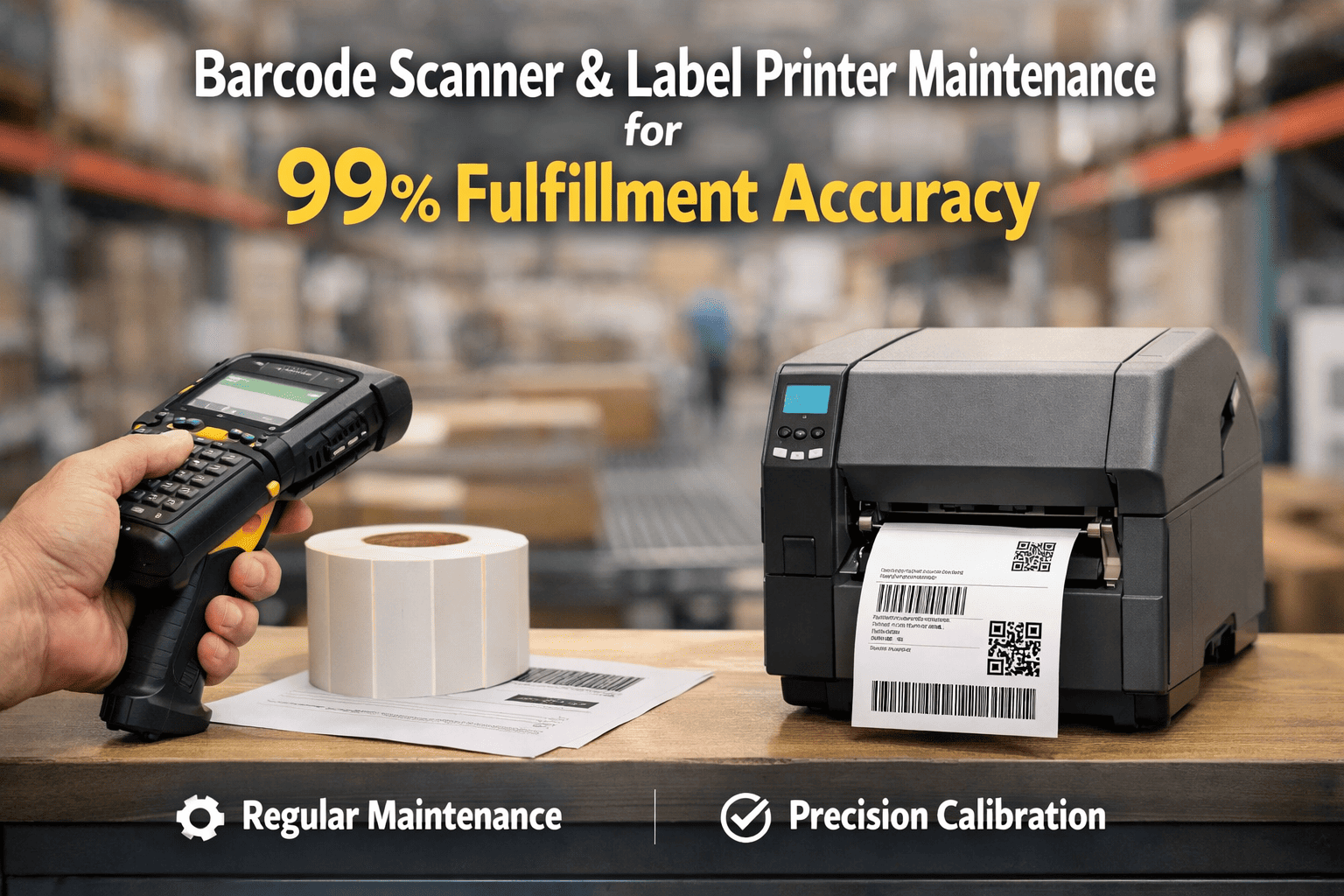
Barcode Scanner & Label Printer Maintenance for 99% Fulfillment Accuracy

By Johnson on April 13, 2026

warehouse-barcode-scanner-label-printer-maintenance-fulfillment-accuracy

In high-velocity fulfillment operations, a single misread barcode or smudged shipping label cascades into wrong-address deliveries, customer complaints, and costly return logistics. When barcode scanners degrade from 99.8% first-pass read rates to 94%, your warehouse processes 6,000 additional manual interventions per 100,000 scans — each one burning 45–90 seconds of picker time and injecting human error into your accuracy chain. When thermal label printers run with worn print heads or incorrect heat settings, barcodes print too light to scan reliably, creating a feedback loop of re-prints, shipping delays, and mis-ships that cost $15–$40 per incident in labor, materials, and customer service overhead. Start your free OxMaint trial to automate barcode scanner and label printer maintenance scheduling, or book a demo to see live workflows built for warehouse automation equipment uptime.

99.8%
Target First-Pass Barcode Read Rate

$35/incident
Average Cost Per Mis-Ship

2–4 weeks
Label Printer Preventive Maintenance Interval

Why Barcode Scanner Maintenance Is Not Optional in Modern Fulfillment

Barcode scanning systems are the central nervous system of warehouse operations — every pick, pack, putaway, and ship confirmation depends on accurate data capture. Unlike conveyor motors or racking systems that fail visibly, barcode scanners degrade silently. A scanner operating at 92% accuracy still works, but it forces pickers to re-scan items multiple times, slows throughput by 8–15%, and introduces mis-picks when frustrated workers override the system. The financial impact is immediate: a 200,000-unit-per-day fulfillment center losing 2% scan accuracy processes 4,000 extra scans daily, costing 50–70 labor hours per day in wasted picker time.

The Hidden Cost of Scanner Degradation: From 99% to 95% Read Rate
1
Scanner Window Scratching
Normal wear from 50,000+ scans creates micro-scratches on laser exit window — light diffusion reduces read range by 15–25%
2
Re-Scan Behavior Begins
Pickers attempt 2–3 scans per item instead of 1 — throughput drops from 120 units/hr to 95 units/hr per picker
3
Override & Mis-Pick Risk
Frustrated workers manually enter SKUs or skip verification — error rate jumps from 0.2% to 1.5%, generating 1,300 mis-ships per 100K orders

The Four-Tier Barcode Scanner Maintenance Program

Warehouse barcode scanners range from handheld laser units to fixed-position 2D imagers on conveyor lines, but all share common maintenance requirements organized around cleaning frequency, calibration intervals, and component replacement cycles. A CMMS-managed program automates these tasks based on scan volume and environmental conditions rather than arbitrary calendar schedules.

Daily
Operational Cleaning
Exit window wipe with microfiber cloth
Dust removal from scanner housing vents
Battery contact inspection for corrosion
Quick function test on shift handoff
Duration: 2 minutes per unit
Weekly
Deep Clean & Verification
Lens cleaning with approved optical solution
Scan performance test with graded symbology chart
Trigger mechanism lubrication (handheld units)
Cradle contact cleaning and charging verification
Duration: 8–12 minutes per unit
Quarterly
Calibration & Testing
Full scan range and decode speed measurement
Multi-symbology test (Code 128, QR, Data Matrix)
Battery capacity test and replacement if below 80%
Firmware update deployment
Duration: 20–30 minutes per unit
Annual
Component Replacement
Laser diode or LED emitter replacement (high-use units)
Protective window replacement if scratched
Full unit re-calibration to factory spec
Lifecycle assessment and replacement planning
Duration: 45–60 minutes per unit
Warehouse CMMS
Automate Scanner Maintenance Before Read Rates Drop
OxMaint tracks scan volumes, triggers cleaning work orders automatically, and alerts your team when calibration windows approach — so scanner performance never degrades below your accuracy targets. No spreadsheets, no missed intervals, no surprise failures during peak season.

Label Printer Maintenance: The Overlooked Link in the Accuracy Chain

Thermal label printers operate under brutal conditions — printing 5,000–15,000 labels per day in dusty warehouse environments with temperature swings and constant mechanical cycling. The thermal print head, a consumable component with a rated life of 1–3 million inches of label stock, degrades predictably but catastrophically if not monitored. A worn print head produces faint barcodes that scan inconsistently, forcing re-prints, slowing pack stations, and creating labels that pass internal quality checks but fail at carrier sortation facilities — resulting in delayed deliveries and carrier chargebacks.

Common Label Printer Failure Modes & Prevention
Failure Mode Symptoms Root Cause Prevention Interval Fix Cost if Deferred
Print Head Wear Faint barcodes, vertical white lines Abrasive label stock, debris accumulation Clean every 5 rolls, replace at 1M inches $200–600 (emergency replacement + downtime)
Platen Roller Glazing Inconsistent label feed, skipped prints Heat buildup from continuous operation Clean weekly, replace every 2 years $150–300 (jams + wasted labels)
Label Path Adhesive Buildup Frequent jams, sensor misreads Low-quality label stock, ambient heat Clean bi-weekly with IPA wipes $80–200 (labor + material waste)
Ribbon Wrinkle Faults Smudged print, barcode voids Incorrect ribbon tension settings Verify tension on media changeover $50–150 (re-print runs)
Sensor Calibration Drift Label positioning errors, double feeds Dust on optical sensors Calibrate monthly, clean bi-weekly $100–250 (mislabeled shipments)
Firmware Bugs Random resets, print queue failures Outdated firmware version Update quarterly or per vendor advisory $500–2,000 (emergency IT support)

Print Quality Verification: What to Measure and When

Visual inspection of printed labels is insufficient for catching degradation before it impacts operations. Industry-standard barcode verification uses ANSI/ISO grading scales that measure contrast, edge determination, modulation, and decodability on a scale from A (4.0) to F (0.0). Shipping labels should grade B (3.0+) minimum to ensure reliable scanning across carrier networks and automated sortation equipment.

Manual Spot Check
Every shift start
Scan 5 consecutive labels with handheld verifier — all must decode first-pass without tilting or repositioning
If any fail: pause printer, clean print head, re-test. Document in CMMS.
Inline Verification System
Continuous (automated)
Integrated camera-based verifier grades every label in real-time, flags sub-standard prints before application
System auto-triggers CMMS alert when grade falls below threshold, prevents bad labels from shipping
Quarterly Calibration Audit
Every 90 days
Print and grade ANSI test pattern on each printer — measure against baseline performance from commissioning
Identify degradation trends, schedule print head replacement before failure, update maintenance intervals

Scanner and Printer Inventory Management in Multi-Site Operations

Warehouses running 200+ scanners and 50+ label printers across multiple shifts face a critical asset tracking challenge: knowing which units are due for maintenance, where they are physically located, and whether spare units are available for swap-out during repairs. A CMMS purpose-built for warehouse operations links each scanner's serial number to its usage history, maintenance records, and current assignment — enabling predictive replacement before failure and eliminating the "borrowed scanner" problem that breaks maintenance schedules.

CMMS-Driven Scanner Fleet Management Workflow
01
Asset Registration
Every scanner and printer receives unique ID, linked to purchase date, warranty status, and usage zone (receiving, picking, packing)
02
Usage Tracking
Scan counts auto-imported from WMS or manually logged at shift end — CMMS calculates maintenance triggers based on volume, not just time
03
Automated Work Orders
Cleaning, calibration, and replacement WOs generated at preset thresholds — assigned to technicians with parts list and procedure attached
04
Spare Pool Rotation
When unit enters maintenance, system assigns pre-tested spare from pool, tracks swap history, ensures no unit operates beyond safe service life
05
Performance Analytics
Dashboard shows fleet-wide read rate trends, failure patterns by zone, maintenance cost per unit — drives vendor selection and replacement planning

Comparing Barcode Technologies: Maintenance Implications

Warehouses deploying new scanning infrastructure often choose between 1D laser scanners, 2D area imagers, and RFID readers based on read speed and accuracy — but maintenance requirements vary significantly across these technologies and directly impact total cost of ownership over a 5–7 year equipment lifecycle.

Technology
Read Accuracy
Cleaning Frequency
Calibration Interval
Component Replacement
Best Use Case
1D Laser Scanner
98–99.5%
Weekly lens cleaning
Quarterly
Laser diode every 3–5 years
High-speed conveyor scanning, simple linear barcodes
2D Area Imager
99–99.8%
Bi-weekly lens + LED cleaning
Semi-annual
LED array every 5–7 years
QR codes, damaged labels, omnidirectional scanning
RFID Reader
99.9%+ (bulk read)
Monthly antenna cleaning
Annual
Antenna replacement every 7–10 years
Pallet-level tracking, high-value inventory, no line-of-sight
Vision System (Camera-based)
99.5–99.9%
Daily lens cleaning in dusty environments
Quarterly
Camera module every 5–8 years
OCR, multi-code reading, damaged packaging
Preventive Maintenance Automation
Track Every Scanner, Printer, and Calibration Cycle in One System
OxMaint integrates with your WMS to pull scan volume data, auto-schedules maintenance based on actual usage, and maintains complete service history for every asset. Stop guessing when equipment needs attention — let the data decide.

Performance Benchmarks: Where Does Your Operation Stand?

World-class fulfillment operations maintain scanner and printer uptime above 99.5% with first-pass read rates exceeding 99.8%. These benchmarks separate reactive maintenance programs that wait for failures from predictive programs that prevent them — and the gap translates directly into throughput, accuracy, and operating cost differences.
First-Pass Barcode Read Rate
World-Class

99.8%+
Industry Avg

96–98%
Scanner Equipment Uptime
World-Class

99.5%+
Industry Avg

94–97%
Label Print Quality (ANSI Grade)
World-Class

B+ (3.5)
Industry Avg

C+ (2.5)
Printer Downtime Events/Month
World-Class

Under 2
Industry Avg

5–8
Maintenance Cost Per Scanner/Year
World-Class

$80–120
Industry Avg

$180–300
Scanner Replacement Cycle
World-Class

5–7 years
Industry Avg

3–4 years

Frequently Asked Questions

Handheld scanners require daily lens wiping in dusty environments and weekly deep cleaning with optical solution. Calibration should occur quarterly or after 50,000 scans, whichever comes first. OxMaint automates these schedules based on actual scan volume rather than arbitrary calendar dates, preventing degradation before it impacts accuracy.
Worn print heads, incorrect heat settings, and adhesive buildup on the platen roller are the primary causes. Print heads degrade after 1–3 million inches of label stock and should be replaced proactively. Book a demo to see how OxMaint tracks print head life and triggers replacement before quality drops below carrier scanning thresholds.
2D imagers handle damaged labels and QR codes better and require less frequent calibration, but cost 30–50% more upfront. 1D laser scanners excel at high-speed conveyor applications with clean linear barcodes. Most operations use 2D for picking stations and 1D for sortation lines. Maintenance costs favor 2D long-term due to fewer moving parts and longer component life.
A centralized CMMS links every scanner's serial number to its service history, current location, and usage metrics. OxMaint's multi-site dashboard shows which units are due for service across all facilities, prevents scanners from falling through maintenance cracks during inter-site transfers, and standardizes PM intervals fleet-wide.
For a facility shipping 100,000 packages monthly, reducing mis-ships from 1.5% to 0.2% saves $45,000–$65,000 annually in re-ship costs, customer service labor, and carrier chargebacks. Inline verification systems cost $8,000–$15,000 per pack line and pay for themselves in 3–6 months through error elimination and reduced label waste from faulty prints.
Warehouse Automation CMMS
Your Scanners Print 500,000 Labels Per Month — Are You Tracking Every Maintenance Trigger?
OxMaint connects your scanning and printing equipment to a predictive maintenance engine that prevents failures before they impact accuracy. Automated work orders, usage-based scheduling, and real-time performance dashboards keep your fulfillment accuracy above 99.5% — every shift, every season, every year.
99.8%
Scan accuracy maintained by OxMaint users

60%
Reduction in equipment downtime

Automated
PM scheduling based on scan volume

Share This Story, Choose Your Platform!