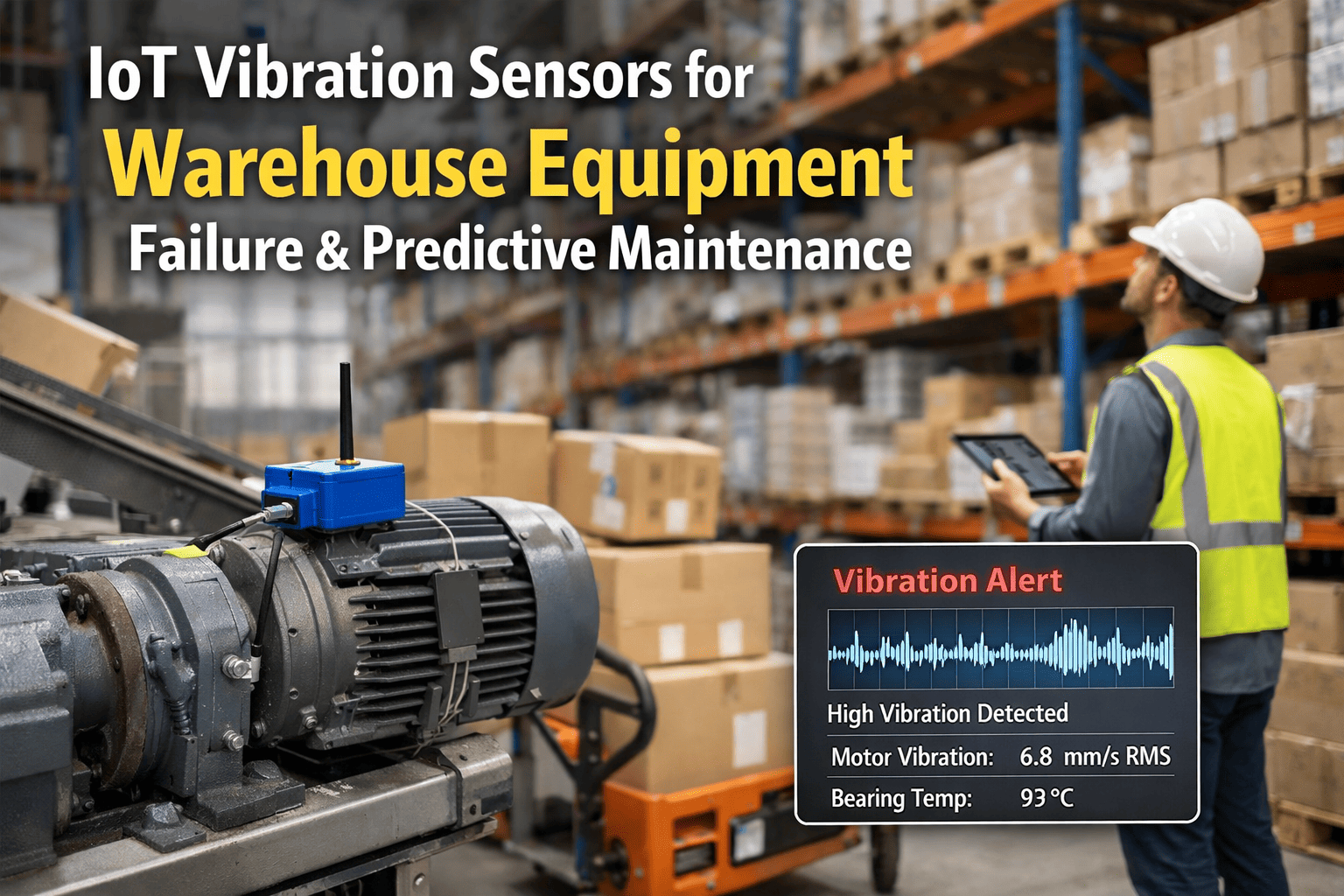
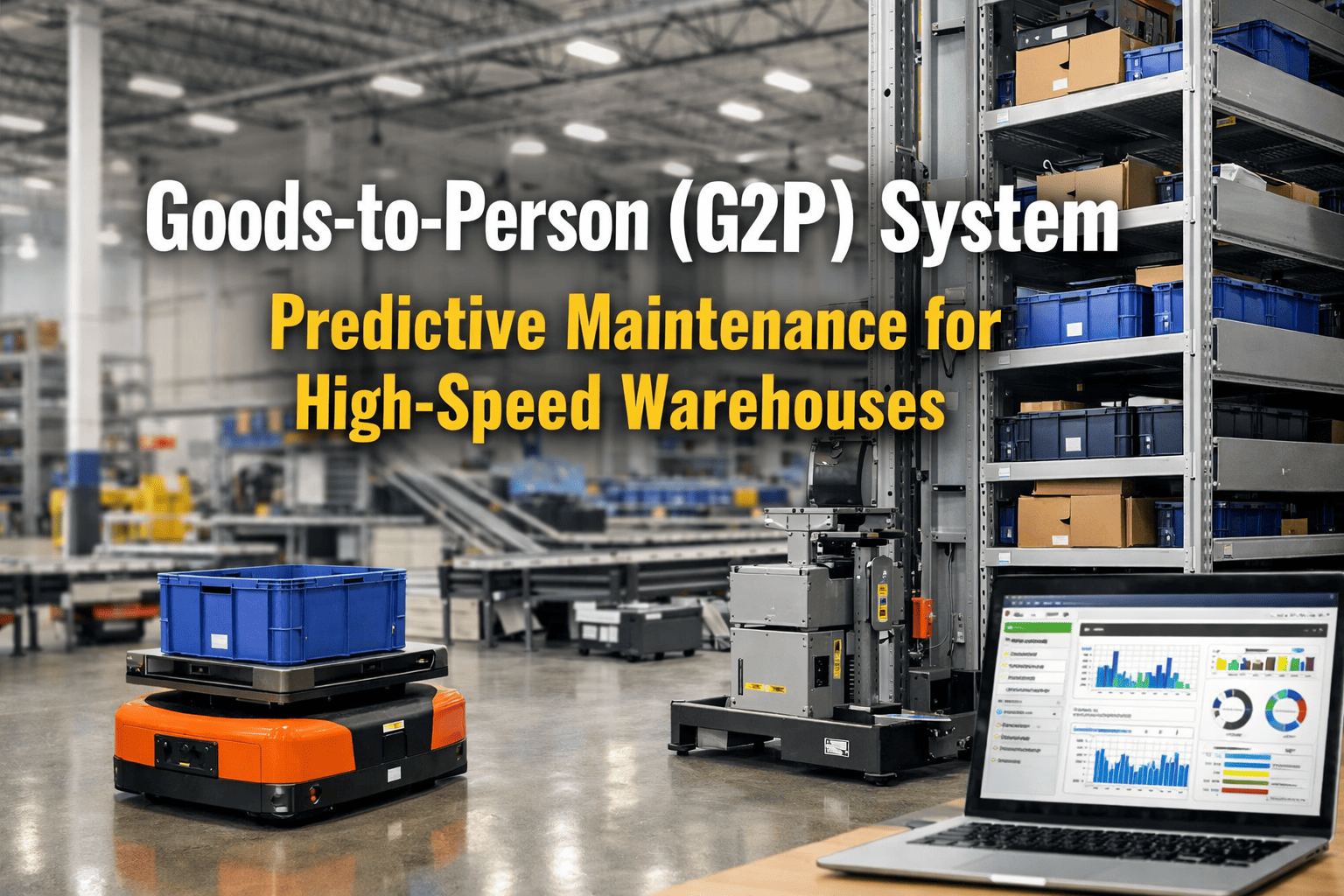
Fulfillment centers lose up to $20,000 per hour during unplanned conveyor outages — and two-thirds of industrial operators experience at least one unplanned downtime event every month. Warehouse conveyor systems running without AI-powered predictive maintenance are not a risk you manage; they are a failure you are waiting to schedule. OxMaint connects vibration sensors, temperature monitors, and motor load data into a single predictive maintenance engine that identifies belt wear, bearing fatigue, and motor strain weeks before they cause a fulfillment stoppage. The result is continuous throughput, protected delivery windows, and maintenance costs that are planned — not emergency-driven. Book a 30-minute demo and see how AI conveyor monitoring integrates with your warehouse CMMS in under a week.
$20,000
per hour
Lost revenue during unplanned conveyor outages in fulfillment centers
75%
downtime reduction
AI predictive maintenance cuts unplanned stoppages vs calendar-based PM
30–40%
of stoppages
Caused by electric drives — detectable weeks early with vibration analysis
98%+
uptime
Achieved by facilities using predictive maintenance vs reactive-only programs
What Conveyor Predictive Maintenance Actually Monitors
Calendar-based conveyor PM is a blunt instrument. A belt running 65 cartons per minute in a peak-season fulfillment center accumulates wear at a rate that a monthly inspection schedule cannot track accurately. Predictive maintenance replaces the calendar with continuous sensor data — reading the actual condition of every monitored component in real time and flagging degradation trends before they reach failure thresholds. OxMaint integrates sensor streams from your conveyor infrastructure into a unified dashboard that gives maintenance teams early warning across four critical signal types.
SENSOR SIGNAL TYPES — WHAT EACH DETECTS AND WHY IT MATTERS
Detects:
Bearing fatigue — frequency signature shifts 3–6 weeks before failure
Belt misalignment — asymmetric vibration signature on idler rollers
Drive chain wear — impact energy patterns at sprocket frequency
Motor imbalance — amplitude growth above baseline indicates rotor wear
Early detection window: 2–6 weeks before failure
Detects:
Motor overheating — load imbalance, cooling blockage, coil degradation
Bearing friction rise — 8–12°C above baseline signals lubrication failure
Drive belt slippage — friction heat signature at contact points
Gearbox oil breakdown — thermal drift across operating cycle
Early detection window: 1–4 weeks before failure
Detects:
Belt drag increase — load current rising above clean-belt baseline
Conveyor blockage — current spike pattern before jam event
Roller seizure — load spike concentrated in zone segment
Gearbox degradation — load current noise floor increase over time
Early detection window: Hours to 2 weeks before failure
Detects:
Edge wear — tracking drift detected via lateral position sensor
Surface degradation — optical scan flags splice fatigue and surface cracking
Tension loss — load cell data shows belt stretch beyond service limit
Splice failure risk — cyclic stress count at known splice locations
Early detection window: 1–8 weeks before failure
Your Conveyor Sensors Are Generating Failure Warnings. Is Anyone Reading Them?
OxMaint's AI layer reads vibration, temperature, and load data continuously — surfacing actionable alerts before failures interrupt your fulfillment throughput.
The Failure Sequence: How a Conveyor Breakdown Collapses a Fulfillment Shift
Warehouse managers often think about conveyor failure as a maintenance event. The operations team experiences it differently — as a cascade that defeats shift throughput targets, delays carrier cut-offs, and forces expediting decisions that carry their own cost. Understanding the full cost sequence is what separates facilities that invest in predictive maintenance from those that keep absorbing reactive repair cycles. Book a demo to model your facility's actual downtime cost exposure with OxMaint's ROI calculator.
CONVEYOR FAILURE COST CASCADE — FULFILLMENT WAREHOUSE, SINGLE SHIFT EVENT
T+0 min
Conveyor Stops
Belt jam, motor failure, or bearing seizure halts a conveyor zone. Pick-to-pack flow stops immediately at affected stations.
Lost throughput begins: 0
T+15 min
Diagnosis Begins
Maintenance called, fault location identified manually. No sensor data means physical inspection of entire conveyor run.
~$2,500 lost throughput
T+60 min
Part Sourcing
Required component not in stock. Emergency supplier call — parts at 2–3x standard price. Delivery ETA: 4–6 hours best case.
~$10,000 lost throughput + $800–$2,400 emergency parts premium
T+4 hr
Carrier Cut-Off Missed
Same-day and next-day outbound orders miss carrier collection window. Downstream SLA failures generated across multiple customer orders.
SLA penalties begin — carrier performance score impact
T+6 hr
System Restored
Conveyor back online after repair. Backlogged orders require overtime to clear. Total event cost calculated post-shift.
Total event cost: $18,000 – $35,000 direct + SLA consequence
AI Predictive vs Preventive vs Reactive: The Maintenance Model Comparison
Most warehouse operations are running a hybrid of reactive and calendar-based preventive maintenance — and paying the cost of both approaches simultaneously. Reactive maintenance generates emergency repair bills and throughput losses. Calendar-based preventive maintenance generates over-servicing on low-utilization equipment and under-servicing on high-cycle assets. AI predictive maintenance replaces both with a single data-driven model that tracks actual component condition and schedules intervention at the optimal cost-efficiency point. OxMaint's predictive maintenance engine is ready to connect to your conveyor infrastructure — start free today.
MAINTENANCE MODEL COMPARISON — CONVEYOR SYSTEMS
| Performance Factor |
Reactive |
Calendar PM |
AI Predictive |
| Failure detection timing |
After failure occurs |
At scheduled inspection |
2–6 weeks before failure |
| Unplanned downtime risk |
Very high — no early warning |
Moderate — misses between-interval failures |
Low — 75% reduction vs reactive |
| Maintenance cost per component |
2–3× higher — emergency pricing |
Standard but over-applied |
Lowest — right time, right part |
| Parts inventory planning |
Reactive stock — unpredictable |
Calendar-based — often excess |
Demand-driven — planned ahead |
| High-cycle vs low-cycle bays |
No differentiation |
Same interval regardless of load |
Service interval per actual wear rate |
| Fulfillment SLA protection |
None — failures hit mid-shift |
Partial — between-interval risk remains |
Highest — planned repairs in off-peak windows |
| Equipment lifespan impact |
Shortest — run-to-failure damage |
Standard — minimal extension |
Extended by 40% with condition-based servicing |
How OxMaint Connects IoT Sensor Data to Maintenance Action
The gap between sensor data and maintenance action is where most facilities lose the value of their IoT investment. Raw vibration and temperature readings are not actionable in themselves — they require anomaly detection logic, baseline learning, alert threshold configuration, and work order generation to translate data into repair decisions. OxMaint provides this full data-to-action pipeline for warehouse conveyor systems, with no custom engineering required. Book a demo to see the OxMaint sensor integration workflow for your conveyor system type.
OxMaint DATA-TO-ACTION PIPELINE — CONVEYOR PREDICTIVE MAINTENANCE
1
Sensor Data Ingestion
Vibration, temperature, motor load, and belt condition data streams from IoT sensors via MQTT, OPC-UA, or direct API. Edge gateway processes locally for sub-second alert latency on critical signals.
2
Baseline Learning
AI establishes healthy-state baselines per conveyor zone, motor, and component within 14 days of deployment. Seasonal throughput variation and peak-load patterns are factored into dynamic thresholds.
3
Anomaly Detection
Continuous comparison of live sensor readings against baselines. Trend degradation triggers staged alerts: watch, warning, and action — each with a predicted time-to-failure estimate.
4
Work Order Generation
Alert crossing action threshold auto-generates a CMMS work order with component ID, fault description, recommended parts, and suggested repair window based on fulfillment schedule data.
5
Scheduled Repair
Maintenance team receives mobile work order with full context. Repair scheduled during off-peak window. Completion data feeds back into the AI model — improving prediction accuracy over time.
"We were averaging three unplanned conveyor stoppages per month during peak fulfillment periods. After deploying OxMaint's predictive maintenance across our sortation and pick conveyor lines, we've gone seven months without a single unplanned stoppage. Our maintenance team now plans every repair — we haven't missed a carrier cut-off in two quarters."
Head of Warehouse Engineering
—
E-commerce Fulfillment Center, 280,000 sq ft, 14 conveyor zones
Conveyor Components: Failure Rates and AI Monitoring Priority
Not every conveyor component carries equal failure risk or equal downtime consequence. A failed tail roller on a low-speed accumulation line is a 20-minute fix. A failed sortation drive motor stops an entire pick-and-ship operation for hours. AI predictive maintenance is most valuable when monitoring priority is aligned to consequence — highest-criticality components get the tightest sensor coverage and the earliest alert thresholds. OxMaint's asset configuration tool lets maintenance managers set criticality tiers per component and calibrate alert sensitivity accordingly. Configure your conveyor asset criticality tiers in OxMaint — free trial, live in 48 hours.
CONVEYOR COMPONENT MONITORING PRIORITY MATRIX
| Component |
Failure Frequency |
Downtime Impact |
AI Detection Method |
Monitoring Priority |
| Drive Motor |
Medium |
High — zone-wide stoppage |
Vibration + temperature + current |
Critical |
| Drive Bearings |
High — most common failure |
High — cascades to belt |
Vibration frequency analysis |
Critical |
| Conveyor Belt |
Medium |
High — full line halt |
Optical + tension + tracking sensors |
Critical |
| Gearbox |
Low — but high severity |
Very high — long repair time |
Vibration + temperature + oil analysis |
Critical |
| Idler Rollers |
High frequency |
Medium — zone slowdown |
Vibration + acoustic emission |
High |
| Drive Chain / Belt |
Medium |
Medium — zone outage |
Tension sensors + load current |
High |
| Tail / Snub Rollers |
Low |
Low — localised effect |
Vibration + visual inspection |
Standard |
Frequently Asked Questions
How long does it take for OxMaint to establish baseline sensor readings on a new conveyor system?
OxMaint's AI baseline learning period is typically 10 to 14 days of continuous sensor data collection per conveyor zone. During this period, the system builds healthy-state profiles that account for throughput variation, speed changes, and load patterns at different times of day and week. Predictive alerts begin generating with meaningful accuracy after this learning window. For high-criticality components, conservative alert thresholds are applied during baseline learning to ensure no failure signals are missed.
Start your free trial — sensor baseline configuration is guided and takes under two hours to complete.
Does OxMaint require replacing existing conveyor sensors, or can it work with sensors already installed?
OxMaint integrates with most commercially available industrial IoT sensors already deployed on conveyor systems, including accelerometers, thermocouples, current transducers, and belt tension load cells. For facilities with no existing sensor coverage, OxMaint supports rapid sensor deployment using low-cost wireless vibration and temperature sensors that clip onto motor housings and bearing points without shutting down the conveyor. You can start with the highest-criticality components and expand coverage incrementally.
Book a demo to review your existing sensor inventory and determine your fastest path to predictive coverage.
How does OxMaint handle alert fatigue from too many sensor notifications?
Alert fatigue is one of the primary reasons IoT monitoring programs fail in practice. OxMaint addresses this through staged alert severity levels — watch, warning, and action — where only action-level alerts generate work orders and mobile notifications. Watch and warning signals are visible in the dashboard but do not interrupt the maintenance team. Alert thresholds are calibrated per component and per conveyor zone, meaning a motor running warm under peak load does not generate the same alert as a motor running warm under standard load. Teams typically see a 70 to 80% reduction in false-positive alerts within the first 30 days after baseline stabilization.
Can OxMaint integrate with our existing WMS or ERP system for work order and cost tracking?
OxMaint supports API-based integration with major WMS, ERP, and CMMS platforms. Predictive maintenance work orders generated by OxMaint can be pushed to your existing work order management system, and repair cost data flows back to maintain accurate cost-per-asset records. For facilities using SAP PM, Oracle, or similar enterprise platforms, OxMaint provides pre-built connectors. Maintenance cost visibility — broken down by conveyor zone, component type, and failure category — is available natively within OxMaint's reporting module even without ERP integration.
Create a free account to explore OxMaint's integration library and connect your warehouse systems.
What ROI should a warehouse expect from conveyor predictive maintenance in the first year?
The ROI calculation depends on your current unplanned downtime frequency and cost per incident, but a typical fulfillment warehouse experiencing two to three unplanned conveyor stoppages per month can expect to recover $150,000 to $400,000 annually in avoided downtime costs, emergency repair premiums, and SLA penalty exposure. Emergency parts procurement typically runs 2 to 3 times standard cost — planned procurement from predictive alerts eliminates this premium entirely. Predictive maintenance also extends equipment lifespan by up to 40%, deferring capital replacement expenditure.
Book a 30-minute session to build a specific ROI model for your warehouse with OxMaint's team.
Conveyor Failures Are Predictable. With OxMaint, They Are Also Preventable.
AI anomaly detection, IoT sensor integration, automatic work order generation, and fulfillment-schedule-aware maintenance planning — all in one CMMS built for warehouse operations.