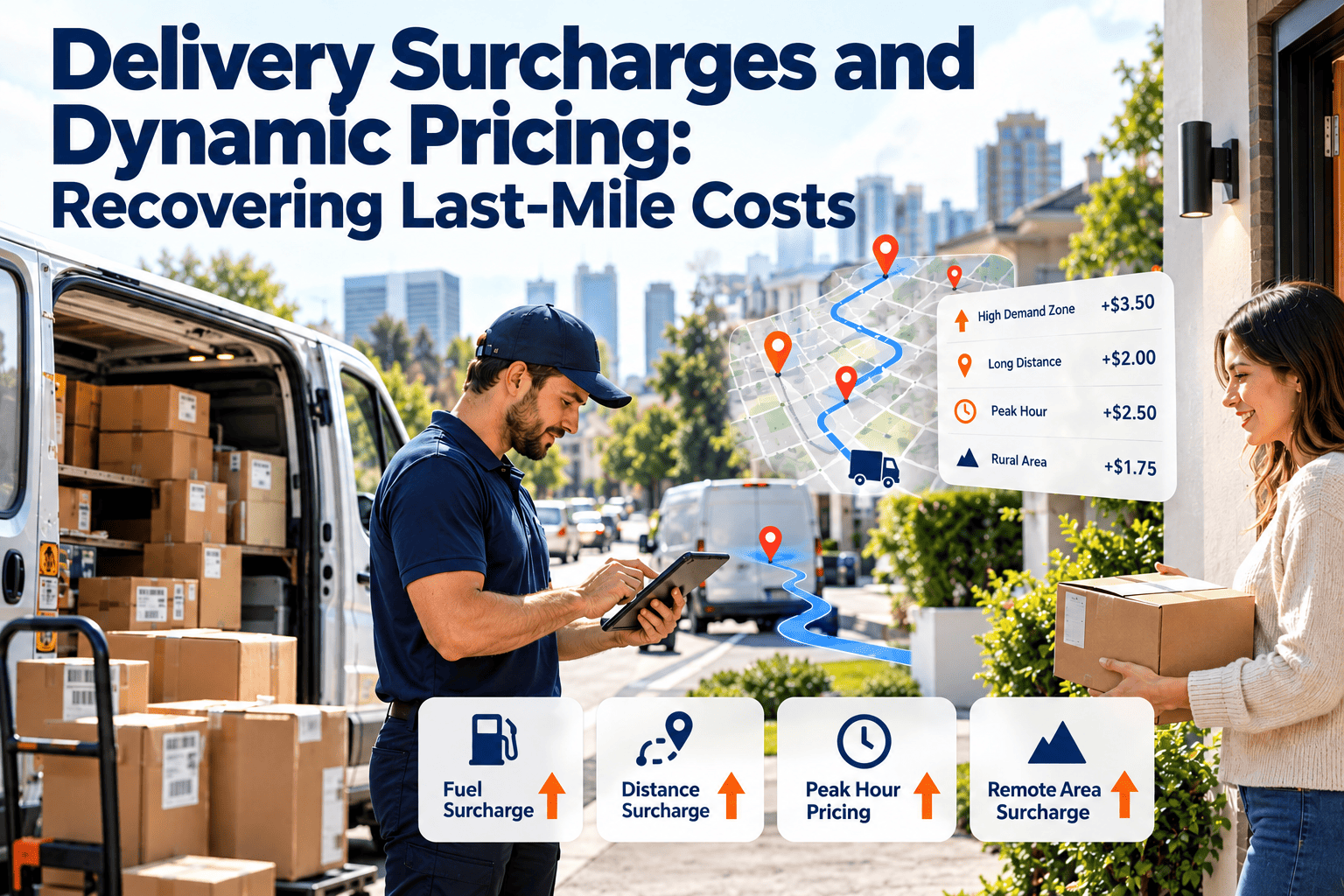
A flat delivery fee treats every stop as if it cost the same, and in practice it never does. A dense apartment block, a rural cul-de-sac, and a two-person oversize drop sit on the same price list even though they consume very different amounts of time, fuel, and vehicle wear. Surcharges and dynamic pricing close that gap by tying price to cost drivers, but they only work when the underlying cost data is trustworthy. This guide explains how to recover last-mile cost fairly, with Oxmaint supplying the fleet and equipment cost records that pricing decisions depend on.
Delivery Surcharges and Dynamic Pricing: Recovering Last-Mile Costs
Price the hard deliveries for what they cost, protect the easy ones, and keep customers informed. A fair fee structure starts with knowing your real cost to serve.
Why Flat Fees Quietly Lose Money
When one price covers every order, profitable deliveries subsidize unprofitable ones. The average may look healthy while specific zones, order types, and time slots lose money on every stop.
The hidden fourth driver: vehicle cost
Heavier loads, stop-and-go routes, and rough access roads accelerate wear on brakes, tires, and suspension. If maintenance cost is not linked back to the routes that cause it, those costs stay invisible in the price.
Surcharge Types and When They Make Sense
Not every surcharge suits every operation. Choose those that map to a measurable cost driver and that customers can understand at checkout.
| Surcharge | Cost driver it recovers | Best used when | Customer risk |
|---|---|---|---|
| Residential delivery | Lower stop density and access effort versus commercial docks | Mix of business and home deliveries | Low if disclosed early |
| Remote or extended area | Extra mileage and low density | Defined zones with consistently high cost to serve | Moderate, needs clear zone maps |
| Oversize or heavy item | Extra labor, equipment, and cube | Items beyond a stated weight or dimension | Low when thresholds are published |
| Peak-season | Temporary capacity premium and overtime | Predictable demand spikes | Moderate, define start and end dates |
| Time-window or same-day | Less efficient routing and reserved capacity | Customer values speed or precision | Low, customer opts in |
| Failed delivery or redelivery | Repeat trip and handling | Meaningful share of missed attempts | Higher, handle with clear notices |
Dynamic Delivery Pricing: How It Works
Dynamic pricing adjusts the fee in real time based on demand, remaining capacity, and route economics. It gives operations a lever other than turning customers away.
Address, items, weight, and requested window enter the system at checkout.
The engine compares the order against current routes, remaining vehicle capacity, and zone cost history.
Rules add or reduce fees within guardrails set by finance and commercial teams.
The customer sees the fee and window options before paying, not after.
Actual cost per stop is compared with the quoted price, and rules are adjusted.
Know Your Real Cost to Serve Before You Price It
Oxmaint tracks work orders, parts, and downtime by vehicle and asset, giving pricing teams a factual view of what each fleet segment costs to keep running.
Fixed Surcharge Versus Dynamic Pricing
Most operations use both. Fixed surcharges handle predictable cost differences, while dynamic rules handle changing capacity.
- Easy to publish and explain on a rate card
- Stable for contracts with B2B customers
- Do not react to sudden capacity shortages
- Need periodic review as fuel, labor, and vehicle cost change
- Responds to demand, zone load, and window scarcity
- Can steer customers toward efficient windows
- Requires clear rules to avoid unpredictable bills
- Depends on accurate, current cost and capacity data
Protecting Customer Trust While Recovering Cost
Customers accept fees they understand and reject fees that feel hidden. These practices keep recovery from turning into churn.
Where Maintenance Data Feeds the Pricing Model
Pricing teams often model fuel and labor accurately and approximate vehicle cost. A maintenance system closes that gap with record-based inputs.
| Maintenance data point | Pricing question it answers |
|---|---|
| Repair and parts cost per vehicle | Which vehicle types cost most to run, and should heavier loads carry a fee |
| Downtime days per vehicle | How much spare capacity must be priced into peak-season rates |
| Cost per mile by vehicle class | Whether remote area fees cover the true extra distance |
| Inspection and defect history | Whether rough routes or overloaded vehicles drive repeat failures |
| Equipment cost for liftgates and ramps | What a fair oversize or two-person handling fee looks like |
A note on scope
Oxmaint does not set prices. It provides the maintenance and asset cost records that finance and commercial teams use as inputs to their own pricing rules.
A Practical Rollout Plan
Metrics to Watch After Launch
Set Guardrails Before Any Rule Goes Live
Pricing rules that move without limits create customer anger and legal risk. Agree boundaries with finance, legal, and customer service before launch, and write them down so everyone applies the same logic.
Benchmarking Against Carrier and Retailer Practice
Carriers, retailers, and 3PLs publish or negotiate fee structures, and comparing yours with theirs shows whether your approach is typical. Check current rate schedules for exact amounts, since they change often, and focus on structure rather than copying numbers.
| Party | Common fee structure | What to learn |
|---|---|---|
| Parcel carriers | Published surcharge schedules covering residential delivery, extended areas, oversize, and peak periods, usually updated on a regular cycle | Which cost drivers the industry already prices, and how categories are defined |
| Large retailers | Free or low-cost delivery above a basket threshold, paid options for faster windows, separate fees for bulky items | How thresholds and speed tiers steer customer behavior |
| Grocery and quick commerce | Delivery fees that vary with basket size, slot popularity, and time of day | How slot-based pricing balances load across the day |
| Third-party logistics providers | Contract rates with accessorial charges for waiting time, redelivery, and special handling | How to recover non-standard effort that flat rates ignore |
| Furniture and appliance delivery | Tiered service levels from curbside drop to room-of-choice and installation | How handling effort can be sold as clear service options |
Handling Exceptions, Disputes, and Refunds
Even well-designed surcharges produce exceptions. A clear process for handling them protects both margin and goodwill.
Policies that reduce disputes
- Publish a plain-language fee table that matches what checkout shows.
- Give customer service a script and the authority to correct clear errors.
- Log dispute reasons and review them monthly for rule problems.
- Send a pre-delivery message confirming the fee, window, and any access requirements.
Dispute data is a free source of pricing feedback. A cluster of complaints in one zone or category usually points to a rule that is poorly explained, wrongly defined, or too high for the service delivered.
Communicating Fees Across the Customer Journey
Customers judge a surcharge less by its size than by how and when they learn about it. Clear communication at each step reduces abandonment and complaints.
| Touchpoint | What to show | Common mistake |
|---|---|---|
| Product page | Estimated delivery fee range and any size or weight rules that trigger extra charges | Hiding fees until the final checkout step |
| Cart and checkout | Itemized fee with the reason for each surcharge and the cheaper window options | Showing one blended number with no explanation |
| Order confirmation | The fee charged, the chosen window, and access requirements for the driver | Sending a confirmation that omits the surcharge |
| Pre-delivery message | Reminder of window, fee, and any action needed such as clearing access | Waiting until the driver arrives to ask for access details |
| Help center | Plain-language fee table, zone map, and size limits kept in step with live rules | Leaving outdated pages that contradict checkout |
Keep the message consistent
Every channel that mentions delivery cost, from product pages to support scripts, should draw from one fee table. When rules change, update that single source first so customers never see two different answers to the same question.
Delivery Surcharge Questions
Price With Facts, Not Averages
Give your pricing team accurate fleet and equipment cost records, and make surcharges that reflect what deliveries truly cost to run.