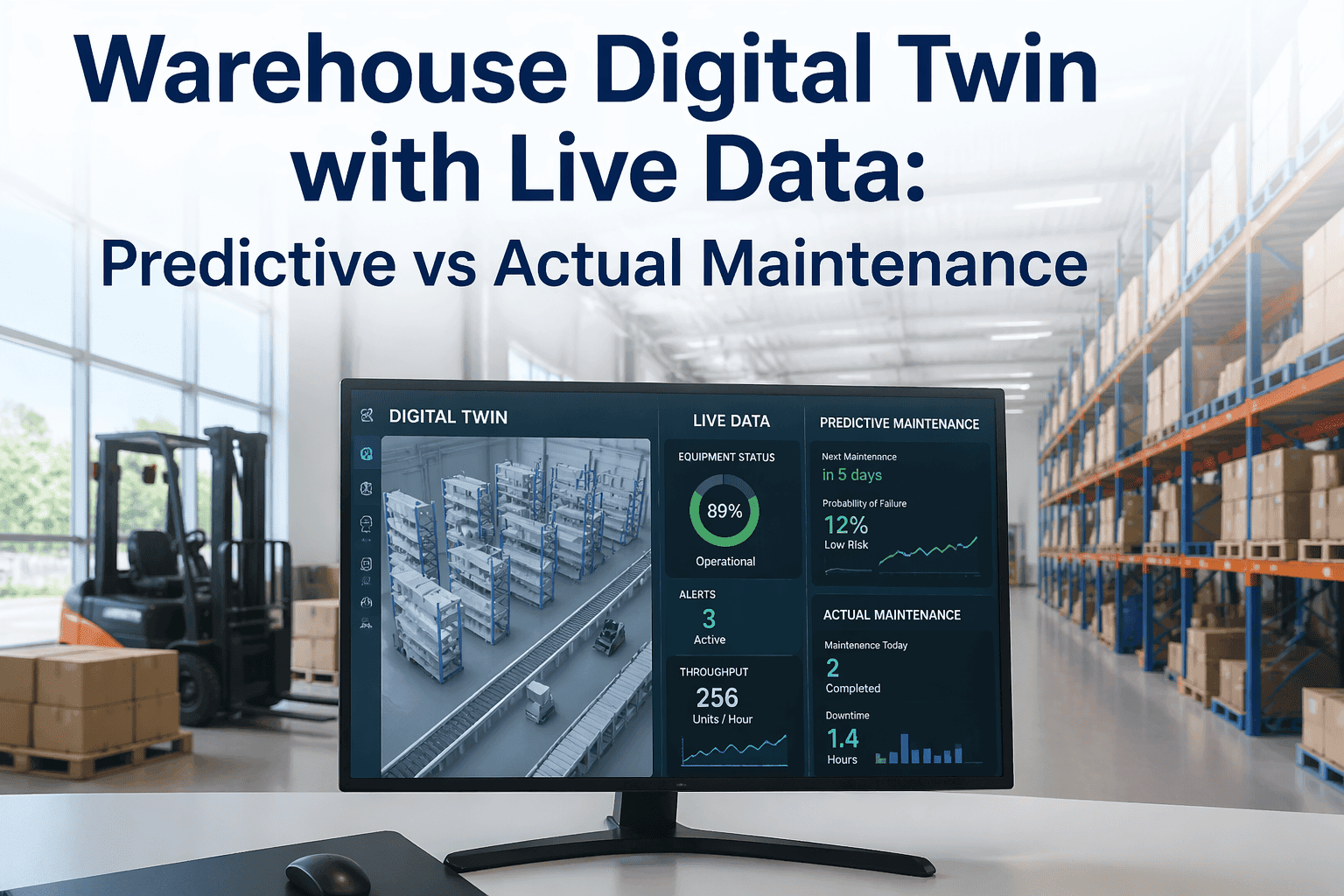
The regional distribution director for a consumer goods company in Atlanta stared at a spreadsheet that summarized the previous quarter's performance across four distribution centers. One facility, a 380,000-square-foot DC outside Nashville processing 22,000 orders per day, had experienced 14 unplanned conveyor shutdowns, 9 sortation system failures, and 3 HVAC outages that forced product holds on temperature-sensitive inventory. The combined downtime totaled 187 hours across the quarter, or roughly 2 hours of lost capacity per day. At an average throughput value of $4,200 per hour, the direct cost of unplanned downtime was $785,400 in the quarter. The maintenance team had been performing preventive maintenance on schedule, replacing components at manufacturer-recommended intervals. The problem was that those intervals were based on generic operating assumptions, not on how the Nashville facility actually used its equipment. Conveyors running 19 hours a day at 94 percent capacity in a humid climate degrade faster than the manufacturer's model predicted for standard 8-hour shifts. The sortation system's diverters were cycling 40 percent more frequently than the baseline because the Nashville facility's SKU mix had shifted toward smaller, lighter packages that required more sorts per pallet. Nobody had a model that reflected how this specific facility's equipment behaved under this specific facility's operating conditions. When they built one, a digital twin that ingested real-time sensor data from 2,400 monitoring points and simulated equipment degradation under actual operating loads, the model predicted 11 of the 14 conveyor failures with an average lead time of 18 days. The $785,400 quarterly loss was preventable with a system that cost $180,000 to deploy.
The global digital twin market reached $21.14 billion in 2025 and is projected to grow to $149.81 billion by 2030 at a CAGR of 47.9 percent. Predictive maintenance holds the largest application share at 31.04 percent of the market in 2026, and the digital twin in logistics segment specifically is projected to grow from $1.9 billion in 2025 to $18.7 billion by 2035. Warehouse and inventory management applications account for 35.4 percent of logistics digital twin revenue. Distribution facilities are adopting digital twins because generic maintenance schedules waste money on healthy equipment while missing the equipment that is actually about to fail. A digital twin of a distribution center is a real-time virtual replica of every conveyor, sortation system, dock door, HVAC unit, and material handling asset in the facility, continuously updated with sensor data, that simulates equipment behavior under actual operating conditions to predict failures before they happen, optimize maintenance timing based on real degradation rates, and identify throughput bottlenecks that static analysis cannot reveal. When integrated with a CMMS, the digital twin's predictions become work orders, its simulations become capital plans, and its real-time visibility becomes the foundation for every maintenance decision in the facility.
Global digital twin market 2025
CAGR through 2030, fastest-growing enterprise tech
Predictive maintenance share of digital twin applications
Reduction in unexpected stoppages with digital twin deployment
Warehouse management share of logistics digital twin revenue
The Physical Facility and Its Digital Mirror
A digital twin is not a 3D model of a warehouse. A 3D model is a static picture. A digital twin is a living simulation that changes in real time as the physical facility changes, predicting what will happen next based on physics-based degradation models and machine learning trained on the facility's own operational history.
Physical Facility
Conveyors running at variable speeds based on order volume
Sortation diverters cycling 8,000-12,000 times per shift
Dock doors opening 40-80 times per day with seal compression
HVAC units maintaining temperature under varying load and weather
Forklifts logging 18-22 miles per shift on concrete floors
2,400+ IoT sensors generating real-time vibration, temp, current data
Digital Twin
Simulates belt wear rate under actual load curves, predicts replacement date
Models diverter actuator fatigue, forecasts failure window to 18-day accuracy
Tracks seal compression cycles, alerts when thermal loss exceeds threshold
Simulates energy consumption, identifies chiller degradation before temp drift
Models tire wear and hydraulic degradation against actual usage patterns
Aggregates all sensor feeds into unified facility health score updated every 60 seconds
The physical facility generates data. The digital twin turns that data into predictions. The CMMS turns those predictions into maintenance actions. Sign up free on OXmaint to connect your facility's sensor data to predictive maintenance workflows that act on digital twin insights automatically.
What Distribution Center Digital Twins Simulate
01
Equipment Degradation Modeling
Physics-based models simulate how each asset degrades under its actual operating load, speed, temperature, and duty cycle. A conveyor belt running 19 hours per day in 78 percent humidity degrades at a measurably different rate than the same belt running 8 hours in a climate-controlled facility. The twin uses real sensor data, vibration amplitude, motor current draw, bearing temperature, and belt tension, to calculate remaining useful life for every monitored component.
Outcome
18-day avg failure prediction lead time
02
Throughput Bottleneck Identification
The twin simulates order flow through every zone of the facility: receiving, putaway, storage, picking, packing, sortation, and shipping. By modeling actual order profiles, SKU velocity distributions, and labor allocation patterns, it identifies the constraint that limits daily throughput. Often the bottleneck is not where operations managers assume. The twin reveals that a packing station, not the sortation system, limits peak capacity because carton erection speed cannot match pick wave completion.
Outcome
12-20% throughput gain from bottleneck resolution
03
Energy Consumption Optimization
Distribution centers consume $4-$8 per square foot annually in energy, making a 400,000 square foot facility's energy bill $1.6 million to $3.2 million per year. The twin models HVAC load against external weather, internal heat generation from equipment and personnel, and dock door open-close cycles. It identifies when chiller efficiency drops below threshold, when lighting schedules waste energy in unoccupied zones, and when conveyor startup sequences create demand spikes that trigger peak rate charges.
Outcome
15-25% energy cost reduction achievable
04
Maintenance Schedule Optimization
Generic PM schedules replace components on fixed intervals regardless of actual condition. The twin replaces time-based maintenance with condition-based maintenance by modeling the actual degradation trajectory of each asset. A motor bearing that the manufacturer says to replace at 8,000 hours may actually have 11,000 hours of life remaining under this facility's load pattern, or may need replacement at 5,500 hours because duty cycles exceed manufacturer assumptions.
Outcome
30-40% reduction in unnecessary PM tasks
Generic PM Schedules vs. Digital Twin Predictive Maintenance
When to maintain
Fixed calendar intervals from manufacturer manual
When sensor data + degradation model shows actual need
Failure prediction
None. Reacts when equipment stops or inspection finds wear
18-day avg lead time on 80% of failures before any symptom
Parts inventory
Stock everything that might be needed. High carrying cost
Order parts for predicted failures 2-3 weeks before needed
Labor scheduling
PM tasks clustered on calendar dates regardless of workload
Maintenance scheduled during low-throughput windows from twin simulation
Equipment lifespan
Components replaced before end of useful life, wasting value
Run to optimal replacement point, extending life 15-40%
Unplanned downtime
14 events per quarter in Nashville example ($785K cost)
3 events per quarter after twin deployment (78% reduction)
Capital planning
Age-based guessing. Replace at 10 years regardless of condition
Condition-based forecasting with 3-5 year replacement projections
Every distribution center already has a maintenance schedule. The digital twin makes that schedule intelligent by matching maintenance timing to actual equipment need instead of calendar assumptions. Schedule a demo to see how OXmaint integrates digital twin predictions into automated work order generation.
ROI of Digital Twin Deployment for Distribution Facilities
Based on a 380,000 square foot distribution center processing 22,000 orders per day with $4,200 per hour throughput value and 180+ monitored assets.
$2,360,000
Unplanned Downtime Reduction
78% reduction in unplanned events: from 187 hrs/qtr to 41 hrs/qtr at $4,200/hr throughput value
$520,000
Energy Optimization
20% energy reduction on $2.6M annual energy spend through HVAC, lighting, and demand optimization
$380,000
Maintenance Labor and Parts Efficiency
30% reduction in unnecessary PM tasks plus elimination of emergency premium parts ordering
$290,000
Throughput Improvement
Bottleneck simulation reveals 8% capacity gain without capital equipment, adding 1,760 orders/day
Total Annual Savings$3,550,000
Digital Twin Platform + Sensors + Integration$180,000 - $350,000 Year 1
First-Year ROI10x - 20x
Implementation Roadmap
Asset Inventory and Sensor Audit
Catalog every asset to be modeled: conveyors, sortation, dock equipment, HVAC, MHE. Audit existing sensors and identify monitoring gaps. Define the data points needed per asset type. Load complete asset hierarchy into CMMS with manufacturer specs, installation dates, and operating parameters.
Sensor Deployment and Data Integration
Install additional IoT sensors where monitoring gaps exist. Connect all sensor feeds to data aggregation platform. Establish baseline operating profiles for every asset under normal conditions.
Sign up free to begin building your asset hierarchy and sensor integration framework.
Twin Construction and Model Training
Build physics-based degradation models for critical asset types. Train machine learning models on 60-90 days of baseline data. Validate predictions against known maintenance events. Configure automatic work order generation from twin predictions into CMMS.
Continuous Learning and Expansion
Model accuracy improves continuously as it learns from each prediction outcome. Expand to additional asset classes. Run what-if simulations for capacity planning.
Schedule a demo to see how OXmaint integrates twin outputs into your maintenance workflow.
Frequently Asked Questions
What is a digital twin for a distribution center?
A digital twin for a distribution center is a real-time virtual replica of the entire facility and its equipment that continuously updates from IoT sensor data to simulate how every asset is performing and degrading under actual operating conditions. Unlike a static 3D model or a dashboard of metrics, a digital twin uses physics-based degradation models and machine learning to predict future equipment behavior, identify when components will fail, simulate throughput under different scenarios, and optimize energy consumption. It ingests data from vibration sensors, temperature probes, motor current monitors, and cycle counters across hundreds of assets, and produces actionable predictions that feed directly into the CMMS as maintenance work orders with specific timing and repair recommendations.
How accurate are digital twin failure predictions?
In the Nashville facility example, the digital twin predicted 11 of 14 conveyor failures with an average lead time of 18 days before the failure would have occurred. Prediction accuracy depends on sensor density, data quality, model training period, and the type of failure mode. Mechanical degradation failures like bearing wear, belt stretch, and motor winding deterioration are highly predictable because they follow physics-based degradation curves. Sudden failures from external causes like power surges or impact damage are less predictable. After 6 to 12 months of operation, digital twins typically achieve 75 to 85 percent prediction accuracy on mechanical failures with steadily improving performance as the model learns from each prediction outcome.
What ROI can distribution facilities expect?
A 380,000 square foot distribution center processing 22,000 orders per day can expect approximately $3,550,000 in annual savings from unplanned downtime reduction ($2.36M), energy optimization ($520K), maintenance efficiency ($380K), and throughput improvement ($290K). Against a first-year investment of $180,000 to $350,000 for platform, sensors, and integration, the ROI is 10 to 20x. The dominant savings category is always downtime reduction because distribution center throughput values of $4,000 to $8,000 per hour mean that even small reductions in unplanned stoppage translate to significant financial impact. The digital twin in logistics market is growing at 25.7 percent CAGR specifically because the ROI is demonstrable and immediate.
How long does digital twin implementation take?
A complete digital twin deployment for a distribution center takes 4 to 6 months from initial asset audit to validated predictions. Month one covers asset inventory and sensor audit. Months two and three handle sensor deployment, data integration, and baseline establishment. Months four and five focus on model construction, training, and validation. The twin begins generating useful predictions as soon as it has 60 to 90 days of baseline operating data, so early value appears in month four. Accuracy continues improving for 12 to 18 months as the model accumulates more operating history and learns from each prediction outcome. Facilities with existing IoT sensor infrastructure can compress timelines because the data collection phase is already complete.
187 Hours of Downtime. 14 Failures. One Model That Predicted 11 of Them.
That Nashville DC lost $785,400 in a single quarter because their maintenance schedule was designed for a facility that does not exist, a generic model running 8-hour shifts in standard conditions. Their actual facility runs 19 hours at 94 percent capacity in Tennessee humidity. The digital twin saw what the maintenance schedule could not. Your facility has the same gap between how the manufacturer thinks your equipment runs and how it actually runs. The twin closes that gap.