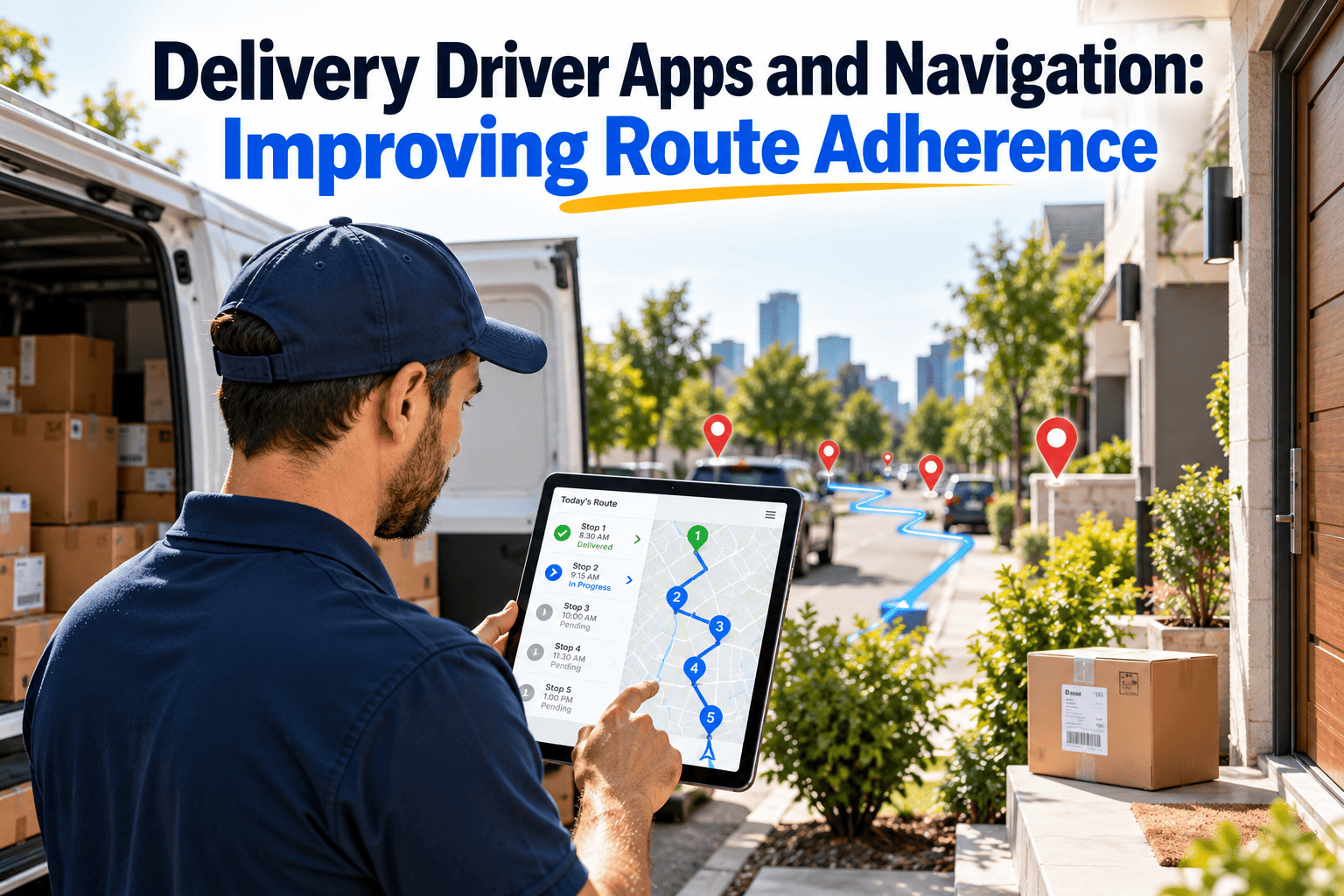
An optimized route only creates value if drivers actually run it. Between the dispatcher's plan and the customer's doorstep sits the driver app, which decides whether the sequence is followed, whether exceptions are captured, and whether the office learns what really happened. Many fleets invest heavily in planning and little in this last link. This guide covers what a delivery driver app must do, why drivers deviate, how to measure route adherence, and how coaching and reliable vehicles, supported by vehicle inspection and maintenance software, close the gap.
What Route Adherence Really Means
Adherence is how closely the executed route matches the planned one, in order, timing, and path. It is a means, not an end.
Not every deviation is a problem
A driver who skips a stop to avoid a blocked road may be right. Measure deviations, then investigate patterns instead of assuming drivers are at fault.
Why Drivers Deviate, and What to Do About It
| Reason for deviation | What it usually signals | Response |
|---|---|---|
| Driver knows a better path | Planner lacks local knowledge | Capture feedback and update road or access rules. |
| Route feels poorly ordered | Sequence ignores practical effort | Review service times and stop grouping. |
| Parcels loaded in the wrong order | Loading process does not match sequence | Align load plans with route order. |
| Customer request or access issue | Information gaps at planning time | Add notes and customer contact options. |
| App is slow or confusing | Poor usability | Simplify screens and fix performance first. |
| Navigation conflicts with plan | Separate tools giving different paths | Use one navigation source tied to the route. |
| Personal preference | Weak accountability or coaching | Coach with data and clear expectations. |
What the Driver App Must Do
Before the route
- Show the day's stops, windows, and notes clearly
- Support a pre-trip vehicle inspection
- Display load order guidance
- Work offline if signal is weak
During the route
- Provide turn-by-turn navigation to the next stop
- Capture proof of delivery and exceptions quickly
- Receive re-sequenced routes with a clear reason
- Offer easy customer contact without sharing personal numbers
After the route
- Sync completion and exception data
- Record vehicle issues found during the day
- Show a simple summary of the shift
- Feed data back to planning and maintenance
Usability decides adoption
- Few taps per stop, readable in daylight, usable with gloves or one hand.
- Large, clear status actions instead of dense menus.
- Fast loading, even on older phones and weak networks.
- Prompts that appear only when they help, not constantly.
Put Vehicle Inspections in the Driver's Hands
Mobile inspections catch defects before a route starts and turn them into work orders that maintenance can act on immediately.
Navigation: One Source of Truth
When the app plans one path and a separate navigation tool suggests another, drivers choose. Conflicting guidance is a common hidden cause of poor adherence.
- Use navigation that accounts for vehicle size, weight, and height limits.
- Pass the planned stop order directly into turn-by-turn guidance.
- Allow safe, logged overrides when a driver reports a closure or hazard.
- Keep voice prompts and screen alerts short, to limit distraction.
- Update navigation when the route is re-sequenced, not afterward.
Measuring Adherence Without Creating Distrust
- Stops completed in appBaseline completion and scan compliance.
- Stops in planned orderSequence adherence per route.
- Stops inside windowTiming adherence against commitments.
- Deviations with a reasonShare of changes that were logged and explained.
Measurement principles
- Tell drivers what is measured and why.
- Compare routes of similar difficulty, not drivers across unequal territories.
- Separate unavoidable deviations from avoidable ones.
- Review trends weekly instead of reacting to a single route.
A Coaching Loop That Closes the Gap
Incentives that work
- Reward reliable outcomes such as on-time delivery and clean proof records, not only speed.
- Avoid incentives that encourage unsafe driving or skipped checks.
- Credit drivers whose feedback improved routes.
- Keep targets realistic for the territory.
Before and After: A Driver App Rollout
Before
- Paper manifests and phone calls
- Separate navigation app
- Unknown reasons for deviation
- Vehicle issues reported late
After
- One app for route, navigation, and proof
- Deviations logged with reasons
- Weekly review drives planning fixes
- Inspections create work orders at once
The Vehicle Behind the App
Even a perfect app cannot overcome a vehicle that fails mid-route. Oxmaint does not provide driver navigation; it supports inspections and maintenance for the vehicles drivers depend on.
- Mobile inspection checklists let drivers record defects before leaving the yard.
- Defects convert to work orders so repairs are assigned and tracked.
- Preventive maintenance schedules reduce roadside breakdowns.
- Asset records hold service history, documents, and compliance information.
- Inventory control supports quicker repairs.
- Reports show recurring defects, repair cost, and downtime by vehicle.
Why this affects adherence
Breakdowns force reassignments, which break planned routes. Fewer surprises mean routes stay closer to plan.
Driver App Evaluation Checklist
- Works offline and recovers cleanly
- Few taps per stop
- Navigation tied to the planned route
- Re-sequencing explained to drivers
- Proof of delivery and exceptions captured
- Pre-trip inspection supported
- Adherence reporting by route and zone
- Driver feedback channel in place
Frequently Asked Questions
What is route adherence in delivery?
It is how closely drivers follow the planned stop order, timing, and path during a route.
Why do drivers ignore optimized routes?
Usual reasons are local knowledge, poor sequencing, load order, confusing apps, or conflicting navigation.
Should low adherence always be penalized?
No. Investigate first, since many deviations reveal planning or data problems worth fixing.
How does inspection software help drivers?
It lets them report defects fast so repairs happen early. You can sign up for Oxmaint to try it.
Can I see a fleet maintenance workflow first?
Yes, a short session covers inspections and work orders. You can book a demo to see it.
Onboarding Drivers to a New App
Rollout decides adoption. A good app introduced poorly still fails.
Before launch
- Involve a small group of respected drivers in testing and feedback.
- Test on the phones, mounts, and network conditions drivers actually use.
- Prepare short training focused on daily tasks, not every feature.
- Explain how data will be used and what will not be monitored.
During the first weeks
- Provide a quick way to ask for help during routes.
- Fix the most common frustrations quickly and tell drivers what changed.
- Run side-by-side comparison with the old process briefly, then retire it.
- Review early adherence data as a learning tool, not a performance verdict.
Safety, Distraction, and Compliance
App design affects safety. Reduce interaction while the vehicle is moving and keep required checks simple.
Safe design principles
- Lock complex entry while the vehicle is in motion.
- Use voice or large single-tap actions for common updates.
- Avoid prompts that appear at unsafe moments.
- Support hands-free navigation guidance.
Compliance considerations
- Capture pre-trip and post-trip inspections consistently.
- Record hours and breaks where regulations require it.
- Keep proof of delivery and exception evidence tied to each stop.
- Retain records according to your policies and local rules.
Handling Poor Connectivity and Device Problems
Delivery work happens in basements, rural areas, and dense buildings. The app must survive weak signal.
Resilience features
- Store routes and stop details on the device and sync when connection returns.
- Queue proof-of-delivery data and upload automatically later.
- Show clear sync status so drivers know when data has reached the office.
- Provide a simple recovery path if the app crashes mid-route.
Device management
- Standardize on supported devices and operating system versions.
- Plan battery needs, chargers, and mounts for full shifts.
- Define what happens when a device is lost, damaged, or fails.
Using Adherence Data to Improve the Plan
Adherence data is most valuable when it improves the next plan, not when it only grades drivers.
Questions the data can answer
- Which stops are skipped or reordered most often, and why?
- Which zones show the largest gap between planned and actual time?
- Do certain customers or buildings regularly extend service time?
- Does adherence fall at the end of long routes or during peak periods?
Actions to take
- Update service times and access notes based on repeated findings.
- Adjust route size where drivers consistently cannot finish.
- Share improvements with drivers so they see their feedback matters.
Features That Support Route Adherence Beyond Navigation
Navigation alone does not create adherence. Supporting features remove the reasons drivers deviate.
Information features
- Stop notes, entry codes, and contact details visible without extra taps.
- Clear window and priority indicators on each stop.
- Parcel and load order guidance so the next package is easy to find.
Workflow features
- Quick exception codes for missed access, absent customers, and damaged goods.
- Photo and signature capture that works fast and offline.
- Break and shift tracking that fits the route rather than interrupting it.
Communication features
- Two-way messaging with dispatch limited to meaningful updates.
- Customer contact tools that protect driver privacy.
- Alerts that explain why the route changed.
Common Adherence Problems and Practical Fixes
Patterns usually point to a specific fix. Treat recurring deviations as design feedback.
Problems and responses
- Drivers regularly skip the first stop: check depot loading order and departure timing.
- Drivers reorder in the afternoon: check whether service times are too optimistic.
- Specific streets are avoided: review access rules and restrictions.
- Scans happen in batches after the route: simplify steps and fix connectivity issues.
- Navigation and route disagree: connect them to the same stop sequence.
Reporting for Operations and Management
Different audiences need different views. Dispatchers need today's exceptions, while managers need trends.
Dispatcher view
- Routes currently off plan and the likely cause.
- Stops at risk of missing windows.
- Drivers needing support or reassignment.
Manager view
- Adherence trends by depot, zone, and week.
- Deviation reasons grouped into planning, loading, access, and behavior.
- Effect of app changes and coaching on results.
Maintenance view
- Defects reported by drivers and time to resolution.
- Vehicles with repeat defects that interrupt routes.
- Inspection completion rates by depot.
Questions Managers Should Ask About Adherence
Good questions turn adherence data into decisions and help avoid blaming drivers for planning problems.
Review questions
- Is low adherence concentrated in certain zones, shifts, or routes?
- Are deviations logged with reasons, or are they unexplained?
- Do drivers who deviate also finish earlier or later than planned?
- Did a recent app, navigation, or planning change affect results?
- Are vehicle problems interrupting routes more often than expected?
Building Trust Between Dispatch and Drivers
Adherence improves when both sides believe the other is acting in good faith.
Practices that help
- Share why routes are built the way they are.
- Respond quickly when drivers report access or address problems.
- Recognize drivers whose feedback improved routes.
- Keep communication short, specific, and respectful.
- Avoid public ranking of drivers on raw adherence alone.
What Good Looks Like After Six Months
A successful driver app program shows up in everyday operations as well as in reports.
Operational signs
- Dispatchers spend less time phoning drivers for status.
- Drivers report fewer surprises with addresses and access.
- Exceptions arrive with clear reasons and photos.
- Routes are adjusted from data instead of arguments.
Reporting signs
- Adherence and on-time measures improve together.
- Deviations are mostly logged with causes.
- Planning changes are traceable to driver feedback.
- Vehicle defects are reported earlier and resolved faster.
Common Driver App Selection Mistakes
Buyers often compare feature lists and miss the factors that decide daily use.
Mistakes to avoid
- Choosing on dispatcher dashboards while ignoring the driver screen.
- Skipping field tests on older phones and weak networks.
- Treating navigation as a separate purchase from routing and adherence.
- Launching without a feedback channel from drivers.
- Measuring drivers on raw adherence before fixing planning problems.
Summary: Turning Plans Into Performance
Adherence is the visible result of a chain of decisions: sensible routes, usable tools, fair measurement, honest coaching, and vehicles that start the day ready. Weakness in any link pulls the whole chain down.
Checklist of priorities
- Make the app fast and simple.
- Use one navigation source tied to the plan.
- Measure with context and share results openly.
- Fix planning causes before coaching drivers.
- Keep vehicles inspected and maintained.
Practical Tips for Dispatchers Supporting Drivers
Dispatchers shape adherence daily through how they respond to drivers on the road.
Habits that help
- Answer driver questions quickly and with specific instructions.
- Avoid changing routes without a reason the driver can see.
- Record access problems so the next plan improves.
- Check vehicle defect reports each morning before assigning routes.
- Thank drivers for useful reports so feedback keeps coming.
Help Drivers Start Every Route With a Ready Vehicle
Connect mobile inspections, preventive maintenance, and repair tracking so planned routes are not undone by avoidable breakdowns.