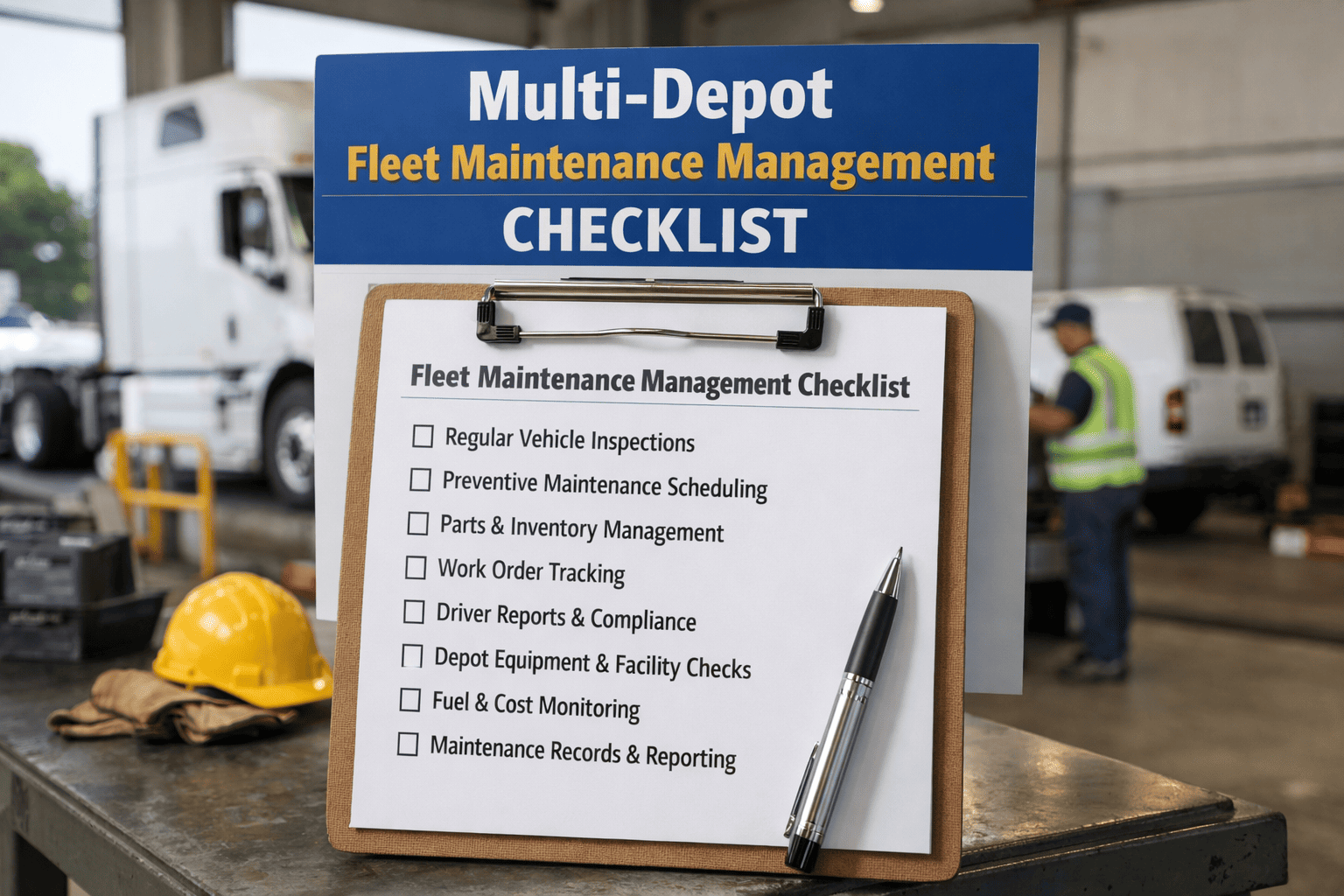
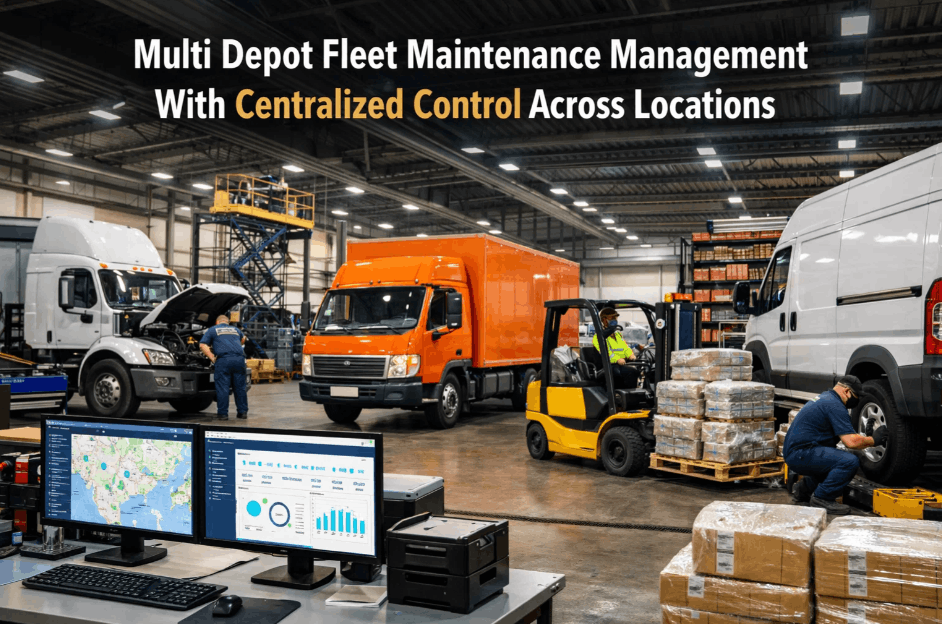
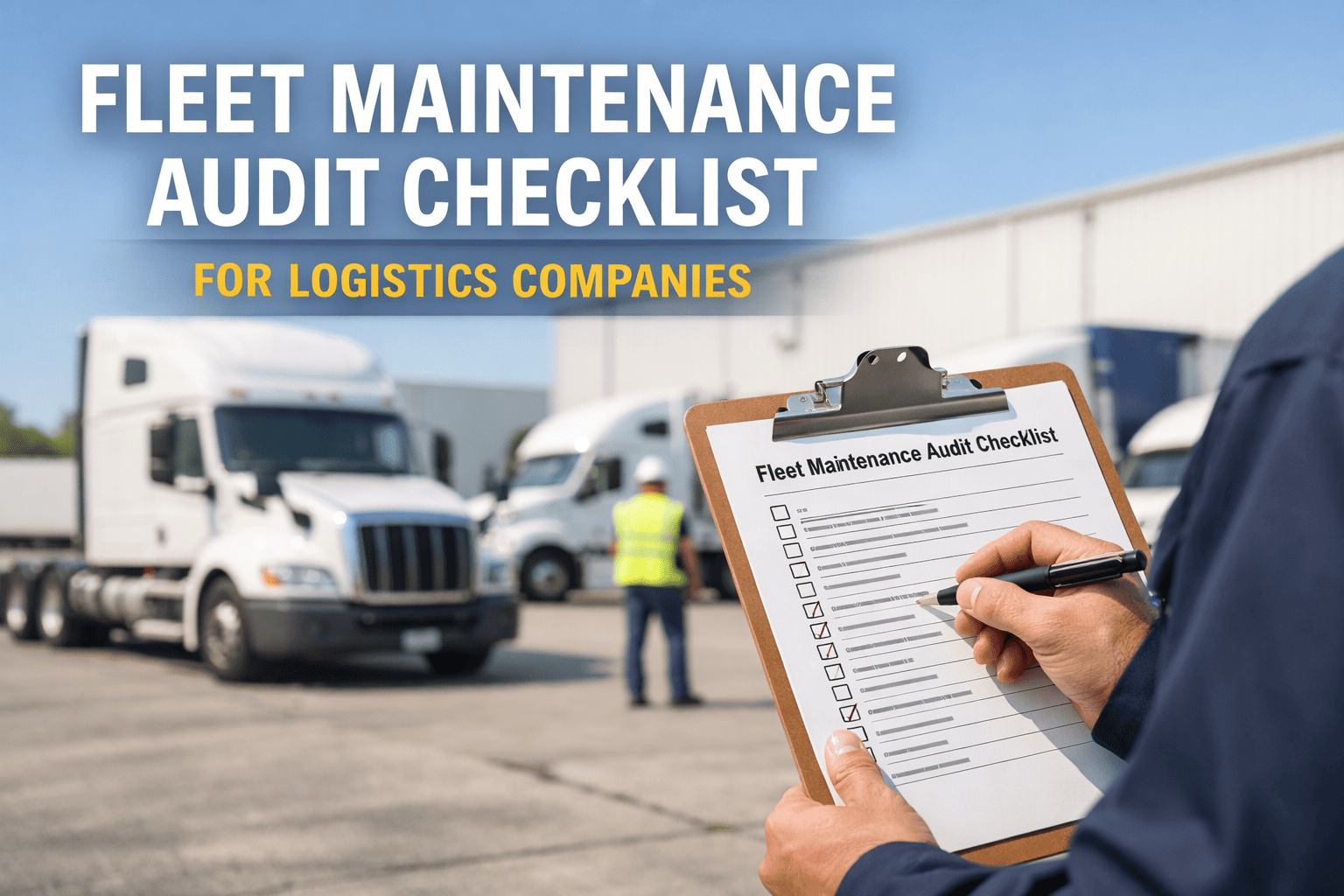
Managing a fleet across a single depot is complex enough. Scale that to multiple depots — each with its own team, vehicles, and maintenance habits — and the gaps multiply fast. Inconsistent inspection standards, siloed service records, and no unified view of fleet health across locations are the hallmarks of a multi-depot operation that has outgrown its processes. This checklist gives enterprise fleet managers a structured framework to standardise maintenance across every depot, centralise oversight, and build operational consistency at scale. Start centralising your fleet operations on Oxmaint or book a free demo to see how enterprise teams manage fleets across locations from one platform.
3x
more maintenance inconsistencies found in multi-depot fleets vs. single-location operations
47%
of enterprise fleet managers cite lack of cross-depot visibility as their top operational challenge
$22K+
annual cost per depot of inconsistent maintenance practices in large delivery fleets
35%
lower maintenance cost per vehicle in centralised vs. decentralised fleet operations
Why Multi-Depot Fleets Break Down Differently
Single-depot problems are visible and correctable. Multi-depot problems hide — buried in inconsistent processes, fragmented records, and local workarounds that no one at the enterprise level can see. By the time a pattern emerges, the cost is already significant.
01
Each Depot Operates Independently
Local teams develop their own maintenance habits, inspection formats, and scheduling logic. Standards drift apart and no two depots run the same process.
→
02
Records Remain Siloed
Service histories, work orders, and inspection logs live in separate systems — or paper files. Enterprise management cannot see fleet health across locations in one view.
→
03
Compliance Gaps Go Undetected
Expired certificates, overdue PMs, and unfiled inspection reports accumulate silently at individual depots until a regulatory inspection or breakdown brings them to light.
→
04
Enterprise Cost Spirals
Without centralised oversight, emergency repairs, duplicated parts ordering, and reactive maintenance practices compound across every location — multiplying total operating cost.
Unify your fleet operations across every depot
Oxmaint gives enterprise fleet managers a single dashboard to manage maintenance, inspections, and compliance across all locations.
Start Free Trial
Section 1 — Centralised Fleet Standards Checklist
Before any depot can be managed consistently, enterprise-wide standards must be defined and enforced. These are the foundation checks that determine whether your multi-depot operation is running from a shared playbook or improvising at each location.
Unified Vehicle Asset Register Across All Depots
Every vehicle, trailer, and support unit across all locations is in a single asset register — with VIN, registration, depot assignment, and responsible manager recorded.
Standardised PM Intervals by Vehicle Class
Preventive maintenance schedules are consistent across depots for the same vehicle types. Local teams cannot modify intervals without enterprise-level approval.
Shared Inspection Templates Deployed Everywhere
Pre-trip, post-trip, and periodic inspection checklists are identical across all depots. Drivers at any location complete the same structured form with no local variations.
Work Order Formats Consistent Fleet-Wide
All depots raise, assign, and close work orders in the same system and format. Enterprise management can read any work order from any location without translation.
Defect Severity Classifications Standardised
Category A through D defect classifications are applied consistently at every depot. A critical defect grounding rule at one location applies uniformly across the enterprise.
Compliance Document Expiry Monitoring Centralised
Registrations, insurance certificates, and inspection records for every vehicle at every depot are tracked in one system with shared expiry alerts — not managed individually at location level.
Section 2 — Per-Depot Maintenance Operations Checklist
Once enterprise standards are set, each depot must be individually audited against those standards. This section verifies that every location is executing the shared programme — not just acknowledging it.
PM
PM Programme Execution
Zero vehicles with overdue PM at this depot
PM completion rate above 95% for past 30 days
Maintenance scheduled in off-peak hours, not during dispatch windows
Technician coverage confirmed for all scheduled PM days
INS
Inspection Compliance
100% pre-trip completion rate for all operating days this month
Post-trip reports filed for every active vehicle every shift
All defects reported via digital system — no paper forms in use
No vehicles dispatched with unresolved critical defects this month
DOC
Documentation Status
All vehicle registrations current and on file for this depot
Insurance certificates valid for all vehicles operating from this location
Annual inspection certificates in-date for every vehicle in the depot
Driver licence and medical certificate files current for all assigned drivers
Audit every depot from one dashboard — not a spreadsheet
Oxmaint shows PM compliance, inspection completion, and open defects for every location in real time.
Book a Demo
Section 3 — Cross-Depot Visibility and Reporting Checklist
Enterprise fleet management only works when leaders can see across all locations without depending on local teams to report upward. This section checks whether your visibility infrastructure is enterprise-grade or location-dependent.
Enterprise Dashboard Shows All Depots
A single screen displays PM compliance, inspection status, open defects, and vehicle uptime for every depot simultaneously — updated in real time without manual reporting.
Cross-Depot Performance Benchmarking Active
Depot-level KPIs — PM on-time rate, breakdown frequency, cost per vehicle — are compared side by side. Underperforming locations are visible before they escalate to crises.
Vehicle Transfer Records Maintained Enterprise-Wide
When a vehicle moves between depots, its full service history, open work orders, and compliance documents transfer with it. No maintenance history is lost in relocation.
Automated Alerts Escalate to Enterprise Level
Critical events at any depot — a vehicle grounding, a compliance expiry, a series of breakdowns — automatically escalate to regional and enterprise managers without local teams needing to report them manually.
Monthly Enterprise Fleet Report Generated
A consolidated fleet performance report covering all depots is generated and distributed monthly. Report includes breakdown rates, maintenance costs, uptime percentages, and compliance status by location.
Audit Export Available for Any Depot at Any Time
Enterprise compliance teams can export a full maintenance and inspection record for any individual depot or vehicle in minutes — without contacting local teams or waiting for manual compilation.
Section 4 — Parts and Procurement Centralisation Checklist
Fragmented parts procurement across depots is one of the most overlooked cost drivers in enterprise fleet operations. Centralised procurement aligns purchasing power, eliminates duplication, and ensures supply availability where it is needed most.
Depot-Level Requirements
Critical parts stocked at every depot independently
Oil, filters, brake pads, and bulbs available at each location without cross-depot transfer dependency for emergency repairs.
Local reorder thresholds set and monitored
Each depot has minimum stock levels defined. Alerts trigger before stockouts occur — not after a repair is delayed waiting for parts.
Parts usage logged per vehicle at every depot
Every part consumed is linked to a vehicle and work order. Usage patterns identify vehicles with recurring failures and support proactive replacement decisions.
Enterprise-Level Controls
Approved vendor list applied uniformly across all depots
All depots source from the same preferred supplier list. Eliminates maverick spend, ensures part quality consistency, and consolidates negotiating leverage.
Aggregated parts spend visible enterprise-wide
Total parts expenditure across all depots is reported in one view. Identifies cost outliers by location and enables volume-based supplier renegotiation.
Inter-depot parts transfer process documented
When a critical part is available at one location but needed urgently at another, the transfer process is defined, authorised, and logged — not ad hoc.
Multi-Depot vs. Centralised: The Performance Gap
Siloed Depot Operations
Each depot maintains its own records in different formats
Enterprise managers request manual reports to get fleet visibility
PM standards vary by location — some disciplined, some reactive
Compliance gaps at one depot undetected until external inspection
Parts ordered independently at each depot at higher unit cost
Vehicle transfers lose maintenance history between locations
Centralised Fleet Management
All depots feed into one platform — same format, real-time data
Enterprise dashboard shows all locations without manual reporting
PM standards enforced uniformly — no local variation permitted
Compliance alerts escalate automatically before expiry at any depot
Consolidated procurement reduces parts cost 15–25% enterprise-wide
Vehicle history travels with the asset regardless of depot assignment
Enterprise KPIs: Tracking Performance Across Every Depot
| KPI |
What It Measures |
Enterprise Target |
Review Frequency |
| PM On-Time Rate |
% of scheduled PMs completed before due date per depot |
95% or above |
Monthly per depot |
| Vehicle Uptime % |
Active operational time vs. time in maintenance or repair |
95%+ |
Weekly fleet-wide |
| Inspection Completion Rate |
% of operating days with filed pre-trip and post-trip reports |
100% |
Daily per depot |
| Cost Per Vehicle Per Month |
Total maintenance spend divided by active vehicle count |
Benchmarked vs. prior quarter |
Monthly enterprise |
| Cross-Depot Breakdown Rate |
Unplanned breakdowns per 1,000 operating hours by location |
Below 2 per 1,000 hrs |
Monthly per depot |
| Compliance Document Currency |
% of vehicles with all compliance documents current across all depots |
100% |
Weekly enterprise |
35%
lower maintenance cost per vehicle in centralised vs. fragmented depot operations
60%
faster compliance reporting when all depot records are in one enterprise platform
2.4x
improvement in PM consistency across depots after standardising maintenance software
How Oxmaint Scales Across Multi-Depot Enterprise Fleets
Enterprise fleet teams do not need more depot-level tools. They need a platform that gives both local managers the operational control they need and enterprise leadership the visibility to manage across every location without manual reporting. Oxmaint is built for that model — one platform, all depots, real-time. Start for free and connect your first depot in under a day.
Multi-Location Fleet Dashboard
View PM compliance, open defects, vehicle uptime, and inspection status across all depots from one enterprise screen. No reports requested, no data chased — live and automatic.
Standardised Inspection Templates
Deploy the same pre-trip, post-trip, and periodic inspection checklists to every depot simultaneously. Templates are managed centrally — local teams complete them, not customise them.
Centralised PM Scheduling
Set maintenance intervals by vehicle class and apply them fleet-wide. Oxmaint auto-generates work orders at every depot based on the same enterprise standard — no local scheduling variation.
Enterprise Compliance Tracking
Registration, insurance, and inspection document expiry dates for every vehicle at every depot are tracked centrally. Alerts escalate to enterprise level 30, 14, and 7 days before any lapse.
Parts Inventory Across Depots
Track stock levels at each location, compare parts usage patterns across depots, and identify where centralised procurement can reduce cost and prevent stockout delays.
Cross-Depot Analytics and Benchmarking
Compare breakdown rates, maintenance costs, PM compliance, and inspection completion across all depot locations. Identify which sites need attention and which are setting the benchmark.
Manage Every Depot Like Your Best One
Oxmaint gives enterprise fleet operations teams the tools to enforce maintenance standards, centralise compliance records, and benchmark performance across every depot — from a single platform that scales with your operation.
Frequently Asked Questions
What is the biggest maintenance challenge specific to multi-depot fleet operations?
The core challenge is consistency — each depot develops its own maintenance habits, inspection standards, and record formats over time. Without a centralised platform enforcing a shared standard, enterprise managers lose the ability to compare performance across locations, identify systemic issues, or ensure compliance is maintained fleet-wide rather than just at individual sites.
How should enterprise fleet managers audit maintenance across multiple depots?
The most effective approach is to establish a set of standardised KPIs — PM on-time rate, inspection completion rate, vehicle uptime, and compliance document currency — and track them at the depot level in real time through a central platform. Monthly cross-depot benchmarking reports allow enterprise managers to identify underperforming locations and direct support before issues escalate.
Can Oxmaint manage fleets across multiple depots in different regions?
Yes. Oxmaint is designed to support multi-location fleet operations with a centralised dashboard that displays all depots simultaneously. Maintenance schedules, inspection templates, compliance tracking, and work order management all operate from a single platform — giving enterprise managers full visibility across every location without requiring local teams to push data upward manually.
What happens to a vehicle's maintenance history when it is transferred between depots?
In Oxmaint, all maintenance history, inspection records, and compliance documents are attached to the vehicle asset itself — not to the depot. When a vehicle transfers between locations, its complete record transfers with it automatically. The receiving depot has immediate access to full service history, open work orders, and upcoming PM due dates without any manual handover process.