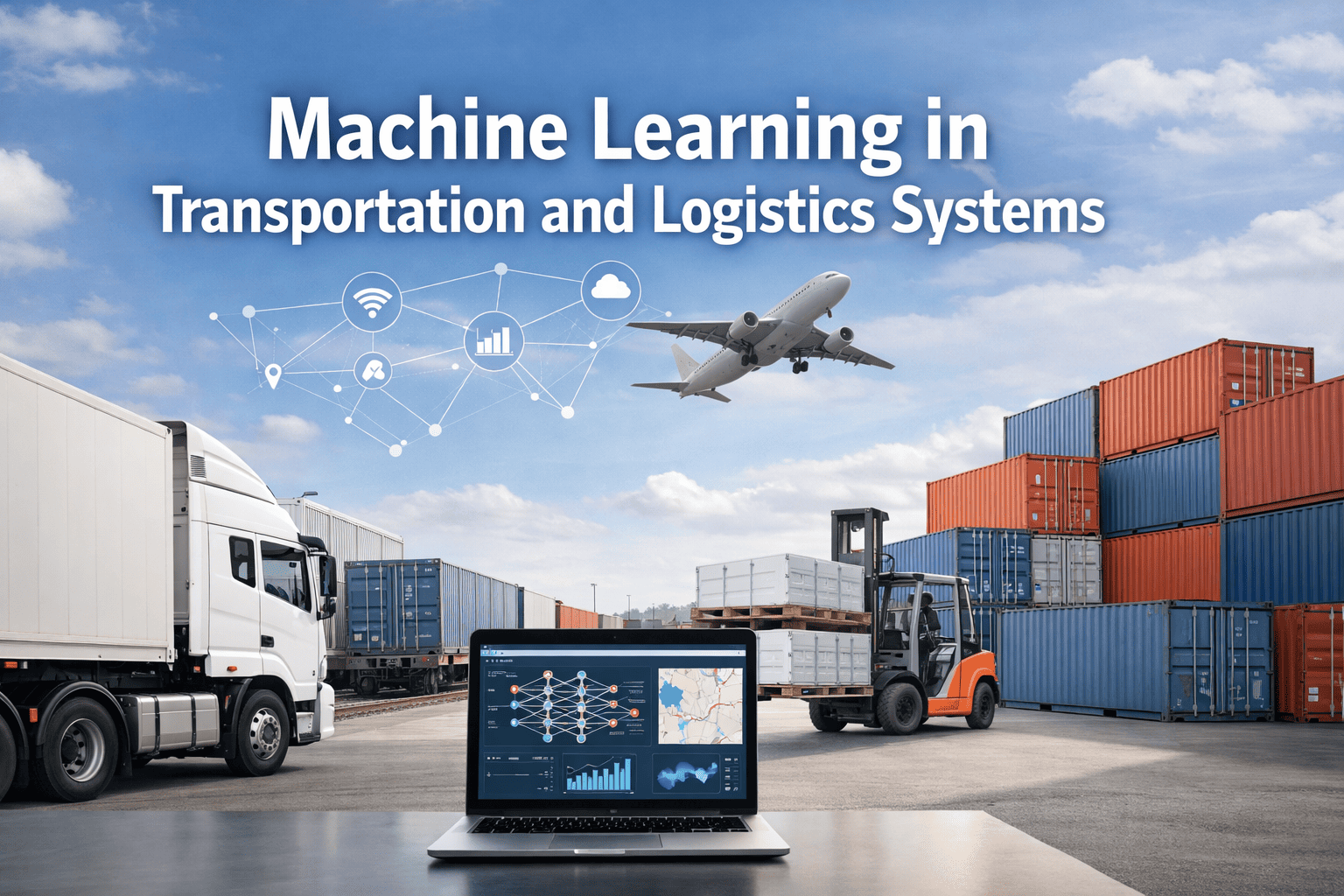
Transportation and logistics networks generate more data every day than most industries produce in a year — GPS pings, fuel transactions, demand signals, delivery confirmations, traffic feeds, and sensor readings from thousands of vehicles and facilities. For years, that data sat unused. Machine learning changes that. It turns operational noise into actionable intelligence: predicting demand before it spikes, detecting risk before it becomes failure, and routing smarter without adding headcount. See how Oxmaint applies ML to your operations or book a free demo to explore predictive analytics built for logistics teams.
$1.3T
projected value AI and ML will add to global logistics by 2030
35%
reduction in inventory costs achievable with ML-powered demand forecasting
25%
fewer unplanned maintenance events when ML predictive models are deployed on fleets
4x
faster anomaly detection in logistics operations using ML vs. rule-based systems
Where Traditional Logistics Systems Hit Their Ceiling
Manual planning and rules-based systems were built for predictable environments. Modern logistics is not predictable. ML fills the gap by processing variables faster and more accurately than any human-designed rule set can handle.
D
Demand Forecasting
Old way: historical averages and seasonal adjustments
ML way: multi-variable models using weather, events, market signals, and real-time order data
R
Risk Detection
Old way: post-incident reporting and manual audits
ML way: anomaly detection flags patterns before incidents occur — in transit, in warehouse, and in vehicle health
S
Route and Load Planning
Old way: dispatcher experience and static route maps
ML way: continuous optimization across thousands of variables — stops, capacity, traffic, time windows, fuel cost
M
Maintenance Scheduling
Old way: mileage intervals and time-based service calendars
ML way: predictive models trained on sensor data, failure history, and usage patterns to forecast exact service needs
Turn your logistics data into a competitive advantage
Oxmaint's ML-powered platform connects fleet health, maintenance forecasting, and operational analytics in one place — built for transportation teams.
Start Free Trial
The 4 Core ML Applications in Logistics
Machine learning is not a single technology — it is a family of techniques applied to specific logistics problems. Each application below addresses a distinct operational challenge with a measurable output.
01
Demand Forecasting
ML models ingest historical shipment data, customer order patterns, external signals like weather and economic indicators, and promotional calendars to produce demand forecasts that are far more accurate than seasonal averages. The result is tighter inventory positioning, fewer stockouts, and reduced safety stock.
Time-series modeling
Multi-variable regression
Demand sensing
02
Predictive Maintenance
Sensor data from vehicles and equipment feeds ML models trained to identify failure signatures before they produce downtime. Instead of fixed service intervals, maintenance is triggered by actual wear signals — reducing both over-maintenance and unexpected breakdowns on active routes.
Anomaly detection
Remaining useful life
Sensor pattern analysis
03
Risk and Anomaly Detection
ML continuously monitors shipment data, vehicle telemetry, and operational metrics to detect patterns that indicate risk — cargo theft, driver fatigue, route deviation, temperature excursion, or billing fraud. Alerts are generated before the risk materializes into a loss event.
Unsupervised learning
Real-time scoring
Pattern deviation flags
04
Operational Intelligence
ML aggregates performance data across fleet, warehouse, and last-mile operations to surface the decisions that have the highest impact on cost and service. It answers the questions that dashboards cannot — not just what happened, but why it happened and what to do next.
Causal inference
KPI forecasting
Decision support
ML Impact: Transportation vs. Legacy Systems
Legacy System Approach
Demand planned from last year's data with manual adjustments
Vehicle maintenance triggered by mileage calendar, not actual condition
Risk detected after incident — through reports and complaints
Route planning locked in at start of shift with no live adaptation
Operational data sits in siloed systems, never analysed together
Decisions made on experience and intuition, not pattern recognition
ML-Powered Operations
Demand forecasted daily using live signals — 30 to 40% fewer stockouts
Predictive maintenance triggered by failure signature — 25% fewer breakdowns
Anomalies flagged in real time before they become incidents
Routes recalculated continuously as conditions change mid-shift
All operational data unified into one ML model — correlations visible
Recommendations generated automatically with confidence scores
ML Use Cases Mapped to Logistics Challenges
| Logistics Challenge |
ML Technique Applied |
Measurable Outcome |
| Inaccurate demand forecasting |
Ensemble time-series models with external variable inputs |
Forecast accuracy improves to 90%+ — inventory costs fall by up to 35% |
| Unexpected vehicle breakdowns |
Predictive maintenance models trained on sensor and failure history data |
25 to 30% reduction in unplanned downtime — repair cost per incident drops |
| Cargo theft and transit risk |
Anomaly detection on GPS telemetry, route deviation, and timing patterns |
High-risk events flagged 4x faster than manual monitoring — fewer losses |
| Fuel cost overruns |
ML route optimization and driver behaviour scoring models |
Fuel spend per km reduced by 15 to 20% across active fleet |
| High failed delivery rate |
Customer availability prediction combined with dynamic time-window routing |
First-attempt delivery success rate rises to 92% or higher |
| Inefficient warehouse throughput |
Demand signal integration with pick-path and slotting optimization models |
Picks per hour increase by 18 to 24% without adding labour |
Predictive analytics built for transportation operations
Oxmaint connects vehicle health data, maintenance history, and operational performance into ML-powered dashboards that tell you what will happen — before it does.
Book a Demo
How ML Learns and Improves Over Time
The most important property of machine learning in logistics is that it gets better with use. Every delivery completed, every breakdown logged, and every demand signal captured trains the model to make more accurate predictions the next time.
1
Data Collection
Vehicle sensors, GPS telemetry, order systems, and maintenance records feed a unified data layer continuously.
→
2
Model Training
ML algorithms identify patterns in historical data — correlating inputs like weather, load, and driver behaviour with outcomes like breakdowns, delays, and fuel overruns.
→
3
Prediction and Action
Trained models score live operational data in real time — flagging risks, generating maintenance alerts, and recommending route adjustments before problems occur.
→
4
Feedback Loop
Outcomes from each prediction are fed back into the model. Correct predictions strengthen confidence; incorrect predictions recalibrate the model — improving accuracy continuously.
Key ML Performance Metrics for Logistics Teams
F
Forecast Accuracy
Percentage match between ML demand prediction and actual order volume. Target 90%+ for effective inventory positioning and capacity planning.
P
Predictive Maintenance Hit Rate
Percentage of breakdowns that were flagged by the ML model before they occurred. Measures whether the predictive model is calibrated to your actual fleet.
A
Anomaly Detection Precision
Ratio of true risk events to total alerts generated. High precision means fewer false alarms and more trust in the system from operations teams.
L
Model Latency
Time from data input to actionable prediction output. For real-time logistics decisions — routing, risk flagging — latency under 500ms is the operational standard.
35%
average inventory cost reduction with ML demand forecasting vs. traditional planning
25%
fewer unplanned breakdowns in fleets running ML-based predictive maintenance models
4x
faster risk detection in transit operations using ML anomaly scoring vs. manual review
How Oxmaint Brings ML to Your Transportation Operations
Most logistics operators understand the value of machine learning — the barrier is always connecting the right data sources to a system that can act on them. Oxmaint closes that gap by unifying vehicle health data, maintenance history, inspection records, and operational performance into a single ML-ready platform designed for transportation and fleet teams. Start for free and have your first predictive maintenance model live within days.
Predictive Maintenance Engine
ML models trained on your fleet's sensor data, fault history, and usage patterns generate maintenance predictions before failures occur — not after they ground a vehicle.
Anomaly Detection Alerts
Continuous scoring of vehicle telemetry, route data, and operational metrics flags deviations from normal patterns — surfacing risk before it becomes an incident or a cost.
Operational Intelligence Dashboard
ML-aggregated performance data across fleet, maintenance, and delivery operations gives managers a single view of where inefficiency is concentrated and what to fix first.
Unified Data Layer
Vehicle inspections, work orders, PM records, and parts usage are captured in a structured format that feeds ML models directly — no data cleaning or manual exports required.
Automated Work Order Triggers
When ML flags a predictive maintenance alert, Oxmaint auto-generates a work order and assigns it to the appropriate technician — closing the gap between prediction and action instantly.
Continuous Model Improvement
Every completed repair, inspection, and delivery outcome feeds back into Oxmaint's models — improving prediction accuracy over time as the system learns your specific fleet behaviour.
Your Logistics Data Already Contains the Answers. ML Reads Them.
Oxmaint gives transportation and logistics teams the ML-powered tools to forecast demand shifts, predict vehicle failures, detect operational risk, and act before disruption happens — all in one platform built for the pace of modern logistics.
Frequently Asked Questions
What is machine learning in transportation and logistics?
Machine learning in logistics refers to algorithms trained on operational data — shipment history, vehicle sensor readings, demand patterns, and route performance — to make predictions and recommendations that improve over time. Key applications include demand forecasting, predictive vehicle maintenance, risk and anomaly detection, and route optimization.
How does ML-based demand forecasting differ from traditional methods?
Traditional forecasting relies on historical averages and seasonal adjustments applied by analysts. ML models ingest dozens of variables simultaneously — weather, economic signals, customer behaviour patterns, real-time order data — and update forecasts continuously as new data arrives. The result is significantly higher accuracy, typically 85 to 95%, compared to 60 to 70% for manual methods.
How quickly can a logistics operation see results from ML predictive maintenance?
Initial predictive alerts typically appear within 30 to 60 days of deploying a predictive maintenance model, depending on the volume of historical sensor and failure data available. Model accuracy improves over the following 3 to 6 months as the system learns fleet-specific failure patterns. Measurable reductions in unplanned downtime are usually visible within the first quarter.
Does Oxmaint support ML-based predictive maintenance for mixed fleets?
Yes. Oxmaint captures vehicle health data, inspection records, and maintenance history across mixed fleet types — vans, trucks, refrigerated vehicles, and heavy equipment. The ML models are trained per vehicle class and adapt to the specific failure patterns of each asset type, rather than applying a generic model across the entire fleet.