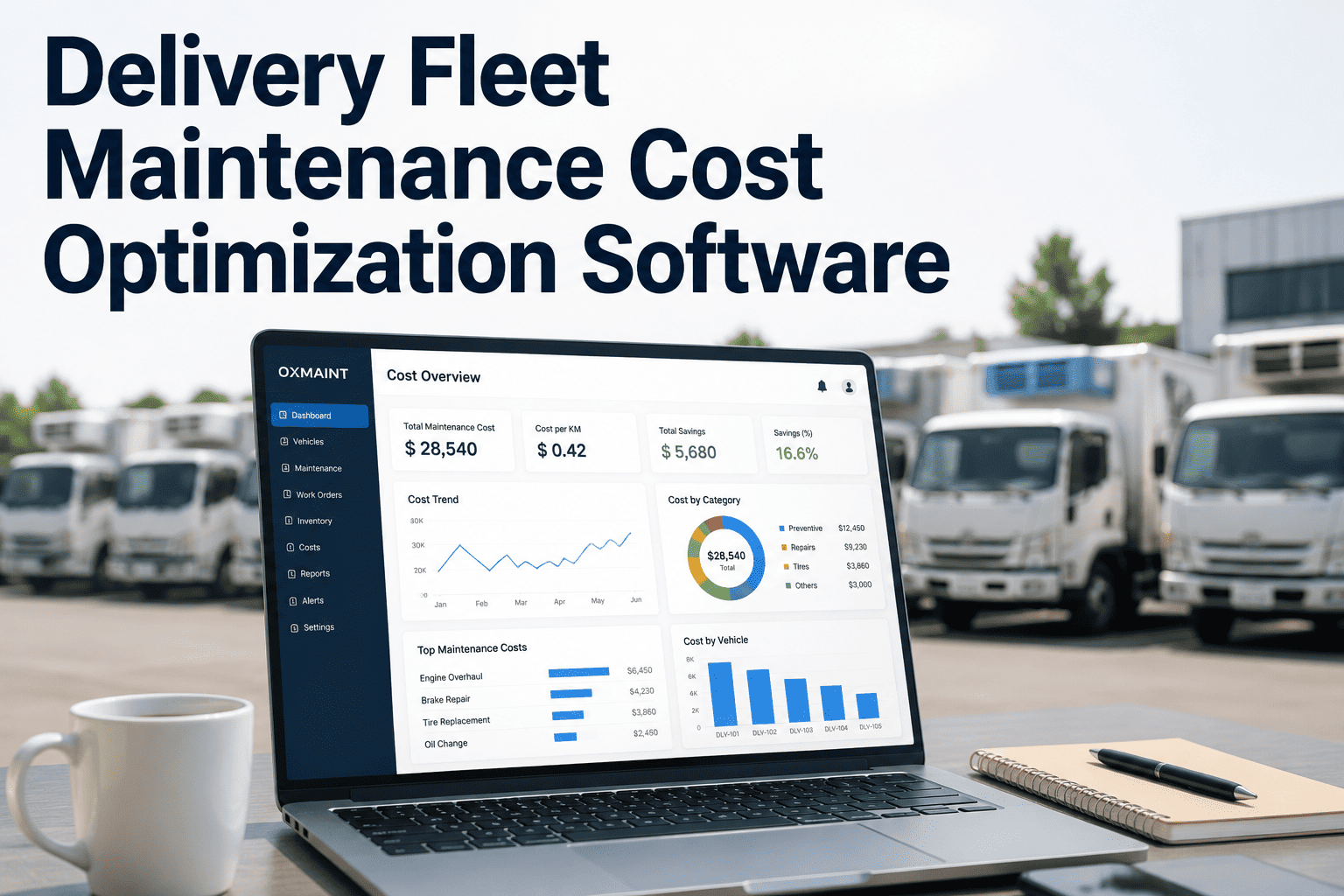
A fixed 10,000km service interval was designed for predictable, uniform vehicle usage. A delivery fleet is the opposite. The van doing 80 urban stops per day accumulates brake wear at 2.8 times the rate of the van doing 20 suburban stops — yet both get serviced at the same mileage marker. The result is a PM programme that simultaneously under-services the vehicles most likely to break down and over-services the vehicles that didn't need attention yet. That is not a scheduling quirk — it is a structural flaw in every calendar or mileage-based PM system. AI-driven dynamic PM scheduling eliminates it by building a per-vehicle service programme from actual OBD usage data, adjusting in real time as routes and workloads change, so every vehicle in your fleet is serviced at precisely the right interval for how it is actually being operated.
OxMaint · Dynamic AI-Based PM Scheduling
Stop Servicing Every Van the Same Way. They Don't All Drive the Same Route.
Usage-based PM schedules built from real sensor data — per vehicle, per route, per component. Reduce over-servicing by 40%. Eliminate under-servicing entirely.
40%less over-servicing. Switch from fixed intervals to usage-based PM.
35%of fleets are under-servicing high-cycle vans right now.
$18Ksaved annually on 20 vans by cutting unnecessary service events.
The Fixed-Interval Problem: Why One Schedule Fails Every Van
A delivery fleet is the opposite of uniform. The urban van doing 80 stops a day accumulates brake wear at 2.8× the rate of the suburban van doing 20. Batteries stress 3× harder on urban cold-start cycles. Tyre wear patterns differ by road surface and stop-start frequency. Service both vehicles at the same fixed interval and your PM programme fails two vehicle types at once — under-serving the high-cycle van until it breaks down, and wasting parts and labour on the low-cycle van that didn't need servicing yet. OxMaint builds each vehicle's actual wear profile from OBD sensor data from the first day of deployment — so intervals reflect reality, not assumptions.
SAME VAN MODEL · SAME 10,000KM FIXED INTERVAL · OPPOSITE OUTCOMES
Under-Serviced
Urban High-Cycle
80 stops/day
Brake wear rate: 2.8× baseline
Brakes reach critical wear at 3,600km — but aren't serviced until 10,000km. That's 6,400km of elevated failure risk per interval.
Over-Serviced
Suburban Low-Cycle
20 stops/day
Brake wear rate: 0.7× baseline
Optimal interval is 14,400km — but service happens at 10,000km. That's 4,400km of useful pad life thrown away every cycle.
Fixed: Urban
OxMaint Dynamic PM
3,600 km trigger
Triggered by actual brake application count
Service happens when wear data says so — not when the odometer does. Zero breakdown risk from under-servicing. Every time.
Fixed: Suburban
OxMaint Dynamic PM
14,400 km trigger
Extended interval — low cycle count confirmed by OBD
No wasted service events. Parts and labour only spent when the vehicle actually needs them. Saving captured automatically.
How AI Dynamic PM Scheduling Works
OxMaint reads OBD diagnostics continuously — brake application frequency, engine load profile, DPF accumulation, cold-start patterns, tyre pressure trends — and calculates a component-specific service trigger for each vehicle based on its actual wear rate, not the odometer. When any component's wear model reaches the service threshold, a PM work order generates automatically, parts inventory is checked in the same action, and the technician is assigned without anyone intervening. The programme updates itself as usage patterns change — a van moved to a heavier route sees its intervals shorten automatically, a van on a lighter run sees them extend. No manual recalculation. No missed service. Book a demo to see OxMaint build a live PM programme from your fleet's actual sensor data.
How Dynamic PM Is Built — From Vehicle Data to Scheduled Service
OBD Sensor Data
Brake freq · Engine load · Cold starts · DPF · Tyres
→
Wear Rate Model
AI builds per-vehicle degradation curve per component
→
Per-Vehicle PM Plan
Component-specific intervals adjusted by actual usage
→
Auto Work Order
Generated at threshold — parts checked, technician assigned
→
Repair + Model Update
Completion resets wear clock · AI improves next prediction
Per-Vehicle PM Profiles: What Usage-Based Scheduling Looks Like in Practice
Two identical vans on different routes need completely different service schedules — different brake intervals, different oil change triggers, different DPF management frequencies, different battery check cycles. OxMaint produces all of them automatically from usage data, and updates them in real time when a vehicle's route changes. The maintenance manager doesn't set these intervals or recalculate them when routes shift — the programme adjusts itself as new OBD data arrives. Because OxMaint's SAP bidirectional integration writes every PM event to SAP PM and MM without manual entry, your enterprise asset records always reflect the actual maintenance state of each vehicle.
Component
Fixed Interval
VAN-01 Urban (80 stops)
VAN-05 Mixed (40 stops)
VAN-09 Suburban (20 stops)
Brake pads
20,000 km
7,200 km
14,000 km
28,000 km
Engine oil
10,000 km
6,800 km
10,200 km
13,600 km
Battery check
Annual
Every 90 days
Every 180 days
Annual
DPF regeneration
Fault-triggered
Scheduled weekly
Bi-weekly
Monthly
Tyre rotation
15,000 km
8,000 km
14,000 km
18,000 km
Brake fluid
2 years
9 months
16 months
26 months
Your Fleet Already Has the Data. OxMaint Turns It Into a PM Schedule.
No manual recalculation. No generic intervals. A living, self-adjusting PM programme per vehicle.
Technologies That Make Dynamic PM Scheduling Possible
Dynamic PM scheduling is not a single technology — it is the output of four integrated data sources working together. OBD provides the real-time usage feed that drives most service triggers. AI digital twin simulation lets you test interval changes on virtual vehicles before applying them to the physical fleet. AI camera vision catches wear indicators that sensors cannot see. SAP and PLC integration tie everything to your enterprise infrastructure and depot charging systems. Each source adds a layer of intelligence the others cannot provide alone — and together they produce a PM programme more accurate than any single input could deliver.
OBD Integration
The Real-Time Usage Feed
Every brake application, cold start, and engine load event feeds the AI wear model continuously — not sampled at service intervals. An odometer can never tell you this. For fleets with existing telematics,
OxMaint connects via API without replacing any hardware.
Powers 70% of all dynamic PM triggers in OxMaint
AI Digital Twin
Simulate Intervals Before You Apply Them
Want to extend brake service from 7,200km to 8,000km? Test it on the virtual vehicle first. If the simulation flags elevated risk, the change is rejected before a real vehicle is affected. No more trial-and-error with live vehicles.
Reduces PM interval optimisation risk by ~40%
AI Camera Vision
Visual Wear Data That Sensors Cannot Capture
Tyre sidewall cracks, brake disc wear, suspension deterioration — OBD sensors cannot see them. AI cameras at the depot gate catch them in under 90 seconds per vehicle. Any threshold breach triggers a PM work order and generates the photo-evidenced compliance record required by DVSA, FMCSA, and NHVL automatically.
Catches ~12% of PM triggers that sensors alone miss
The Cost Impact: What Dynamic PM Saves Annually
Dynamic PM scheduling saves money in two directions at once. It eliminates unnecessary service events on low-cycle vehicles — parts and labour that were being spent before the component actually needed attention. It simultaneously prevents breakdowns on high-cycle vehicles that were being under-serviced on fixed intervals. On a 30-vehicle mixed fleet, these two savings combined exceed $46,000 per year. The figures below come from actual OxMaint deployment data across mixed delivery fleets of equivalent size.
30-VEHICLE MIXED FLEET · ANNUAL SAVING — DYNAMIC PM VS FIXED INTERVAL
Wasted Service Events
Fixed PM: 48/yr
Dynamic PM: 3/yr
−$18,000/yr
Breakdown Cost (Under-service)
Fixed PM: $24,000/yr
Dynamic PM: $2,900/yr
−$21,100/yr
Emergency Parts Premium
Fixed PM: $8,400/yr
Dynamic PM: $1,200/yr
−$7,200/yr
Total Annual Saving
$46,300
30-vehicle fleet · Dynamic vs Fixed PM
ROI positive within 5 months
Compliance and PM Records: Built Automatically, Audit-Ready Always
Every PM event generated by OxMaint's dynamic scheduling engine creates a complete compliance record automatically — timestamped, technician-attributed, and formatted for the applicable regulatory standard without any separate administrative step. For US fleets under FMCSA Part 396, systematic PM inspection records are generated per vehicle per event. For UK DVSA O-licence operators, PMI documentation is auto-generated at the correct frequency. For Australian NHVL Chain of Responsibility requirements, maintenance management records are created without manual input. Fleet directors facing a DOT audit or DVSA inspection can export a complete PM history for any vehicle within minutes — no manual record assembly required.
Deployment Plan — Dynamic PM Scheduling Go-Live (30-Vehicle Fleet)
1
Asset Register and Route Classification
Log every van — route type, daily stop count, engine type. Import 12 months of service history. Gives the AI a baseline before OBD data begins.
2
OBD Installation and Baseline Data Collection
30 vehicles connected in one day. Existing telematics via API — no hardware swap. Wear baselines build immediately. First PM schedule differences visible within 2–3 weeks.
3
SAP Integration and Compliance Template Setup
Configure SAP sync. Set DOT/DVSA/NHVL compliance templates — records build automatically from day one. Load parts inventory buffers for high-turnover components.
4
Full Go-Live — Dynamic PM Active Across Fleet
Every vehicle gets its own live PM schedule based on actual wear. High-cycle vehicles diverge from old fixed intervals within the first week. Review PM cost vs breakdown rate at month 3.
Is Your Current PM Programme Working? A Quick Self-Assessment
Regular servicing and correct maintenance are not the same thing. A fleet that services every van at 10,000km is running a schedule — not a programme. These eight questions are designed to reveal the difference honestly. Most fleet managers find they answer No to at least three. Each No represents a structural gap that fixed-interval PM cannot close, regardless of how consistently the service schedule is followed.
Answer honestly. Each "No" is a gap that dynamic PM scheduling closes directly.
Do different vehicles in your fleet have different service intervals based on their actual route intensity?
Yes → Good
No → Fixed intervals are over/under-servicing by up to 40%
Can you see each vehicle's brake wear rate, battery charge efficiency, and DPF load in real time — not just at service?
Yes → OBD monitoring active
No → You're blind to component degradation between services
Does your PM schedule automatically adjust when a vehicle moves to a different route or usage pattern?
Yes → Dynamic model working
No → Route changes are creating undetected service gaps
When a PM threshold is reached, does a work order generate automatically — or does someone need to notice and create it manually?
Yes → Automated triggers active
No → Human delay adds 18–36 hours between detection and action
Are required parts automatically checked and reserved when a PM work order is generated?
Yes → Parts procurement integrated
No → Parts unavailability is extending your repair cycle time
Do your PM records sync automatically to SAP or your ERP system without manual data entry?
Yes → SAP integration live
No → Double entry is creating record lag and data inconsistency
For EV or hybrid vehicles, does your PM programme include battery health-triggered service intervals — not just calendar checks?
Yes → EV PM model active
No → Calendar PM misses battery degradation entirely
Can you export a complete, audit-ready PM history for any vehicle on demand — without manually assembling records?
Yes → Compliance records auto-built
No → Your next audit will require hours of manual record retrieval
Frequently Asked Questions
Q1How long before dynamic PM intervals differ noticeably from fixed intervals?
High-cycle urban vehicles typically show schedule differences within the first 2–3 weeks as OBD data reveals their actual wear rate. Low-cycle vehicles take slightly longer — 3–5 weeks — as their extended intervals diverge from the fixed baseline. Fleets that import 12 months of historical data at go-live see meaningful differentiation within the first week.
Q2Does dynamic PM scheduling work for EV and hybrid delivery vans?
Yes — OxMaint applies separate monitoring profiles for EV vehicles. Battery health triggers replace engine-based intervals, charge cycle efficiency feeds the service model, and PLC charging data provides depot-level battery health input. Mixed diesel and EV fleets are managed in one dashboard with appropriate PM models per vehicle type.
Q3Will dynamic PM cause compliance issues by deviating from manufacturer-recommended intervals?
No — OxMaint's dynamic intervals are always at or shorter than manufacturer recommendations for high-cycle vehicles, and only extend beyond them for low-cycle vehicles where actual wear data justifies it. The system flags any calculated interval that would exceed the manufacturer maximum, ensuring the PM programme stays within safe operating bounds while eliminating unnecessary servicing.
Q4How does OxMaint handle multi-depot fleets with different route profiles per location?
Q5What happens to the PM schedule when a vehicle is reassigned to a different route?
The AI model begins incorporating the new route data immediately. Within 7–14 days of route reassignment, the wear rate model reflects the new usage profile and PM intervals adjust accordingly. The historical wear data from the previous route is retained but weighted to the current route pattern — preventing a sudden reset that would ignore accumulated component wear.
Build a PM Schedule That Fits Every Van — Not a Generic Interval That Fits None.
OxMaint builds per-vehicle preventive maintenance programmes from real OBD data. No manual recalculation. No over-servicing. No missed failures.