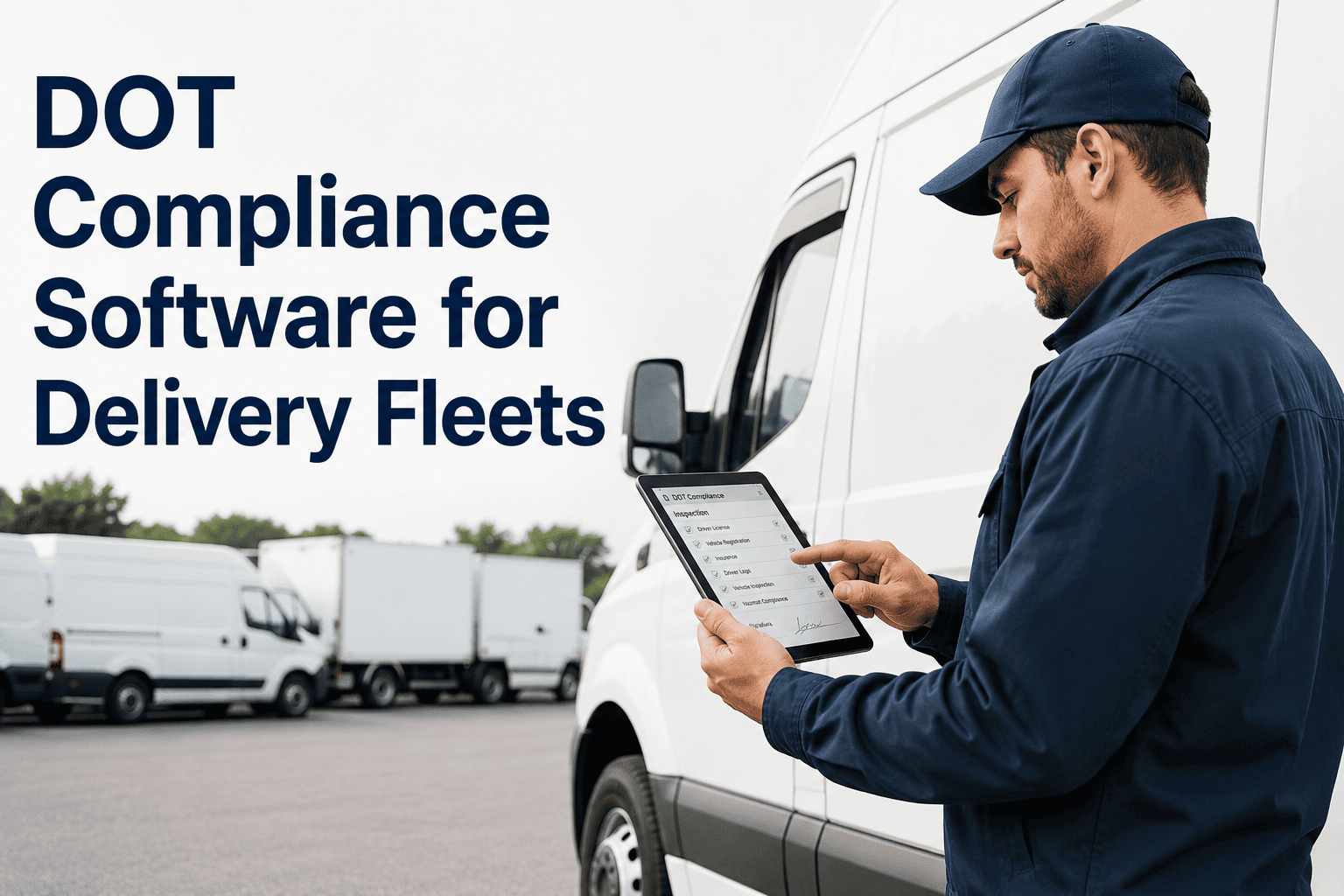
Every delivery fleet manager knows the feeling: a truck breaks down mid-route, a driver calls in stranded, and a day's worth of deliveries is suddenly at risk. Unplanned vehicle downtime now costs fleets between $448 and $760 per vehicle per day, and the average fleet loses 8.7 days of unplanned downtime per vehicle annually. But in 2026, AI-powered predictive maintenance is turning that reactive nightmare into a thing of the past. Fleets implementing these systems are reporting up to 35% less downtime, 30% lower maintenance costs, and 60% fewer emergency repairs. This is not a pilot program anymore — it is how the smartest delivery operations run today. Here is how it works, what it costs, and how to get started with a platform built for fleet maintenance intelligence.
The Delivery Fleet Maintenance Crisis — By the Numbers
Downtime Cost
$448-$760/Day
Avg Unplanned Days
8.7/Year
PM Priority
68% of Fleets
Why Delivery Fleets Are Bleeding Money on Reactive Maintenance
The numbers tell a brutal story. According to Fleetio's 2026 Benchmark Report — drawn from 1.2 million vehicles and $7 billion in service spend — 54.4% of fleet managers say rising costs are their top concern. Communication gaps (31.5%), technician shortages (27.4%), and unscheduled service volume (25.2%) are the top barriers to on-time maintenance. Meanwhile, vehicles over 10 years old consume 33.5% of total service spend despite representing only 12.1% of miles driven.
For delivery fleets specifically, every hour a truck sits idle is a missed delivery, a frustrated customer, and revenue walking out the door. Roadside assistance alone costs $350 to $700 per call. Replacement rentals run up to $3,000 per month. And the ripple effects — rerouted drivers, missed SLAs, compliance risks — compound fast.
Reactive Maintenance
Emergency Roadside Repair
$350-$700/call
Vehicle Rental (replacement)
$3,000/month
Lost Productivity per Hour
$448+
Catastrophic Engine Failure
$50,000
Avg. Annual Cost per Vehicle
$12,000-$18,000
AI Predictive Maintenance
Planned Repair (pre-scheduled)
$900-$3,000
Vehicle Rental Needed
Rarely
Downtime per Incident
Near zero
Failure Caught Early
2-4 Weeks Ahead
Avg. Annual Cost per Vehicle
25-40% Lower
How much is reactive maintenance costing your fleet?
Most delivery fleets discover they are spending 2-3x more than necessary on emergency repairs alone.
Book a Free Fleet Assessment
How AI Predictive Maintenance Actually Works
Predictive maintenance is not guesswork and it is not calendar-based scheduling. It uses real-time sensor data, historical repair records, and machine learning algorithms to forecast exactly when a component will fail — and trigger action before it does. Here is the three-stage process that modern AI CMMS platforms use to keep delivery fleets running.
01
Real-Time Data Collection
IoT sensors and OBD-II devices continuously monitor engine diagnostics, vibration patterns, tire pressure, fluid levels, temperature fluctuations, and brake wear across every vehicle. This data streams to a centralized cloud CMMS platform in real time.
Engine performance
Vibration patterns
Temperature and pressure
02
AI Pattern Analysis and Risk Scoring
Machine learning algorithms compare real-time readings against historical failure data and baseline performance metrics. Each vehicle receives a dynamic risk score — not a fixed schedule. The system detects subtle anomalies that human inspectors and basic telematics would miss entirely.
ML anomaly detection
Dynamic risk scoring
90%+ prediction accuracy
03
Automated Action and Work Order Generation
When risk thresholds are exceeded, the CMMS auto-generates a prioritized work order, assigns the right technician, checks parts inventory, and schedules the repair during a low-impact window. No manual triage. No missed alerts. The truck gets fixed before it ever breaks down on route.
Auto work orders
Smart technician dispatch
Parts inventory check
What Delivery Fleets Actually Gain: Proven Results
These are not theoretical projections. They are documented outcomes from fleets that have made the switch from reactive or basic preventive maintenance to AI-driven predictive systems.
35%
Less Vehicle Downtime
AI condition monitoring catches failures 2-4 weeks early, keeping delivery trucks on the road and routes on schedule.
30%
Lower Maintenance Costs
Planned $3,000 repairs replace catastrophic $50,000 engine failures. Parts waste drops. Emergency premiums disappear.
60%
Fewer Emergency Repairs
Roadside breakdowns and after-hours emergency calls drop dramatically when the system flags issues weeks in advance.
"52% of fleet managers using AI-powered predictive maintenance report directly reduced vehicle downtime. The fleets that succeed are not the ones with the biggest budgets — they are the ones with the most disciplined processes."
— Fleetio 2026 Fleet Benchmark Report
Based on 1.2 million vehicles, $7 billion in service spend, and 600+ fleet professionals surveyed
Real Scenario: A Delivery Truck Engine Issue at Each Stage
Abstract technology claims only matter if you can see how they play out on a Tuesday afternoon when one of your trucks is loaded and scheduled for 38 stops. Here is the same engine issue handled four different ways.
Reactive: Fix After Failure
Cylinder head fails mid-route. Driver stranded. Emergency tow: $500. Engine replacement: $50,000. Rental truck: $150/day. 38 missed deliveries. Customer complaints filed. Total impact: $55,000+ and damaged reputation.
Preventive: Calendar Schedule
Truck was serviced 45 days ago per schedule. The calendar could not detect accelerated wear from summer heat and heavy loads. Failure still caught the team off guard. Slightly less chaos, but the same financial hit.
Predictive: AI Catches It Early
Sensors detect exhaust temperature creep and fuel efficiency drop 3 weeks before failure. CMMS generates a work order. Technician replaces the degrading component during a planned Saturday window. Cost: $3,000. Zero missed deliveries.
AI-Driven CMMS: Fully Automated
AI detects the pattern, cross-references load history and route data, auto-orders the replacement part, and dispatches the best-rated technician. Fleet manager gets a summary notification. Cost: $2,800. System updates the model for all similar trucks.
The 5 Failure Points AI Detects That Humans Miss
Traditional inspections and even basic telematics focus on obvious fault codes. AI predictive systems go deeper — catching the subtle, gradual deterioration patterns that precede 80% of fleet breakdowns.
01
Injector Wear and Fuel Inefficiency
Gradual drops in fuel economy signal injector degradation long before fault codes trigger — saving $2,000-$8,000 per engine.
02
Cooling System Degradation
Rising coolant temperatures under load reveal pump wear and clogging weeks before overheating events strand drivers.
03
Uneven Brake Wear Across Axles
AI compares brake wear patterns across all wheels, catching alignment and caliper issues invisible during standard inspections.
04
Drivetrain Stress Under Load
Vibration and torque pattern shifts under heavy delivery loads expose transmission and bearing degradation early.
05
Electrical System Anomalies
Voltage irregularities and alternator output fluctuations predict electrical failures — the fastest-growing cause of fleet downtime.
Ready to stop reacting and start predicting?
Start with your highest-value vehicles. See results within 30-90 days.
Start Free Trial
Implementation Roadmap: From Reactive to Predictive in 90 Days
You do not need to replace your fleet or overhaul your entire operation. Here is the proven phased approach that delivery companies are using to get predictive maintenance running fast.
Move all work orders, asset records, and maintenance history into a cloud CMMS. Assign unique asset IDs to every vehicle. This is the data foundation everything else depends on.
Digital work orders
Centralized asset records
Install OBD-II or IoT sensors on 5-10 high-value or high-mileage vehicles. Connect telematics data feeds to the CMMS. Establish performance baselines for engine, brakes, and drivetrain.
IoT sensor deployment
Baseline metrics set
Activate predictive algorithms. AI accuracy hits 90%+ by month two as it learns your specific fleet patterns. Auto-generated work orders begin replacing manual triage. First prevented breakdowns typically pay for the entire system.
Predictive alerts active
Auto work order generation
Expand to remaining vehicles. Enable automated parts ordering and technician dispatch. Shift team focus from reactive firefighting to strategic fleet optimization. Measure and report ROI monthly.
Fleet-wide coverage
Full automation enabled
What Delivery Fleet Managers Are Asking
How much does AI predictive maintenance software cost for delivery fleets?
Pricing typically ranges from $5 to $50 per vehicle per month depending on fleet size and features. Oxmaint offers a free tier with core maintenance features so you can start digitizing immediately with zero financial risk. Most fleets see ROI within 3-6 months as the first prevented breakdown often pays for the entire system.
Can AI really predict truck breakdowns before they happen?
Yes. AI systems analyze real-time sensor data — vibration, temperature, pressure, fuel efficiency — alongside historical repair records to identify patterns that precede failures. Modern platforms achieve over 90% prediction accuracy and can flag issues 2-4 weeks before breakdown. A 50,000-vehicle fleet documented turning $50,000 engine replacements into $3,000 planned repairs across 80 trucks, saving $1 million in just four months.
Do I need to replace my entire fleet or install expensive hardware?
No. Start with affordable OBD-II devices or basic IoT sensors on just 5-10 vehicles. Most modern telematics hardware already captures the data AI models need. The critical first step is simply digitizing your work orders and asset records in a cloud CMMS — which requires zero hardware investment.
How fast can I expect ROI from switching to predictive maintenance?
Most delivery fleets identify measurable savings within 30 to 90 days through reduced emergency repairs, lower towing costs, and fewer rental replacements. Predictive maintenance implementations typically deliver 2-4x ROI within 12-24 months. Smaller fleets often see higher percentage returns because a single prevented failure has immediate impact on tight margins.
What is the difference between preventive and predictive maintenance?
Preventive maintenance follows a fixed calendar or mileage schedule — change the oil every 5,000 miles regardless of condition. Predictive maintenance uses real-time data to determine actual component health and schedules service only when truly needed. This eliminates both premature maintenance (wasting money) and missed failures (causing breakdowns). AI-driven CMMS platforms like Oxmaint bridge both approaches automatically.
What is the first step I should take right now?
Digitize your maintenance operations. Move work orders off paper and spreadsheets into a cloud-based CMMS that centralizes every asset record, automates scheduling, and tracks all maintenance actions. This creates the data foundation that AI models learn from. You can
create a free Oxmaint account and start capturing fleet data today — it takes minutes, not months.
Key Takeaways for Delivery Fleet Leaders
01
Reactive maintenance is the most expensive strategy: At $12,000-$18,000 per vehicle annually in unplanned costs, doing nothing is actively draining your margins. Predictive systems cut that by 25-40%.
02
AI accuracy now exceeds 90%: Modern machine learning models trained on fleet-specific data predict failures weeks in advance with documented precision that eliminates guesswork.
03
Start small, prove fast: Install sensors on 5-10 vehicles, digitize your records, and run a 60-90 day pilot. The first prevented breakdown typically covers the entire cost of the system.
04
Data discipline beats expensive tech: The 2026 benchmark data is clear — top-performing fleets win on process consistency, not budget size. A CMMS is the foundation.
05
The adoption window is now: Only 5.6% of fleets are using AI broadly today. Early movers gain a compounding data advantage that late adopters cannot catch up to.
Stop Losing Revenue to Preventable Breakdowns
Oxmaint gives your delivery fleet AI-powered predictive maintenance, automated work orders, real-time asset health dashboards, and cost-per-mile analytics — starting free. Digitize your fleet data today or book a live walkthrough to see how it works with your vehicles.