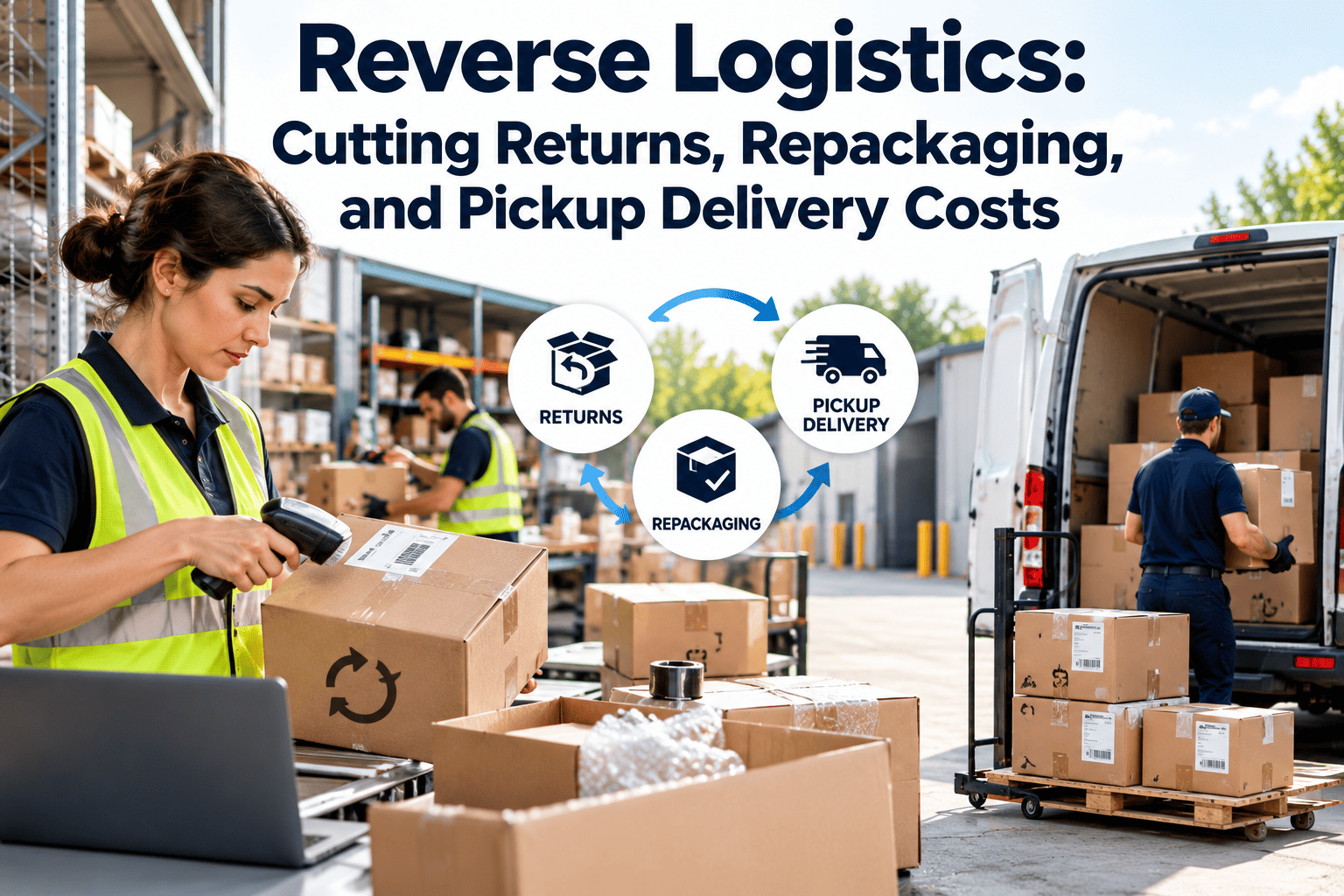
Returns are the part of last-mile delivery that no route plan was built for. They arrive one at a time, in unknown condition, through channels designed for outbound flow, and each one adds pickup mileage, handling labor, inspection time, packaging material and a disposition decision. The margin earned on the original order can be gone before the item is back on a shelf. This guide covers reverse logistics and returns cost management, from consolidation and disposition rules to equipment reliability, and shows how Oxmaint maintenance management software protects the assets that keep the reverse flow moving.
The last mile back should not erase the margin on the way out
Returned parcels need pickup, receiving, grading, repackaging and a decision on where each unit goes next. Controlling that chain is a process problem and an equipment problem at the same time, and delivery operations that treat it as both recover more value per return.
A return is a chain of small costs, not one line item
Forward delivery moves predictable volume through a planned network. Reverse logistics does the opposite: volume is uneven, condition is unknown, and every unit needs a decision. That asymmetry is why returns cost so much more per unit to process than the outbound parcel that preceded them.
- Return freight or pickup mileage, often subsidized or free to the customer
- Receiving labor to scan, open, match and photograph each unit
- Inspection and grading time, which grows when criteria are vague
- Repackaging materials and relabeling for resale
- Disposition cost, including liquidation fees, recycling charges or disposal
- Holding cost while the unit waits for a decision and loses resale value
The disposition ladder: route every unit to its best outcome
After inspection, a returned unit can recover close to full value or close to nothing. The difference comes from how quickly it is graded and how consistently the routing rules are applied.
Returns processing only works when the equipment does
Scales, conveyors, label printers and pickup vans decide how fast a return moves from the customer to its next outcome. Oxmaint keeps that equipment on a maintenance schedule instead of a repair queue.
Pickup delivery: individual collections versus consolidated returns
A van sent to collect one parcel carries the full cost of a delivery stop for a fraction of the value. Consolidating returns is the most direct lever on pickup cost.
Individual pickups
- One stop per parcel, scattered across the service area
- Failed collections when the customer is not ready
- Vans return partly empty after the outbound run
- No control over how the item is packed or labeled
- High mileage per unit recovered
Consolidated returns
- Drop-off points, lockers or counters that batch returns
- Pickups folded into existing delivery routes
- Scheduled collection windows that cut failed attempts
- Pre-printed labels and packaging guidance
- Full pallets or cages moved to the returns center
Combine pickup and delivery on the same route
When return collection shares a route with outbound stops, the van is already in the neighborhood. Route planning should treat a pickup as a stop with its own service time and cargo space, not as an afterthought added at the end of the day.
Refurbish or liquidate: a decision to model per SKU family
Refurbishment can recover the most value per unit, yet it is also the most demanding path. A simple rule applies: refurbish only when expected resale value, after the cost of collection, inspection, repair and repackaging, beats what liquidation or disposal would return.
| Factor | In-house refurbishment | Bulk liquidation |
|---|---|---|
| Best suited to | Higher-value, repairable, branded goods | Low-value, slow-moving or mixed-condition stock |
| Labor | Testing, repair and repackaging time per unit | Sorting and palletizing only |
| Equipment | Test benches, tools, packing stations, label printers | Pallet handling, wrapping, scales |
| Cycle time | Longer, with value decaying while units queue | Short, once a lot is assembled |
| Main risk | Low yield turns repair spend into a loss | Low recovery per unit, brand exposure on resale |
| Maintenance dependency | High: test and pack equipment must stay calibrated | Moderate: handling equipment must stay available |
Most efficient operations use both paths and let data-driven rules decide, with thresholds set by age, value and SKU rather than by whoever is standing at the bench.
What happens when returns equipment stops
A returns line is small compared with the outbound sortation system, which makes it easy to neglect. It is also a bottleneck by design, so a single failure spreads quickly.
Assets worth tracking in the reverse flow
A maintenance workflow for the reverse flow
Oxmaint does not manage returns orders or customer refunds. It manages the maintenance of the vehicles, machines and tools that handle them, so the process is not interrupted by preventable failures.
Register every returns asset
Add vans, scales, conveyors, printers and balers to the asset register with locations and service history.
Schedule preventive maintenance
Set time-based and usage-based tasks so calibration, lubrication and inspections happen before peak return periods.
Capture faults on mobile
Let graders and drivers raise a work order from a phone, with a note and photo, the moment something fails.
Keep critical spares on hand
Track inventory for belts, printheads and scanner batteries so repairs are not delayed by a missing part.
Review reports before peak season
Use downtime and repeat-failure reports to decide what to repair or replace ahead of the returns surge.
Read the reason code before it becomes a cost
Not every return is a disposition problem. Many are the visible end of an upstream failure, and reason codes show which part of the operation to fix first.
Reverse logistics KPIs that tie to cost recovery
| KPI | What it tells you | Maintenance link |
|---|---|---|
| Return rate | Share of units returned, by SKU and channel | Sets the load the returns line must handle |
| Cost per return | Transport, labor, packaging and disposition per unit | Repair spend and downtime raise it |
| Recovery rate | Value regained through restock, refurbish or resale | Test equipment accuracy affects yield |
| Throughput time | Days from return initiation to final disposition | Equipment availability shortens or lengthens it |
| Refurbish yield | Share of units that reach resale-ready condition | Tooling condition and calibration drive it |
Prepare the returns line before the surge arrives
The returns tail follows the buying season, and it can stretch for weeks. Equipment that was marginal in October becomes a bottleneck in January, so preparation should be scheduled work, not a reaction.
Audit
Review repeat failures and open work orders on returns assets. Decide what to repair, replace or rent.
Service
Complete preventive maintenance on conveyors, balers, vans and scales. Calibrate and record the results.
Respond
Prioritize work orders by their effect on throughput. Keep a technician and critical spares close to the line.
Learn
Compare downtime and cost per return with the audit. Feed the findings into next season's maintenance plan.
Traceability, safety and compliance in the returns center
Returns centers handle mixed goods, some of which carry regulatory or safety obligations. Equipment records are part of the evidence that the process is under control.
Calibration records
Scales used to verify weights and refund values should have documented calibration dates and technician sign-off.
Safety inspections
Balers, compactors, lift gates and racking need recorded inspections so guarding, interlocks and load limits stay verified.
Waste and recycling handling
Items sent for recycling or disposal may carry local rules, so the handling equipment and its service history should be documented.
Vehicle condition
Pickup vans need pre-trip checks and defect reporting that flow into work orders, not into a notebook on the dashboard.
A practical starting checklist for returns cost control
Process
- Calculate cost per return across every step
- Standardize reason codes at the return request
- Write grade criteria with reference photos
- Set disposition rules by SKU family and value
- Define a maximum time in the grading queue
Network
- Map where returns originate and how they travel
- Test drop-off points and lockers in dense zones
- Fold pickups into existing delivery routes
- Pre-print labels to reduce receiving errors
- Review failed pickup attempts weekly
Equipment
- List every asset the reverse flow depends on
- Assign preventive maintenance to critical items
- Calibrate scales and scanners on a schedule
- Stock spares for known failure points
- Service vans and balers before peak season
Reverse logistics and returns cost, answered
Why are returns more expensive to handle than outbound deliveries?
Returns arrive unpredictably, in unknown condition, and each unit needs inspection and a disposition decision. Outbound parcels move through planned, high-volume flows, so handling cost per unit is much lower.
What is the fastest way to reduce pickup cost?
Consolidate. Drop-off points, lockers and pickups folded into existing delivery routes cut stops per parcel. Keeping vans maintained also avoids lost capacity from unplanned breakdowns.
How do I decide between refurbishing and liquidating?
Compare net recovery for each SKU family: expected resale value minus collection, inspection, repair and repackaging cost. Refurbish only where that figure clearly beats liquidation.
Does Oxmaint manage returns orders?
No. It manages maintenance for vans, conveyors, scales, balers and tools that process returns. You can book a demo to see how work orders and schedules apply to a returns center.
Which returns assets should get preventive maintenance first?
Start with the single points of failure: receiving conveyors, intake scales, label printers and pickup vans. A failure there stops the entire return flow.
Turn returns from a cost sink into a controlled process
Set disposition rules, consolidate pickups and put the equipment behind the reverse flow on a real maintenance schedule. Start with your most critical returns assets and expand from there.