Last-mile delivery is where logistics promises meet physical reality — and in 2026, that reality is harder than ever. It is the most expensive, most complex, and most failure-prone segment of the entire delivery chain. The final mile accounts for 53% of total shipping cost yet represents only the last few percent of the journey. Fuel surcharges, traffic congestion, failed delivery attempts, vehicle breakdowns, and rising customer expectations are compressing margins to near zero for operators still running manual processes. The companies solving last-mile challenges in 2026 are doing it with data — not more drivers or more vehicles.
Trend + Problem-Focused · Delivery Operations Management · 2026
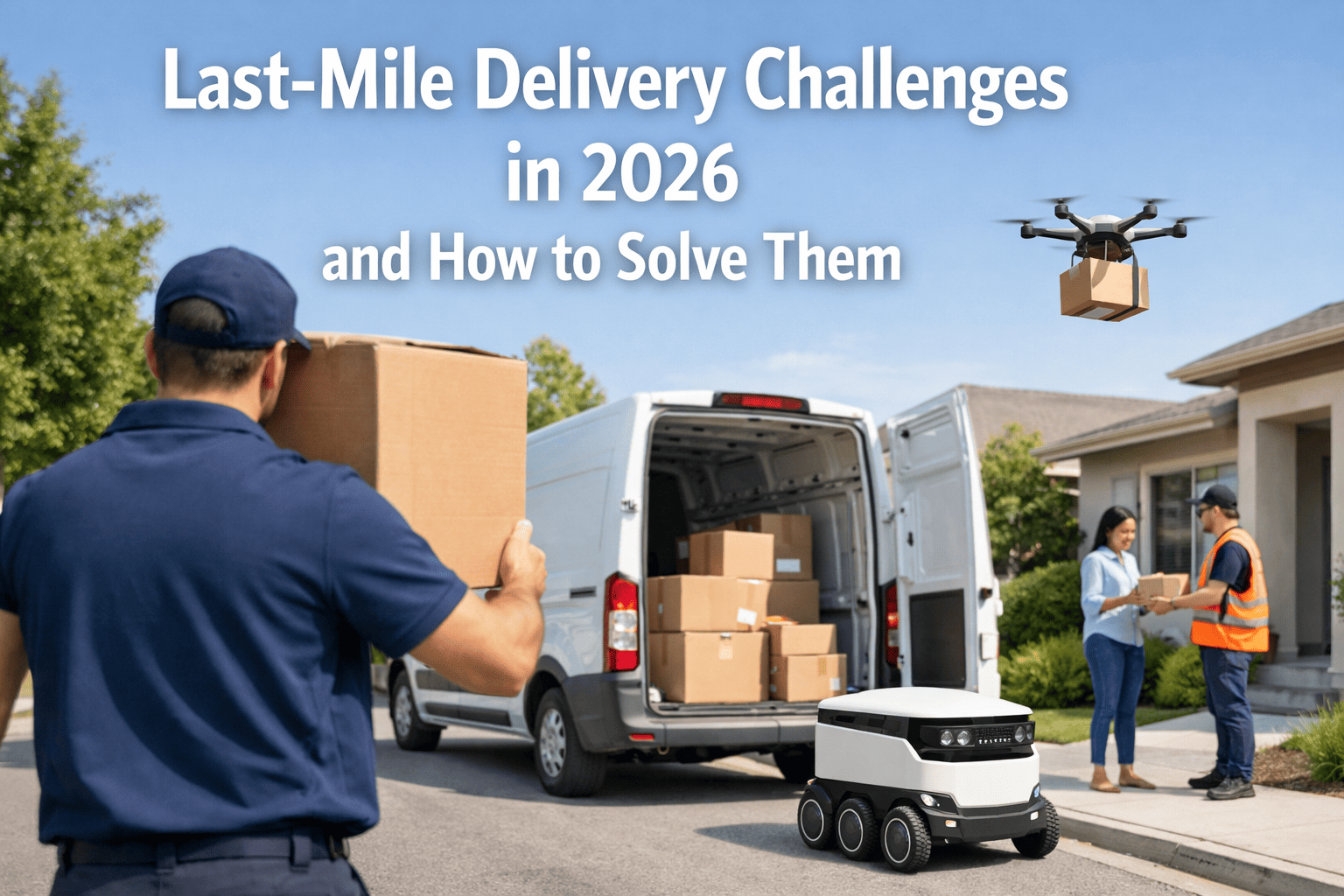
Last-Mile Delivery Challenges in 2026 and How to Solve Them
The biggest obstacles hitting last-mile delivery operations right now — and the proven strategies, systems, and technology that high-performance fleets are using to overcome them.
53%
Of total delivery cost is last-mile — the most expensive leg of every shipment
$1.47
Average cost of a failed delivery attempt — before redelivery, customer service, and penalty costs
26%
Of last-mile delivery failures trace directly to vehicle mechanical issues or unplanned downtime
$17.2B
Annual US cost of last-mile inefficiency — route failures, redeliveries, SLA penalties, and downtime
The 7 Biggest Last-Mile Challenges in 2026
01
Unplanned Vehicle Breakdowns Mid-Route
Critical
A vehicle failure during a last-mile route does not just delay one delivery. It collapses the entire route — every stop downstream is now late, rerouting is reactive, and the SLA clock does not pause. For a 30-stop route, one breakdown can generate 15–20 SLA misses simultaneously.
The Fix
Predictive maintenance platforms monitor engine sensors, brake wear, and drivetrain health continuously. AI detects degradation patterns 4–7 days before failure — enabling maintenance to be scheduled in depot windows, not on the side of a road during peak hours.
02
Rising Fuel and Operating Costs
High
Fuel remains the largest controllable cost in last-mile operations — and static route planning wastes 15–22% of it. Inefficient routing, excessive idling, suboptimal load density, and poor driver behavior compound fuel waste across every vehicle in the fleet daily.
The Fix
AI route optimization continuously recalculates the most fuel-efficient paths considering real-time traffic, delivery sequences, load weight, and vehicle range. Telematics-backed driver coaching reduces idle time and aggressive acceleration — delivering 15–22% fuel savings without changing a single vehicle.
03
Failed First-Attempt Deliveries
High
Every failed first attempt doubles the delivery cost — driver time, fuel, vehicle wear, and dispatch overhead are consumed twice for one delivery. Failed attempts also trigger customer satisfaction damage that is disproportionately expensive to repair in repeat-business logistics models.
The Fix
Real-time delivery window communication — SMS/app notifications with accurate ETAs — dramatically reduces recipient unavailability. AI scheduling that matches delivery windows to recipient availability history, combined with smart access solutions for unattended delivery, pushes first-attempt rates above 92%.
04
SLA Breach Accumulation and Contract Risk
Critical
SLA penalties are no longer just financial — they trigger contract reviews, carrier rating damage, and customer churn. A single high-volume shipper experiencing consistent SLA breaches will switch carriers. In 2026, most major shipper contracts include automated penalty triggers and carrier performance reporting shared across procurement networks.
The Fix
Per-delivery SLA risk scoring — powered by AI — flags deliveries approaching breach 30–90 minutes before the window closes. Dispatchers intervene before the miss is recorded, not after. Predictive fleet uptime prevents the vehicle failures that cause the reactive SLA collapses that manual operations cannot recover from.
05
Driver Shortages and Retention
Medium
The US commercial driver shortage reached 78,000 unfilled positions in 2025 and is growing. High turnover — averaging 94% annually in the trucking sector — means operators spend $8,000–$15,000 per replacement driver before that driver generates a single productive delivery. Unreliable vehicles, inefficient routes, and poor data tools are key drivers of voluntary departure.
The Fix
Reliable, well-maintained vehicles reduce driver frustration at the source. Digital tools — mobile DVIR, real-time route guidance, clear stop sequencing — remove administrative friction. Data-backed performance coaching replaces arbitrary management. Drivers who feel supported by technology stay longer.
06
Urban Density and Access Restrictions
Medium
Urban delivery restrictions are tightening in 2026 — low-emission zones, time-of-day access restrictions, vehicle size limits, and congestion pricing are active in over 40 major US cities. Routes planned without real-time regulatory data generate violations, delays, and rerouting costs that accumulate invisibly in operational reports.
The Fix
AI route optimization platforms that integrate live restriction databases — LEZ boundaries, time windows, vehicle class rules, congestion pricing triggers — generate compliant routes automatically. Fleet composition data (vehicle type, emissions class, weight rating) is matched to route restrictions before dispatch, not discovered on arrival.
07
Lack of Real-Time Fleet Visibility
High
Fleet managers running without real-time visibility cannot make proactive decisions — they discover problems after they have already become failures. A vehicle running an abnormal engine temperature, a driver 45 minutes behind schedule, a route with three consecutive failed stops: none of these are visible until the damage is done without continuous monitoring.
The Fix
Integrated fleet management platforms combine telematics, maintenance status, driver behavior, and delivery progress into a single real-time dashboard. Anomaly alerts surface automatically. Dispatchers act on data — not on driver phone calls — compressing the gap between event and response from hours to minutes.
Most last-mile failures start in the maintenance bay — or the lack of one
OxMaint gives delivery operations the digitized fleet maintenance backbone — automated PM scheduling, digital DVIR, real-time vehicle health, and the analytics-ready data that prevents breakdowns before they collapse your routes.
The Cost of Last-Mile Inefficiency — By the Numbers
Annual Cost Impact per 50-Vehicle Last-Mile Fleet
Unplanned vehicle breakdowns
SLA penalties and contract risk
Failed delivery reatttempts
Excess fuel from inefficient routing
Driver overtime and turnover costs
Compliance violations and fines
Total Avoidable Annual Cost
$1,110,000+
Most of this is recoverable with the right maintenance management and analytics platform
Last-Mile Challenge Scorecard: Where Does Your Fleet Stand?
Operational Area
Reactive Fleet
Average Fleet
Optimized Fleet
Vehicle breakdown rate
6–10 / mo
2–5 / mo
Under 1 / mo
On-time delivery rate
Under 78%
82–90%
95%+
First-attempt delivery rate
Under 80%
83–88%
92%+
Planned vs. reactive maintenance
Under 50% planned
60–75% planned
90%+ planned
Cost per delivery
Increasing YoY
Flat or variable
Decreasing YoY
Fleet visibility
GPS only, no health data
Basic telematics
Full health + AI alerts
The Solution Stack: What Optimized Last-Mile Fleets Use
Fleet CMMS and Maintenance Management
Digitized work orders, automated PM scheduling, condition-based alerts, and full vehicle maintenance history. The data foundation that powers predictive uptime and prevents the breakdowns that collapse last-mile routes.
Impact: 70–85% reduction in unplanned breakdown events
AI Route Optimization
Dynamic real-time routing that accounts for traffic, delivery windows, load capacity, vehicle health, and access restrictions simultaneously — not just the fastest path from A to B.
Impact: 15–22% fuel reduction, 12–18% more deliveries per vehicle
Real-Time Fleet Health Dashboard
Live vehicle status, driver behavior scoring, delivery progress, and SLA risk indicators in a single view. Dispatchers respond to alerts — not to failures already in progress.
Impact: Response time to fleet events compressed from hours to minutes
Digital DVIR and Compliance Automation
Digital driver vehicle inspection reports replace paper forms — creating searchable, timestamped vehicle condition data that feeds maintenance alerts, compliance documentation, and warranty records automatically.
Impact: 100% DVIR compliance, zero paper — and a maintenance alert feed from every driver, every day
Key Takeaways: Last-Mile Delivery in 2026
Vehicle reliability is the most preventable last-mile failure: 26% of last-mile delivery failures trace directly to mechanical issues. Unlike traffic or recipient unavailability, vehicle breakdowns are almost entirely preventable with predictive maintenance — making fleet maintenance the highest-ROI investment in last-mile reliability.
Cost reduction requires data, not just more vehicles: Adding vehicles to solve last-mile capacity problems adds cost without addressing efficiency. AI route optimization, predictive maintenance, and digital operations tools consistently deliver 25–35% total cost reduction for fleets that were previously running manual processes.
SLA breaches compound faster than most operators realize: A single vehicle breakdown during peak delivery hours can generate 15–20 simultaneous SLA misses. Managing SLA risk at the route level — through real-time scoring and proactive rerouting — is the only way to prevent compounding breach events.
The maintenance data foundation comes before the analytics: Every last-mile optimization — AI route planning, predictive uptime, SLA risk scoring — depends on clean, structured fleet data. A CMMS that digitizes maintenance records is not the endpoint. It is the starting point for every improvement that follows.
Last-Mile Delivery Challenges Start and End With Fleet Reliability
OxMaint gives last-mile delivery operations the maintenance management platform they need — digitized vehicle history, automated PM scheduling, real-time condition monitoring, and the data foundation that turns reactive breakdowns into planned, zero-disruption interventions.
Automated PM and condition-based scheduling
Digital DVIR and work order management
Real-time fleet health dashboard
Full analytics-ready maintenance history
Frequently Asked Questions
What are the biggest last-mile delivery challenges in 2026?
The seven most impactful last-mile delivery challenges in 2026 are: unplanned vehicle breakdowns mid-route (responsible for 26% of all last-mile failures), rising fuel and operating costs from inefficient routing, failed first-attempt deliveries that double per-delivery cost, SLA breach accumulation and contract risk, driver shortages and high turnover rates, urban access restrictions in major metro markets, and lack of real-time fleet visibility that prevents proactive decision-making. Of these, vehicle reliability is the most preventable — and the highest-ROI problem to solve first.
How much does last-mile delivery inefficiency cost per year?
For a 50-vehicle last-mile delivery fleet, avoidable inefficiency costs typically total $1.1M–$1.4M annually — including $310,000 in unplanned breakdown costs, $280,000 in SLA penalties, $195,000 in failed redelivery attempts, $145,000 in excess fuel from inefficient routing, $118,000 in driver overtime and turnover, and $62,000 in compliance violations. The majority of these costs are recoverable with predictive fleet maintenance, AI route optimization, and digital operations management tools — at a platform investment typically under $36,000 per year for a fleet of this size.
How does predictive maintenance reduce last-mile delivery failures?
Predictive maintenance reduces last-mile failures by detecting vehicle component degradation 4–7 days before a failure event would occur — allowing maintenance to be scheduled in depot windows rather than experienced as mid-route breakdowns. Engine sensors, brake wear indicators, drivetrain temperature, and fluid system data are monitored continuously. AI pattern recognition identifies the signatures that precede specific failure types for each vehicle make and model. Fleets implementing predictive maintenance typically reduce mid-route breakdown events by 70–85% within 12 months, directly recovering the SLA performance lost to reactive failures.
What is the most effective way to improve first-attempt delivery rates?
The three most effective levers for improving first-attempt delivery rates are: proactive recipient communication with accurate real-time ETAs (reducing unavailability-driven failures), AI scheduling that matches delivery windows to historical recipient availability patterns (reducing timing mismatches), and driver digital guidance tools that optimize stop sequences and provide real-time instructions at complex delivery locations. Fleets combining all three consistently achieve first-attempt rates above 92% — compared to the 78–83% industry average for manually operated equivalents.
How do you solve driver shortage challenges in last-mile delivery?
Driver retention — not just recruitment — is the highest-leverage solution to last-mile driver shortages. Reducing voluntary turnover saves $8,000–$15,000 per driver retained versus replaced. The primary retention drivers within an operator's control are: reliable, well-maintained vehicles that do not strand drivers or generate breakdowns; digital tools that reduce administrative friction (mobile DVIR, digital work orders, clear route guidance); data-backed performance feedback that replaces arbitrary management; and fair route assignments that reflect actual vehicle capability. Operators who solve fleet reliability first consistently report improved driver satisfaction scores and lower voluntary departure rates.