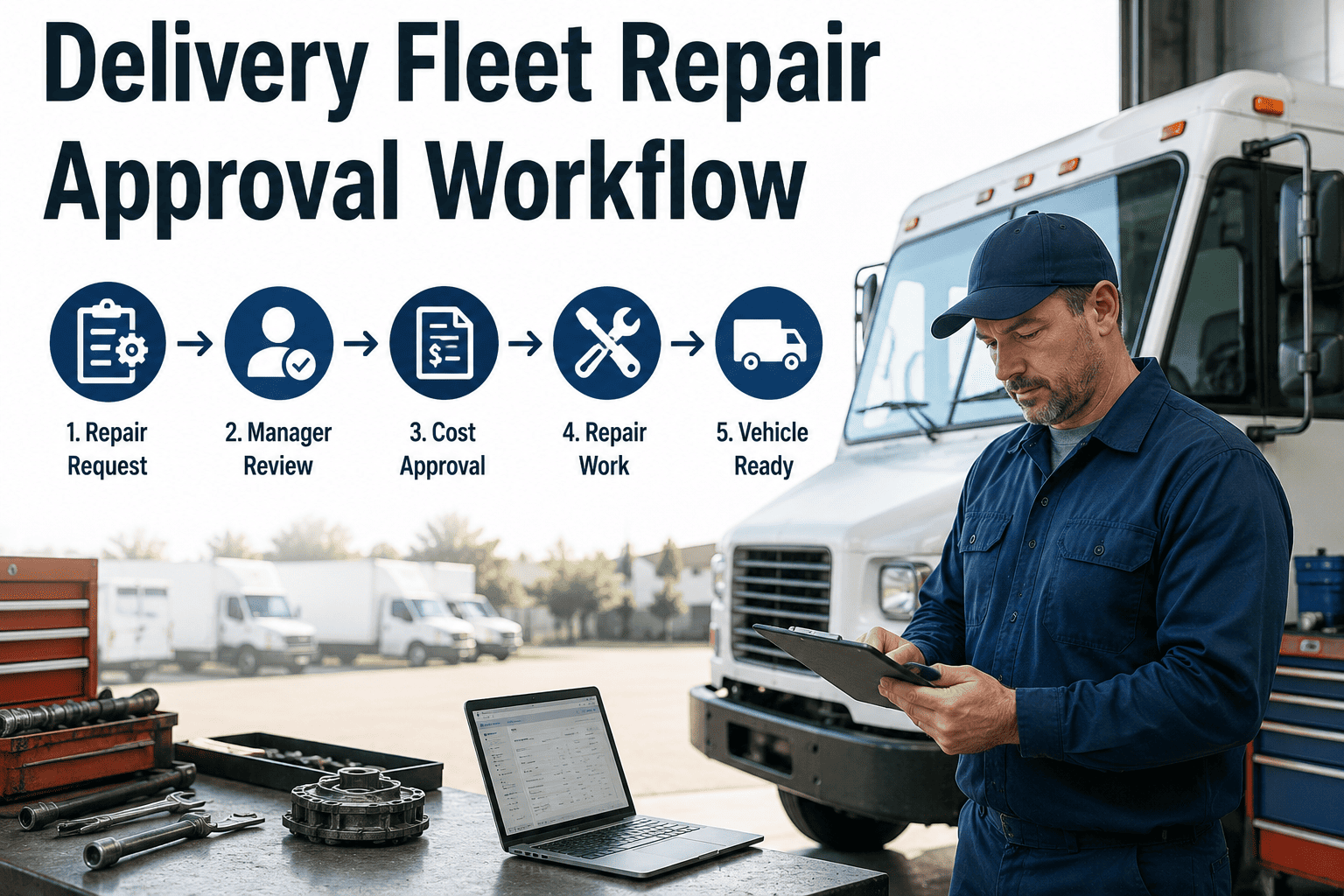
When three vehicles need repairs and only two technicians are available, the fleet manager makes a choice. That choice — which vehicle gets fixed first — determines whether tomorrow's highest-volume route runs on time or triggers a penalty clause. In most delivery operations, that decision is made on gut feel, seniority, or whoever shouts loudest. It should be made on data: which vehicle carries the most route-critical delivery obligation in the next 24 hours, which repair is fastest to complete, and which breakdown risk is highest if the vehicle runs unrepaired. OxMaint AI work order automation brings that data to the surface so repair prioritization becomes a system, not a gamble. Start your free trial and bring route-aware repair logic to your fleet today.
Repair Priority Spectrum — How Most Fleets Decide vs How OxMaint Decides
Without OxMaint
First vehicle in the shop queue
Loudest tenant or dispatcher wins
Technician availability, not route urgency
No visibility into which route is at risk
Reactive — vehicle breaks down, then prioritized
With OxMaint AI
Route SLA value and delivery window urgency
Defect severity scored against breakdown risk
Vehicle availability matched to route schedule
Repair time estimate vs dispatch window
Proactive — ranked before breakdown occurs
Why Repair Prioritization Fails Without Route Context
A vehicle with a worn serpentine belt on a light duty route is a low-urgency repair. The exact same defect on a vehicle assigned to a refrigerated grocery delivery route with a 6AM window is a critical repair — because the consequence of failure is not just a tow call, it is a spoiled load, a missed SLA, and a contract review meeting. The defect is identical. The priority is completely different. Route context is what makes the difference, and it is the one variable that standard CMMS platforms built for general maintenance operations never factor in.
Same Defect
Worn serpentine belt — estimated 2 days to failure
Vehicle A — Low Priority
Assigned to: Light depot shuttle, 18 miles, no SLA window
Repair by end of week is acceptable
Vehicle B — Critical Priority
Assigned to: Refrigerated grocery, 140 miles, 6AM window, $4,200 SLA penalty
Repair must complete before 4AM dispatch
The Four Inputs OxMaint Uses to Score Repair Priority
AI Work Order Automation for Delivery Fleets
Fix the Right Vehicle First. Every Time.
OxMaint scores repair urgency against route obligations, defect severity, and dispatch windows — so your technicians always work on what matters most before the shift starts.
How AI Work Orders Change the Repair Queue
Live Repair Queue — OxMaint Work Order View
CRITICAL
Unit 47 — Refrigerated Van
Coolant leak — brake system pressure low
HIGH
Unit 12 — Box Truck
Worn brake pads — rear axle
MEDIUM
Unit 31 — Cargo Van
Serpentine belt — early wear detected
LOW
Unit 08 — Sprinter Van
Windshield wiper blade replacement
Results When Route-Critical Prioritization Runs on Data
35%
Reduction in missed SLA events within 90 days
Fleets that implement route-aware repair prioritization see SLA breach rates drop significantly in the first quarter — because high-risk vehicles are identified and repaired before they fail on route, not after.
2.1x
Faster work order assignment with AI routing
AI-generated work orders assign to the right technician based on skill set, current workload, and proximity to the vehicle — cutting assignment time from minutes to seconds and keeping the repair queue moving.
28%
Fewer emergency substitute dispatches per month
When route-critical repairs are completed before dispatch windows, the need for scramble substitutions drops — and with it, the operational chaos, fuel premium, and customer service damage that comes with emergency route coverage.
Frequently Asked Questions
How does OxMaint know which vehicles are route-critical?
Each vehicle in the OxMaint asset registry is linked to its current route assignment and dispatch schedule. When a work order is created, the system cross-references the vehicle's assignment against the repair urgency and dispatch window to generate the priority score.
See how asset registry and routing connects in OxMaint.
Can OxMaint handle prioritization across a fleet of 50 or more vehicles?
OxMaint scales from small fleets to large multi-depot operations. The priority scoring and work order routing engine handles any fleet size — and the dashboard gives dispatch managers a single ranked view across all vehicles, depots, and shifts without manual sorting.
Book a demo to see OxMaint at fleet scale.
Does the AI prioritization require integration with a dispatch system?
No integration is required to start. Fleet managers input route assignments and dispatch windows directly into OxMaint, and the system builds its prioritization from there. Deeper integrations with dispatch platforms are available as the operation scales but are not required for day-one value.
What happens when a high-priority repair cannot be completed before dispatch?
OxMaint automatically flags the vehicle as unavailable for its assigned route and alerts the dispatch manager with enough lead time to assign a substitute. The original vehicle's work order stays active with full repair tracking until the vehicle is cleared for service.
Start your free trial to see this workflow in action.
How do technicians receive and update work orders in the field?
Technicians use the OxMaint mobile app to receive assigned work orders, view vehicle history and defect notes, log parts used, and close the order with a sign-off timestamp. All updates sync to the dashboard in real time so dispatch and management always have current repair status without calling the shop floor.
OxMaint AI — Fleet Repair Prioritization
Route Urgency Should Drive Your Repair Queue — Not the Luck of the Draw
AI work order automation, route-aware priority scoring, real-time technician dispatch, and complete vehicle history — built for delivery fleets where the right repair at the right time is the difference between a completed route and a penalty invoice.