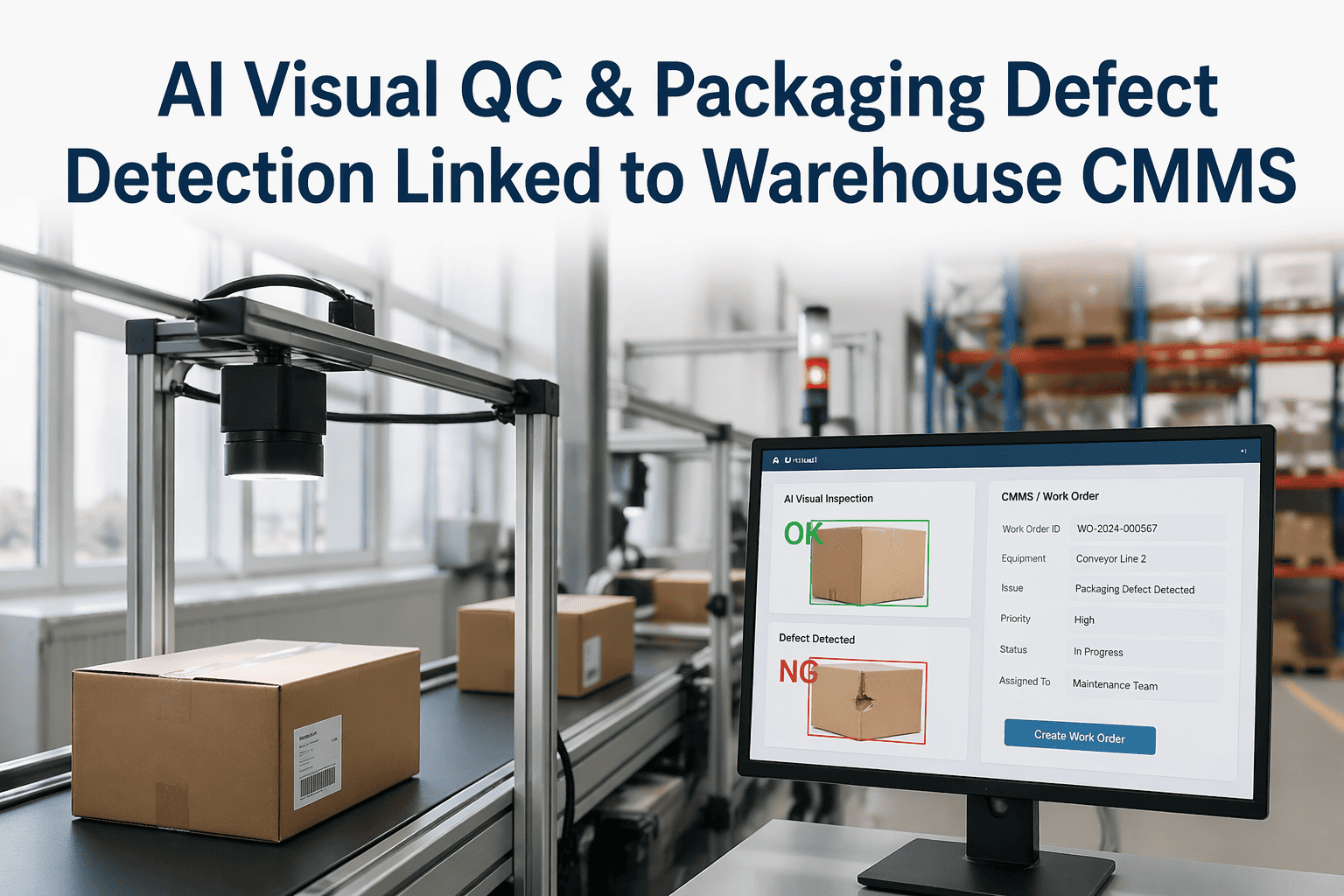
A busy fulfillment center moves a package every two seconds, and every single one of them is a quality decision. A human inspector parked at the end of a packaging line catches 65 to 80 percent of surface defects on a good shift. The 20 to 35 percent that slip through leave the dock, reach a retailer, and return as chargebacks averaging $50 to $100 per shipment, or reach a customer and return as one-star reviews where 51 percent of shoppers say they will not repurchase from a brand that delivered damaged goods. AI visual QC cameras inspect 100 percent of packages at line speed, flag defects in under 20 milliseconds, and classify seal failures, label errors, print defects, and structural damage with 94 to 99 percent accuracy. The hard part is not detection. The hard part is what happens next, and that is where a warehouse CMMS like Oxmaint turns every AI-flagged defect into a targeted maintenance work order against the machine that produced it, or book a 30-minute demo to see the closed loop on your own packaging line.
Warehouse Vision AI + CMMS
Your Camera Sees the Defect. Without a CMMS, Nothing Actually Changes.
AI visual inspection stops being a cost center the moment defect events turn into work orders against the right asset. Here is the complete technical and operational picture, from photon capture on the packaging line to a work order sitting in your maintenance lead's queue, for warehouse and distribution center operators running sealed pouches, cartons, labels, and palletized shipments.
94%
Reduction in defect escape rate
20ms
Per-frame AI classification
3-4%
Industry package damage rate
$315
True cost per consumer-facing defect
At a glance
AI visual QC in warehouse packaging combines high-speed line-scan or area-scan cameras, structured LED lighting, and convolutional neural networks to inspect every seal, label, barcode, and carton surface at full throughput. When a defect is detected, the system is only valuable if the next step is automatic. CMMS integration takes the defect event, the offending asset ID, the severity score, and the image evidence, and opens a prioritized work order in the same second, before the next package rolls through the same bad sealer or misaligned label applicator.
The Silent Tax on Every Warehouse Running Sample-Based Inspection
Sample-based manual QC is not a quality program. It is a sampling statistic pretending to be a control. When a packaging line runs at 120 units per minute and an inspector checks one unit every 30 seconds, the inspection is covering less than 2 percent of output. Everything else is shipped on faith, and the arithmetic does not favour faith.
01
The Sampling Gap
A 120 units per minute line produces 57,600 packages in an 8-hour shift. Sample-based QC at one unit per 30 seconds inspects 960 of them, or 1.67 percent. A 0.5 percent defect rate means 288 defective packages ship unseen every shift.
02
The Chargeback Compound
Retailers assess chargebacks of $50 to $100 per non-compliant shipment for missing or unreadable labels, damaged cartons, and failed ASN matching. Amazon alone charges $1.99 per unit for uncertified packaging arriving at FBA.
03
The Equipment Drift
Heat sealers, label applicators, coders, and cappers do not fail suddenly. They drift. Without real-time defect trend data tied to specific assets, the drift is invisible until the defect rate is high enough for a human to notice it, typically hours or days later.
04
The Brand Damage Multiplier
Among consumers who receive a damaged shipment, 51 percent will not repurchase. 85 percent report negative brand perception after a single damaged delivery. Customer lifetime value destruction is the largest unbooked cost on every warehouse P&L.
The 8 Packaging Defect Families Grouped by Severity
Packaging defects are not all equal. Retailers and regulators classify them into critical, major, and minor categories, and each category triggers a different commercial consequence. AI visual inspection catches all three, but the CMMS response needs to match severity with urgency.
Critical Defects
Stop the line. Trigger a PM audit on the responsible asset within the hour.
Seal Integrity Failure
Incomplete heat seal, channel leak, or contamination trapped in seal area. Risks product spoilage, regulatory breach, and FDA recall.
Root asset: Heat sealer, vacuum chamber, jaw temperature
Wrong SKU Label
Label applicator puts the wrong product identifier on the package. Consumer safety risk for pharma, nutritionals, and allergen-flagged food.
Root asset: Label applicator, print engine, data feed
Missing Component or Under-Fill
Multi-pack missing a unit, vial under-filled, kit incomplete. Instant customer refund trigger and FTC compliance issue.
Root asset: Filler, pick-and-place, counter sensor
Major Defects
Retailer chargeback risk. Queue work order within the shift.
Unreadable Barcode or QR
Smudged, misaligned, or out-of-contrast code. Fails at retailer scan, forces manual re-work, breaks ASN reconciliation.
Root asset: Thermal print head, label stock, applicator
Structural Carton Damage
Crushed corner, torn flap, punctured wall, wet spot. Retailers reject at dock. E-commerce returns at first-mile carrier scan.
Root asset: Case erector, conveyor edge, robotic arm
Print Copy or Color Defect
Missing color channel, mis-registered overprint, illegible lot code or expiry date. Brand compliance failure, traceability gap.
Root asset: Flexo or digital printer, ink supply, coder
Minor Defects
Cosmetic. Track trends. Schedule PM at next window.
Label Wrinkle or Tilt
Minor skew beyond tolerance, small wrinkle, off-center placement. Not a functional failure, but a brand consistency erosion signal.
Root asset: Applicator tamp, web tension, guide rails
Surface Scratches or Scuffs
Light surface marks from conveyor rub, guide wear, or pallet handling. Trigger for preventive guide alignment.
Root asset: Conveyor guides, transfer points, wrap arm
Where AI Beats the Human Eye on Packaging Lines
The accuracy gap is not uniform. AI dominates on speed-invariant categories where sub-millimeter detail, subtle color shifts, and subsurface features determine the grade. These are the defect types that most often escape to the chargeback ledger.
Human inspector
AI vision system
Human inspector numbers reflect controlled-condition performance. Field numbers drop further under fatigue, shift-end lighting variance, and peak-season volume.
Detection is a sunk cost. Action is the ROI.
Turn Every Defect Event Into a Work Order Against the Asset That Produced It
Oxmaint ingests defect streams from any AI vision platform via REST API. Asset ID, defect class, severity score, and image evidence flow straight into a work order routed to the right technician. No paper. No manual dispatch. No drift untracked.
From Camera Click to Work Order in Under 3 Seconds
A complete AI visual QC pipeline integrated with CMMS runs as three linked stages. Each stage has a measurable time budget, and the whole loop must close before the next package passes the same station. Here is what happens in the 2,800 milliseconds between a defect being photographed and a technician being notified.
Stage 01
0 - 50 ms
Capture and Classify
Line-scan or area-scan camera captures the package surface under structured LED lighting. GPU edge server normalizes the image, runs CNN inference, and returns defect class, severity score, and bounding box coordinates. All under 50 milliseconds per frame.
Stage 02
50 - 250 ms
Score and Route
Severity scoring engine weights defect class by asset criticality and downstream commercial impact. High-severity events jump the queue. Low-severity patterns aggregate until threshold-breach triggers a scheduled PM. All logic runs at the edge.
Stage 03
250 ms - 3 s
Work Order and Dispatch
Oxmaint receives the event payload, opens a structured work order with asset ID, defect image, recommended procedure, and parts list. The work order routes to the on-shift technician mobile app with push notification. Technician acknowledges, travels, repairs, closes.
The Cost Math of a Single Packaging Defect
The same defect costs something different depending on where it is caught. A carton with a torn corner detected by the vision camera at the end of the line costs you the material and the seconds to replace it. The same carton caught by the customer costs you the customer. Here is the full ladder.
At the Line
$0.80 - $3
Per defect
Rejected package, replacement materials, 2 to 4 seconds of line time. Contained inside the packaging cell. No commercial escalation.
x20
At the Retailer Dock
$50 - $100
Per chargeback
Retailer chargeback for non-compliant shipment. Amazon FBA assesses $1.99 per unit for uncertified packaging, compounding on volume.
x4
At the Consumer Door
$200 - $315
Full-loaded cost
Replacement, return shipping, CS ticket, refund, and the 51 percent probability the customer never buys from you again. True cost is the customer lifetime value lost.
Annualized Impact on a 50,000 Package-Per-Day Operation
$2.1M
Retailer chargebacks eliminated at 94 percent escape-rate reduction
41%
Reduction in unplanned packaging-line downtime through early asset flagging
12-18
Months typical payback for AI vision plus CMMS deployment
85%
Decrease in consumer-reported damaged shipment complaints
What CMMS Integration Actually Unlocks on the Maintenance Side
Vision AI without CMMS is an expensive alarm bell. CMMS without vision AI is a reactive ticket system. The integrated stack changes the economics of packaging quality by making maintenance data-driven against defect telemetry, not guesswork against inspector reports.
01
Defect-To-Asset Mapping
Every AI-flagged defect carries a spatial tag that links to the upstream asset most likely responsible. Seal defects to the sealer, print defects to the coder, label defects to the applicator. One click from the work order to the asset history.
02
Trend-Based PM Triggers
A single scratch is noise. Fifty scratches on the same asset in the same shift is a signal. The CMMS watches rolling trend windows and promotes repeat patterns to preventive maintenance tasks before the defect rate becomes a customer problem.
03
Automatic Work Order Generation
Critical-tier defects trigger immediate work orders with image evidence, recommended repair procedure, required parts, and technician assignment. No dispatcher in the middle. No lag while the shift lead decides who goes.
04
Parts Inventory Forecasting
Defect volumes predict parts consumption. Heat seal element replacements, label applicator rollers, print heads, and coder jets are forecast against the actual defect curve and auto-requisitioned before they stock out.
05
Audit Trail for Retailer Compliance
Every shipped carton carries a linked inspection record. When a retailer challenges a chargeback, the audit trail shows defect data, disposition history, and corrective action. Structured evidence reduces disputed chargebacks dramatically.
06
Shift-Level Quality KPIs
Dashboards show defect rate by line, asset, shift, operator, product SKU, and retailer-bound order. Quality managers see trends before they escalate. Plant leadership sees the maintenance-to-quality correlation in real numbers.
Deployment Roadmap From Installation to Closed Loop
AI visual QC and CMMS integration is a phased deployment, not a forklift upgrade. Most warehouse operations reach the fully closed loop in 14 to 20 weeks with no production interruption beyond normal maintenance windows.
Phase 1
Weeks 1 - 3
Hardware Install and Commissioning
Camera arrays mounted on existing packaging line structure. LED lighting installed. GPU edge server commissioned at line-side. No control system integration yet. All work during scheduled maintenance windows.
Phase 2
Weeks 4 - 8
Model Training on Plant-Specific Data
Pre-trained baseline models start inspecting on day one. Plant-specific defect images accumulate during normal production. Models fine-tune against your actual defect taxonomy, product mix, and acceptance criteria.
Phase 3
Weeks 9 - 14
CMMS API Integration and Dry Run
Oxmaint receives defect events in parallel with existing QC workflow. Work orders generate automatically but operate advisory only. Maintenance team validates asset mapping, severity scoring, and routing logic without commercial risk.
Phase 4
Weeks 15+
Closed-Loop Production
AI promoted to primary detection. Work orders live and actionable. Inspector roles shift from manual scanning to pattern analysis and root cause investigation. Full defect-to-maintenance loop operational.
Two systems, one closed loop
Bring Your Vision Data Into a CMMS That Actually Closes the Loop
Oxmaint works with any AI vision platform through REST API integration. If you already have cameras on the line, you are halfway there. Start your free account or walk through a live integration with our team.
Frequently Asked Questions
Does the vision system need to replace our existing QC inspectors?
No. Inspectors shift from visual scanning to root cause investigation and pattern analysis. The AI handles 100 percent coverage at line speed. Humans do the higher-value work that actually lowers defect rates over time.
How does Oxmaint connect to third-party AI vision platforms?
Integration is handled through REST API. Your vision platform posts structured defect events to Oxmaint, which creates work orders with asset mapping, severity scoring, and image evidence attached automatically.
What accuracy should we expect on our packaging defect classes?
Modern AI vision models reach 94 to 99 percent accuracy on common packaging defects after 4 to 8 weeks of plant-specific fine-tuning. Pre-trained baseline models deliver 85 to 90 percent accuracy on day one.
How long does a typical deployment take?
Most warehouse and distribution deployments reach the fully closed loop in 14 to 20 weeks. Hardware installation completes in 3 weeks. Model training and CMMS integration continue in parallel during normal production.
What is the typical ROI payback period?
Warehouse operations typically see full payback in 12 to 18 months. Returns come from chargeback reduction, customer complaint elimination, parts inventory optimization, and reduced unplanned packaging-line downtime.
Warehouse vision AI, maintenance-grade
Every Defect That Reaches Your Customer Is a Work Order You Did Not Open in Time
Oxmaint connects the vision system you already have, or the one you are evaluating, to the maintenance discipline that actually prevents repeat defects. Start with the packaging line that costs you the most in chargebacks.
AI defect classification
Auto work order routing
Trend-based PM triggers
Retailer audit trail