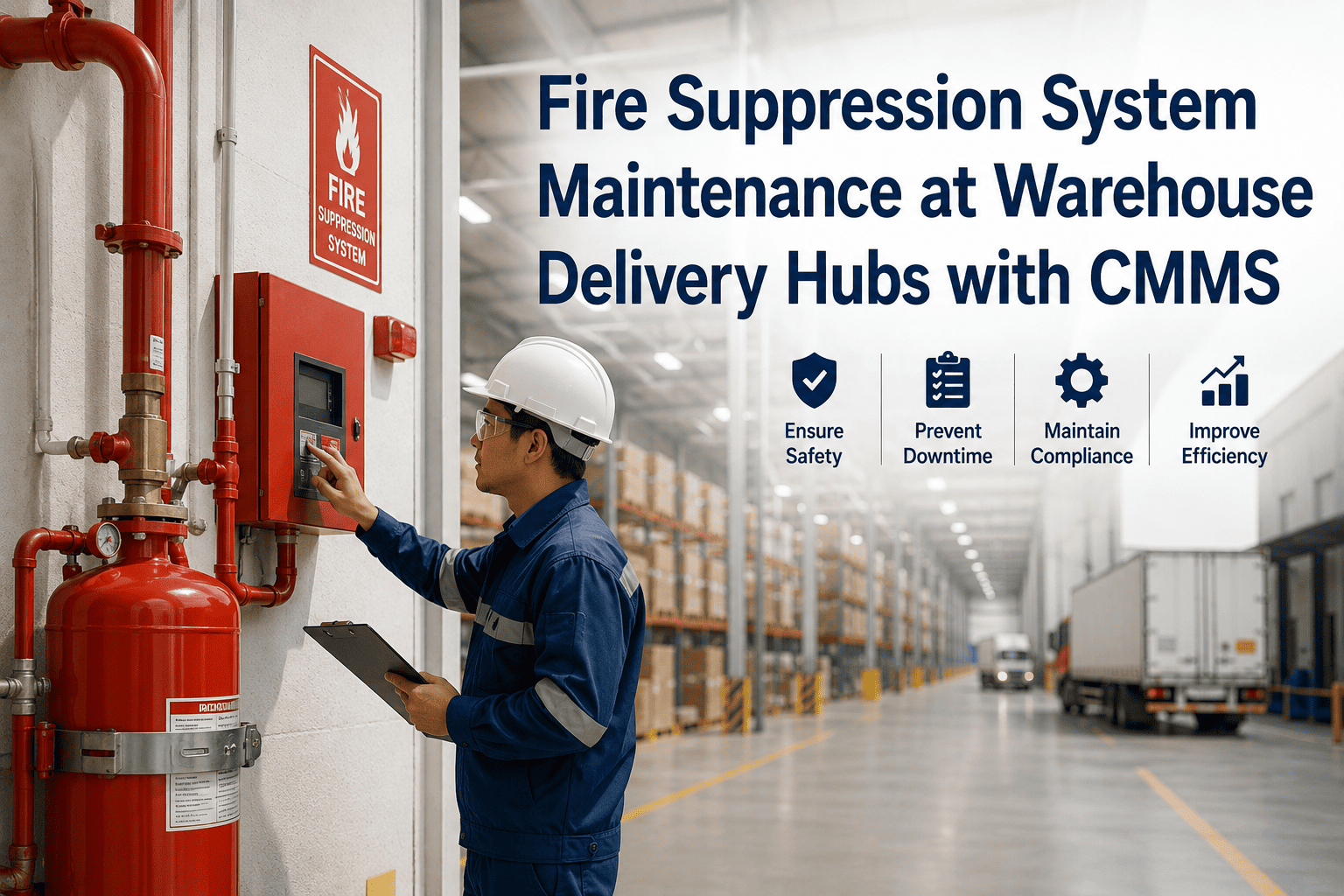
Every warehouse delivery hub runs on speed — but one uninspected fire suppression system can halt operations entirely, trigger regulatory fines, and put lives at risk. OxMaint CMMS gives maintenance teams a structured, automated way to schedule, track, and document every fire suppression inspection — keeping facilities compliant and systems ready when it counts.
Automate Fire Suppression Maintenance in Your Warehouse
OxMaint schedules inspections, tracks compliance, and alerts your team before any fire system falls out of service — fully mobile, fully auditable.
Why Fire Suppression Maintenance Fails in Warehouses
The Inspection Gap That Regulators Are Watching
Warehouse delivery hubs face a unique fire risk profile — dense racking, high-throughput conveyor systems, lithium battery charging stations, and constant forklift traffic. Most facility teams know inspections are required, yet compliance gaps persist because inspection scheduling is manual, records are scattered, and no one owns accountability between shifts. NFPA 25 mandates quarterly, annual, and 5-year inspection cycles for wet pipe sprinkler systems, yet industry surveys show that over 40% of warehouses fail at least one fire system inspection per year due to missed intervals.
01
Missed Quarterly Tests
Sprinkler control valve inspections required every 13 weeks are the most commonly missed — no automated trigger means no reminder.
02
Incomplete Paper Trails
Manual inspection logs omit technician sign-off, test results, or corrective actions — failing ISO and AHJ audits on first review.
03
No Cross-Shift Visibility
A deficiency flagged on night shift is invisible to the day team unless a digital system surfaces it in real time.
04
Suppressed Alarm Faults
Heat and smoke detector faults discovered during weekly walk-throughs are closed verbally — never logged, never tracked to resolution.
NFPA 25 Inspection Schedule for Warehouse Fire Systems
What CMMS Must Track by Frequency
| Component |
Frequency |
NFPA Reference |
CMMS Action |
| Control Valve (sealed / locked) |
Weekly |
NFPA 25 §13.3.2 |
Auto work order + mobile checklist |
| Wet Pipe Sprinkler System |
Quarterly |
NFPA 25 §5.2 |
Scheduled PM with flow test prompt |
| Fire Pump — Churn Test |
Weekly |
NFPA 25 §8.3.1 |
Recurring task with runtime log |
| Backflow Preventer |
Annual |
NFPA 25 §12.6 |
Annual PM trigger with cert upload |
| 5-Year Internal Pipe Inspection |
Every 5 years |
NFPA 25 §14.2 |
Long-cycle PM with vendor assignment |
| Smoke / Heat Detector Function |
Annual |
NFPA 72 §14.4 |
PM checklist with pass/fail capture |
| Suppression Agent Level (FM200) |
Semi-annual |
NFPA 2001 §7.2 |
Meter reading trigger via IoT sensor |
How OxMaint CMMS Manages Fire Suppression Maintenance
From Inspection Scheduling to Audit-Ready Records
1
Asset Registration & QR Tagging
Every fire system asset — sprinkler zones, control valves, fire pumps, suppression cylinders — is registered with a unique asset ID and QR tag. Technicians scan the tag to instantly access the asset's service history, open deficiencies, and upcoming inspection schedule without manual lookup.
2
NFPA-Aligned PM Schedule Configuration
Maintenance managers configure inspection frequencies by NFPA reference — weekly, quarterly, annual, or multi-year. OxMaint generates work orders automatically at the correct interval, assigns them to the responsible technician, and sends push notifications before the due date.
3
Guided Mobile Checklists at Point of Inspection
Technicians complete structured inspection checklists on mobile — step by step, with mandatory fields for test results, pass/fail status, and photo capture. Skipped steps auto-escalate to supervisors, ensuring no inspection is partial or undocumented.
4
Deficiency Tracking to Resolution
Any failed inspection item automatically generates a corrective work order, assigned with a resolution deadline. The deficiency remains open in the system until a technician closes it with documented repair evidence — creating a traceable corrective action trail.
5
Audit-Ready PDF Export in Seconds
When an AHJ, insurance inspector, or ISO auditor arrives, OxMaint generates a complete fire system maintenance history as a structured PDF — including technician sign-offs, test results, parts replaced, and deficiency resolution dates — in under two minutes.
See How OxMaint Schedules Fire System Inspections Automatically
Walk through a live CMMS configuration for warehouse fire suppression assets with our product team in 30 minutes.
Compliance Impact: CMMS vs Manual Inspection Tracking
Benchmark Data from Warehouse Fire System Maintenance Programs
Inspection Completion Rate (CMMS-scheduled vs manual reminder)
Reduction in Overdue Fire System PMs after CMMS deployment
Audit Pass Rate — Facilities Using Structured Digital Records
Time to Generate Audit Report (Digital CMMS vs Paper Log)
Expert Review
Warehouses that rely on calendar reminders for fire suppression inspections are gambling with compliance. The moment a quarterly test slips past its due date and an AHJ arrives, you are looking at a Notice of Violation — and potentially a shutdown order. CMMS-automated scheduling removes human memory from the equation entirely. The system never forgets a quarterly test, never misses a churn test cycle, and never loses a calibration certificate. That is the baseline that every distribution facility should be operating at.
Marcus Ellroy
Fire Protection Engineer, NFPA Certified — 17 years warehouse safety consulting
During audits of large-format distribution centers, the single most common compliance gap I find is deficiency closure. A technician notes a control valve seal needs replacement, writes it on a clipboard, and it sits unresolved for three months while the paperwork circles between shifts. A digital CMMS that generates a corrective work order the moment a deficiency is logged — and keeps it open until evidence of repair is uploaded — eliminates that entire failure mode. It is not a nice-to-have for high-throughput warehouses; it is a regulatory necessity.
Dr. Priya Nair
Industrial Safety Systems Researcher — formerly OSHA compliance advisor for logistics sector
Frequently Asked Questions
What NFPA standards apply to fire suppression maintenance in warehouse delivery hubs?
Warehouse fire suppression systems are primarily governed by
NFPA 25 (Inspection, Testing, and Maintenance of Water-Based Fire Protection Systems), NFPA 72 (National Fire Alarm and Signaling Code), and NFPA 2001 for clean agent suppression systems. Each standard prescribes specific inspection frequencies — weekly, quarterly, annual, and multi-year — that a CMMS like OxMaint can schedule and track automatically, ensuring no interval is missed across any asset category in the facility.
How does OxMaint handle corrective actions after a failed fire system inspection?
When a technician marks any inspection item as failed in OxMaint, the system automatically generates a corrective work order linked to that asset and deficiency. The work order is assigned with a resolution deadline, escalated to a supervisor if not actioned, and remains open in the system until the technician closes it with documented repair evidence and a photo. This closed-loop corrective action trail is exactly what AHJ auditors and insurance inspectors require —
book a demo to see it live.
Can OxMaint generate fire system maintenance reports for insurance and regulatory audits?
Yes. OxMaint exports a structured PDF or CSV of the complete fire suppression maintenance history for any asset or asset group — including technician sign-offs, test results, corrective actions, parts replaced, and timestamped closure records. Reports are generated on demand in under two minutes and are formatted to meet ISO, AHJ, and insurance audit requirements. Facilities using
OxMaint report a 96% first-pass audit success rate compared to 54% for teams relying on paper or spreadsheet-based logs.
Does OxMaint work offline for technicians inspecting remote warehouse zones?
OxMaint includes a true offline mode that allows technicians to complete inspection checklists, log test results, capture photos, and close work orders without a network connection. All data syncs automatically when connectivity is restored. This is critical for warehouse environments with Faraday-shielded cold storage zones, basement pump rooms, or areas with poor cellular coverage where signal-dependent tools would leave inspection records incomplete.
Fire suppression systems in warehouse delivery hubs are not optional infrastructure — they are the last line of defense against a catastrophic loss event. Keeping them inspection-ready requires more than a clipboard and a calendar reminder. Sign up for OxMaint and have your fire system inspection schedule automated, your deficiencies tracked, and your audit records ready within the same week. For enterprise facilities managing multiple warehouse sites, book a 30-minute demo and walk through a live CMMS configuration built for your asset portfolio.