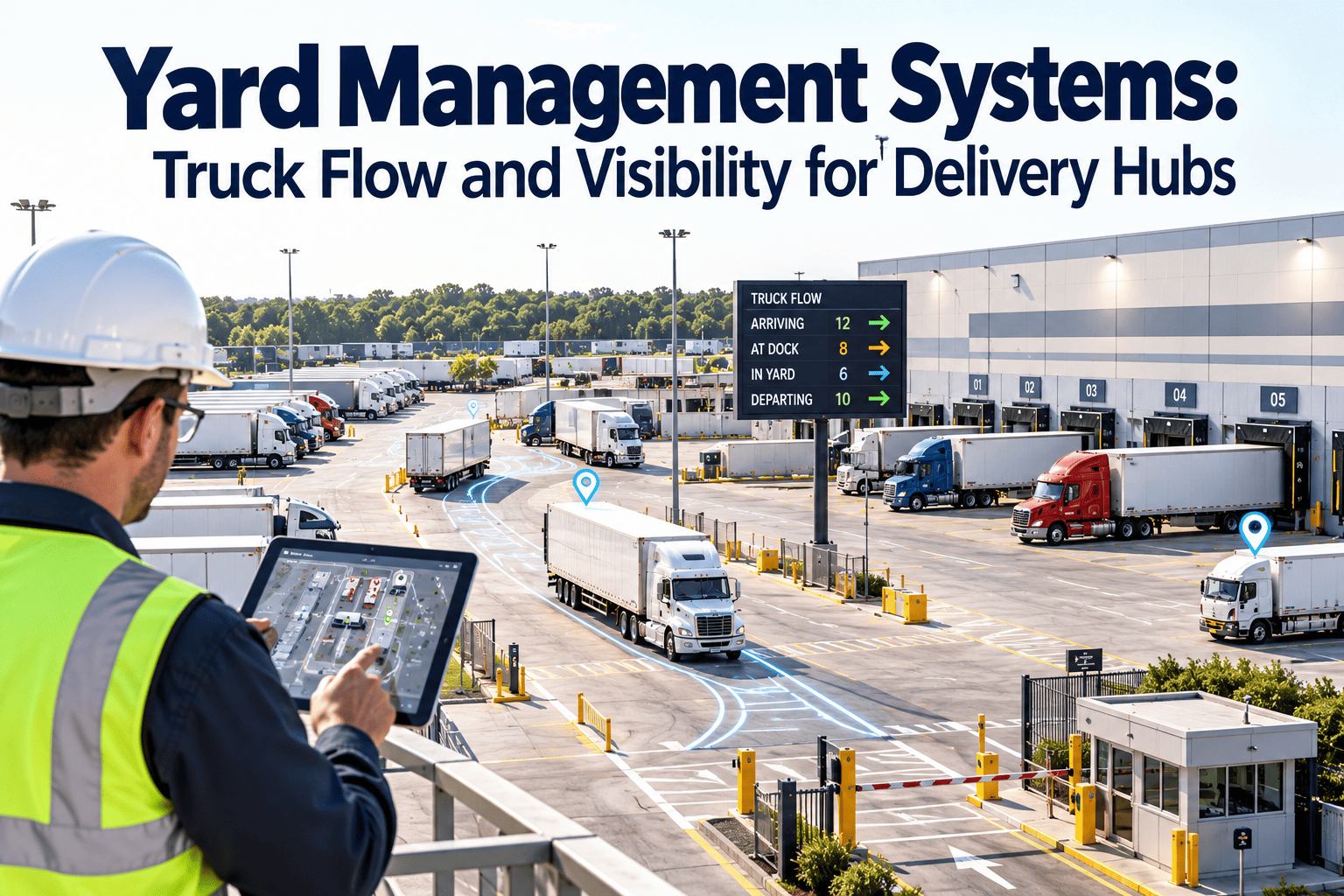
The yard is where inbound plans meet outbound deadlines, and when nobody can see it clearly, every other process pays. Trailers get parked in the wrong lane, drivers wait at the gate for a door that is not ready, and spotters spend shifts searching instead of moving. A yard management system turns that blind spot into a controlled flow of trucks, trailers and docks. This guide covers yard management systems for delivery hubs, including selection, real-time tracking, gate integration and the equipment upkeep that keeps yard trucks working, and shows how Oxmaint maintenance software supports that last part.
Turn a yard full of unknowns into a predictable path to the dock
A good yard process answers three questions at any moment: where is every trailer, what is it waiting for, and which door should it use next. The answers depend on software, discipline and yard equipment that starts every shift.
What a yard without visibility really costs
A yard managed from memory and radio calls works until volume rises. After that, small delays stack up, and the facility absorbs them as detention, overtime and missed departures.
Lost trailers
Staff walk the lot to find a unit that the system lists in a lane it left hours ago.
Idle spotters
Yard drivers wait for instructions, or move trailers twice because the first plan was wrong.
Dock conflicts
Two trailers are sent to one door, or a door sits empty while loaded trailers queue outside.
Carrier friction
Drivers wait without information, and detention disputes follow because nobody can prove arrival times.
The trailer lifecycle a yard management system controls
A trailer passes through the same sequence of states on every visit. A YMS records each transition, so the yard has a live picture instead of a daily guess.
How yards track trailers, and where each method breaks
Real-time tracking is the core of a YMS, but the accuracy of the picture depends on how location is captured. Most sites combine more than one method, using automatic capture where it is affordable and scanning discipline where it is not.
| Method | How it works | Strength | Limitation |
|---|---|---|---|
| Manual yard checks | Staff walk the lot and enter locations | Low upfront cost | Out of date within minutes on a busy yard |
| Gate and spotter scans | Barcode or mobile scan at each move | Good accuracy when scanning is consistent | Relies on discipline from every driver |
| Camera and plate recognition | Cameras read trailer and plate numbers at the gate | Fast gate throughput | Needs clean lenses, clear lighting and upkeep |
| RFID or tag-based location | Fixed readers detect tags on trailers or stalls | Automatic updates | Reader coverage and tag condition must be maintained |
| GPS or real-time location devices | Trailer or tractor devices report position | Continuous position data | Battery and installation upkeep, yard accuracy limits |
Choosing a YMS: questions that separate fit from feature lists
Integration with your systems
Confirm it connects to the warehouse or transport system for appointments and dock status, so data is not typed twice and the yard never works from a stale schedule.
Mobile tools for drivers
Spotters should receive tasks and confirm moves on a rugged device, in all weather, with minimal steps.
Gate automation
Look for appointment matching, digital check-in and automatic recording of arrival and departure times.
Rules and visibility
Dock assignment rules, dwell alerts and a live yard map should be configurable without custom development.
Reporting
Check that turn time, dwell and detention can be reported by carrier, door and shift.
Scale and support
The system should handle your peak volume and any future sites with consistent setup and training.
Gate integration and dock scheduling that remove waiting
The gate controls the pace of the whole yard. A slow or inconsistent check-in creates queues on the public road, while a fast one feeds the dock with the right trailer at the right time.
At the gate
- Check drivers in against a scheduled appointment window
- Capture trailer number, seal and driver details once
- Issue yard instructions through a mobile message or printed slip
- Flag early, late or unscheduled arrivals automatically
- Record departure time to support carrier performance reviews
At the dock
- Assign doors by cargo type, equipment and available labor
- Release a move task only when the door is ready
- Prioritize outbound trailers with firm departure times
- Track door idle time as well as trailer wait time
- Reassign doors quickly when a door goes out of service
The maintenance side of the yard
A YMS tells the spotter where to go, but it cannot move a trailer when the tractor is down. Yard equipment works harder than road equipment in many ways: short cycles, constant coupling, frequent idling and little downtime between tasks.
Which yard assets deserve preventive maintenance first
Not every asset deserves the same attention. Ranking by how often it fails and how far a failure spreads shows where preventive work pays back first. Use your own work order history to place each asset in the grid, and revisit the placement each quarter as failure patterns change.
A maintenance workflow built around the yard
Oxmaint does not assign doors or track trailer location. It keeps the assets that move and hold trailers in a known, documented condition.
Asset register
List spotters, levelers, gate hardware and trailers with their location and service history.
Usage-based PM
Trigger service by engine hours or calendar interval, so busy tractors are serviced when they need it.
Daily inspections
Drivers complete pre-shift checklists on a phone, and defects become work orders immediately.
Corrective work
Assign, prioritize and close repair jobs, with parts and labor recorded against the asset.
Parts and reports
Stock fifth wheel parts, hoses and tires, then review downtime to find the assets worth replacing.
Detention, appointments and the proof problem
Carriers measure a facility by how long drivers wait. When arrival and release times are recorded in one place, disputes shrink and appointment compliance can be discussed with facts.
Yard safety depends on equipment that is checked, not assumed
Yards combine moving tractors, pedestrians, dock activity and uneven lighting. Many incidents trace back to equipment defects or missing procedures, so documented inspections matter.
Pre-shift vehicle checks
Brakes, lights, horn, mirrors, air connections and fifth wheel condition recorded before each shift.
Dock safety devices
Restraints, lights and levelers verified so a trailer cannot move while a forklift is inside it.
Trailer condition
Landing gear and floor checks completed before trailers are placed at doors for loading.
Lot lighting and signage
Night visibility, pedestrian routes and speed signs inspected and repaired on a schedule.
A start-of-shift checklist for yard equipment
Spotter tractor
- Walkaround for leaks, damage and loose parts
- Tires and wheel fasteners
- Service brakes and parking brake
- Fifth wheel lock and release function
- Air and electrical line condition
- Lights, horn, backup alarm and camera
Dock and gate
- Door operation and seal condition
- Leveler movement and safety legs
- Vehicle restraint and chock status
- Gate barrier and scanner response
- Kiosk, printer and network connection
- Walkways and floor free of hazards
Yard metrics that show whether flow is improving
Preparing the yard for peak volume and multiple sites
Peaks expose every weakness at once: fuller lots, tighter appointment windows and less time to recover from a breakdown. Preparation is cheaper than recovery.
A realistic path from yard chaos to controlled flow
Yard management systems and truck flow, answered
What does a yard management system do?
It records where every trailer is and what it is waiting for, then directs moves, door assignments and gate activity. The result is a live view of yard flow instead of manual searching, with fewer duplicate moves and clearer handoffs between gate, yard and dock teams.
How accurate does trailer location need to be?
Accurate enough that a spotter can go straight to the right stall without searching. Scanning at every move is usually the minimum, with cameras or tags adding automation.
Why include yard trucks in a maintenance system?
Spotter tractors work hard and carry the whole flow. Tracking engine hours and inspections prevents surprise failures, and you can book a demo to see usage-based schedules in action.
Should we maintain equipment before buying a YMS?
It is worth stabilizing both together. New software will expose unreliable yard equipment quickly, so preventive schedules help the process deliver the gains you expect.
Which yard metric should we track first?
Start with trailer dwell and gate-to-dock time. They show where trailers wait, and they point to whether the cause is process, labor or equipment. Add equipment availability early so repair delays are not mistaken for planning problems.